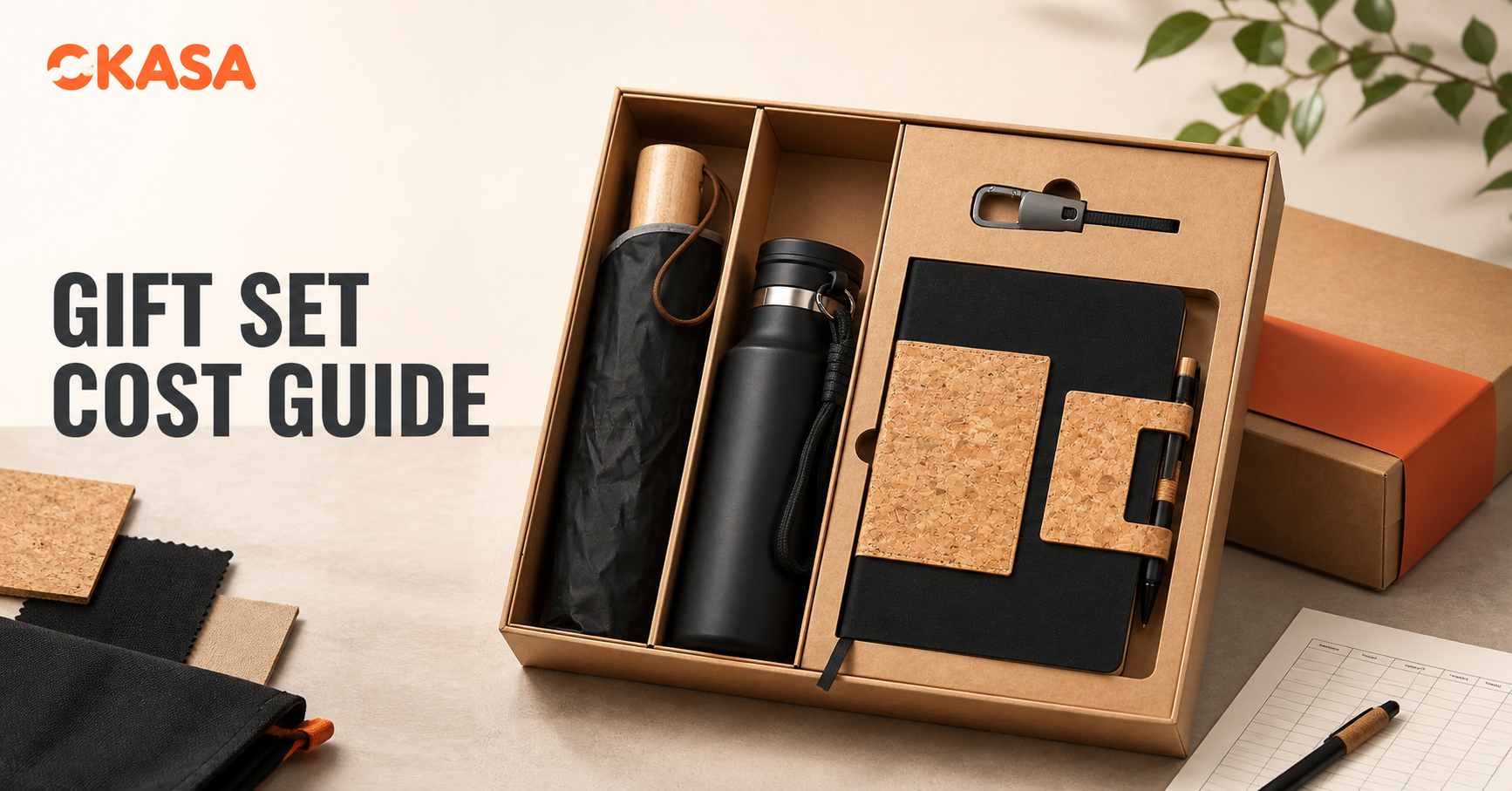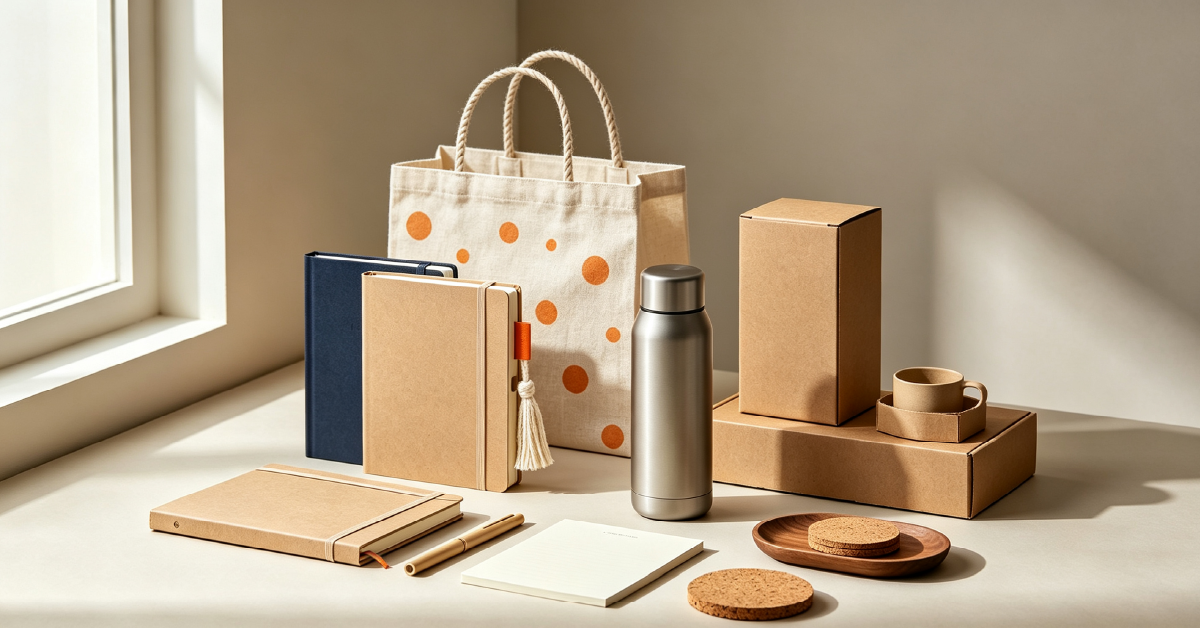


Direct answer: Custom corporate gift sets do not have an honest "standard" price. Change the bottle, the stitch count, the insert, or even the packing sequence and the figure moves. Testing and a tight arrival date move it again. Begin the inquiry with four facts: recipient, quantity, spending boundary, and in-hand date. Add the ship-to country, artwork, a description of the opening experience, and the documents procurement expects to file. That is enough for a supplier to expose the real choices instead of guessing.
A gift set is not one product. It is a small supply chain packed inside one box. A bottle can be ready while the notebook is late. The products can pass inspection while the insert is too tight. The unit price can look competitive while individual packing, barcode labels, testing, kitting, or protective master cartons are excluded. That is why two visually similar sets can produce very different quotations-and why a short request such as "Please quote an eco gift box with our logo" rarely creates a dependable answer.
This guide to custom corporate gift sets is for the person who has to defend the quote after the attractive rendering has won everyone over: a distributor, agency buyer, HR lead, event owner, or procurement manager. It opens up the price, including minimums, decoration, packaging, samples, quality work, environmental evidence, and timing. You will not find a made-up universal unit price here. Without a build and a destination it would only mislead. What follows is a way to ask three bidders for genuinely comparable offers.
Need a tailored corporate gift set proposal? Send the headcount, recipient, spending range, destination, in-hand date, and logo. Before you pay for rounds of samples, OKASA can sketch a product-and-packaging route that is realistic for those constraints.
✉ Request a Gift Set Quote →
Why "three pieces" tells you almost nothing about the price
Buyers naturally shorthand sets as three-piece, four-piece, or five-piece. That count is only the silhouette of the offer. A vacuum bottle and hardcover notebook held in a molded rigid box can cost more than five small stock items dropped into a plain mailer. Material, construction, decoration, pack engineering, and the level of control do the real work in the quotation.
Volume helps, unevenly. A screen, die, mold, or artwork setup is spread across more pieces, and a longer run may use material more efficiently. It does not make premium components, an outside laboratory, one-address-at-a-time fulfillment, or international freight disappear. Ask for those lines to be visible. Otherwise, a buyer cannot tell whether a design choice improves the recipient's experience or simply adds quiet complexity.
Time changes the menu as well as the freight bill. A close deadline pushes the team toward stock colors, proven parts, simpler marks, parallel approvals, and perhaps air transport. Give the project breathing room and custom dyeing, dedicated packs, tooling, consolidated production, or sea freight may become sensible. A bargain unit that arrives after the event-or requires emergency rework and air freight-is an expensive program.
Open the quote into seven spend decisions
| Where the money goes | What may be hiding there | A useful buyer question |
|---|---|---|
| The objects | Material grade, small components, build, surface, color, and ordinary unit packing | Which piece earns its place for this recipient? |
| The brand marks | File preparation, setup, screens or fixtures, print, engraving, stitches, and tooling | Could one quieter visual system replace six unrelated logo treatments? |
| The presentation pack | Box, insert, sleeve, tissue, protective layer, labels, and shipping carton | Will it still look intentional after the trip? |
| Getting to an approved build | Renders, samples, tooling, dielines, physical mockups, revisions, and courier charges | What decision is this next sample supposed to unlock? |
| Proof and quality work | Material records, laboratory work, inspections, sorting, photographs, and reports | Which failure would hurt the user, brand, or destination market? |
| Putting the set together | Counting, orientation, names, cards, address labels, and split shipments | When can clean recipient data be released? |
| Getting it there | Export cartons, dimensional space, pickup, freight, cover, border charges, and last-mile delivery | What does each landed scenario cost and risk? |
Looking at the layers prevents a familiar mistake: saving on one line while inflating the whole program. A heavy rigid box creates drama, but it also buys air in the freight calculation. A cheaper bottle might need an extra protective collar. Names can delight recipients and simultaneously add data cleaning, setup, checking, and careful sorting. Judge each choice against the campaign outcome and the landed total.
Start with the moment, not a catalogue page
Before choosing a bottle, ask what is happening when the box arrives. Is a leader thanking an executive? Is a new employee opening it on Monday morning? Perhaps it is a sales reward, a trade-show follow-up, a distributor launch, a remote-team milestone, or a campaign built around material choices. The person and the moment tell you where the budget deserves to land.
For onboarding, the useful objects often reveal themselves during that first week-a notebook, a cup or bottle, a pen, a cable aid, and a welcome note. An executive may value fewer, better-made pieces and a box without shouty branding. Event teams care about weight and fast handout; remote teams care about compact parcels, truthful customs descriptions, and delivery to many addresses. Counting objects rewards clutter. Keep the ones that strengthen the moment.
Write one sentence before opening the catalogue: "This set should help [recipient] feel or do [outcome] at [moment], within [budget and delivery constraints]." Read every candidate item against it. Attractive distractions fall away, and the supplier has a proper reason to challenge the first idea.
Four product choices that reshape the offer
Notebooks
"A5 hardcover notebook" is still not a build. How many leaves, what paper, which ruling and binding? What sits beneath the cover, and are a pocket, elastic, ribbon, loop, or treated edges really needed? A stock book with one print setup behaves very differently from custom inside pages, matched accessories, debossing, and a documented paper claim. For custom notebooks bulk, describe how the book should write and survive daily use before judging the cover photograph.
Drinkware
Drinkware cost varies with capacity, material grade, single- or double-wall construction, vacuum performance, lid design, gasket, internal finish, external coating, stock or custom color, logo method, testing, and protective packing. A large print area may favor one decoration process while a small premium mark favors another. For custom drinkware bulk, include the destination market and intended use because evidence and test requirements can differ.
Bags and sleeves
A few grams of cloth can change both hand-feel and cost. Then come seams, lining, reinforcement, handles, zip, hardware, pockets, finished dimensions, decoration, and the weight the bag must survive. A tote can double as the gift's carrier, but only after solving how it stays clean and keeps its shape on the journey. Compare custom promotional bags by likely reuse and by proof of the fiber story-not by a flat product image.
Technology and small accessories
Small does not mean simple. An electronic accessory can bring battery, compatibility, label, transport, and local-document questions. A metal item needs a close look at finish and function; even a pen brings refill, writing, clip, coating, and logo decisions. One inexpensive accessory can hold every box if its test record or tiny inner pack arrives a week late.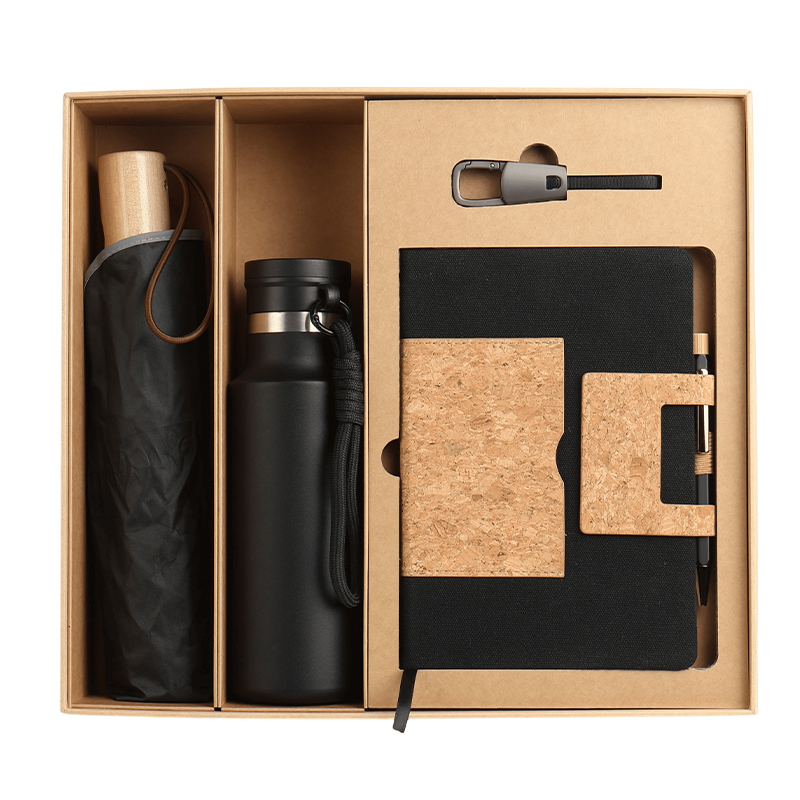 The invisible parts belong in the quote too: fitted insert, outer protection, and the labor that turns separate pieces into one clean set.
One finished set, five production thresholds
A salesperson may quote one MOQ, yet five separate thresholds can sit underneath it:
• The object itself: bottles, notebooks, bags, and accessories may all begin at different quantities.
• A special material or shade: mills and coaters run cloth, paper, plastic, or color in their own batch sizes.
• The mark: screens, embroidery heads, transfer setup, engraving fixtures, and embossing tools each have a practical run.
• The pack: printed boxes, sleeves, fitted inserts, labels, and unusual finishes rarely share the same threshold.
• The packing line: below a certain volume, setting up, counting, and checking the kit becomes disproportionately expensive.
The final set MOQ is normally constrained by the highest inflexible minimum. However, a supplier can sometimes create a lower-volume route by combining stock products, standard colors, digital or low-setup decoration, generic boxes, custom sleeves, and cut inserts. The result may not match every detail of a high-volume design, but it can protect brand quality while reducing commitment.
Ask for options, not simply a lower number. A useful response might compare: stock product plus logo; stock product plus custom sleeve; stock product plus fully printed box; or fully custom product and packaging. Each path should show the quantity, what can be customized, what remains standard, sample route, evidence scope, lead time, and price implication.
How logo methods affect price and perceived value
Logo printing on promotional products is a family of processes, not a menu item called "logo." The right answer depends on the surface, artwork, run size, expected wear, color, and the voice of the brand. Use this table to start the conversation, then insist on a test on the actual item.
Possible treatment | Where it often earns its keep | What changes the quote-or causes trouble |
Screen printing | Simple spot colors and suitable flat or fabric surfaces | Screens, colors, coverage, registration, substrate, curing, and quantity |
Laser engraving | Metal, coated metal, wood, cork, and compatible materials | Mark size, time, substrate response, tone variation, and fixture |
Embroidery | Bags, textiles, and fabric covers | Digitizing, stitch count, thread colors, backing, fabric stability, and size |
Embossing or debossing | Paper, leather-like covers, compatible fabrics, and packaging | Tooling, material response, pressure, heat, area, and fine detail |
Digital or transfer process | Multicolor artwork, gradients, or certain lower-volume applications | File quality, color management, surface compatibility, adhesion, and durability |
Printed sleeve or insert | Strong campaign storytelling without decorating every item heavily | Paper, print coverage, finish, die line, fit, assembly, and pack-out |
Premium does not have to mean a large mark on every surface. Try a quiet engraving on the bottle, a restrained deboss on the notebook, and let the sleeve carry the campaign message. That hierarchy usually looks more considered and can avoid needless setup. Begin with a rendering, but hold a real decorated sample whenever color, grip, depth, adhesion, or exact position could change the decision.
Packaging: the biggest hidden lever in gift set cost
Packaging has to present the idea, hold the objects, protect them, and carry the message. A beautiful open-box photograph proves only the first job. Follow the pack through assembly, storage, export cartons, transport, and the recipient's hands. A presentation box going straight to one person will usually need a plain protective mailer outside it; otherwise, the courier label and the journey become part of the design.
There is no default structure. Folding cartons ship flat; rigid boxes trade space for presence; corrugated mailers tolerate a harder journey. A paper tube, sleeved standard box, or reusable bag can be right for a different reason. Inside, the support might be folded board, pulp, a corrugated divider, foam, or something else entirely. For custom paper tube packaging, refuse a one-line quote. Record inside and outside dimensions, the wall and wrap, lid behavior, insert, artwork, finish, real product fit, and its place in the master carton.
Several packaging choices affect both price and lead time:
• Standard versus custom size and structure.
• Whether the box forms from one piece or several pieces that must be made and joined.
• Decide where the words earn attention: wrap, box, sleeve, small label, or perhaps no print at all on a kraft surface.
• Touch matters. Compare matte and gloss film, varnish, foil, texture, embossing, and the discipline of leaving the board plain.
• Custom insert tooling and the number of product cavities.
• Manual assembly steps and required orientation.
• Transit testing or drop-test expectations.
• Master-carton quantity, dimensions, weight, and pallet pattern.
A powerful cost-control technique is to separate presentation customization from structural customization. A proven standard box and insert platform can sometimes carry a custom printed sleeve, belly band, card, or label. The buyer gets campaign-specific storytelling without developing every structural component from zero. The trade-off is less dimensional freedom, so the supplier must confirm product fit and presentation.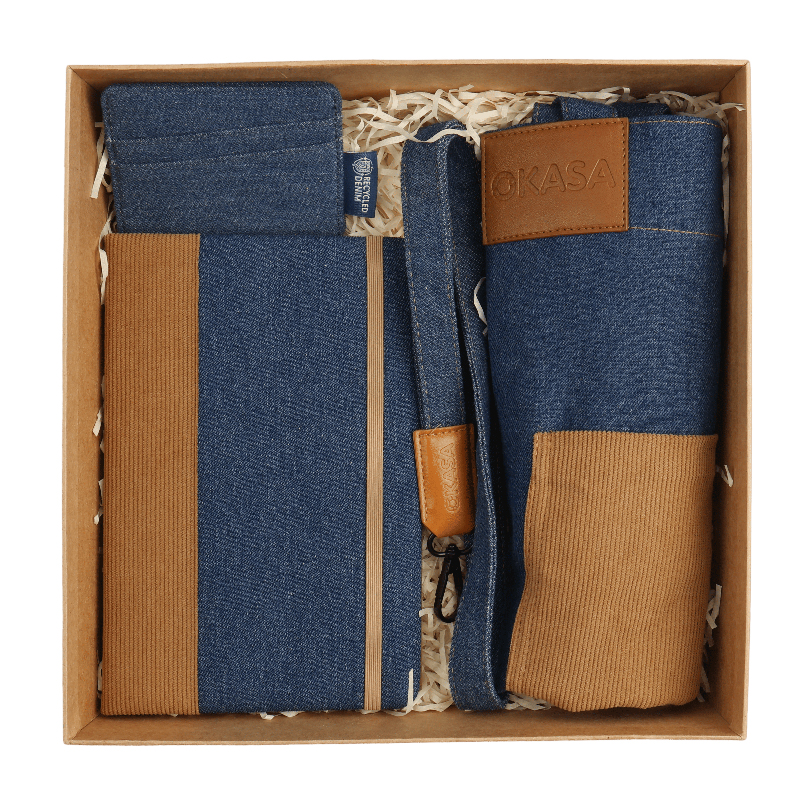 Packaging cost includes structure, insert engineering, print and finish, assembly, protection, and the space the completed set occupies in transport.
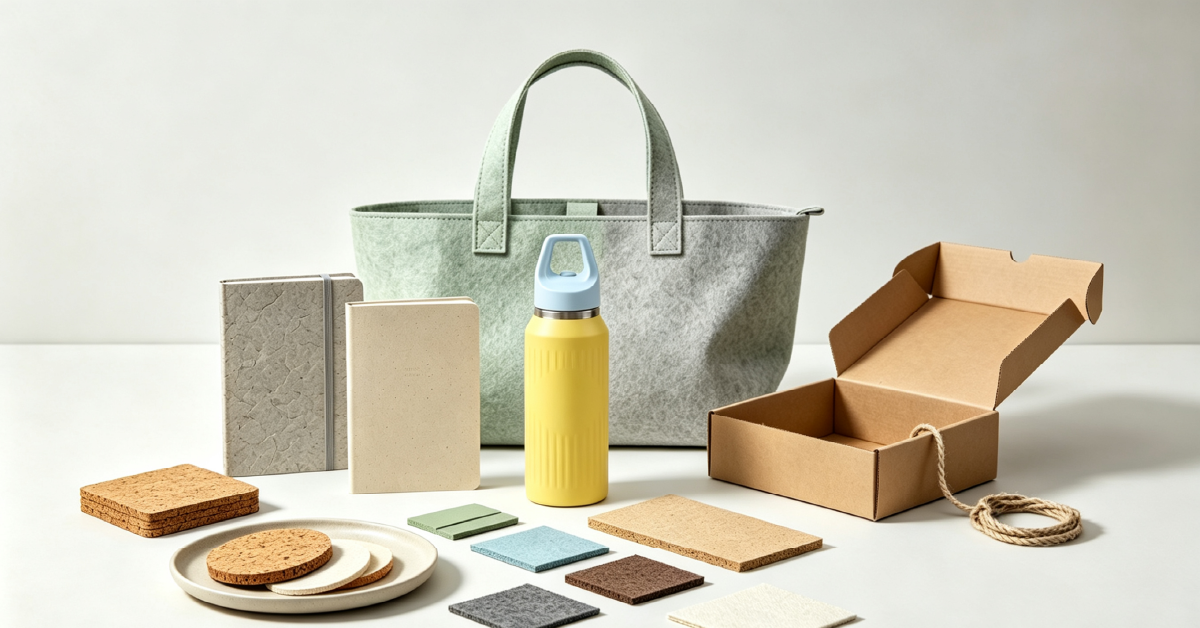
Sustainable gift sets: pay for evidence, not vague language
Buyers increasingly request sustainable promotional products, but the quotation should distinguish product design from claim evidence. A material may contain recycled content, use forest-based inputs, reduce mixed materials, improve durability, or reduce packaging. Each benefit needs its own support and limitations.
Paper claims need a chain, not a green icon. FSC's chain-of-custody system follows forest-based input as it passes between certified organizations. Even so, the words and marks available for a particular order depend on scope, transaction records, and trademark rules. Recycled textiles use a different framework: Textile Exchange's Global Recycled Standard addresses recycled input, its custody trail, and specified processing practices. OEKO-TEX STANDARD 100 answers another, narrower question about harmful substances in a tested textile article. None of these should be stretched into a blanket promise about an entire mixed set.
Ask four questions for every environmental statement:
• What exact component and material does the statement cover?
• What percentage, grade, or chain-of-custody status is relevant?
• Which current certificate or transaction document supports the order?
• What wording and logo use are permitted on product and marketing materials?
Evidence has a cost, but vague language has a greater reputational risk. Budget for required records, testing, and claim review at the brief stage. If the evidence is not available, revise the material or the statement before campaign copy is approved.
Sample stages and what each one should prove
Sampling is most efficient when the buyer assigns a decision to each stage. Ordering repeated samples without a defined question increases time and courier cost.
Digital concept or rendering
This stage explores product combination, general color, logo placement, unboxing order, and packaging direction. It is fast and useful for stakeholder alignment. It does not prove exact color, material texture, physical fit, logo durability, construction, or final production quality.
Stock sample
A stock sample can confirm scale, weight, hand feel, function, and general product quality. It may not use the final color, logo, packaging, or material claim. Record which decisions are approved and which remain open.
Decorated sample
This stage tests the logo method, size, position, color, surface response, and appearance. If the final item uses a different material or coating, the sample may not fully represent production. Ask whether the decoration used production equipment and settings.
Packaging prototype
A white or digitally printed prototype can test dimensions, product fit, retention, unboxing sequence, and structure. Final printing, board, finish, or tooling may still differ. Test the assembled set, not an empty box.
Pre-production sample
This is the rehearsal for the actual build. Use the intended material, colors, components, decoration, pack, and assembly wherever practical. Sign it against the current specification and keep its twin as a reference. One excellent sample still says nothing about variation through thousands of pieces, so the bulk lot must be inspected in its own right.
Lead time: build a stage plan, not one optimistic number
A realistic gift set schedule includes overlapping but connected stages. The exact duration depends on product, quantity, custom depth, evidence, revisions, production load, holidays, and shipping. Ask the supplier to provide milestone dates and dependencies for:
• Brief clarification and feasibility review.
• Quotation and option comparison.
• Artwork and dieline preparation.
• Stock, decorated, packaging, or pre-production samples.
• Testing or material-document review.
• Material and component purchasing.
• Production of every component.
• Decoration and in-process checks.
• Box, insert, sleeve, and label production.
• Kitting, counting, packing, and carton marking.
• Final inspection, corrective action, and reinspection allowance.
• Export handover, freight, customs, and destination delivery.
Name the moment when the clock starts. It may be later than the deposit: perhaps the signed order, final file, approved sample, and material papers must all be in place. For an immovable campaign date, work backward and put a last-decision date beside every approval. Slow feedback from the buyer can sink the schedule just as surely as a factory delay. Ask the supplier to draw the critical path and circle the point after which a major custom change costs the delivery date. A set reaches the date only when product, decoration, insert, box, and transport share the same approval calendar.
Quality control for multi-component gift sets
Gift-set quality requires two inspection levels. First, inspect each product against its own specification and functional tests. Second, inspect the assembled set for completeness, orientation, fit, cleanliness, presentation, labeling, protection, and carton packing. A bottle can pass and a notebook can pass while the set still fails because the insert deforms the cover or components rub during transit.
A practical promotional product quality control plan defines:
• Critical, major, and minor defects for each component and the assembled set.
• Approved specifications, artwork, samples, and packaging references.
• Incoming checks for important materials and purchased components.
• First-article approval for decoration and assembly.
• Functional tests appropriate to bottle, notebook, bag, accessory, or packaging.
• Quantity reconciliation across all components, spare units, sets, and cartons.
• Final sampling plan, lot definition, and acceptance rules.
• Corrective action, rework controls, and reinspection requirements.
If the set includes items with different risk levels, do not use one generic inspection checklist. A leaking bottle is different from a faint print variation on an internal card. Classify defects by effect on safety, function, regulatory compliance, brand presentation, and recipient experience.
An illustrative landed-cost model
The following model is not an OKASA quotation and contains no universal percentages. It shows the categories a buyer should request so hidden costs become visible.
Line | Input to request | Typical misunderstanding |
Products | Per-item specification, quantity, waste and spare assumption | Quote uses visually similar but different grades |
Decoration | Method, colors, locations, setup, run charge, durability check | Only one logo location is included |
Packaging | Box, insert, sleeve, label, protective pack and master carton | Presentation box excludes shipping protection |
Development | Tooling, dielines, samples, revisions and sample freight | Sample charge is treated as production unit price |
Evidence and QC | Documents, tests, inspections and reinspection assumptions | Existing report is assumed to cover the new order |
Kitting | Assembly sequence, personalization, inserts, sortation and splits | Bulk components are quoted without assembly |
Logistics | Incoterm, carton data, freight, insurance, duty/tax assumption and delivery | Factory price is compared with landed price |
Ask every supplier to state the Incoterm and quote validity, currency, payment terms, estimated carton dimensions and weight, tooling ownership, sample-credit policy, overrun or underrun allowance, and exclusions. If carton data is not final, mark freight as estimated and update it after packaging approval. This prevents a "fixed" budget from absorbing a late dimensional-weight surprise.
Where to save without making the gift look economical
1. Choose the item that carries the memory
Put more budget into the item most likely to be used and remembered. Simplify secondary items or convert one into a printed message card. A strong bottle or notebook can anchor the experience better than several disposable extras.
4. Engineer packaging for both presentation and transport
A compact set can reduce paper, protective material, carton volume, and freight. Avoid unused internal space. At the same time, do not remove the retention or protection needed to prevent damage. Packaging optimization should be proven with the assembled products.
5. Freeze decisions earlier
Late changes create new samples, material loss, overtime, rework, or faster freight. Establish approval owners, decision dates, and a controlled specification. A disciplined approval process is a cost-reduction method even though it never appears as a product line.
Compare three realistic gift set routes
Ask for a good, better, and premium option against the same quantity, destination, required date, and recipient. The differences should be explicit in product specification, logo, packaging, evidence, and landed-cost assumptions.
✉ Request a Curated Proposal →
The quote-ready corporate gift set brief
Copy the following fields into your inquiry. Completing them will shorten clarification time and improve quote comparability.
• Program: occasion, recipient, message, and expected use.
• Quantity: total sets, spare allowance, and possible repeat order.
• Markets: destination countries, delivery points, and intended user.
• Budget: target product budget and whether it includes development, testing, freight, duty, and fulfillment.
• Timeline: required-in-hand date and fixed stakeholder approval dates.
• Products: preferred categories, must-have function, materials, colors, sizes, and acceptable alternatives.
• Branding: vector artwork, color references, decoration preferences, positions, and maximum or minimum logo treatment.
• Packaging: presentation, shipping route, insert, printed message, label, barcode, and unboxing expectation.
• Sustainability: exact material or packaging goals and evidence required for campaign claims.
• Quality: critical features, market tests, inspection expectations, and sample approval route.
• Where finished sets go: one bulk address, several warehouses, or named recipients; include any personalization and label work.
• How the deal is framed: chosen Incoterm, currency, payment preference, ownership of tooling, and the date the offer expires.
A capable promotional products supplier will question the gaps and print each assumption beside the price. A number returned in five minutes is fine for a rough shortlist. Do not use it to release production until both sides have signed off the build and every inclusion.
Frequently asked questions
Why can't a supplier give one standard price for every gift set?
Because there is no universal build. Material and construction change by item; volume, marking, packaging, proof, assembly, destination, and freight add further variables. Ask for an itemized offer tied to one dated brief. Keep one-time development and tooling away from the repeat unit figure, then compare landed scenarios on the same Incoterm and scope.
What is the MOQ for a custom gift set?
The effective MOQ is usually the highest constraint among products, custom materials or colors, decoration, printed packaging, and assembly. Lower-volume routes can use stock products, standard colors, digital or low-setup decoration, standard boxes, and custom sleeves or labels. Ask what remains standard and what becomes custom at each quantity.
How long does a custom corporate gift set take?
Timing depends on brief clarity, sample stages, custom depth, testing, production load, packaging, inspection, and transport. Request a stage-based plan with starting conditions, approval deadlines, critical path, corrective-action allowance, and destination delivery. If the event date is fixed, choose the product and customization route that fits the schedule instead of assuming every design can be accelerated.
Which logo method is best for a premium gift set?
Start with the material and the brand's voice. Engraving can be beautifully quiet on the right metal; a deboss or emboss belongs on a responsive cover; restrained embroidery can suit a stable textile; a crisp spot color may beat all three elsewhere. Hold the samples and compare wear, small-detail limits, setup, and price. Often the premium move is a precise little mark while the packaging tells the fuller story.
Final buyer checklist before approving the purchase order
• Every component has a measurable specification and approved artwork.
• The quote clearly separates products, decoration, packaging, development, evidence, kitting, and logistics.
• All MOQ constraints and quantity assumptions are visible.
• Packaging has been checked with the real product combination.
• Sample status and remaining approvals are documented.
• Material and sustainability claims have order-specific support.
• Testing and market requirements are agreed before production.
• The schedule names starting conditions, milestones, owners, and contingency.
• Quality checks cover each component and final assembly.
• Personalization and recipient data controls are defined when applicable.
• Carton information and freight assumptions will be updated after packaging approval.
• Changes require written approval and a recorded impact review.
• Final shipment requires passed inspection, correct quantities, packing, and documents.
A high-conversion gift set is not simply attractive. It is useful to the recipient, coherent with the brand, supportable in its claims, realistic for the quantity and deadline, and controlled through delivery. The strongest supplier conversation begins with those outcomes. Price then becomes a decision tool rather than a surprise.
Build a gift set your procurement team can approve
Share the recipient, quantity, budget range, destination, date, preferred products, artwork, and evidence requirements. OKASA can help turn the idea into comparable product, packaging, and decoration options.
✉ Contact OKASA for a Tailored Quote →
Related sourcing paths
Explore connected decisions across promotional products supplier qualification, sustainable promotional products, custom corporate gift sets, custom notebooks bulk, custom drinkware bulk, custom promotional bags, custom paper tube packaging, logo printing on promotional products, and promotional product quality control.
Authoritative references
• Forest Stewardship Council, Chain of Custody Certification.
• Textile Exchange, Global Recycled Standard (GRS).
• OEKO-TEX, STANDARD 100.