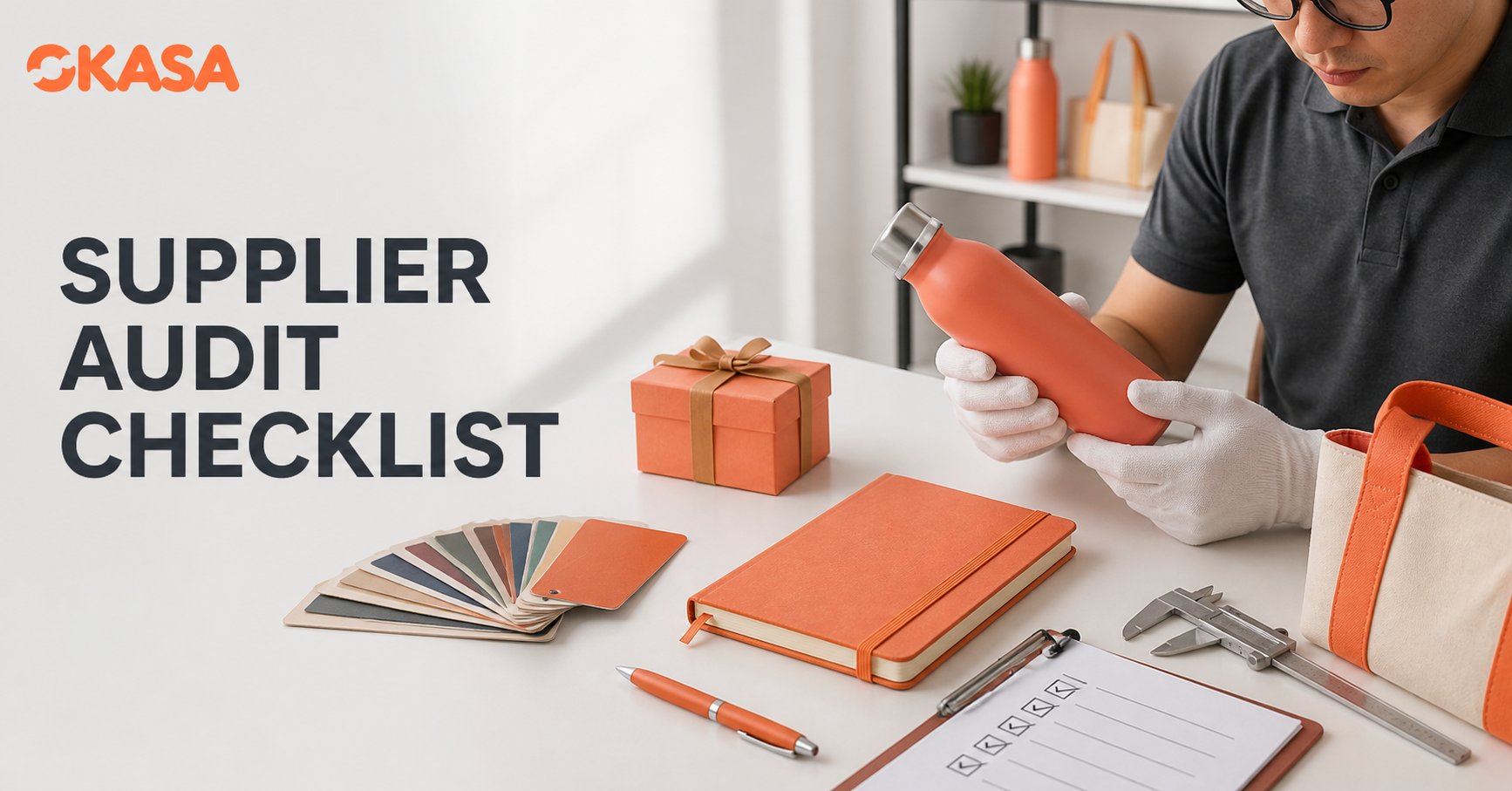


Direct answer: A reliable promotional products supplier should be audited against five connected risks: business legitimacy, specification control, material and claim verification, production capability, and shipment quality. The fastest route is not to ask whether a supplier is “good.” It is to request evidence for 31 specific checks, approve a measurable product specification, and connect every inspection result to a written acceptance rule before bulk production begins.
That distinction matters because most failed promotional orders do not begin with an obviously dishonest quotation. They begin with an incomplete brief. A buyer approves a sample that looks right, yet the bulk purchase order does not define color tolerance, packaging strength, logo position, carton marks, approved substitutions, defect classes, or the documents required before shipment. The supplier then optimizes around an unclear target, the buyer inspects against an unspoken target, and both sides lose time arguing about what “same as sample” meant.
This guide is a working audit for distributors, agencies, procurement teams, and brand managers. It tells a buyer what proof to ask for, where a measurement belongs, when a release should stop, and what must be settled before a factory handles the full order. The questions also move with the product. A notebook, vacuum bottle, sewn bag, paper tube, and mixed gift set do not fail in the same way.
Planning a time-sensitive promotional program? Send the product type, quantity, destination, artwork, target date, and required compliance documents. OKASA can review whether the brief is quotation-ready and identify the checks that should be completed before production.
Request a Supplier Audit Quote →Audit the build first; compare the prices second
A unit price means very little until every bidder is pricing the same build. A line described as “500 ml vacuum bottle,” for example, might use another steel grade, a thinner wall, a cheaper gasket, lighter packing, and no logo-abrasion test. Notebook, bag, and gift-set quotes conceal similar choices. The cheapest total may therefore be a smaller promise, not a purchasing win.
A supplier audit reverses the usual sequence. First, define what the order must achieve. Second, identify the failures that would damage the campaign. Third, request evidence that the supplier can control those failures. Only then compare price, MOQ, and lead time. This makes the commercial comparison more accurate because every bidder is quoting against the same measurable requirement.
For example, a promotional bottle for an internal employee event and a retail-adjacent bottle for a consumer campaign may look similar in a catalogue. The second project can require tighter surface-finish control, more durable logo decoration, stricter packaging presentation, traceable material documentation, and market-specific testing. A supplier that can produce both items may still quote them differently because the control plan is different. A useful audit reveals that difference before the purchase order, not at final inspection.
The 31-check promotional products supplier audit
The 31 checks sit behind seven decision gates. Do not fire every question into the opening email. Ask for proof when it can still change a decision: some before the quote, more before sample sign-off, and the rest before production or shipment. Keep a document only when it answers a genuine risk question.
| Gate | What it proves | Decision |
|---|---|---|
| 1. Business fit | The supplier is legitimate and suitable for the product and market. | Proceed to detailed briefing or stop. |
| 2. Specification control | The team can translate a creative brief into measurable requirements. | Release a development sample. |
| 3. Material and claims | Material, recycled-content, and certification statements are supportable. | Approve claims and documentation scope. |
| 4. Capacity and process | The production route, subcontractors, capacity, and schedule are credible. | Release production after a risk review. |
| 5. Quality planning | Defects, tests, sampling, and corrective actions are defined. | Approve the control plan. |
| 6. Commercial control | MOQ, price, tooling, change control, and payment assumptions are clear. | Finalize the purchase order. |
| 7. Shipment release | Final inspection, packing, documents, and logistics match the order. | Release, rework, reinspect, or reject. |
Gate 1: business fit and legitimacy
- Legal identity: confirm the contracting entity, address, invoice details, and bank beneficiary are consistent.
- Relevant category experience: request recent examples from the exact category and decoration process, not a general catalogue.
- Destination experience: name the countries recently supplied, then show an example of the paperwork prepared for one relevant market.
- Who actually makes it: draw the route through forming, decoration, coating, assembly, testing, and packing; mark every outside workshop.
- Who answers when it goes wrong: put names beside commercial, technical, quality, and shipping decisions before a problem lands.
A polished website is useful context, but it is not the audit. Evidence has to belong to the order on the table. Experience with fabric bags says little about vacuum drinkware or a close-fitting paper tube. The label on the door is not decisive either: an open, disciplined trading company may control a mixed program better than a factory that quietly outsources the difficult steps. Follow the work, find the decision owner, and make sure the party signing the purchase order remains answerable for the result.
Gate 2: can the approved idea survive bulk production?
- One source of truth: keep a single specification and print its revision and approval date on every release copy.
- Critical-to-quality features: define the measurements and appearance features that cannot drift.
- Artwork control: record artwork version, Pantone or color reference, logo size, location, orientation, and decoration method.
- Sample status: label each sample as concept, functional, pre-production, or shipment reference.
- Golden sample control: retain matched approved samples with signatures or other traceable approval records.
“Approved” must answer four questions: approved by whom, on what date, against which specification revision, and for what purpose. A concept sample may approve the idea but not the exact material. A digital mockup may approve logo placement but not print durability. A pre-production sample should represent the intended bulk construction, but even then a single sample cannot prove lot consistency. Clear sample status prevents one approval from being stretched beyond its meaning.

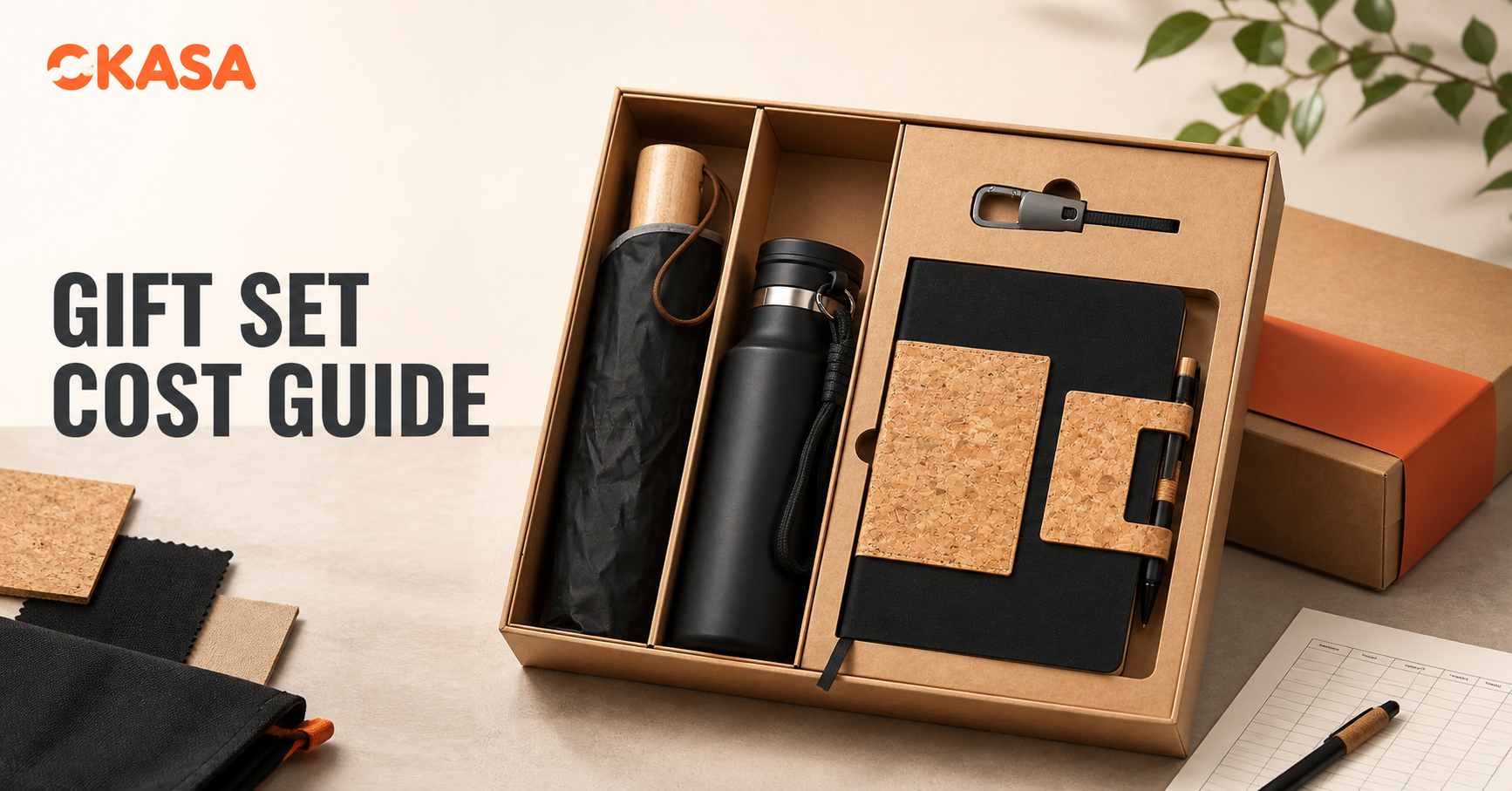
A multi-component gift set requires separate acceptance rules for every item, the insert, the box, and final assembly.
Gate 3: material, certification, and sustainability claims
- Material declaration: specify composition, grade, weight, thickness, finish, and approved alternatives.
- Certificate scope: verify certificate holder, standard, product or process scope, validity, and transaction evidence when applicable.
- Claim wording: approve exactly what may be printed on the product, packaging, and campaign materials.
- Testing plan: identify market-specific chemical, physical, food-contact, labeling, or performance tests required by the buyer.
- Traceability: define how material batches, production lots, and finished cartons will be connected.
This is where a broad sustainability statement must become a verifiable procurement requirement. “Recycled,” “eco-friendly,” and “responsible” can mean different things unless the material, percentage, evidence, and claim boundary are stated. The Forest Stewardship Council explains that chain-of-custody certification tracks forest-based material through the supply chain; that means a buyer should verify the relevant certificate scope and claim, not assume any paper product may carry an FSC claim. Textile Exchange’s Global Recycled Standard similarly provides a chain-of-custody framework for recycled content and includes additional processing requirements. The evidence must match the actual product and order.
When sourcing sustainable promotional products, ask the supplier to separate three questions: What is the product made from? What evidence supports that statement? What wording can the buyer legally and accurately communicate in the destination market? A certificate logo should never be placed on a product merely because a similar material was used elsewhere. Trademark authorization and claim rules matter.
Gate 4: capacity, process, and schedule
- Process route: map material purchasing, forming, printing, assembly, inspection, packing, and dispatch.
- Constraint check: identify the slowest process, long-lead material, tooling need, and subcontracted step.
- Capacity evidence: compare the project quantity with realistic daily output and current production load.
- A schedule with real handoffs: date the artwork decision, material arrival, sample sign-off, production start, inspection, packing, and carrier handover.
- Recovery plan: define options if the first sample, material batch, logo process, or inspection fails.
A lead time is credible when it is built from stages. “Thirty days” is not a plan unless the starting event is defined. Does the clock begin at deposit, artwork approval, pre-production sample approval, or material confirmation? Does it include export packing and transport to the buyer’s destination? Are public holidays, test turnaround, and reinspection included? A serious supplier will expose the dependencies instead of presenting one optimistic date.
Capacity should also be product-specific. A supplier may have sufficient assembly space but limited laser-engraving capacity. A bag program may depend on dyeing or fabric availability. A custom box may be constrained by insert tooling or finishing. Ask for the bottleneck, not just the maximum theoretical output. The most valuable answer is often a limitation stated early.
Gate 5: quality planning and inspection
- Defect catalogue: classify critical, major, and minor defects using product-specific examples and images.
- Look before the last day: decide whether incoming goods, the first decorated piece, work in progress, packed units, or container loading need a check.
- Write down how the sample is chosen: define the lot, inspection level, number drawn, pass/fail limits, and any rule for changing severity.
- Test the way people will use it: measure leakage, print rub, handle load, zipper travel, closure, fit, or pack drop—whichever failure would matter.
- Plan for a miss: quarantine the affected lot, find the cause, show the rework, and inspect again before asking for release.
Acceptance Quality Limit is often reduced to three numbers pasted into a purchase order. That shortcut leaves the hard decisions unanswered. ISO published the third edition of ISO 2859-1 in 2026 for lot-by-lot inspection by attributes. In practice, a defined number of units is drawn from a defined lot and the result supports an accept-or-reject decision. It is not a promise that every accepted piece is free of defects. The buyer still owns the choice of plan, the lot definition, consistent defect classes, and the balance of producer and consumer risk. ISO 28590 is the useful starting point when a team needs to choose among the inspection systems in the wider series.
The practical lesson is simple: sampling works only after the specification and defect definitions are clear. A beautiful logo that is two millimeters off-center may be a major defect for a premium gift program but a minor defect in another application. A sharp edge on a drinkware component may be critical. A shade difference inside an unseen paper insert may be minor. The classification belongs to the buyer’s risk context, not a generic chart.

Drinkware inspection can combine appearance, dimensions, closure fit, leakage, surface finish, and logo-durability checks.
Gate 6: commercial and change control
- Quotation scope: itemize product, decoration, packaging, tooling, testing, inspection, freight basis, and taxes or duties assumptions.
- MOQ logic: identify whether the minimum is driven by material, forming, printing, packaging, or commercial policy.
- Change procedure: require written approval for material, color, component, artwork, process, or subcontractor changes.
- Intellectual-property control: define artwork access, sample disposal, confidentiality, and restrictions on overrun or rejected goods.
- Remedy path: agree how shortage, late delivery, nonconformity, rework, replacement, and credit decisions will be handled.
Commercial control prevents an approved sample from drifting during cost negotiation. A supplier may propose an alternative material to protect the deadline or meet a new price target. That can be a sensible engineering decision, but it must be visible. The buyer should receive the proposed change, reason, impact, new evidence, and approval request before implementation. Silence is not change approval.
MOQ should be discussed in the same transparent way. One component may require 1,000 units while another can be decorated at 250. A stock-product strategy may reduce minimums, whereas a custom color or molded component raises them. Ask the supplier to separate product MOQ, decoration MOQ, packaging MOQ, and economic order quantity. This creates options instead of a simple yes-or-no negotiation.
Gate 7: final shipment release
- Shipment release pack: combine the passed inspection report, quantity reconciliation, carton and pallet information, required test or claim documents, product photos, packing photos, and logistics documents before authorization to ship.
The last check is intentionally broad because it connects every earlier decision. A final inspection report is weak if it does not reference the approved specification. A passing product is not ready if cartons use the wrong marks, the quantity is incomplete, or documentation is missing. Release should be a controlled business decision. If the lot fails, record the containment plan, rework method, reinspection scope, and revised dispatch date before pressure from the campaign deadline erodes the standard.
How to score a supplier without hiding a critical risk
A single average score can mislead. A supplier might earn strong marks for price, communication, and design while failing one critical safety or claim-verification requirement. Use a two-layer decision. First, apply mandatory gates: legal identity, measurable specification, required compliance evidence, critical-defect control, and shipment release documentation. A failure in any mandatory gate blocks production. Second, score the remaining commercial and operational factors.
| What are we judging? | Starting share | What would persuade us? |
|---|---|---|
| Can the build be repeated? | 20% | A live revision, signed samples, and a short list of features that may not drift |
| Can the material story be proved? | 20% | Declarations that match the item, scoped certificates, test decisions, and batch links |
| Will the date hold? | 15% | A route through production, the true bottleneck, current capacity, and dated handoffs |
| What happens when a piece fails? | 20% | Photographed defect limits, records from the line, test results, and a closed corrective action |
| Is the offer open about cost and change? | 15% | An itemized quote, an explained MOQ, written change approval, and stated remedies |
| Can a buyer get a decision? | 10% | Real owners, useful answers under time pressure, and a record of what was decided |
These percentages are a starting conversation, not an industry rule. A children’s item or a product with regulatory exposure deserves more weight on test evidence and traceability. A conference order cannot miss the venue date, so the schedule may dominate. For an executive gift, a scuffed box can be as damaging as a product defect. Write the reason beside any changed weight; that note is more valuable than a mathematically tidy average.
Product-specific audit questions
Custom notebooks
For custom notebooks bulk, record finished size, page count, paper weight and color, opacity expectations, ruling, binding, cover construction, elastic and ribbon details, corner shape, logo method, and individual packaging. Confirm whether paper or cover claims require chain-of-custody documentation. Inspect page sequence, registration, trimming, glue or stitching, cover warpage, color, and repeated-use durability.
Custom drinkware
For custom drinkware bulk, define capacity, dimensions, material grade, wall construction, lid and gasket material, internal and external finish, odor requirement, leakage method, insulation requirement when applicable, decoration location, and packaging. Testing and documentation must match the destination market and intended use. A supplier should explain what is tested, by whom, to which method, and on which production lot.
Promotional bags
For custom promotional bags, specify fiber composition, fabric weight, color, construction, dimensions, handle length, seam type, reinforcement, zipper or hardware, logo process, load expectation, and packing. Inspect fabric defects, shade variation, stitching density, skipped stitches, seam security, dimensions, print alignment, embroidery backing, hardware operation, and carton compression.
Paper tube and gift packaging
For custom paper tube packaging, specify inside and outside dimensions, board or wall construction, paper wrap, insert material, lid fit, print color, lamination or coating, surface finish, edge condition, odor, product fit, and transit protection. A package can pass visual inspection and still fail because the insert is too tight, the lid loosens after transport, or the printed wrap scuffs during packing.
Gift sets and mixed components
With custom corporate gift sets, audit each component as its own product and then audit the assembled set. Confirm that component suppliers use the same approved artwork, colors, and schedule. Reconcile quantities because a shortfall in one small accessory can stop thousands of complete sets. Inspect the insert fit, unboxing order, orientation, presentation, protective materials, master carton strength, and barcode or label placement.
Logo decoration: approval is more than a digital mockup
Logo printing on promotional products needs three different “yes” decisions. First, look at the file: is the spelling right, is it truly vector artwork, and are the colors, scale, and quiet area unambiguous? Next, prove the method on the actual surface; a good screen print choice on one item may be a poor answer for another. Finally, inspect bulk pieces for location, shade, adhesion, wear, clean edges, and the amount of variation a customer will actually see.
Ask what the chosen process cannot do. Tiny negative spaces may fill during screen printing; a transfer that looks clean on plain fabric can lift or change hand-feel over a coating. With engraving, the revealed color belongs to the metal and finish, so it is not always predictable from a monitor. Embroidery introduces another chain of choices—digitizing, thread, backing, fabric movement, and stitch density. Embossing brings its own material and tooling limits. A candid recommendation is more useful than a supplier who says every method will work.

Decoration selection should connect artwork, substrate, durability expectations, and approved production tolerances.
What a quote-ready inquiry should contain
A high-quality inquiry produces a better supplier response because it removes hidden assumptions. Include the following information in the first brief:
- Buyer role, destination market, campaign purpose, and intended user.
- Product category, reference image or existing item, preferred materials, and acceptable alternatives.
- Quantity, target unit-cost range if available, sample quantity, and expected repeat volume.
- Artwork files, number of colors, decoration preference, placement, and brand-color references.
- Packaging structure, labels, barcodes, carton marks, and unboxing requirements.
- Required material evidence, tests, certificates, inspections, and buyer-specific compliance documents.
- Required-in-hand date, destination, shipping mode assumptions, and milestone flexibility.
- Approval owners and what the sample must prove.
This brief lets a promotional products supplier expose trouble before a price is locked. It gives the buyer one record of every clarification, so the same question does not produce three private interpretations. Where the brief is silent, require the quotation to show the assumption in plain words.
Let us pressure-test the brief before the factory does
Send the product, volume, artwork, destination, deadline, and any evidence your organization must retain. OKASA can flag the missing decisions, suggest a workable production route, and return the questions worth resolving before money and material are committed.
Send Your Brief for Review →Common supplier-audit mistakes
Approving appearance but not function
Buyers naturally focus on color and logo because they are visible. Functional failures can create greater cost: a leaking lid, weak handle, detached insert, jammed zipper, loose component, unstable box, or poor page binding. The approval record should separate appearance, dimensions, construction, function, claims, and packaging.
Waiting for final inspection to discover process risk
Final inspection is a filter, not a manufacturing strategy. If the logo process is unstable, the buyer needs first-article approval and in-process checks. If a critical dimension depends on tooling, verify it before the full lot. If multiple components converge at assembly, track readiness before the assembly date. Earlier controls are usually cheaper than sorting or rework after production.
Treating “eco-friendly” as if it were a specification
An environmental claim needs nouns and numbers: the material, its share where that matters, the supporting record, the organization making the claim, and the words the campaign may use. Better on one measure does not mean better on every measure. Durability, transport weight, and end-of-life can point in different directions. Saying where the evidence stops protects both trust and the buyer’s campaign copy.
How audit evidence supports Google-visible expertise and buyer trust
For a supplier website, generic promises such as “high quality” and “fast delivery” are difficult for buyers to evaluate. Useful content explains the mechanism: how specifications are controlled, how defects are classified, when samples are used, what a certificate does and does not prove, and how a failed inspection is handled. This is the substance behind promotional product quality control.
That evidence also gives a search visitor something worth saving: a checklist, a defensible comparison, and a clearer path to an inquiry. Descriptive headings and tables help people scan, while definitions and primary sources help them verify. First-page visibility can never be promised from prose alone; crawling, internal links, site reputation, user response, and stronger competing pages all influence the result. Evidence-led writing at least gives the page an honest reason to earn attention.
OKASA’s public website presents more than two decades of industry experience and product categories covering gift sets, notebooks, bags, drinkware, packaging, technology gifts, and pens. Buyers should still verify claims and evidence for their specific project. The best next step is not to accept a broad capability statement. It is to send a detailed brief and request the exact documents, samples, and control plan that the order needs.
Frequently asked questions
How do I audit a promotional products supplier remotely?
Start with document and video evidence tied to the specific product. Verify the legal contracting identity, process map, subcontractors, relevant product examples, specification template, sample-control method, material evidence, quality records, production schedule, and final-inspection process. Use a live video call to walk through relevant areas and ask the supplier to show traceable records rather than only a prepared presentation. For higher-risk orders, add an independent on-site audit or inspection.
What documents should I request before ordering?
Request an itemized quotation, controlled specification, artwork proof, sample approval record, process and milestone plan, required material or certificate evidence, market-specific test plan, inspection plan, packaging specification, change-control agreement, and shipment release document list. Not every document is needed at the first inquiry, but the timing should be agreed before the purchase order.
Does an AQL inspection guarantee zero defects?
No. Acceptance sampling uses a sample to make a lot decision and carries statistical risk. It does not inspect every unit and does not guarantee a defect-free lot. Define defect classes, lot formation, inspection level, sampling scheme, functional tests, and remedies. For critical risks, use process controls, appropriate testing, and stricter acceptance rules rather than relying only on a final random sample.
What practical controls protect confidential artwork and IP?
Start with the path the file will travel. Name who may download it, where the approved copy is stored, and how a decorator receives a controlled version. The contract should also say what happens to trial pieces, overruns, rejects, tooling, and old digital files. Ask the same access question of any outside decoration shop, and never let portfolio use be assumed. Valuable intellectual property deserves advice written for the actual contracting parties and jurisdictions.
What if the bulk order fails inspection?
Stop shipment, identify and contain the affected lot, classify the failure against the approved specification, determine root cause, and propose a documented remedy. Options may include sorting, rework, replacement, concession, or rejection depending on risk and contract. Require evidence of corrective action and reinspect the corrected lot. Do not let a fixed event date turn an unrecorded deviation into accidental approval.
Final supplier-audit decision checklist
- The contracting entity and payment beneficiary are verified.
- The supplier has relevant category, process, and destination-market experience.
- In-house and outsourced processes are visible.
- One revision-controlled specification governs the order.
- Critical-to-quality features, tolerances, and defect classes are documented.
- The approval sample status is clear and traceable.
- Material and environmental claims have order-specific evidence.
- Required tests and applicable market requirements are agreed.
- The schedule is stage-based and exposes bottlenecks.
- Capacity is credible for the actual process and current load.
- Inspection and functional tests match product risk.
- Quotation scope, MOQ logic, and tooling are transparent.
- Changes require written review and approval.
- Artwork, intellectual property, overruns, and rejects are controlled.
- Shipment release requires passed product, packing, quantity, and document checks.
A supplier audit is successful when it improves the order, not when it produces the longest questionnaire. Use the 31 checks to reveal assumptions, select proportionate controls, and build a shared definition of success. That shared definition protects quality, delivery, sustainability claims, and commercial relationships at the same time.
Ready to qualify a product and request a precise quote?
Tell OKASA what you are sourcing, how many units you need, where the order will be used, and when it must arrive. Add your artwork and required documentation so the team can respond with relevant questions instead of a generic price.
Contact OKASA for a Project Review →Related sourcing paths
Build a connected sourcing brief by reviewing product and process options across sustainable promotional products, custom corporate gift sets, custom notebooks bulk, custom drinkware bulk, custom promotional bags, custom paper tube packaging, logo printing on promotional products, and promotional product quality control.
Authoritative references
- International Organization for Standardization, ISO 2859-1:2026 — Sampling procedures for inspection by attributes, Part 1.
- International Organization for Standardization, ISO 28590:2017 — Introduction to the ISO 2859 series.
- Forest Stewardship Council, Chain of Custody Certification.
- Textile Exchange, Global Recycled Standard (GRS).