

At the registration desk you get about ten seconds, maybe less. Someone's handing out notebooks. The guest's got a phone in one hand, a badge somewhere, and a line forming behind them. The card needs to slide in without a fight. The cover should already say whose book this is. First page blank and ready. Do that and the notebook earns its place in the welcome pack. Miss it and your crew is fixing the problem right there in the queue, by hand. If you're buying custom conference notebooks bulk, that ten-second handoff is the only test worth caring about.
Buying a custom conference notebook with a display window is annoying because it's two buys in one. Stationery, and logistics. The cut-out, the pocket, the paper, the sticky notes, the artwork, how it all gets packed, they have to agree or the thing breaks. A sample looks fine on a white desk and then fails on site. Card runs too tall. Names in the wrong order. Packer can't tell which side faces out. All of that happens more than you'd think.
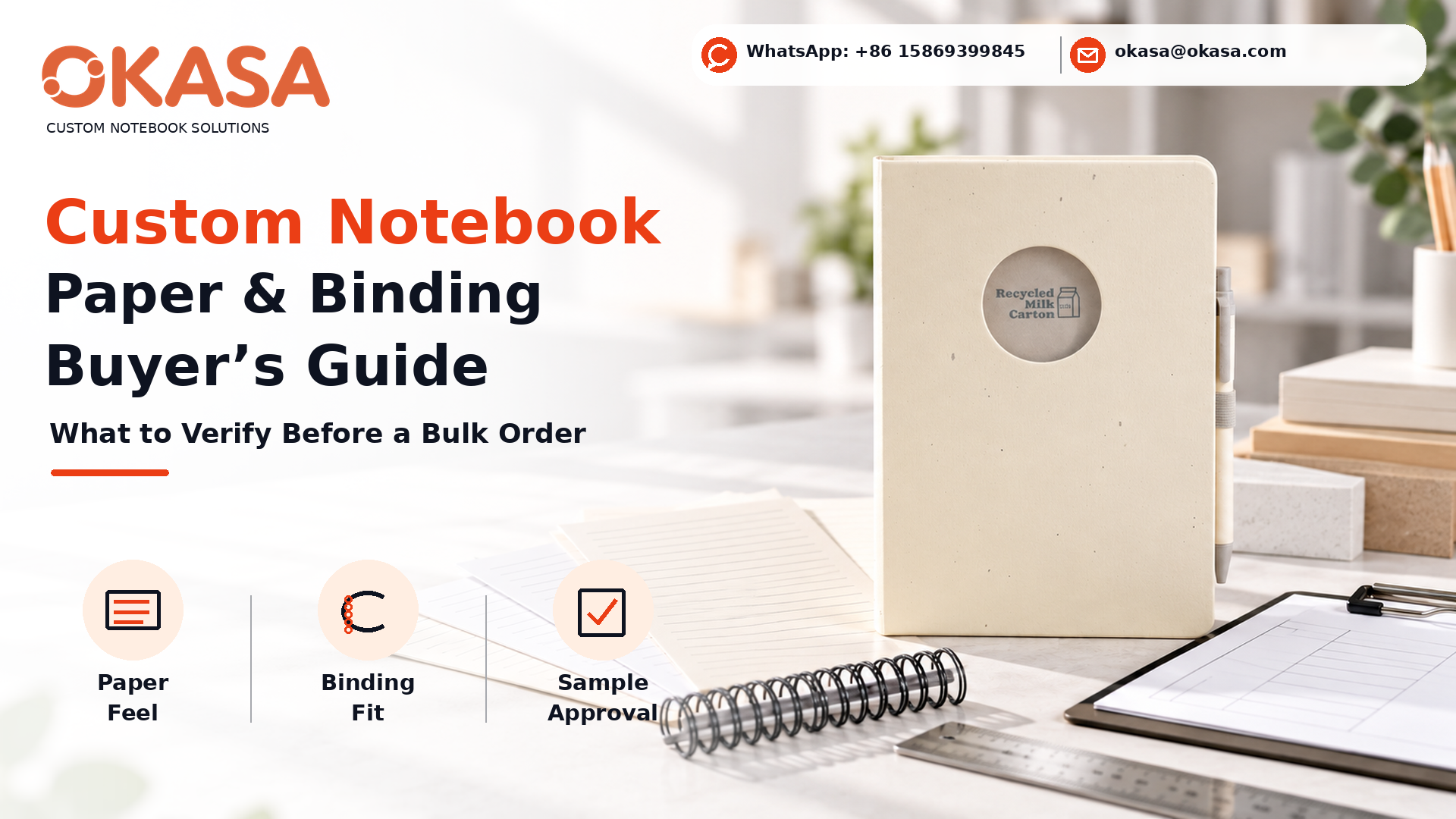
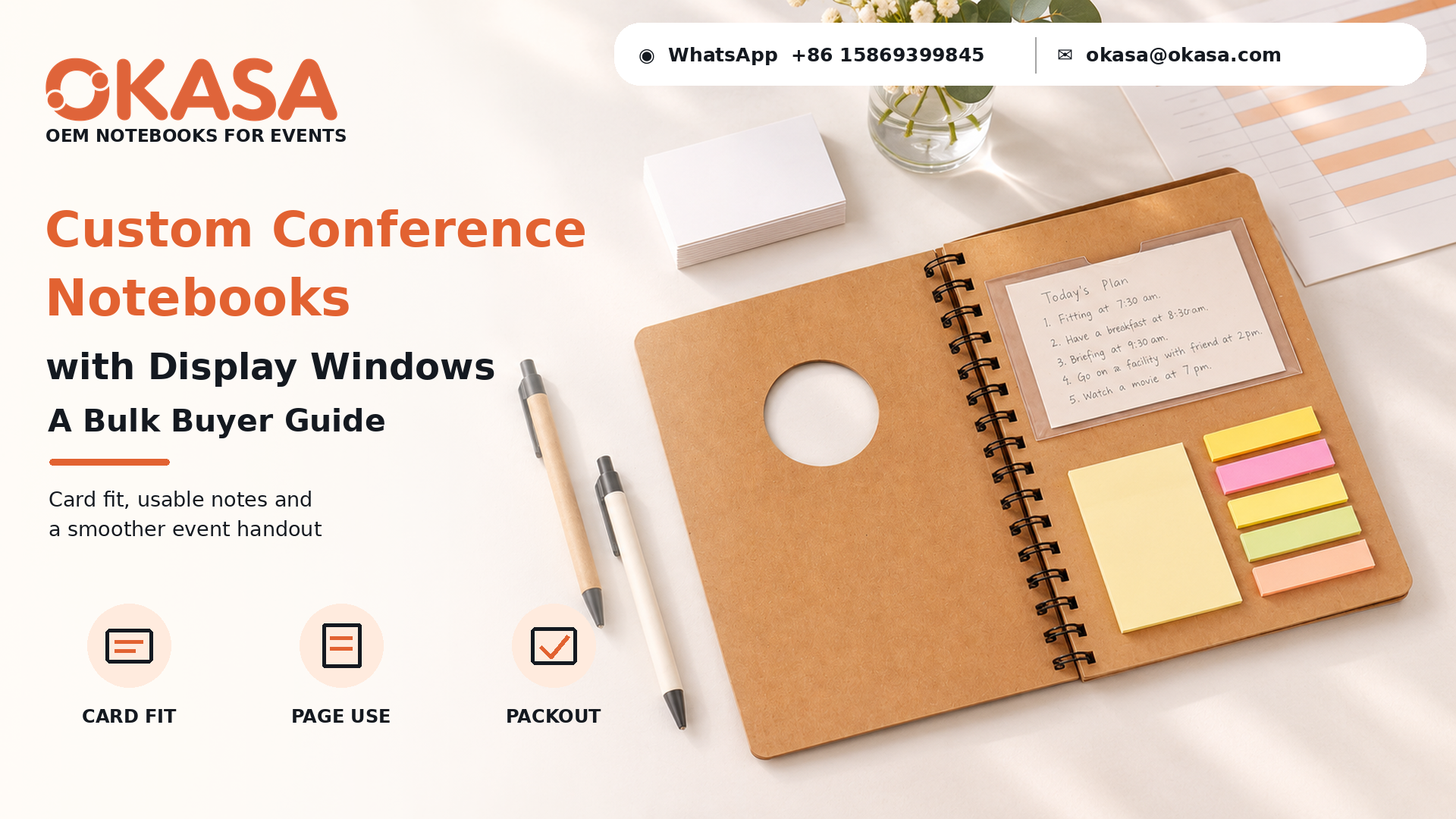
We'll follow one notebook from the card design to the moment it gets handed out. Quick note first. The event stories here are made up. They're exercises, not OKASA customer stories, and not a promise about any order. The product we keep coming back to is a kraft coil notebook with sticky notes, the kraft paper coil notebook with display pocket and sticky notes from OKASA. Their page lists a kraft cover, a 5 cm round window, a clear PP or PE pocket on the front endpaper, sticky notes and flags, recycled inside pages, and 14 x 21 cm. None of it is locked until you've held a sample and seen a real quote. Source: OKASA product page.
Begin with the handout, not the hero photograph
Run the same event two ways and you'll see the difference. Way one, plain notebook plus a separate badge. Way two, a small card slips into the clear pocket and shows through the window while the cover's still closed. The second feels nicer. But now you've got variable printing and a matching job nobody asked for. Decide what the notebook is actually for before you price it.
Before ordering, someone has to decide what the window is even for. Guest name. Campaign logo. Session number, QR, a card you can swap. It changes everything. A name means your team sorts. A generic card skips sorting but the person who gets it might not use it. A QR sounds clever, except the size and contrast and angle all need testing on a real notebook. Session numbers only work if the plan keeps them fixed. None of it changes the notebook. It's all in the print file and how you pack.
Write the spec like the person packing boxes will read it. "Personalized covers" sounds fine to a marketer. To a packer it can mean a different cover for every single guest. Usually the smarter move is one kraft cover and separate insert cards. Tell the supplier to price it as lines. Notebook. Generic inserts. Variable inserts. Labor to put them in. Then when the list changes you see exactly which line moved.
That round cut-out on a notebook with name card window is a display window. Not a badge replacement. It stays part of a notebook. Whether it stands in for a real badge depends on how your staff check access and how people carry the book. If credentials need to show while folks walk, keep a separate badge. Use the window for ID and a message, useful at handout, seating, follow-up.
A small but useful SKU check
One thing that bites people later. The OKASA page puts TNB755 in the heading, the variant label says TNB775. You can see the mismatch right on the listing. Throw the link and a screenshot into your first RFQ. Ask OKASA to state the exact code and version on the quote and the sample label. Don't let purchasing quietly pick one number and assume the other's a typo. The sample and the signed order are what actually settle which build you bought.
Work backward from the circular opening
The published cut-out is 5 cm across. That's the hole. Not the printable area of every insert. Not the full pocket. Not the safe zone for text. The card behind it needs to be wider than the circle or it slides out of view. The pocket wants room too, so a card goes in without creasing. Put all of it on one dieline.
On that drawing, get four numbers. Finished cover opening. Where its center sits from two fixed edges. The pocket's inner size. The card's cut size. Shade a safe zone, the bit still visible when the book's closed. If the card has a name, don't approve off 'John.' Test a short name. The longest real name. Accented characters. Whatever language the event uses. A centered 'John' is a weak test for a real conference.
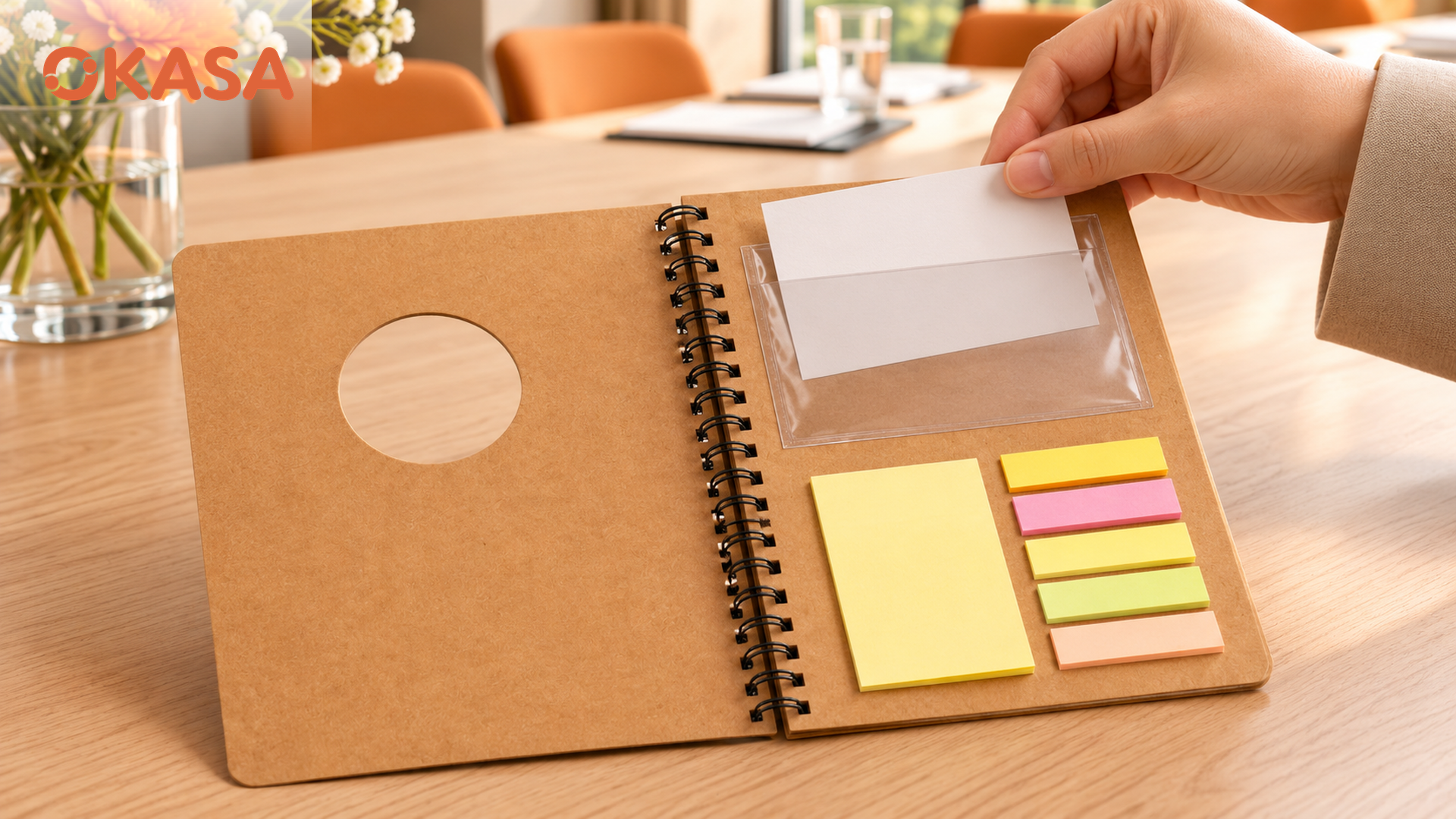
Judge the safe zone on the real closed cover. Not a screen. The cover and front endpaper drift when the coil clamps and pages settle. A mock-up shows perfect alignment and has zero thickness. Print a few cards with a border for the sample round. Close the book, turn it, hold it by the coil, look. Any letters creeping to the edge of the circle.
Color needs the same reality check. Black on white or pale stock usually reads. A busy patterned insert can disappear behind the cut-out. Brand wants an orange card, test the ink on that exact stock under event light. Warm ballroom light makes a good proof read worse than on your monitor. Keep the first card simple enough that staff recognize it while handing out hundreds.
Don't assume that pocket is sealed forever. The product mentions PP or PE, and those are two different things you need to confirm. Ask if the opening's at top or side, which edge is attached, how the insert stays, whether the recipient can swap it later without ripping. That answer changes how it's built and how it behaves after.
For approval, hand the pocket to someone who's never seen it. Give them the card, ask them to stand it up in the pocket. Forget the stopwatch. Watch what they do. See if they found the opening. See if the card buckled. See if they got it out. A photo looks clear while the real pocket mouth is a pain to find. Five minutes with one person catches it before a line repeats it ten thousand times.
Decide what information belongs in the card
Planners cram everything onto one insert. Name, company, title, QR, session color, sponsor logo, all on a badge. Only a slice shows through a small window. So what should someone learn from one glance at a closed notebook. Pick one message. Put the rest on the part the pocket shows when the cover opens.
Match the insert to the event. Multi-session meeting, a generic cover with a session-color insert keeps distribution simple. Premium client workshop, a name insert might be worth the handling. Public trade show, a campaign or QR insert can work, but only if you tested that QR through the window and people actually scan. Never approve a QR from the print file. Put the card under the finished cover, grab phones, use real light.
If you're printing names or any personal data, settle the basics. Who prepares it. Who sees the file. When it freezes. How corrections work. What happens to inserts nobody used. A supplier can build and pack without touching your database, if you'd rather insert on site. That local labor is a good trade when names move late.
Version control matters the second the name list moves. Stamp the artwork with date and version. Keep the generic background. Send variable data in a format you both agreed. Ask up front how duplicates, blanks, long names get flagged before printing. A name wrapping badly in a 5 cm circle is easier to fix on a proof than at a registration desk. The same record should say who inserts, who sorts, or whether they ship blank books plus a card pack.
Made-up example, just to make it real. Say 2,400 attendees, plus staff and a reserve. Planning numbers, not an OKASA minimum, not a forecast. Names unsettled till the last week, you might buy 2,500 identical notebooks and print names closer to the date. List's solid, pre-inserted books save time at the door. Run both against real labor, sorting, late changes, loss. Cheaper unit price isn't always the cheaper event.
The inside must earn its place after the badge moment
Once the cover's done its job, the inside has to hold. OKASA's build puts sticky notes and flags on the front endpaper, recycled pages behind. The description doesn't pin down page count, ruling, weight, or a pen. Put those in the RFQ. Don't guess from a photo.
Think about how much page people need. A keynote, maybe a few pages. A three-day training wants sections and tougher stock. Printing the agenda, decide where it lives, a card, the inside cover, the first pages. Pages printed for one year or venue are hard to reuse. Generic pages plus a swap insert keep options open.
Trial the sticky pad and flags by hand. Check if one sheet comes off without dragging three. Check if the adhesive holds that recycled stock long enough. Check if flags poke past the edge and snag in packing. Confirm quantity, color order, size, position on the sample, a picture won't define those for a custom order. Pen in the mix, test that exact pen on the real page and a sticky note. Ballpoint, gel, marker, all different, especially writing on both sides.
Open the sample on a narrow conference table, the kind you'll actually have. A coil lies flat, sure, but that wire eats room at the inner margin. Watch a left-hander and a right-hander. Have them jot a few lines, close it with the card in. Card drifts, sticky notes mash the inner page, book bows when closed, that's a build or packing problem. A desk photo won't tell you.
The OKASA page says 14 x 21 cm and calls it A5. ISO 216 sets trimmed sizes for A-series paper, but a finished notebook's cover, coil, trim can differ from that label. If it has to fit a sleeve, box, bag pocket, mailer, use measured finished dimensions and a sample, not the A5 name. ISO 216:2007 describes trimmed A- and B-series paper sizes, not the outer footprint of every bound product.
Make the brand work on the material you actually order
Natural kraft feels warm and uncoated, good for the right campaign. It also shifts how your logo reads. A small dark mark looks crisp on one batch, flat on the next. A light mark may need an underprint or different method. Ask for the logo technique, position, max size, a decorated sample on the exact cover you're ordering. Judge it next to the card in the window. Logo and card need a clear order, not a fight for the same glance.
Keep the material claim away from the marketing claim. The page mentions kraft cover and recycled inner pages. It doesn't prove the pocket film, coil, adhesive, printed insert are all recycled too. "100% recycled notebook" needs evidence past that line. Ask which component holds what, what percentage you can back, what wording your market allows.
An FSC label needs the certificate and claim route for the finished item. Don't assume one FSC paper component lets you put the logo on the product. The Forest Stewardship Council explains that its chain-of-custody system tracks qualifying forest-based materials through production and controls claims on finished goods. For U.S. sales the FTC's Green Guides summary says recycled claims should be qualified when only part of the product is recycled. These are references, not proof this notebook has the certification.
Durability belongs in the sustainability story too. A notebook that survives and stays in use beats one tossed at the exit because the card fell out or the pages were awful to write on. Don't turn that into an environmental comparison you never tested. Keep claims specific. Keep the product useful.
One quotation should describe the same notebook for everyone
When marketing, the agency, and the supplier picture different products, price talk goes nowhere. Get the decisions on one sheet. The table below is a start for an RFQ, but the numbers need confirming against the model and sample you pick.
|
RFQ field |
State on the request |
Check on the physical sample |
Why it changes the quote or workflow |
|
Product identity |
Product URL, agreed SKU and revision |
Label on sample matches quotation |
Prevents the TNB755/TNB775 listing mismatch from entering an order |
|
Finished format |
Width, height, thickness and coil projection |
Measure closed book at several points |
Determines sleeve, bag and carton fit |
|
Window and pocket |
Opening diameter and location; pocket film, opening edge and inner size |
Insert real card, close book and check alignment |
Controls dieline, assembly and card yield |
|
Insert card |
Finished cut size, stock, print, variable data and safe area |
Long names, QR if used, removal and reinsertion |
Changes prepress, sorting and privacy workflow |
|
Writing pages |
Sheet count, stock, color, ruling and printing |
Write with intended pens on both sides |
Changes material, print setup and finished thickness |
|
Sticky notes and flags |
Sizes, colors, counts, adhesive and exact placement |
Lift, stick, turn pages and close |
Changes component cost and pack integrity |
|
Branding |
Logo file, method, location, color reference |
Decorated proof on final cover stock |
Controls setup, appearance and inspection |
|
Packing |
Individual wrap, carton count, sort sequence and labels |
Pack, transport-simulate and unpack sample |
Controls labor, scuff risk and receiving time |
Ask for a base quote with one card design, then a second line for names or session inserts. Add insertion and sorting if the supplier does them. If the agency does, ask for notebooks and cards packed separately, labeled. A quote that hides all this under "custom notebook with logo" leaves you nothing to compare.
Put the product code, card version, artwork version on the approval form and the PO. A new card might leave the notebook alone, but a new pocket or moved cut-out changes the build. Keep them on separate revision lines, that's fair. Ask the supplier which approval repeats after each change, and who pays for obsolete inserts.
Rehearse the entire registration desk before releasing production
Before production, rehearse the whole desk. Start with a plain sample for scale, feel, page use. Then a structural proof with the final window, pocket, sticky bits. A decorated sample checks the logo. A final pre-production sample should carry the agreed card, cover, pages, insert, packing, as close as possible. Note anywhere a sample used substitute stock or a mock-up method. A pretty prototype built different from bulk isn't approval.
Then rehearse the handout. Lay out thirty or forty cards in the order the organizer wants. Have staff insert a few, sort by the real rule, pass a notebook to someone with a phone and a bag, open one at a table. That number's a trial, not a statistical sample. Goal is to find friction while you can still change the product. Note how often someone turns the book wrong, drops a card, stops the line to hunt a name.
Your sample record needs a code, photos of open and closed book, the dieline, artwork version, materials, written dimensions, who approved, the date. Keep a signed sample. When bulk cartons arrive, check the pocket, window, print, sticky pad, pages, packing against it. "Looks about the same" is too loose for a variable-data order.
Check the packout by carton, not just by piece. A notebook passes on its own and still shows up with scuffed kraft corners or curled flags because it was jammed against something. Look at cartons from the start and end of the run. Count card versions, check labels. Names pre-inserted, agree up front if cartons sort alphabetical, by session, region, or serial range. What the recipient sees and what the warehouse reads have to match.
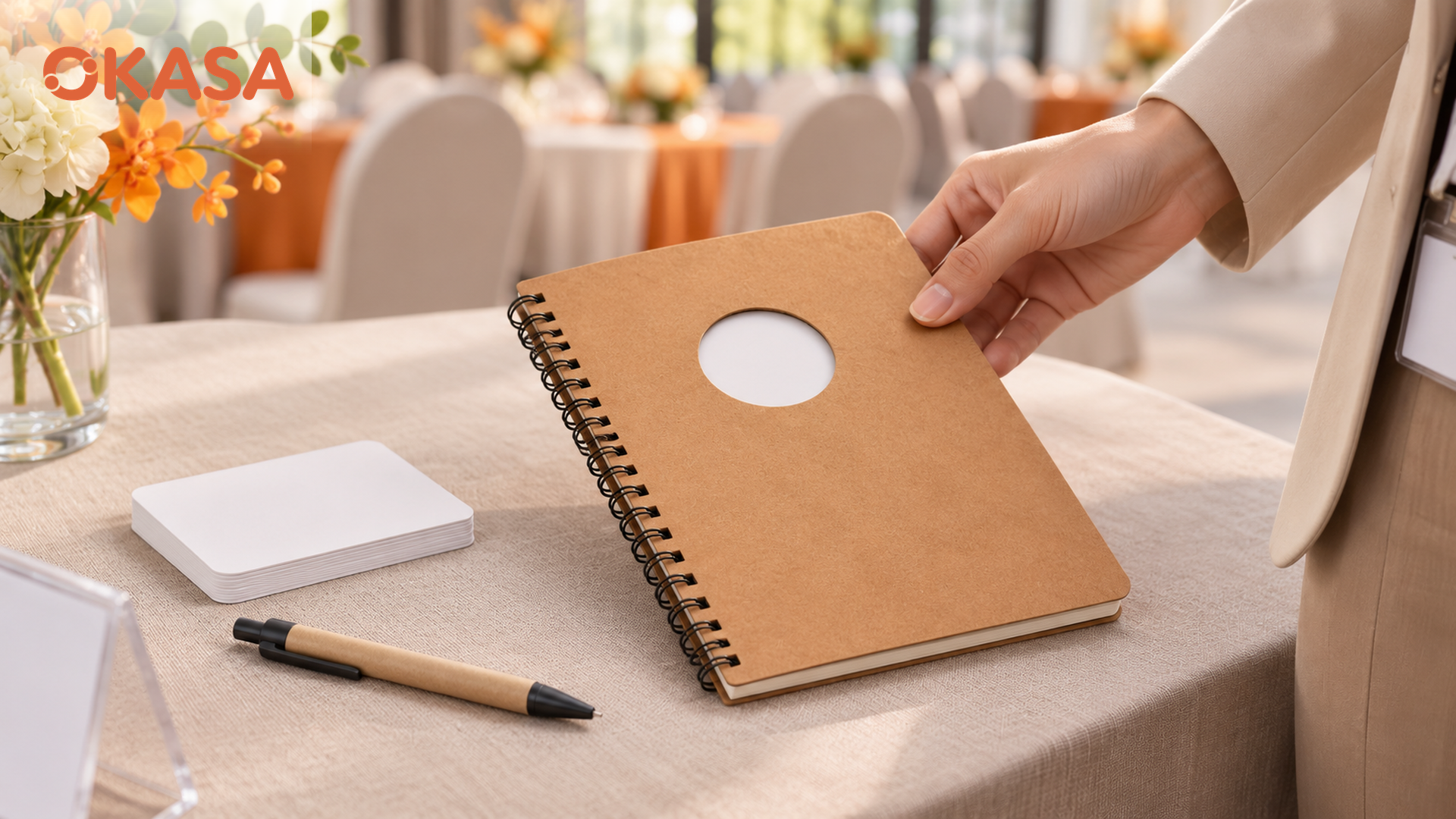
This is where you set a sane reserve. Covers last-minute attendees and damage, but a named insert can't be reassigned on a whim. Decide how many blank or generic inserts ride with the personalized ones, and where they're kept. Don't print spares with a name you're guessing. Your team needs a plan for the person who shows up five minutes before a session.
If the notebook is only one part of the program
When teams compare branded event notebooks wholesale, same rule. Let sourcing follow what the recipient carries. A conference notebook stands alone or lives in a kit. A custom notebook manufacturer can talk through window, pocket, pages. Book goes in a tote, a custom bag manufacturer should see the closed sample and full kit load before bag size and handle are set. A bottle needs its own call with a custom drinkware manufacturer. Water next to exposed paper is a packing problem, not a mood board.
Rigid presentation set, a custom gift box manufacturer needs the final book thickness, card projection, every component before cutting a fitted insert. A custom corporate gift set manufacturer can coordinate a notebook with another item and its box, but personalization and packing ownership stay explicit. A loose notebook in a bag and a nested one in a box share artwork but need different receiving and handout.
Several product types, work with an OEM promotional products manufacturer on one spec register and one shipment plan. Buyers into promotional products sourcing China should compare named components and approval records, not a photo and a price. A promotional products manufacturer China search gives plenty of names. The short list that matters tells you who controls each print file, material, assembly step, carton label.
If the brief has verified material claims, ask a sustainable promotional products manufacturer to name the component and the documents behind each claim. For wider bulk corporate gifting solutions, keep the notebook's operational job in view. A premium gift opens quietly at a desk. A conference kit goes out in a queue. That changes what you test first.
A practical RFQ that invites a useful answer
Your first inquiry can be short if the attachments are tight. Send OKASA the page, event type, quantity, reserve, destination, deadline, what the card's for. Attach a rough layout showing the circle, note if the list's personalized, say who inserts and sorts. Add the logo, cover treatment, inner-page needs, any bag or box it fits. Flag open questions so the supplier can propose. A solid custom conference notebook manufacturer returns options, not just a number.
Ask for two quotes. Option A, one common insert, no variable data. Option B, add names or session variants, with print, insertion, sorting, packing charged separately and spelled out. Both describe the same base notebook, exact model code stated. OKASA suggests a different build, have them show it on a sample and flag the price, minimum, schedule.
That gets a better reply than "please quote your best notebook." You decide if personalization earns its cost, and the supplier prices a defined job. Your team ends with a handout they know how to hand out.
Questions buyers often ask before submitting an inquiry
The round opening can show a QR, but don't approve from a mock-up. Put the code on the real insert, close the book, scan with several phones under real light, leave a quiet zone. The pocket film, cover edge, angle all mess with scanning.
Pens aren't always in. The TNB755 description centers on notebook, pocket, sticky notes, paper. A pen in a lifestyle shot is a prop unless the quote lists it. Event needs one, ask for it as its own line.
Changing the insert after production depends on the pocket. A removable card is what you're testing for, but the film opening and fit need confirming on the build you choose. Ask for a pocket sample, run several insert-remove cycles before promising a reusable system.
The recycled wording doesn't cover the whole notebook. The description points to recycled inner pages. It doesn't make an all-component claim. Get material details and approved wording for your order before printing environmental copy.
Names show up late, decide the split between supplier and on-site insertion before you order. Keep the generic notebook separate from variable data if that gives control, then hand over clear carton labels and a reserve plan. Confirm revised print and freight dates in writing.
A digital proof isn't enough alone. It helps approve spelling, layout, data merge. It can't verify pocket access, cover alignment, card retention, writing feel, carton damage. Sign off physical features on a real assembled sample.
Fastest next step, send the product link, your rough quantity, what you want visible through the window. OKASA can advise on the card, sample sequence, a quote that splits notebook production from variable inserts and packing.
Product and standards references
· OKASA TNB755 kraft notebook product description, published construction and dimensions. Confirm final SKU and details in the quotation.
· ISO 216:2007, trimmed writing-paper sizes. Finished notebook dimensions require measurement.
· FSC chain-of-custody certification, claim control for eligible finished paper-based products.
· FTC Environmental Claims summary, U.S. recycled-content marketing claim guidance.