

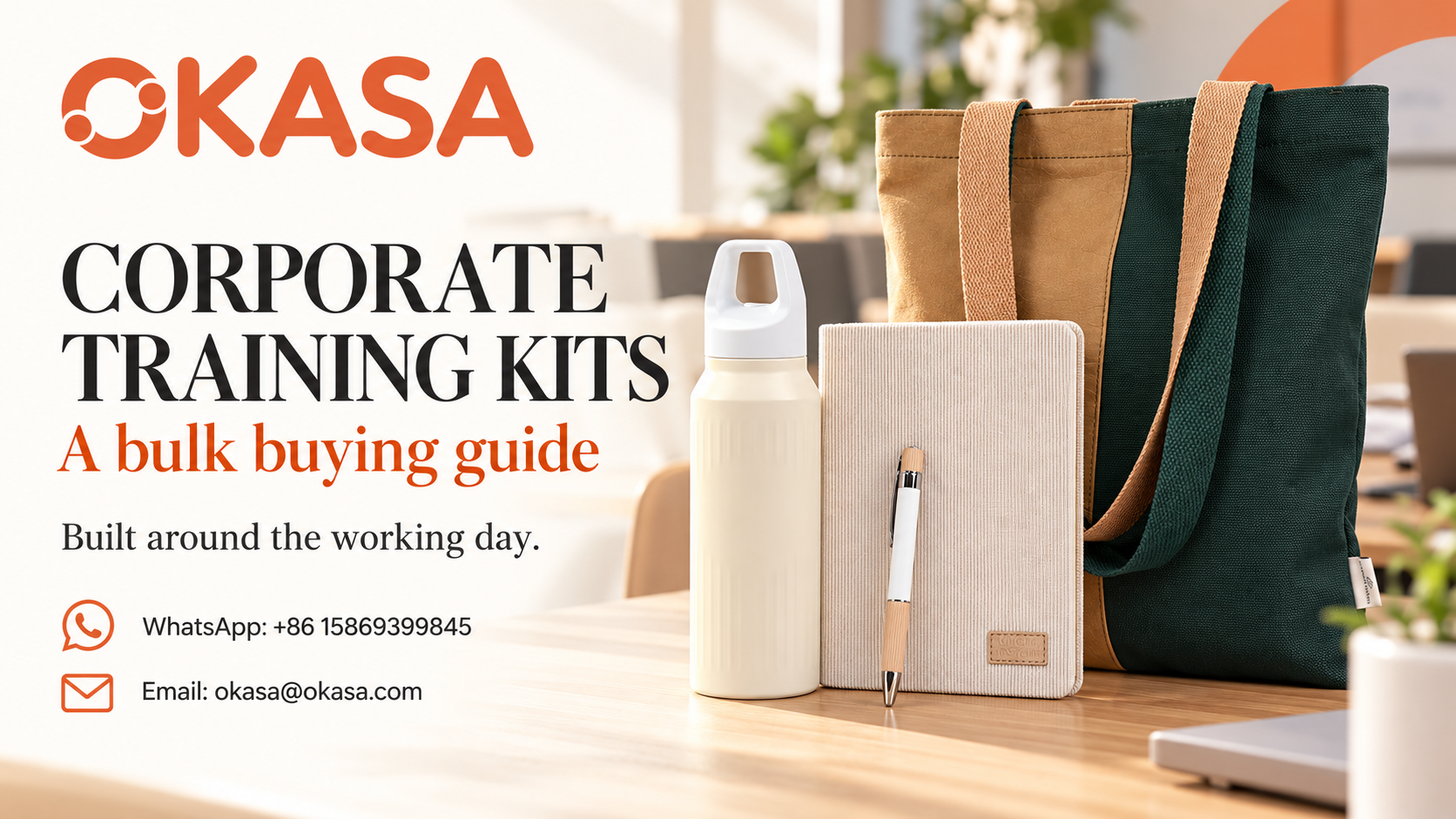
Picture the room before you picture the product. Twenty people, small tables, a workbook plonked down at each place. The trainer says: give me one example from your own job. Sixty seconds later half the room is patting its pockets, because nobody thought to bring a pen. That's the scene worth designing for. A photograph of a box won't tell you a thing about it.
So what's the job, exactly? Two things, and that's the lot. It has to get through the session without anyone cursing it, and it has to be worth the boot space on the way home. A notebook and a pen manage that on their own. Honestly. Strip off the packaging and that's what a corporate workshop kit comes down to. A bottle only pulls its weight where there's drinkable water to put in it, and a tote only pulls its weight when somebody is actually carrying something. Buy all four because the flat-lay looked lovely and you'll finish with a cluttered desk and a chunkier invoice. The training day won't be one degree better.
Fair warning before we go on: we make these kits, so discount the product plugs accordingly. Everything below comes out of two places — the things buyers keep telling us went sideways when they ordered corporate training kits in bulk, and a handful of items lifted straight off OKASA's published range so you can click through and check the numbers yourself. The costing example is invented. It's a planning aid. Please don't read it as a customer order, and definitely don't read it as a price.
1-Start with the agenda, then the catalogue
Before a catalogue gets opened, corner the person who owns the course and ask them to walk you through an ordinary day. Where do people write? Are they stuck at one desk or traipsing between rooms? Printed exercises, laptops, or some unholy mix of both? A two-hour briefing in an office and a week in a residential centre share nothing except perhaps the same twenty faces. Treat them as one brief and you will buy the wrong thing, confidently.
Short session? A notebook and a pen that doesn't skip will do, and plain bulk training notebooks with nothing printed on the cover are usually the cheapest thing that works. Already got a workbook going to print? Then a second big writing product is weight for the sake of weight. Slim notebook for action points, job done. A full-day course is a different animal — measure the desk before anything else. Laptop here. Workbook there. Drink pushed to one side. Elbow room for the writing hand. Whatever survives that arithmetic is your gift's patch of real estate.
The CDC's Develop Training: Captivating and Motivating Adult Learners is worth half an hour of anybody's time. It's aimed at public-health instructors and it's about how adults actually learn in a room together. Nowhere in it does anyone claim a branded mug improves retention — say that and we'd be inventing things. What it does suggest is blunter. If the session asks people to do something, the kit has to let them do it. Practise a skill, argue a point, scribble the next step down — if any of that sits on the agenda, the equipment needs to get out of the way rather than take up the space.
Ask the trainer what a participant should still have a month after the course has finished. Their own worked examples in a notebook? A card that lives in a desk drawer? A workbook that gets reopened in a quiet week? Whatever comes back, that's the piece of the kit with a life beyond the registration photo, and it's the piece you defend when somebody upstairs starts cutting.
Which is why, when a buyer asks a custom corporate gift set manufacturer for a quote, our opening questions are all about the session. How long does it run? Who's actually in the room? What does the venue look like, and are people flying home that evening? Products can wait their turn. A tidy coordinated collection is a pleasant place to start, but it still has to serve the programme, and a fair few of them quietly don't.
|
Training format |
Useful starting configuration |
Check before adding more |
|
Short office workshop |
Notebook and pen |
Whether the workbook already covers note-taking |
|
Full-day classroom course |
Notebook, pen and optional bottle |
Desk space and access to drinking water |
|
Multi-room training programme |
Writing items carried in a tote |
Workbook dimensions and carrying comfort |
|
Residential leadership course |
Coordinated writing and drinkware set |
Luggage space and packed weight |
Use that table as a rough sketch rather than a shopping list. If the trainer can't tell you when an item would be used, take it out of the first quote and price it on its own. Nine times out of ten it never finds its way back in.
2-Treat the notebook and pen as one working pair
Plenty of notebooks look gorgeous in a photograph and behave badly on a training table. Try this instead. Put the sample on the narrowest desk you can find. Write right up against the binding. Then turn three pages while holding a workbook under your other arm. Ten seconds of that beats a paragraph of cover copy, every time.
Ask your custom notebook manufacturer to price it line by line instead of as one comfortable lump. Paper on one line. Binding on the next. Cover after that. Decoration last of all. A5 notebook with logo is not a spec — nobody can build from it. Half the trade confuses page count with sheet count, and a chunky cover says precisely nothing about whether the thing lies flat once it's open on a desk.
One real example, then. OKASA lists the TNB790 corduroy notebook at 21 × 14.5 cm, which is roughly A5. 80 sheets, so 160 pages, on 70gsm ivory ruled stock, with an elastic strap and a pen loop. There's a ribbon marker in there as well. That's a spec you can send to a factory. What it won't tell you is whether your ink bleeds through the paper, or whether the spine stays open on its own. Only a sample does that.
Pick the pen before you sign off the paper. Do it the other way round and you'll find out the hard way, usually in front of the trainer. Write a few lines, wait for the ink to dry, flip the page, look at the back. Now repeat the whole test with the marker the trainer actually intends to use. A ballpoint gliding through tells you nothing whatsoever about how a fat chisel tip behaves on the reverse.
Then there's the pen loop, which almost nobody tests. Too snug and people give up on it by lunchtime. Too slack and the pen is rolling around at the bottom of the bag by Friday. Clip the real pen in. Shut the book. Drop it into the bag you're quoting, haul it back out again, and watch what the clip does to the cover on the way.
Ruled pages are the dull safe answer, and most training content also wants somewhere blank for a sketch or a process map. So before anyone commissions a second notebook version, ask whether a loose worksheet would do the same job for a fraction of the faff. Custom inner pages earn their keep when the same layout comes back term after term. Otherwise each one is another file to proof and another sign-off to chase round the building.
Dates on a cover are a trap. Print one and the surplus is scrap after a single cohort has been through. Leave it off and next year's intake can use the same stock — stick the session name, the date and the room on a card that goes inside instead. People drop out in the final week, remember. Reprinting a card costs pennies. Reprinting a cover doesn't.
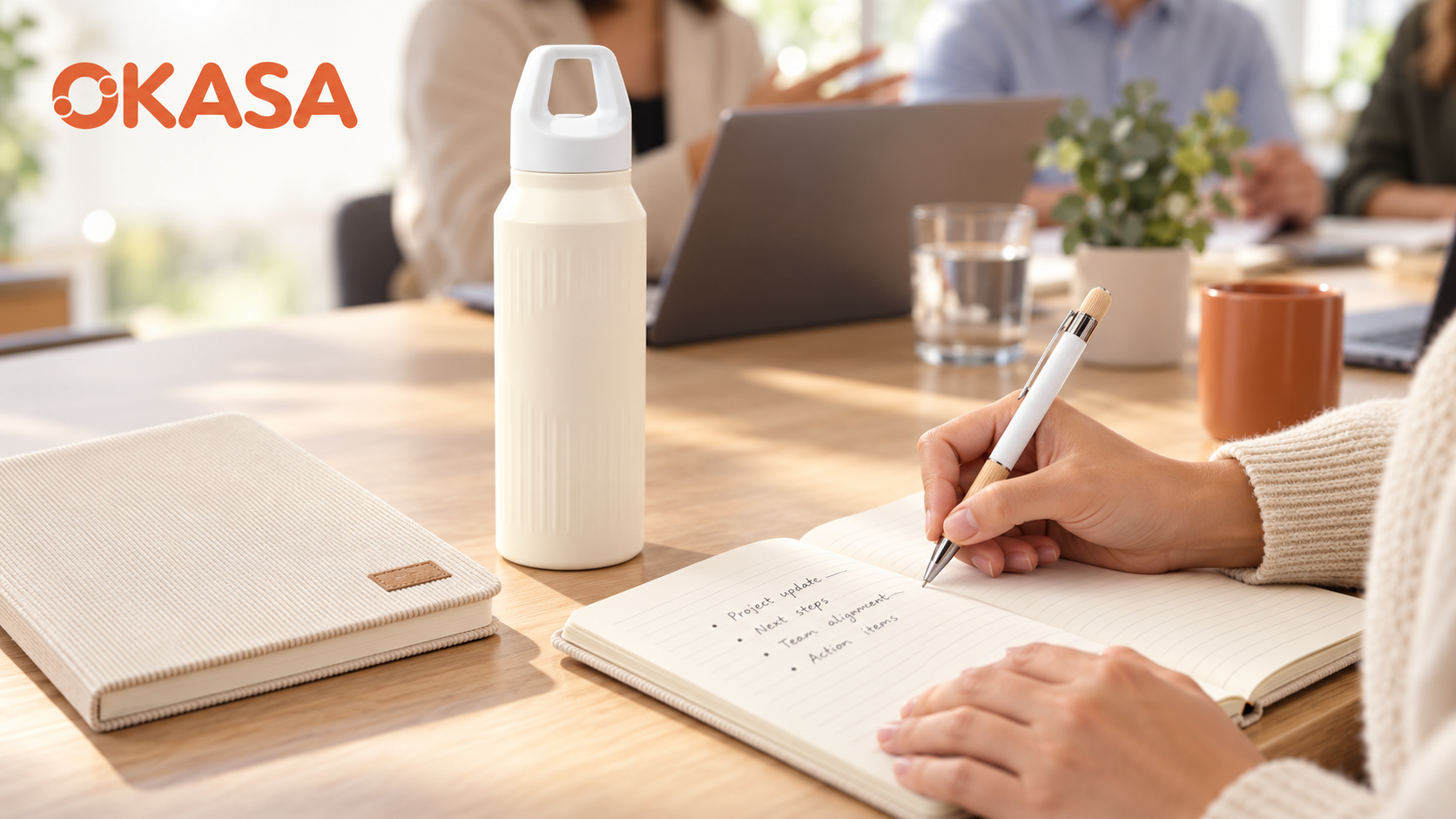
Illustrative usage scene based on OKASA product references.
3-Add drinkware and bags only when they earn it
The water supply matters more than the bottle, and almost nobody checks it before ordering. Will the venue let anyone refill? Is there a dispenser, and does a 500ml bottle fit under it? Get any of that wrong and you've bought a handsome object nobody can use. Dead weight in a bag, rattling about for the rest of the course.
Your custom drinkware manufacturer can only spec the item properly if you say how it gets used, in plain words rather than marketing language. A bottle lives in a bag, gets shoved between rooms, takes knocks on the way. A cup never leaves the table in its entire life. That one difference drives two separate specifications, and the lid is where it shows first. A seal that's fine on a desk fails in a bag, and a photograph of a lid proves nothing whatsoever about whether it leaks.
OKASA's TGS871 makes a useful thing to hold in your head: corduroy notebook, stainless bottle, pen, with the listing giving a 500ml bottle alongside a 21 × 14.5 cm notebook. For a real training order, though, the question worth asking is whether the pieces ship without the gift box, and the answer needs to be in writing. A catalogue page is not an MOQ, and it's certainly not a delivery date.
Once a programme starts moving between rooms, the tote stops being decoration and starts doing structural work. A real workbook goes in first, then the notebook, then a full bottle — and a bag that takes any one of those happily will turn miserable the moment all three are inside together. That's why it's worth measuring loaded and bulging rather than flat on a table, which flatters every tote ever photographed.
OKASA's B113 measures 35 × 40 cm, recycled cotton canvas with washed kraft paper and a fabric lining. Get a sample in your hands before committing to it, though nothing on earth guarantees your workbook will fit. Two measurements decide the whole thing, and both are questions for your custom bag manufacturer: how wide the mouth opens in practice, and how far the handle drops once there's weight in it. Then the load test, with your contents rather than a handful of their own samples.
The inside of the bag is the bit that gets ignored, and it's the bit that decides whether the kit arrives looking new. Without a divider, a bottle grinds against a notebook for a thousand kilometres and both come out looking second-hand, so the question is how the contents survive the journey and then how somebody carries them home from the station afterwards. A sleeve helps, and so does a different packing order — or, frankly, leaving the drinkware out altogether.
A desk-based course barely needs a bag at all, since nobody has to walk one from a lift to a meeting room. A cohort that travels is a different animal, though, especially with printed materials to haul, and in that case the bag ends up doing all the work. The venue decides which of the two you're in, and it's worth getting the alternatives priced side by side so the difference between them is impossible to miss.
4-Branding that reads at arm’s length, and a kit worth keeping
The artwork belongs on a full-size mock-up long before the colour argument starts, mainly because the colour argument is rarely the actual problem. A logo can look beautifully weighted on a 27-inch monitor and then swallow an A5 cover whole. Hairline text that sings on screen has a habit of turning to porridge on a woven label. Know the decoration area and the process limits first, then design inside them, instead of designing something lovely and finding out later that it can't be made.
One approved logo file is a start, but no two surfaces will ever treat it the same way. A woven label, a printed fabric label and a bottle print will never match each other exactly, and chasing that match is a waste of everybody's month. The useful question is what's untouchable: the wordmark obviously, then spacing and the colour reference, then the smallest text that still has to be legible at arm's length. Anything approved on the strength of "same as the picture" will come back to bite somebody.
Language is the decision that's most expensive to reverse, so settle it before anything else gets locked. One bilingual insert covers two cohorts for the price of one. Two fully customised notebooks leave you holding stock that's awkward to shift six months later. Does the programme title change market by market? Does the company name? Who signs the translation off? One conversation, three answers, and the approved file revision goes on the purchase record.
If you're weighing up a sustainable promotional products manufacturer, the useful order of questions runs service life first and materials second, rather than the other way round. Which component actually carries the recycled content, what share of it, and what documentation backs that number up for this specific order are the questions a good supplier answers without flinching. A claim made about one item in a range does not quietly extend to the other four things in the kit.
The US EPA's Recycling Basics and Benefits puts reduction and reuse above recycling in the hierarchy, which for a purchase like this turns into a design question rather than a materials one. Whether the same useful items can outlive a single dated event is the test that matters, and that isn't a measured saving — we're not going to dress it up as one. Percentages stay out of the copy unless somebody has genuinely done the assessment behind them.
Care instructions need to describe the item in the box rather than the item in the catalogue, which sounds obvious until you read a few of them. A partly cotton bag doesn't become machine-washable because cotton usually is, and a decorated bottle isn't dishwasher-safe by default — the print may well be the first thing to go. What's needed is instructions covering the finished article, decoration included, printed on a small insert beside the programme details.
Green wording is best kept on a short leash. If the evidence covers the notebook's paper, say paper and stop there; if it covers part of the bag's fabric, name that part out loud. A procurement team will believe a specific material with a number attached to it, and "planet-friendly" makes them reach for a red pen.
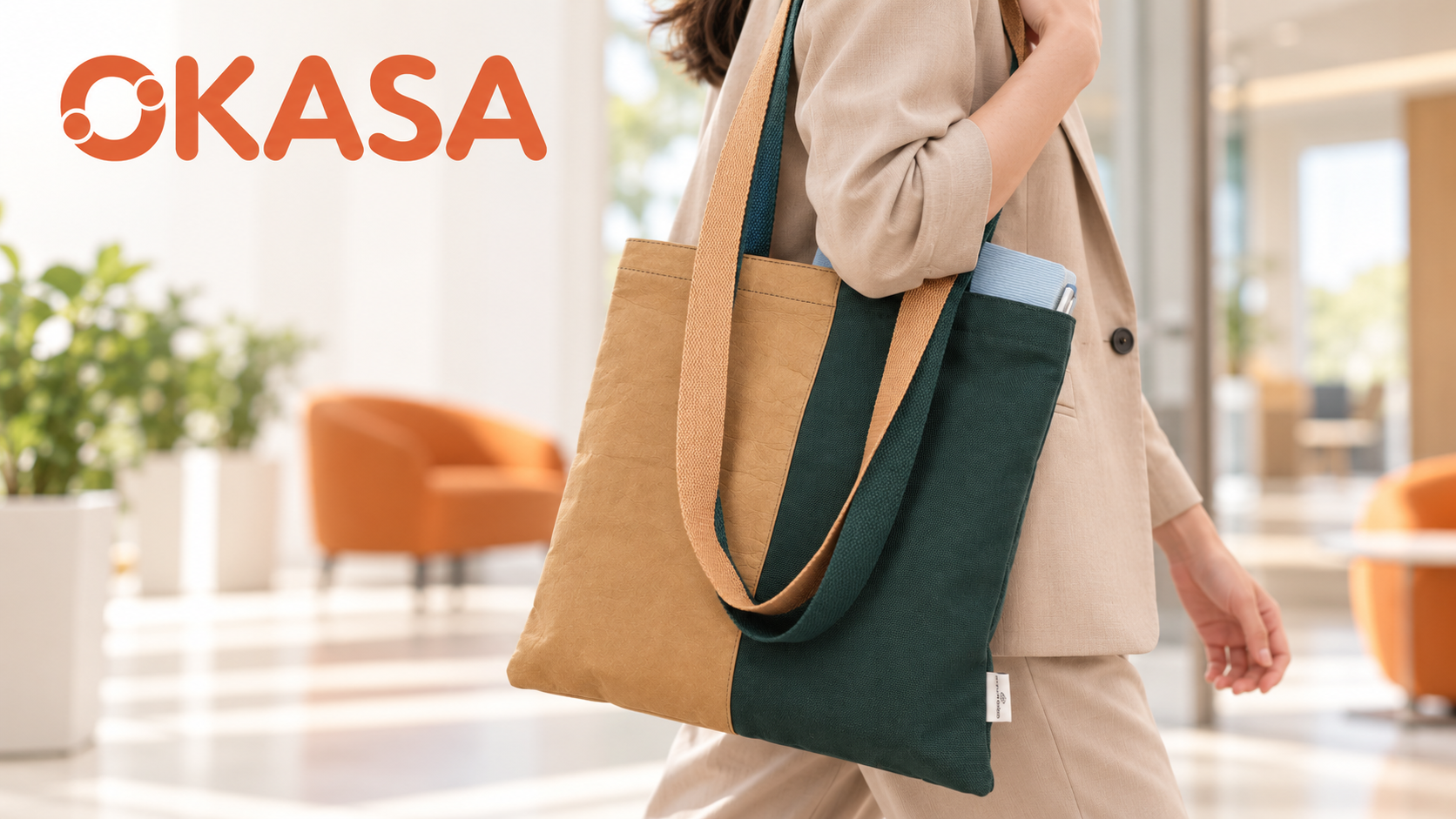
Illustrative usage scene based on OKASA product references.
5-Price the whole kit, not the notebook
We quote these kits for a living, and the most common way a buyer gets an unpleasant surprise is the same every time. The quote they were comparing was for a notebook. The thing they needed was a kit. By the time the box, the print, the packing and the freight are on the page, the cheap quote is usually the expensive one. Nothing dishonest happened along the way. A quote prices what it was asked to price, and what was asked for was a notebook.
Our own rule is simple, and it costs us business: no quote leaves here without the full bill of materials attached, including the parts the buyer didn't think to ask about. It makes our first number look worse than a competitor who prices the notebook alone. We think that's the right trade. Ask any supplier for the same thing — the core kit and the optional extras in two separate columns, in the same document — and adding a tote in year two becomes a phone call instead of a renegotiation.
The table below is invented. It shows how a fixed setup charge and a variable unit cost pull against each other, and nothing more than that. Tax and duty sit outside it, so treat the bottom line as a shape rather than a landed cost.
|
Illustrative cost item |
Calculation |
Amount |
|
Products and agreed decoration |
600 kits × USD 12.00 |
USD 7,200 |
|
Assembly and protective packing |
600 kits × USD 0.80 |
USD 480 |
|
Samples and setup |
Fixed illustrative allowance |
USD 240 |
|
Consolidated delivery |
Illustrative allowance |
USD 600 |
|
Total of listed costs |
Sum of the four rows |
USD 8,520 |
|
Cost per ordered kit |
USD 8,520 ÷ 600 |
USD 14.20 |
Six hundred kits were ordered for one programme. Five hundred and seventy went out and thirty stayed on the shelf. Divide the invoice by six hundred and a kit reads USD 14.95. Divide it by five hundred and seventy and it reads USD 15.74. Both figures are true. The first goes in the report, the second is what a participant actually cost, and the thirty spares covered the extra attendee at session two.
Cohorts are where bulk corporate gifting solutions start earning their keep, and they're also where the arithmetic goes wrong on people. One run of six hundred spreads the setup charge until it barely registers. Six runs of a hundred don't, because each carries its own proof, its own carton labels and its own freight minimum. So put the storage cost in the same column as the unit price. Twelve cartons sitting in a corridor aren't free, and neither is the cash inside them. Almost nobody does this, and it's the comparison that decides whether buying ahead was clever.
Minimums behave badly, too. A plain notebook starts somewhere in the low hundreds. A custom cover fabric pushes the floor up. A printed insert pushes it again, and a second colourway can double it. Buyers usually find this out in week five, when the design they fell for turns out to sit underneath the highest minimum in the kit. Find that component and decide whether to redesign it or accept it. In our experience those are the only two options.
When the total comes back over, the answer is nearly always one item too many rather than one grade too low. Cut the bottle if the room has a tap. Cut the box if the hotel will bin it before lunch. What survives keeps its quality. Then date the revised bill of materials, because the January version has a habit of turning up in a March conversation.
6-Pack for the venue, not the shelf
Plenty of kits are better off with no box at all, and a good few are worse off for having one. A tote that's already carrying the contents can do the presenting as well, and it protects everything in transit either way. What deserves a conversation with the supplier is the stretch between the factory door and the training room: a corner scuffed, a lid creased, a bottle working loose and the whole lot sliding about in a half-empty carton.
A box earns its keep in three situations and no others: kits handed over on arrival at a residential programme, a formal presentation in front of a client, individual kits posted out to separate addresses. Outside those, the money is usually better spent elsewhere. When a box is right, brief the custom gift box manufacturer with the finished products physically in front of you. Dimensions and inserts follow what's already approved rather than lead it. Get that backwards and you're either paying to ship air or shuffling products around to fill a gap that shouldn't exist.
Who signs for the delivery is worth settling before anything leaves the factory, because the answer rewrites the packing plan. A corporate warehouse takes a pallet and breaks the cartons down themselves. A hotel gives you a two-hour window and then stares at you while twelve boxes sit in the lobby. Neither is a problem until it is. Contact name, the address format they'll actually accept, any labelling rule they enforce — pin those down while there's still time to change them.
How the cartons get split should match how distribution happens on the ground, not how the invoice was structured. Three rooms on three dates, each with its own stock, means nobody has to open fourteen boxes hunting for the one English variant. Outside labelling matters as much, and it has to be readable without breaking the tape: which programme, which language, roughly how many inside. Names on cartons only where there's an operational reason.
Four cohorts of a hundred and fifty is six hundred kits. Delivered as one undifferentiated heap, that's somebody counting every single one out by hand, probably on a Friday. Delivered with the cohorts already separated, the packing list shows the split and the total on the same page. Reserve stock gets its own line and, ideally, its own shelf, or somebody raids it in week one.
Anyone doing promotional products sourcing China will save a fortnight by putting the delivery address and the date the goods are needed into the first email rather than the fifth. A factory dispatch date is not the morning the cartons stand in the training room. Work backwards from the day they're actually needed and ask what sits behind the quoted lead time: sample approval, then production, then transport, then whatever your own side has to do before anyone can unpack.
Put the receiving check in the calendar while the order is being placed, not the week it lands. Cartons counted. Damage photographed and logged. Two or three kits opened against the packing list before the course rather than after. Finding the wrong insert at registration, in front of forty people, turns an order that was fine into a morning nobody wants to remember.
7-Approve one complete sample, then write down what you approved
A digital mock-up settles the artwork direction, and that's the whole of its usefulness. It cannot tell you how a pen writes, whether a lid seats properly, or what a loaded bag does to a shoulder after twenty minutes on a train. A physical kit with the actual components and the actual decoration is the only thing that answers those, and every single difference between what arrives and what production is supposed to deliver belongs in writing.
Your OEM promotional products manufacturer is better served by one approval record than by a trail. Comments scattered across email threads, then chat messages, then annotated photos, get misread — we've watched that cost a full week on a perfectly straightforward order. Every change needs an owner and a verdict somebody can act on, and the sample that becomes the production reference gets named in writing before anything else moves.
The sample is best treated as a rehearsal rather than an inspection. One training place gets set out at a real table, a short writing exercise gets done with it, everything gets closed up again and the lot gets carried in the bag. Then hand the kit to somebody who wasn't on the project and watch them unpack it cold; their fumbling for an insert will find a problem the project team stopped noticing three weeks ago.
|
Sample check |
What the buyer should observe |
Record for approval |
|
Writing pair |
Smudging, show-through and comfortable use |
Paper specification and exact pen |
|
Notebook handling |
Page turning, closure and pen-loop fit |
Accepted construction and accessories |
|
Bottle use |
Closure operation and stated care limits |
Model and agreed test requirements |
|
Loaded tote |
Fit, comfort and visible strain |
Trial contents and agreed assessment |
|
Decoration |
Readability, location and visible finish |
Artwork revision and reference sample |
|
Complete pack |
Correct contents, protection and labels |
Bill of materials and packing version |
Everything on this page is a practical check, and practical checks are not a substitute for lab testing or for whatever your market happens to require. Documentation for the product and documentation for the destination are two separate requests, and a trial on a desk proves very little about drinkware safety, or about how anything survives a year of real use.
The categories for defects won't line up on their own, so agree them long before the order is ready to leave. A missing item is one conversation. Wrong artwork is a different one entirely. A tired cosmetic finish is a third, and it's usually the one that gets argued about in a car park. The inspection plan should say what's checked, how samples get picked, and, the bit everyone skips, what happens when the answer comes back no. Strict QC on its own is a phrase, not a process.
The approved spec belongs somewhere a human can find it in eighteen months. Product codes and decoration files definitely, plus colour references, component quantities and the packing instructions. And when a material or a component goes unavailable, a revised sample or a written approval should come before anything is substituted, since a product name on its own controls absolutely nothing.
8-The questions that stall a purchase order
What is the minimum order for a branded training kit
It depends on the components, which is annoying and also true. A plain notebook with a printed insert can go remarkably low, while a custom fabric colour or a foil-blocked cover drags the number right up. What's useful is the minimums broken out honestly — one figure per component, another per colour, a third per decoration method — with whatever the assembly step quietly costs added on top. Coming in under the line leaves a choice: find out what standard materials will allow, or accept that you're about to buy three years of stock you don't need.
Can different cohorts share one production order
Usually, yes, and it costs less than people expect: same products, separate inserts, split at the packing stage. Put the arrangement in writing, though. How many per cohort. Where the reserve physically lives. When each batch goes out. What the handling charge on top comes to. Languages and printed names raise the packing risk considerably, even where the total quantity hasn't moved an inch.
Should every participant receive drinkware
The writing kit should stay identical for everybody, with drinkware treated as an add-on for the longer programmes only. A half-day crowd leaves a bottle on the table and walks out without it, and you've paid for that either way. Budgeting stays per cohort in that arrangement, which keeps finance happy. Two small things before anything is committed: can the bottles be refilled on site, and who's cleaning them after first use?
How far ahead should a buyer order
The morning the kits have to be in the room is the place to start, then walk backwards through the calendar and add a week in reserve without telling anybody. Specification work and samples eat the most time and get forgotten most often; production is usually the bit that behaves. A written schedule built around your exact configuration is worth more than a promised date, since a lead time borrowed from a vaguely similar product is precisely how deliveries end up missed.
Can the kit be supplied without a presentation box
Yes, and quite often it's the better answer. A box-free configuration needs a packing proposal that can survive a courier network — individual sleeves, dividers where they matter, a lid that isn't pretending to be a gift box. One thing worth settling early: whether assembly into the tote happens at the factory or in a hotel corridor at seven in the morning, because that difference changes who you have to pay.
What helps a distributor protect an approved design
Holding on to the files is the starting point. Before a logo goes anywhere, ownership and permitted use belong on paper, not in a friendly phone call, and a single controlled revision with an agreed rule about who has authority to approve a substitution saves an enormous amount of argument later on. For anything genuinely confidential, a catalogue enquiry is not a contract. That conversation needs a lawyer in it, not a sales rep.
9-An enquiry a supplier can actually quote
A brief somebody can actually work from is what turns an approach to a promotional products manufacturer China into a quote rather than an educated guess. Lead with the training format and the total quantity. Then the cohort split, the products you've settled on, where it's going, the date you need it. Whether the budget covers products alone or stretches to packing and freight needs saying plainly, because suppliers guess wrong on that constantly.
The logo gets attached, and the person who can approve a sample gets named. Workbook dimensions matter if it has to fit inside the bag, which on its own saves a whole round of email, and it's worth saying out loud that the drinkware is optional if it is. Small details like that are the difference between a proposal you can use and a catalogue dump with numbers hanging off assumptions.
OKASA will happily quote two versions, a core writing kit and an expanded one carrying the extra items, with MOQs at component level and the decoration options available on each. Sampling is the other thing to pin down early, along with a schedule tied to where you're shipping, since we build it backwards from that date. Pricing gets confirmed against the real order. So do the certification scope and the delivery commitments.
A finished specification isn't needed to begin. A clear course plan and an honest list of open questions will do nicely, and the whole point of that first email is to turn the questions into a sample and a quote that training, marketing and procurement can all put their name to.