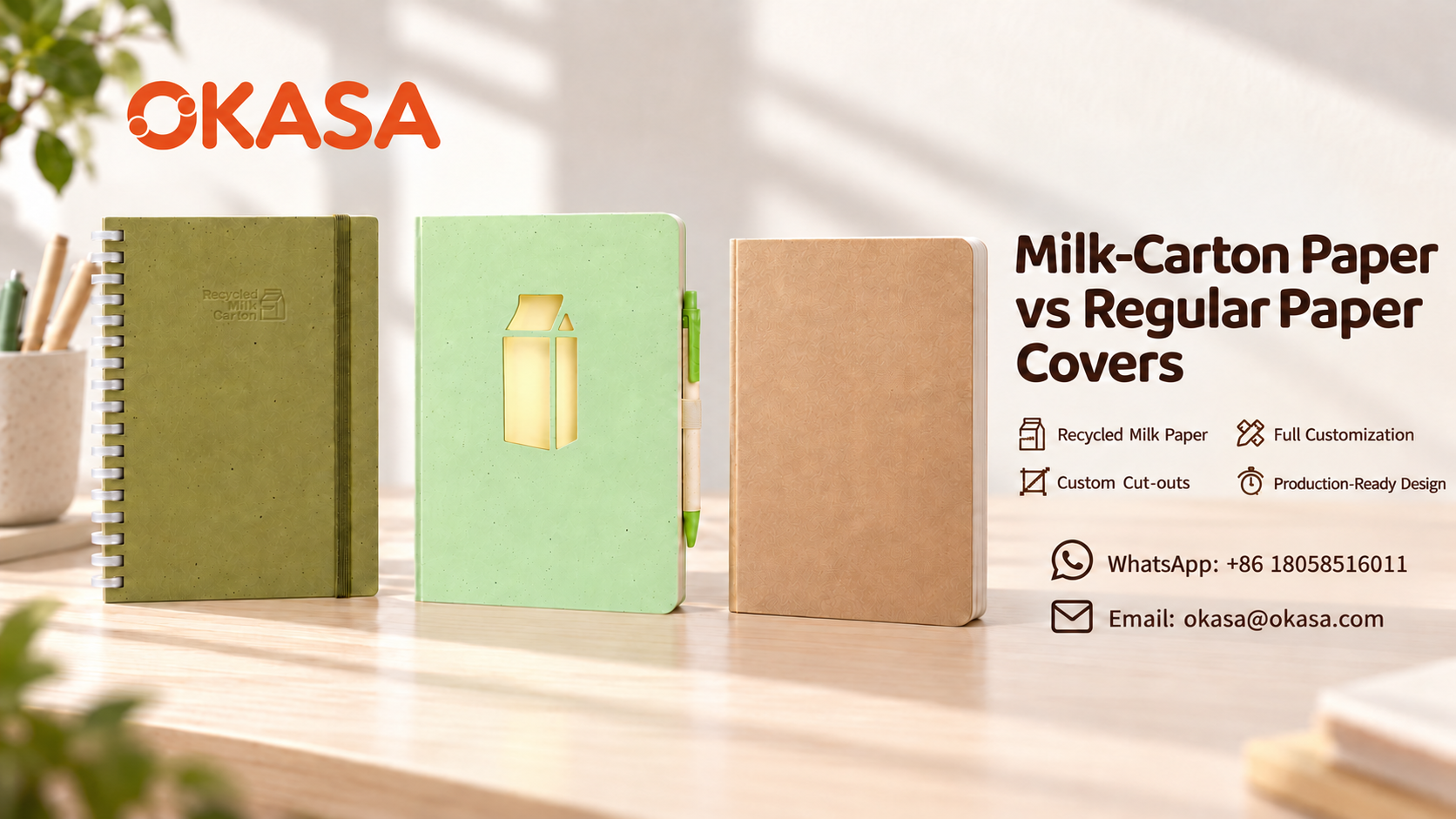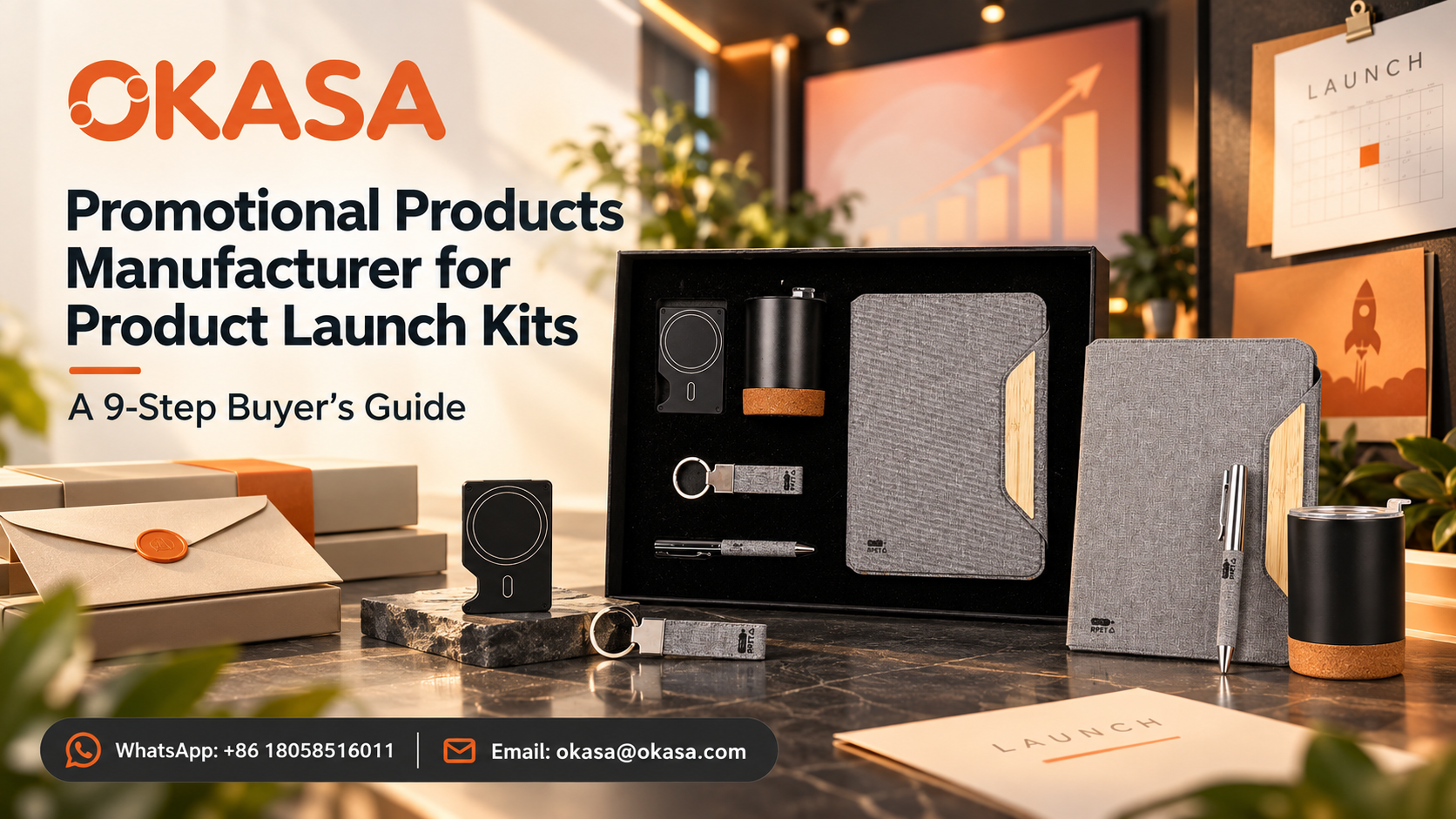


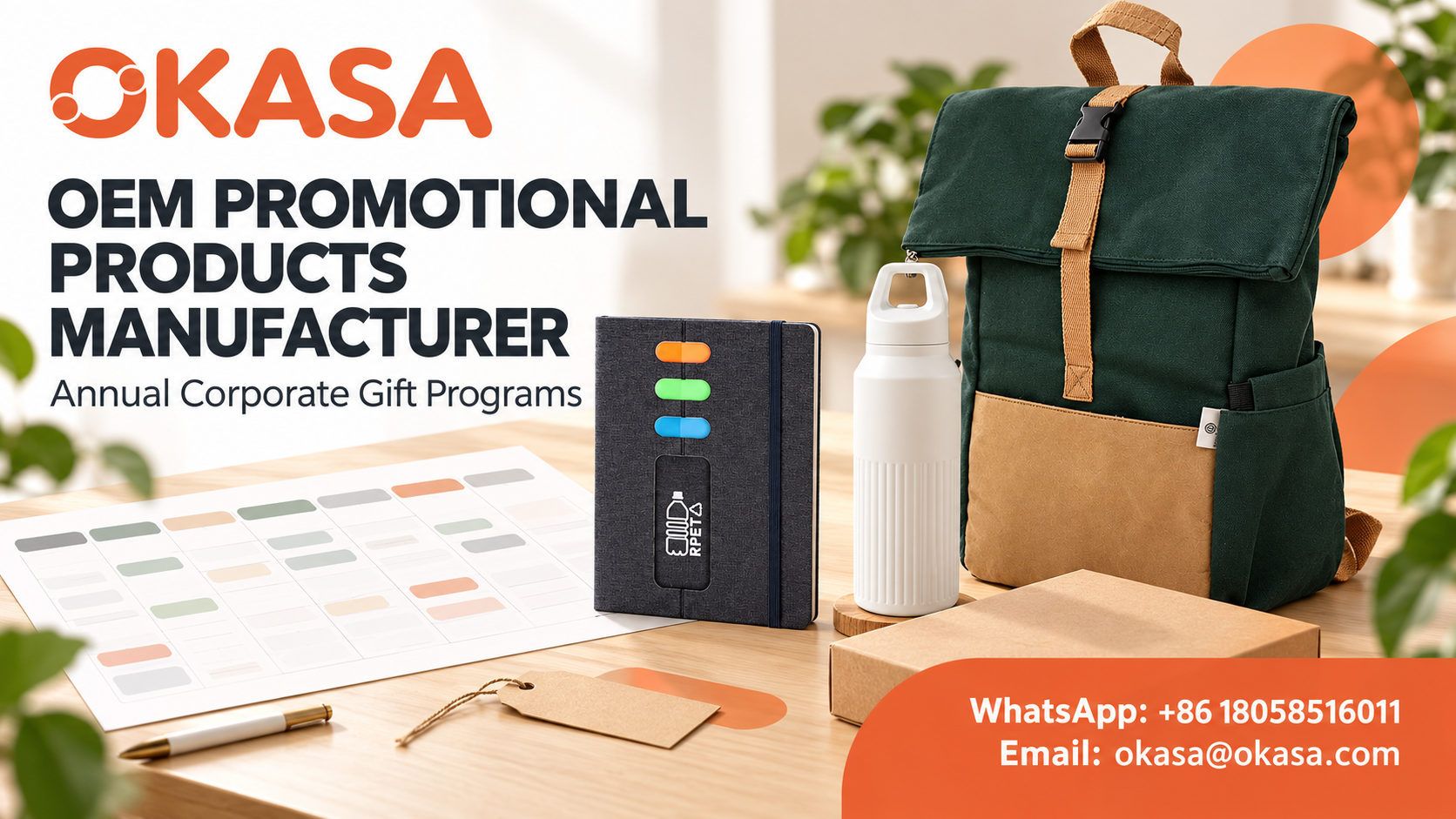
Image 1. Illustrative annual-program planning concept using OKASA product references. Final materials, colors, decoration and packout follow the approved order sample.
A notebook landed for the March sales meeting. Nice one. Cover color right, logo crisp, boxes at the venue with a day to spare.
July. Someone else — different desk, different inbox — places the reorder. They attach an old logo file (the one from two brand refreshes ago), ask for "the same item," and need it fast. The second batch looks fine on screen. Put the two notebooks side by side, though? Night and day.
Here's the thing about annual gift programs: the hard part usually isn't the first product. Any decent factory can nail a one-off. What's hard is batch number two — or six — still looking like it belongs to the same family, after the dates moved, the coordinator left, and marketing decided the EMEA kits now ship with different inserts.
A pretty sample solves none of this.
So before you pick an OEM promotional products manufacturer, skip the glossy catalog question and ask a boring one: six months from now, what can this factory actually identify and reproduce? You want specifics. The approved product version. The artwork file. Which materials are locked, which aren't. How they log changes. "Don't worry, we'll make it the same" is not an answer — it's a hope. In return, you owe the factory a forecast that's actually useful, without pretending it's a firm PO.
We'll walk the whole year here, from a shaky first calendar to a repeat order that doesn't need hand-holding: notebooks, drinkware, bags, gift sets, with OKASA product references where they make a point concrete. One caveat — the quantities and dates in the examples are illustrations, not commitments. Real MOQs, real prices, real lead times get confirmed per item and per destination. Always.
1. Start with the releases you actually know about
Annual budgets sound wonderfully precise right up until someone asks which items, which month. Say you've got about 4,000 units for the year. Spring event: locked. Summer conference: registrations still trickling in. Q4 gift list: not even started. Now divide 4,000 by four and order equal batches — see the problem? You've just manufactured certainty that doesn't exist.
Flip it. Start from the calendar, not the total.
Spring goes on as a firm project. Summer gets a range, maybe 800 to 1,100. Year-end stays open until somebody picks the audience and the packaging. Suppliers handle uncertainty fine — as long as you tell them where the uncertainty lives.
For each release, jot down a handful of practical things. What the campaign's for. Where the goods land. Which product family. Rough volume. Arrival week. Where the artwork stands. Packaging level. And — this one matters — who can actually approve a change. One line each. It should fit on a single sheet, not a deck.
Anything that might come back later gets a program SKU. Same white bottle can be "conference bottle" in March and "customer hydration kit" in August; without one shared ID, two departments will order two slightly different bottles and nobody will notice until the pallets arrive. Accidental redesign, complete.
Three words beat the total volume, by the way: forecast, reservation, purchase order.
|
Planning level |
What you supply |
What the manufacturer confirms |
What stays open |
|
Annual outlook |
Product families, markets, quantity ranges |
Feasible direction + major constraints |
Final qty, artwork, release dates |
|
Rolling forecast |
Expected releases next few months |
Indicative material/capacity needs |
Commercial commitment (unless agreed) |
|
Capacity reservation |
Window, product scope, reservation terms |
Reserved resource + release deadline |
Final PO details per the agreement |
|
Purchase order |
Approved SKU, qty, price, delivery, files |
Production acceptance + milestones |
Only changes via formal approval |
A forecast? That's a maybe. A reservation — when both sides actually agree to one in writing — holds a resource or production window on stated terms. A PO commits you to a quantity. Keep them straight and you avoid the two dumbest fights in this business: the supplier treating your guess as an order, and you treating their courtesy slot as a guarantee.
Put the status next to the quantity, in the same file. Nobody should be decoding color-coded cells from a three-month-old email.
2. Build the product architecture before you forecast quantities
Don't forecast items yet. Group things into families first — it's faster, and it survives contact with reality.
Think in roles. A core desk item shows up every quarter. Drinkware goes to customer programs but never into the lightweight mailer kits. The backpack? That's for the VIPs. Gift packaging swings from a cheap printed sleeve to a hard presentation box depending on who's receiving it.
Now build each product in three layers — this separation is the entire trick:
· Platform — the physical model and construction.
· Brand layer — color, logo process, visible trims.
· Campaign layer — insert, message, sleeve, packaging. The stuff that changes without touching the platform.
Get this right and you can refresh a campaign without disturbing what's already been approved underneath.
Take the TNB783 A5 RPET stand notebook. It's an RPET 300D cationic-fabric notebook with a magnetic folding stand, per OKASA's listing. Treat that physical model as your notebook platform, lock one approved cover color and decoration method for the year — done. A later campaign card does not quietly approve a new cover material or a bigger logo.
The B116 recycled-cotton roll-top backpack is a different animal. Recycled cotton, washed kraft paper, laptop compartment, trolley sleeve. Sewing, hardware, webbing, mixed materials — every one of those needs its own reference points. So its forecast lives separately from the notebook's, even when both ship in the same campaign.
Same logic for the D001 stainless-steel sporting bottle: handled top, powder-coat colors, ribbed lower body. It wants its own finish, lid, gasket, decoration and function spec. Lump all three under "eco gifts" and production plus replenishment will both suffer.
Because these really are different production systems. A custom notebook manufacturer wants paper, page count, ruling, cover construction, edge treatment, closure, logo, packing. A custom drinkware manufacturer needs capacity, steel construction, lid and gasket, finish, color, decoration, testing. A custom bag manufacturer needs fabric, lining, webbing, hardware, dimensions, load expectations, seam details, decoration. An annual program connects the branding. It does not merge the factories.

Image 2. Illustrative program assortment using separate OKASA catalogue references. The final program assortment must be sampled and approved as an actual combination.
3. Forecast in ranges — false precision helps no one
A useful forecast tells the supplier what might move. Three numbers per campaign: working quantity, lowest credible need, highest your budget or venue could absorb. Plus a confidence label.
June conference, open registration? Show 800 low, 1,100 high. And no, don't type 947 because the spreadsheet hates empty cells. That fake precision gets planned around, and there's nothing behind it.
Update on a rhythm. Monthly covers most programs; fast ones need less. Every update says what changed, why, and when the next firm decision lands. Reissue without a change note and your supplier is hand-diffing files — mistakes love that workflow.
Keep demand and safety stock apart. Base forecast 3,000 notebooks across three releases, and you also want spares for replacements plus a late small event? Fine — but each gets its own named line. Same for components the factory holds. Hidden overage can't be allocated, inspected, or priced responsibly. Ever notice how "a few extra units" never has an owner? That's why.
|
Forecast field |
Example entry |
Why it belongs in the file |
|
Program SKU |
NB-RPET-STAND-01 |
Keeps one identity across campaigns |
|
Release window |
Goods ready week 18 |
Gives supplier a planning target pre-route |
|
Quantity range |
Low 800 / working 950 / high 1,100 |
Shows the plausible spread |
|
Confidence |
Firm, probable or exploratory |
Stops a rough idea reading as a commitment |
|
Decision date |
Registration closes Mar 12 |
Shows when the range becomes a PO qty |
|
Change reason |
Event capacity increased |
Makes each revision traceable |
Then use the ranges to ask sharper questions. Which material takes longest to replenish? Which decoration setup turns inefficient below a certain run size? Can printed campaign packaging come later than the base product? Does merging two releases actually save setup, or just trade it for storage and artwork risk? The answers decide: blanket order, separate releases, or hybrid.
Running bulk corporate gifting solutions? Then forecast assembly too. Finished gift sets eat warehouse space like nothing else. Regional inserts going in later? Produce the base items together, release kitting in waves. Price both configurations before you commit — the cheapest item-level plan has a way of getting expensive once storage, repacking and local fulfillment join the party.
4. One master spec, with attachments you can actually control
The master spec is the program's memory. Full stop.
It names the exact product, materials, dimensions, color references, decoration method, artwork file, logo size and position, packaging, carton marks, approved sample ID, inspection points. Drawings and photos go wherever they kill ambiguity. Every revision: who approved it, when it went live.
And keep it lean. A 70-page deck of inspiration shots is not a spec — nobody opens it. Stable requirements live in the master; artwork, dielines, color standards and packout photos hang off it as controlled attachments. Each one gets a filename and a revision. "Logo-final-new.ai" will identify nothing twelve months from now. Nothing.
ISO's guidance on documented information says ISO 9001 lets organizations decide what documented info they need for planning, operation and process control. You don't need to turn a gift order into a paperwork religion. Just keep this one promise: whatever's needed to reproduce and verify the approved result stays controlled and findable.
For each family, tag every characteristic: fixed, selectable, or campaign-specific. Notebook platform fixed; belly band changes. Bottle construction fixed; two approved colors within an agreed allocation. Backpack fixed all year — changing fabric or hardware mid-program opens a whole new sample path. That one tagging habit stops an ordinary reorder from turning into an unpriced development project.
A custom corporate gift set manufacturer also needs a BOM per set version: SKU, qty per set, decoration version, packaging component, placement. A custom gift box manufacturer needs internal dimensions, board/paper construction, insert layout, print files, finish, outer shipping. Box contains products made on different schedules? Flag the last component — that's what releases assembly.
|
Master record |
Controlled evidence |
Reorder risk if missing |
|
Product construction |
Dimensioned spec + approved sample |
A look-alike model replaces the approved one |
|
Color and finish |
Physical/digital ref + tolerance method |
Later batch drifts, same color name |
|
Decoration |
Vector artwork, size, position, process |
Logo scale or placement shifts between releases |
|
Packaging |
Dieline, material, pack sequence, carton marks |
Wrong fit or wrong campaign on arrival |
|
Approval status |
Sample ID, revision, approver, date |
Old and new versions circulate together |
5. Sample labels that survive staff turnover
Recurring programs die quietly. Everyone remembers the first sample differently: one person approved the material, another the logo, a third requested a "small color tweak" over chat. Six months later the reorder says "same as last time" — and the factory is staring at three physical samples, none of them clearly the master.
So label every sample:
· Development — explores construction.
· Color — confirms a finish or material range.
· Pre-production — the intended order, files and materials set.
· Shipment — from completed production. What actually got made.
Simple labels. The value is writing down which decision each sample supports.
Master approved as a physical sample? Store one protected copy with you or the brand owner, and confirm where the supplier's twin lives. Photograph the identifiers and key details — but don't kid yourself: a photo is not touch, gloss, thickness or fit. Anything you'll compare against in six months needs shelter from sunlight, dust and heavy hands. A faded swatch is a terrible benchmark for the next dye lot.
Also: define "same as approved" per characteristic. Printed logo — size, position, legibility, color. Bottle lid — fit and operation. Notebook stand — fold and stability. Backpack — seams, zippers, webbing, dimensions. One generic approval sentence covers none of them.
Change requested? New revision. Don't quietly edit the old record. And say whether it applies to all future orders or just one campaign — a temporary event card should never overwrite base artwork, and a permanent logo update needs an effective date plus an explicit rule for whatever stock remains.
6. Reserve capacity around the real bottleneck
Capacity isn't one number. The supplier may have assembly wide open and still be waiting on custom fabric, a printed insert, a lid component, an outside decoration process. Ask, per SKU: which operation actually controls the schedule? In a mixed program the bottleneck moves between releases as the assortment changes.
A real capacity conversation covers: forecast window, latest PO release date, artwork lock, material reservation, sample requirement, and what happens when the deadline slips. Want the option to add quantity? Ask how late that's accepted and which parts need advance coverage. And get it in writing — a verbal "we'll keep space" is thin comfort the moment commercial terms get disputed.
Material reservations need extra care. Stock fabric, standard bottle color: flexible, fine. Custom-dyed textile, molded component, campaign-printed packaging: one order change and it's dead inventory. So spell out who owns reserved material, when it's billed, how long it's held, whether it can shift to another approved SKU. In the quotation. For that project. Not in a phone call.
Running promotional products sourcing in China? Try a rolling freeze window. Near-term release: fixed. Next release: limited changes. Later releases: forecast ranges. Match the window to the actual product and route — a notebook with materials on hand, a sewn roll-top backpack and a multi-item gift box do not share a template. Don't paste a standard twelve-week plan onto all three.
One more thing: make the supplier disclose planned shutdowns and peak periods that hit your forecast. Then you can pull sample approval or material decisions earlier. "Production: 25 days" with no artwork lock, no material status, no batch size — that's not a plan, it's a wish.
7. Inspect every release against the current version
Repeat orders feel safe. That's exactly how drift survives.
A familiar SKU can run on a new material lot, a different machine setting, a new operator, a subcontracted decoration batch, a fresh packaging print run. So the inspection plan points at the current master spec and revision — every release, no exceptions.
Set checkpoints by product risk. Notebook: construction, cover, page block, print, closure, function. Bottle: finish, decoration, lid operation, leakage, packing. Backpack: dimensions, material placement, sewing, hardware, strap assembly, compartments, decoration. Product-specific criteria plus general appearance and quantity checks.
ISO's current ISO 2859-1:2026 overview describes acceptance sampling indexed by AQL, lot by lot. Useful — if you and the supplier agree on inspection level, lot definition, defect categories, acceptance criteria. Just saying "AQL" without those decisions settles nothing. And critical safety or function items may need separate tests or 100% checks, depending on product and risk.
A sustainable promotional products manufacturer claiming green credentials? Ask for evidence tied to the exact quoted materials. Change fabric, paper, coating or packaging and the claim file may need a revision too. Reusing last year's generic sustainability statement after a material swap is exactly the kind of avoidable risk this guide exists to kill. Link every supporting document to its SKU and revision.
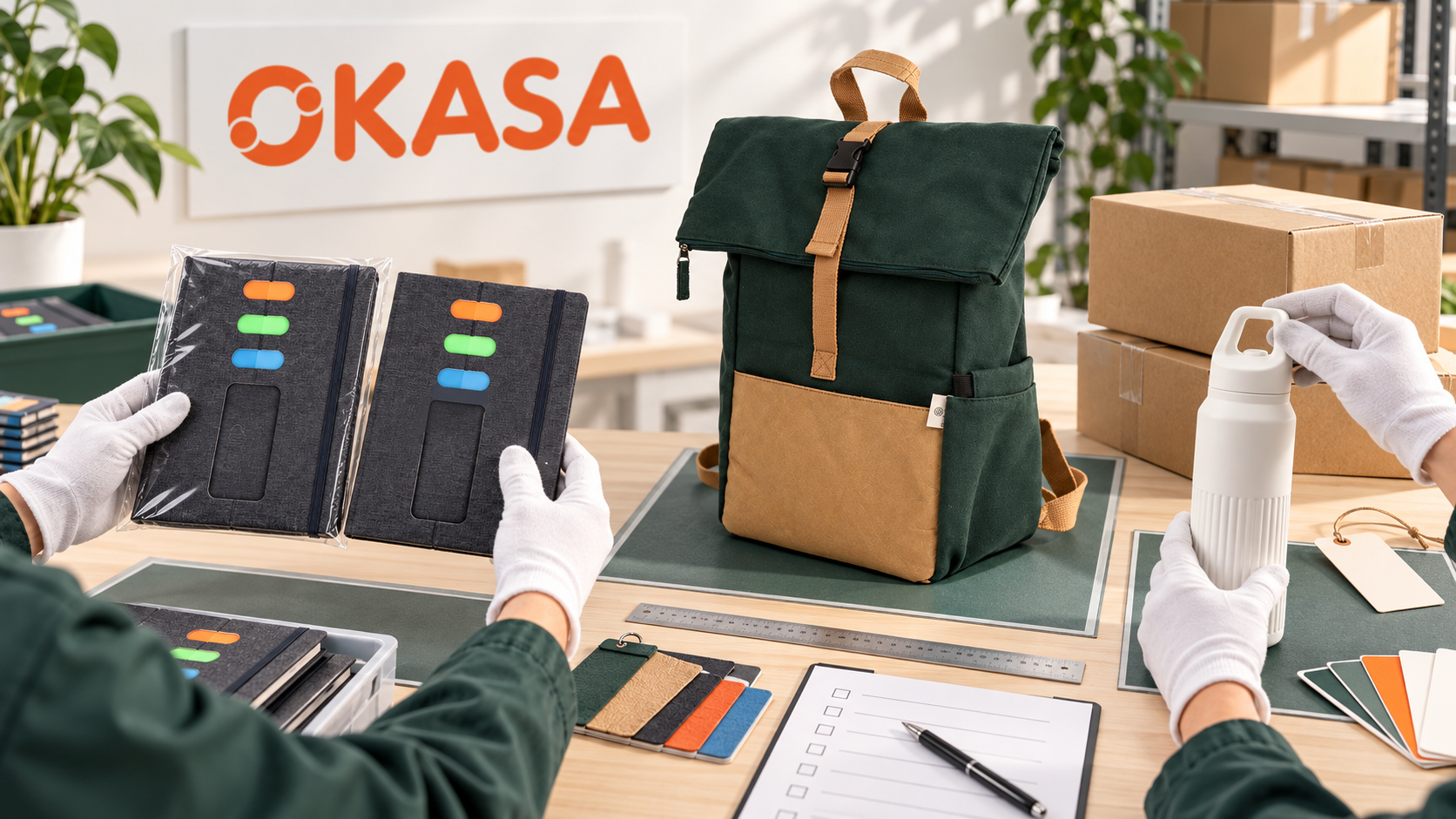
Image 3. Illustrative release inspection and version check. The actual checklist, sampling plan and test methods must be agreed for the ordered products.
Then build a release record you can compare across time: PO, lot/carton IDs, quantity, revision, inspection date, sample size, results, defect details, corrective action, release decision. Photograph recurring visual points from the same angle and lighting when you can. Patterns jump out. One-offs don't.
Last thing, because it matters: the inspection report verifies what you defined, nothing more. "Good quality" isn't measurable. "Logo centered within the approved placement box, legible, matching the signed sample under the agreed comparison method" — that an inspector can check.
8. Hold some, make-to-order the rest
Annual programs whisper a tempting lie: buy everything at once, get the lower unit price.
Sometimes it's true — stable demand, frozen branding, decent storage, economical delivery. Sometimes it locks cash into the wrong campaign, buries the warehouse in bulky boxes, and turns the next artwork update into an expensive regret.
Compare four inventory positions before you decide:
|
Inventory position |
Main advantage |
Main exposure |
Control question |
|
Reserved raw material |
Supports future production without fixing every campaign |
You may own unused material |
Which SKUs consume it, by when? |
|
Undecorated product |
Keeps some branding flexibility |
Later decoration capacity still needed |
Was the base inspected before storage? |
|
Decorated product |
Faster campaign release |
Logo/color update can obsolete stock |
Who approves continued use after a brand change? |
|
Finished gift set |
Ready to dispatch |
Storage volume, pack damage, insert obsolescence |
How often is stock condition/count checked? |
And price the whole position, not the unit. Production, setup, storage, handling, stock checks, repacking, financing, write-off risk, outbound. The lowest factory price at the biggest quantity is not automatically the cheapest program. A scenario comparison beats a blanket "buy more" every time.
Give inventory an owner and an expiry review — even with no formal expiry date. Is the artwork still current? Condition acceptable? Campaign still active? Remaining quantity still matching the latest forecast? For drinkware and other functional items, agree storage conditions and any retest needs with the supplier and quality team up front.
A promotional products manufacturer in China will hold components or finished goods only if that service is explicitly quoted and confirmed. Storage location. Insurance and liability. Stock-report frequency. Access rules. Maximum holding period. Disposition instructions. Don't infer warehousing from the fact that they can make the merchandise — those are two different businesses.
9. Make repeat orders fast without skipping approval
A repeat-order RFQ opens with the program SKU and last approved revision. Previous PO for reference. New quantity. Delivery point and window. And — critical — whether anything changed: artwork, material, color, packaging, compliance. Attach the current master files, not the entire old email thread. Nobody reads that thread. Nobody.
Then ask the supplier to classify the request: true repeat (same product, available inputs), repeat with campaign-only packaging change, or technical change needing a new sample and price. That one classification makes the quote reviewable — and stops a major substitution from hiding under the word "reorder."
The quote itself should split line by line: product, decoration, packaging, sample work, inspection, storage, delivery. Revision, assumed quantity, currency, delivery term, validity, exclusions. Multi-product program? Ask for the critical path and which component governs assembly. If they propose an alternative, it comes back as a priced option with the changed spec visible — never as a quiet swap.
You can absolutely ask a custom corporate gift set manufacturer for a base annual set plus defined campaign variants. Point the custom notebook manufacturer, custom drinkware manufacturer and custom bag manufacturer references in your brief at the intended product pages — those exact keyword links help site navigation too. But the RFQ still carries the full spec, because a catalogue page is not a signed production standard.
Before you release the repeat, five questions, in writing: Product revision current? Approved artwork current? Materials and capacity confirmed? New physical sample needed? Which inspection and delivery records close the order? Fast answers to those five are what make a fast reorder reliable instead of lucky.
A production-ready annual-program RFQ
Steal this brief:
"Please quote an annual promotional merchandise program with planned releases in Q2, Q3 and Q4. The attached file shows low, base and high quantities by program SKU and market. Quote the first firm release separately from later forecast quantities. Identify the material or process that controls lead time for each SKU. Confirm the master sample and revision governing repeat orders, the latest release date for each production window, and any commercial terms for reserving material, capacity or stock. Separate product, decoration, packaging, sampling, inspection, storage and delivery charges. List all assumptions, proposed substitutions and excluded services."
Swap in your real periods. Add destination split, logo files, packaging requirements, delivery term, and the one person who owns forecast updates. Then the supplier can answer with an operating proposal instead of guessing what "annual cooperation" means.
Frequently asked questions
Does an annual forecast guarantee price or production capacity?
No. A forecast says demand is likely. What secures price or factory time is the quote or agreement — a PO, a paid material commitment, or a written reservation with its own terms. Mark firm quantities, record the quotation expiry, decide now how a later quantity or date gets handled.
Should every repeat order get a new sample?
It depends — product, elapsed time, material lots, artwork, process changes, risk. A true repeat can run off the approved master; a new color, logo, component, package or production method may justify another. Set the rule during the annual program, before the next release gets urgent.
How do buyers stop color and logo drift between batches?
Controlled master spec. Approved artwork. A physical reference where it makes sense. A written comparison method. Each revision gets an ID; every later release gets inspected against the current one. Record tolerances — and stop accepting color names as a standard. "Navy" is not a specification.
Better to hold raw materials or finished branded stock?
Whichever matches your forecast confidence, replenishment time, storage cost, decoration capacity, and branding-change risk. Compare full cost and write-off exposure at each stage. Assign ownership, review dates and disposition rules before anything is produced — not after.
What should a buyer send OKASA for an annual-program quotation?
Product references, annual quantity ranges, first firm release, destination markets, artwork, color and decoration requirements, packaging level, sample expectations, inspection needs, preferred delivery windows. Mark every figure firm or forecast. OKASA confirms what's available for your specific project.
Request an annual promotional products program quote
Send your release calendar, program SKUs, forecast ranges and current brand files through OKASA's contact page. Ask for a quotation that shows the master-sample plan, capacity decision dates, repeat-order controls and product-specific inspection records. Assumptions nailed down at the start give both teams something real to build on — for the first release and every reorder after it.