

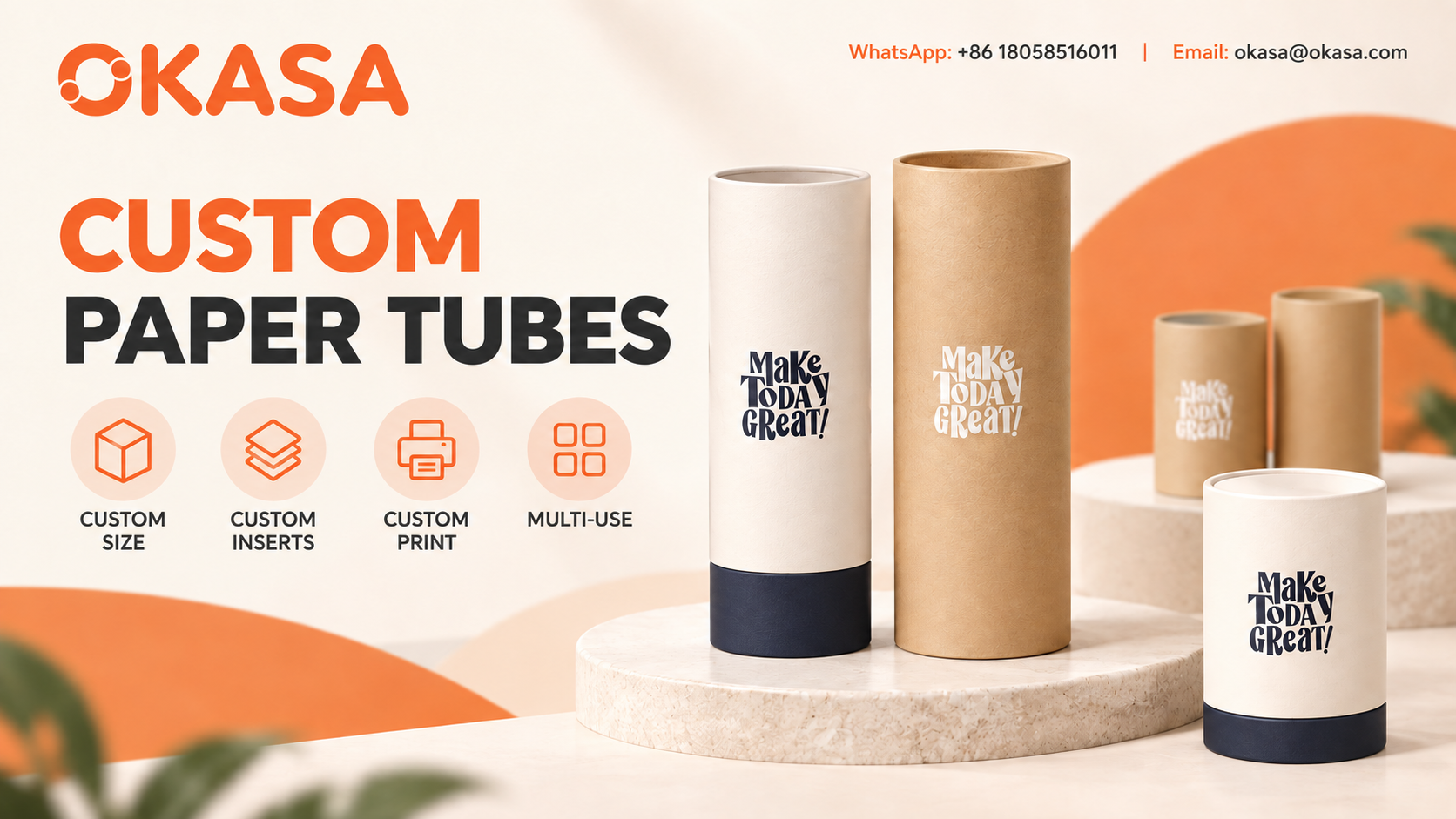
 TC096 and TC097 custom sliding paper tube packaging in kraft white and navy
A cylindrical package can look simple in a catalogue and still be easy to specify incorrectly. That is especially true when the package is not a conventional tube with a loose top lid. OKASA TC096 and TC097 use a pull-out construction: the printed outer cylinder acts as a sleeve, while the inner cylindrical section and its base move in and out of that sleeve. The narrow band visible near the bottom is part of the sliding structure. It is not a separate decorative cap.
That distinction changes almost every buying question. Instead of asking only whether a lid is tight enough, a buyer needs to consider sleeve overlap, extraction force, air resistance, inner-tube alignment and the point at which the recipient can grip the lower section. The insert must work with the moving inner body. Artwork has to stay visually balanced when the pack is closed and when it is partially open. Production inspection must include repeated sliding, not just a quick look at the printed surface.
The format is versatile. The supplied OKASA application guide shows versions used for wine, cosmetics, stationery, cosmetic brushes, candles, combs, tea, umbrellas, kitchenware, fitness accessories, textiles and dried flowers. Its four commercial functions are equally clear: custom size, custom inserts, custom printing and gift-ready presentation. Those claims only become useful, however, when the package is matched to a real product and a repeatable production specification.
This guide is written for promotional-product distributors, sourcing teams, agencies and private-label buyers. It uses a nine-step method to explain how to select between the tall TC096 and shorter TC097 formats, engineer the sliding action, approve the insert and control a bulk order without turning a visual idea into an avoidable packing problem.
First, Understand the Package You Are Buying
TC096 is the taller format shown in kraft and in warm white with a navy inner section. TC097 is the shorter, wider-looking format shown with the same visual options. In both cases, the outer printed sleeve travels over an inner cylindrical body. Pulling the two sections apart reveals the inner container and the product presentation area. Pushing them together returns the package to a clean, continuous silhouette with a visible base band.
This is different from a standard two-piece tube in which a shallow lid lifts off the top. A sliding tube uses more of its length for engagement between the outer and inner components. That overlap helps keep the sections aligned, but it also creates friction across a larger contact area. Paper thickness, roundness, wrap seam, moisture and adhesive control can all change the feel.
The opening action is part of the gift. A sleeve that drops under its own weight feels uncontrolled. One that needs excessive pulling can frustrate recipients or cause them to grip the product incorrectly. The best result is neither “as tight as possible” nor “very loose.” It is a consistent, deliberate slide that suits the product weight and intended user.
For buyers working with a custom corporate gift set manufacturer, the tube may be the complete gift pack or one element within a broader campaign. Either way, its movement and dimensions must be approved with the actual contents inside.
The Nine-Step Sourcing Method
Step 1: Match TC096 or TC097 to the Product Geometry
Start with the product, not the package photograph. Record the maximum width or diameter, total height, weight, hard protrusions and vulnerable finishes. Include every item that will be placed inside the tube: instructions, accessories, tissue, refill, cable, brush guard or promotional card.
TC096 is naturally suited to tall products such as umbrellas, bottles, rolled textiles, stationery collections or fitness accessories. TC097 is a more logical starting point for shorter objects such as candles, coffee cups, cosmetics, brushes, combs, snacks or tea. These are use directions, not automatic approvals. A heavy glass candle and a lightweight paper cup can occupy similar volume while requiring very different inner support.
The supplier’s published TC096 reference is approximately 79 mm in diameter by 225 mm high, while TC097 is approximately 99 mm in diameter by 137 mm high. Confirm whether quoted figures are outside, inside or nominal dimensions for the version being offered. The usable space will be reduced by the wall, inner tube and insert.
Ask for a dimensional drawing before artwork begins. It should identify the outer sleeve, inner body, internal opening, closed height, extended height, engagement length and visible base band. If the supplier proposes a custom diameter or height, confirm which tooling or material minimum changes with it.
|
Product profile |
Better starting format |
Insert priority |
Opening risk to review |
|
Tall, narrow and light |
TC096 |
Bottom centering and top control |
Long sleeve may bind if the tube is out of round |
|
Tall and relatively heavy |
TC096 |
Load-bearing base and shoulder restraint |
Recipient may pull the sleeve while the inner body drops |
|
Short, wide and fragile |
TC097 |
Side cushioning and easy lift-out |
Product may rotate or contact the wall |
|
Short soft goods |
TC097 |
Shape control and tidy reveal |
Contents can expand and increase friction |
|
Multi-item assortment |
Custom evaluation |
Dividers, layers and removal sequence |
Loose parts may interfere with sliding travel |
When the item belongs to another OKASA category, use the same discipline. A custom notebook manufacturer should supply final notebook thickness and accessory dimensions. A custom drinkware manufacturer should confirm the widest lid, handle or loop rather than only the nominal cup diameter.
Step 2: Define the Opening Direction and User Sequence
A pull-out pack needs a planned hand position. Decide which section the recipient is expected to hold and which section moves. In the white-and-navy reference, the contrasting navy base creates an obvious lower grip area. A kraft-on-kraft version is more understated, so the joint line, artwork placement or a small instruction may need to make the action clear.
Write the opening sequence in ordinary language: hold the inner base, lift the printed outer sleeve, reveal the insert, then remove the product. Give the sample to someone who has not seen it. If the person searches for a top lid, twists the package or turns it upside down, the visual cue is not yet strong enough.
The inner product also needs a removal route after the sleeve is raised. A tall item can project enough to be gripped. A short item may sit below the rim and need a ribbon, finger notch, paper pull tab or removable platform. The opening of the package and the removal of the product are two separate actions; both should feel intentional.
For public events or gifts sent without a sales representative, a small printed cue can reduce confusion. Keep it simple. One arrow or a short “pull to open” message is usually more useful than a paragraph. Confirm that the instruction is visible before the recipient has already solved the mechanism.
Step 3: Specify Sliding Fit, Overlap and Tolerances
The most important technical issue is the relationship between the outer sleeve and inner tube. Their diameters must allow smooth movement without visible wobble. Their overlap must be long enough to maintain alignment and short enough to give the desired opening travel. Roundness matters as much as nominal diameter.
Air can affect the movement. A close-fitting cylindrical sleeve may create temporary suction or compression, particularly when the base and insert restrict airflow. The package should not “pop” unpredictably, trap the inner body or push itself apart after closing. A controlled vent path, small clearance change or different insert detail may solve the problem, but it should be tested rather than assumed.
Paperboard is not machined metal. Wall thickness, spiral winding, wrapping pressure, adhesive and humidity introduce variation. A fit that works on one hand sample may not represent a full production lot. Ask how the factory controls diameter and roundness, how samples are conditioned, and which measurements will be taken during production.
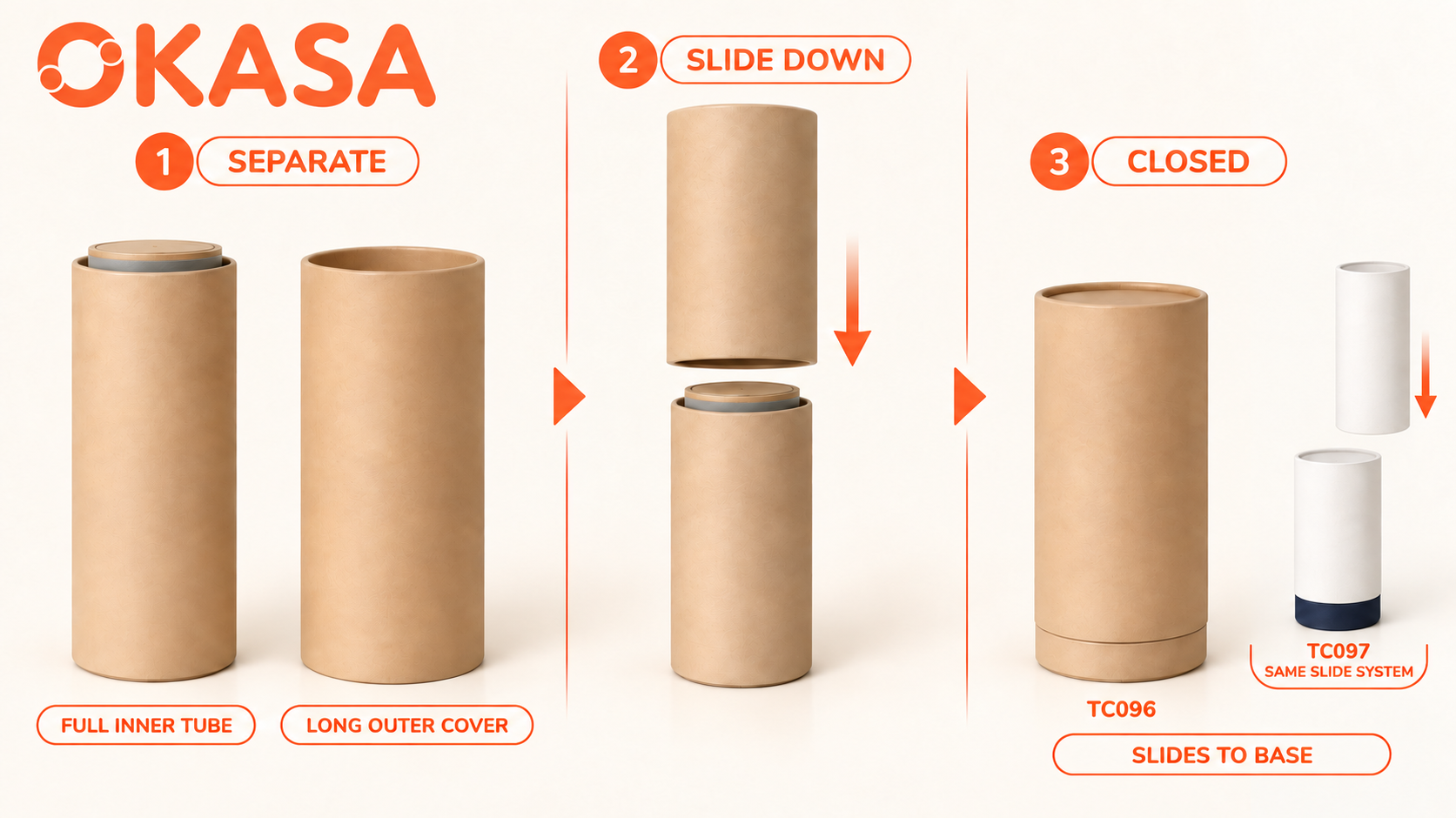
TC096 outer sleeve inner tube and custom insert shown in a sliding structure approval scene
|
Fit characteristic |
What to approve |
Possible failure if ignored |
|
Closed alignment |
Sleeve sits straight with an even base band |
Package looks tilted or seam appears stepped |
|
Pull resistance |
Deliberate but comfortable movement |
Sleeve drops freely or is difficult to remove |
|
Side play |
Minimal visible wobble during opening |
Printed sleeve rocks and scuffs the inner tube |
|
Engagement length |
Stable guidance through the pull |
Components separate suddenly or bind at an angle |
|
Air release |
Smooth movement without a strong pop |
Pack traps pressure or pushes itself open |
|
Cycle consistency |
Similar feel after repeated opening |
Wrap rubs, fibers lift or fit becomes loose |
Step 4: Engineer the Inner Tube, Base and Insert as One System
The inner cylinder carries the product while the outer sleeve provides the main printed presentation. The load path should therefore run through the insert into a base designed for the full packed weight. A heavy item should not depend on a thin decorative disc or on friction against the wall.
For tall products, use bottom centering and, where needed, an upper collar that prevents the product leaning into the sliding surface. The collar must stay below the travel path of the outer sleeve. For short products, a raised platform can position the item near the reveal line. That platform needs enough support beneath it; an unsupported paper ring can collapse during a drop or when the recipient presses down.
The insert opening should follow the actual product shape, not a marketing dimension. Bottle caps, cup handles, umbrella straps and cosmetic pumps often exceed the main body. A fitted insert should locate the item without scratching it or making removal difficult. Request samples from the final product lot when possible, because small dimensional changes can affect a close fit.
Material choice depends on weight, protection, appearance and disposal objectives. Folded paperboard, corrugated structures and molded pulp can support many gifts. Foam may offer controlled cushioning for fragile goods but introduces a mixed-material decision. Avoid calling the total pack recyclable until the complete material combination and local collection route have been reviewed.
A sustainable promotional products manufacturer should be able to describe materials precisely. “Paper-based construction with a removable insert” is a more useful starting point than an unsupported claim that every configuration is fully sustainable.
Step 5: Design Printing for Both Closed and Open Views
The package has two presentations. Closed, it reads as a continuous cylinder with a lower band. Partially open, the outer sleeve, inner body and product appear together. Artwork should make both states look deliberate.
Mark the vertical wrap seam, lower joint, sleeve travel and visible inner section on the artwork template. Keep the main logo away from the seam unless the design intentionally crosses it. Do not place critical text so low that it is interrupted by the base band or appears to move awkwardly during opening.
The reference range uses kraft, warm white and navy effectively. Kraft supports a natural or craft-led direction. Warm white provides a neutral surface for darker graphics. Navy creates contrast on the inner body and makes the sliding action easy to understand. Color appearance will vary by paper base, ink and coating, so approve physical swatches rather than relying on a screen.
Ask which decoration methods are available for the selected wrap. Standard print handles most campaign graphics. Embossing can add a tactile detail. Spot UV creates a gloss contrast. Hot stamping or foil can add a metallic accent. Each method needs artwork suited to the paper texture and tube curvature; fine foil lines or small reversed text may not reproduce cleanly.
|
Artwork area |
Design objective |
Approval check |
|
Outer sleeve front |
Main brand recognition |
Logo size, color and seam position |
|
Visible inner band |
Opening cue or contrast |
Band height remains even when closed |
|
Inner tube |
Secondary message or color field |
Surface does not scuff during repeated sliding |
|
Insert surface |
Product framing and instructions |
Cutout, copy and product orientation align |
|
Bottom information |
Barcode, origin or recycling detail |
Text remains legible on the curved or circular area |
For a multi-category campaign, a custom bag manufacturer or custom gift box manufacturer may use different substrates and print processes. Coordinate the visual system, but approve each material separately. The same orange will not look identical on woven fabric, kraft paper and a white coated wrap.
Step 6: Use the Multi-Purpose Claim Responsibly
The application guide is useful because it shows the range of product shapes the format can support. Tall TC096-style packs can suit wine, umbrellas, stationery, brushes, fitness accessories and rolled garments. Shorter TC097-style packs can suit candles, tea, coffee cups, cosmetics, combs and small gift assortments. Dried flowers and kitchen tools show that the concept can extend beyond traditional corporate gifts.
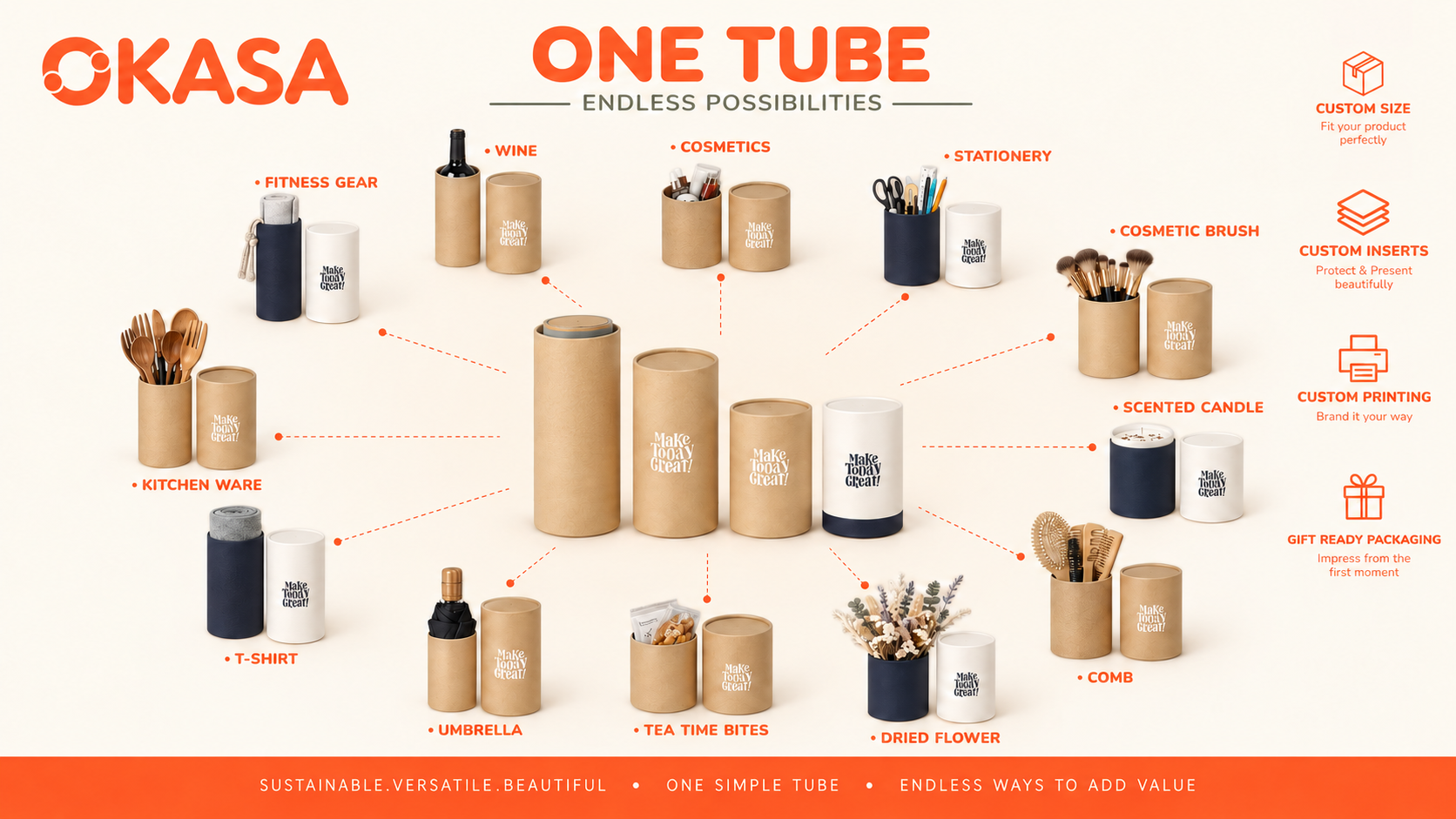
TC096 and TC097 sliding paper tube packaging applications for wine cosmetics stationery candles tea combs and umbrellas
“Multi-purpose” does not mean one stock insert fits everything. The common platform is the cylindrical outer-and-inner structure. Diameter, height, board strength, insert, print and packing method still need to follow the product. A wine pack must manage concentrated weight and glass protection. A cosmetic brush pack needs cleanliness and bristle protection. A tea pack may require an inner sealed product package because the presentation tube alone should not be assumed to provide a food barrier.
This is where the four functions shown in the supplied material work together:
· Custom size adapts the diameter and height to the product rather than leaving excessive empty volume.
· Custom inserts locate, protect and present the contents during opening.
· Custom printing turns the outer sleeve and visible inner band into a coordinated brand surface.
· Gift-ready packaging combines the product, insert, message and opening sequence into a pack that can be handed to the recipient.
Reusability should be treated as a design goal, not a guaranteed user behavior. A clean, durable tube with a smooth sliding action is more likely to be kept for stationery, brushes or small objects. If reuse matters to the campaign, make the secondary function plausible and avoid date-specific graphics that shorten the package’s relevance.
For bulk corporate gifting solutions, the same tube platform can create a family look across several gift tiers. The tall and short sizes can share colors and artwork while using different inserts. That approach is more credible than forcing unrelated products into one universal cavity.
Step 7: Test Samples for Real Handling and Transport
Approve the package as a filled system. An empty sleeve may slide beautifully but behave differently when the inner tube carries a heavy product. Weight can increase tilt during opening, change friction and stress the base. The final insert can also restrict airflow.
Begin with repeated opening and closing. Use several samples and several users. Record whether the sleeve starts smoothly, stays aligned, exposes the product to the intended height and closes without trapped air. Examine both sliding surfaces for dust, rub marks, lifted paper fibers and color transfer.
Then test product removal. The recipient should not need to shake a fragile item out. A ribbon or tab should remain accessible and should not become trapped between the sliding walls. Printed instructions and accessories should stay in position through ordinary handling.
Transit testing should reflect the route. Palletized export shipments need attention to compression, vibration, moisture and carton stacking. Individual courier shipments face more unpredictable drops and orientations. Agree on an appropriate test method with the supplier or a qualified laboratory when product value, fragility or customer requirements justify it.
Inspect the package after each test, not only the product. Confirm that the base stays attached, the inner body remains round, the sleeve still travels smoothly and the visible band is not crushed. A tube can protect the contents yet fail the gift experience if it arrives scuffed or jams on first opening.
Step 8: Calculate the Complete Pack Cost and Timeline
Compare quotations only after the configurations match. A low price for an empty printed sleeve is not comparable with a price that includes the inner tube, fitted insert, packing labor, instruction card and export carton.
Ask suppliers to separate unit price from tooling, sample, printing plate, foil or embossing charges. Confirm the minimum quantity for the chosen diameter, wrap and insert. Record allowed overrun or underrun, payment terms, quotation validity and delivery basis.
Carton cube matters because cylindrical packs create spaces inside rectangular export cartons. Obtain the final master-carton quantity, dimensions and gross weight after the packed sample is approved. Freight estimates based on an empty tube or an early render can be misleading. Do not reduce board strength or internal protection merely to reach a preferred freight figure.
Build the schedule backward from the required-in-hand date. Allow time for structural drawing, blank sample, decorated sample, insert correction, packed sample, production, inspection and international transport. If TC096 and TC097 are used in the same campaign, the order should not release until both versions and their artwork allocations are clear.
|
Milestone |
Supplier evidence |
Buyer decision |
Main delay risk |
|
Structure proposal |
Drawing of sleeve, inner tube and overlap |
Select TC096, TC097 or custom size |
Artwork begins on the wrong geometry |
|
Blank sample |
Production-relevant sliding sample |
Approve fit, grip and opening travel |
Diameter or airflow needs revision |
|
Insert sample |
Actual contents packed inside |
Approve protection and removal |
Product sample changes late |
|
Decorated sample |
Printed complete package |
Approve color, seam and open/closed views |
Finish or copy requires new proof |
|
Pre-production sample |
Final pack and carton data |
Release mass production |
Freight booking remains uncertain |
|
Final inspection |
Measurements, function tests and photos |
Ship, rework or hold |
Criteria were not agreed in advance |
Buyers considering promotional products sourcing China should ask for milestone dates rather than one vague lead-time number. The factory controls manufacturing. The buyer also controls artwork response, sample approval and last-minute changes. Both sides need visible responsibilities.
Step 9: Inspect the Bulk Order as a Sliding Package
Final inspection should use the signed specification and approved samples. Begin with model, quantity, size, color, artwork revision, insert and pack contents. Confirm that TC096 and TC097 allocations have not been mixed and that export carton marks match the shipping plan.
Measure the outside and relevant inside dimensions on a defined sample. Check closed height, visible band height and alignment. Rotate each package to examine the wrap seam, rim, base, print, surface contamination, glue marks and roundness.
Function testing must include the slide. Open and close sampled packs several times with the approved contents installed. Look for sticking, sudden release, sleeve drop, excessive wobble, trapped air and abrasion. The inner body should stay secure in the user’s hand, and the insert should not lift or rotate with the outer sleeve.
Inspect the product after opening. Check for marks caused by the insert, wall or loose accessory. Confirm that printed matter, ribbon and instructions are present and correctly positioned. Repack the item to make sure the closing process works without crushing the contents.
Define critical, major and minor defects before inspection. A detached load-bearing base, wrong product, unusable sliding action or missing safety information is not equivalent to a small cosmetic mark in a low-visibility area. An agreed classification makes the acceptance decision more consistent.
An experienced OEM promotional products manufacturer should help convert a visual reference into measurable checkpoints. The same is true when selecting a custom branded merchandise manufacturer or promotional products manufacturer China partner. Price matters, but the quotation must describe the same structure the buyer expects to receive.
Common Questions About TC096 and TC097
Are TC096 and TC097 ordinary paper tubes with a top lid?
No. The reference products use a sliding outer sleeve and inner cylindrical body. The visible lower band is connected to that pull-out structure. Samples should be reviewed by opening the sleeve vertically rather than searching for a shallow detachable top cap.
Which model is better for corporate gifts?
TC096 is a logical starting point for taller products, while TC097 suits shorter and wider product groups. The correct choice depends on maximum product dimensions, weight, insert, opening experience and carton efficiency.
How tight should the sliding action be?
It should feel controlled without requiring excessive force. Approve several filled samples and define either a test method or a physical reference range. Check the feel again after repeated cycles and realistic conditioning.
Can the package be customized for different products?
Yes. Size, insert and printing can be adapted, which is the main value shown in the application guide. Each product still needs its own fit and protection review; multi-purpose does not mean one insert is universal.
Can the tube be described as sustainable?
Describe the verified materials and design choices rather than using an absolute claim. Paper-based components and reuse potential may support the sustainability story, but coatings, adhesives, foils and insert materials affect the complete package.
What should be included in an RFQ?
Send product dimensions and weight, representative samples, quantity, destination, required date, preferred model, artwork, color references, insert requirements, distribution route, sample stages, inspection expectations and delivery terms.
The Sliding Mechanism Is the Product Experience
TC096 and TC097 are not simply round boxes in two heights. Their identity comes from the interaction between the outer sleeve and inner cylindrical body. When the fit is right, the package opens with a controlled reveal and closes into a clean branded form. When the fit is wrong, even excellent artwork cannot hide the wobble, sticking or confusing hand position.
The buying process should therefore begin with product geometry and user sequence, then move through sliding tolerances, inner support, artwork, testing, freight and inspection. Custom size, custom inserts and custom printing are not separate catalogue options. They are connected decisions that create the gift-ready result.
Use TC096 for tall applications and TC097 for shorter applications only as a starting rule. Test the actual item. Approve the filled sliding sample. Record the open and closed appearance. Inspect the bulk order with the same product, insert and movement criteria. That is how a versatile packaging idea becomes a repeatable corporate-gift program.
Ready to Develop Custom Sliding Paper Tube Packaging
Share your product dimensions, quantity, destination, deadline, artwork and sliding-fit requirements with OKASA.