

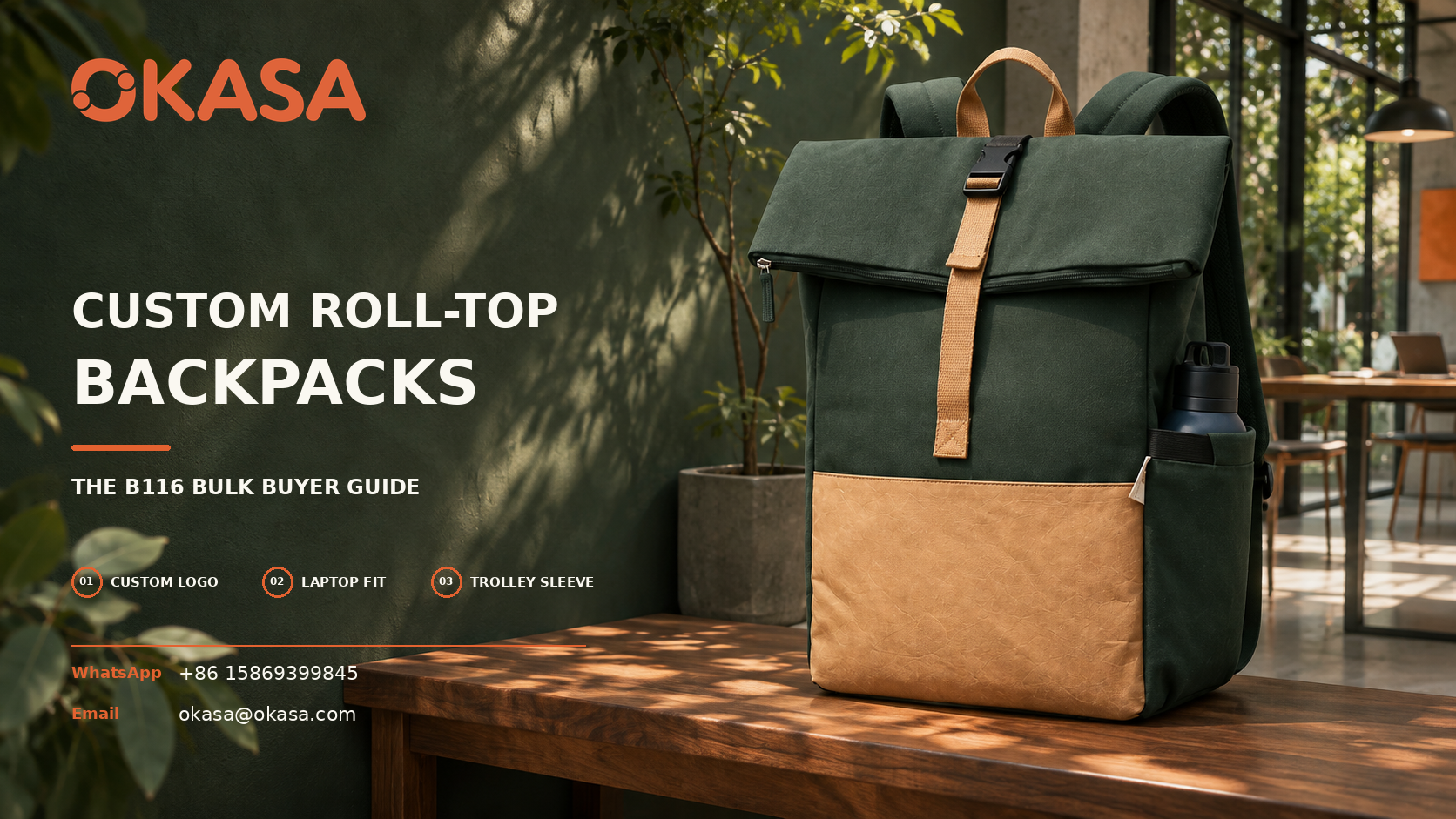
A roll top backpack photographs beautifully. Standing open on a studio table, it looks like it'll swallow a week's luggage. Then somebody puts a laptop in, folds the top down three times, clips the buckle, jams a bottle in the side pocket — and the bag from the PDF is gone.
It's rarely a supplier lying about the outside dimensions. What happens is duller: nobody wrote down which state of the bag those numbers describe. Open? Folded once? Folded until the strap actually reaches? Buyer and factory walk away with two different pictures, both reasonable, and six weeks later the sample is on a desk and everybody's annoyed.
A custom roll top backpack manufacturer should be able to hand you a packed sample and a dimensioned drawing. If the answer is a product link and a nice photo, you're not buying a specification yet. This guide walks one bag through a fairly ordinary work trip and stops at each place where things tend to go sideways. It's for distributors, procurement teams and brand managers putting together a travel gift — not for anyone shopping on shape alone.
The bag is OKASA's B116 recycled cotton roll top backpack. The published description lists 26 × 14 × 56 cm, 16oz recycled cotton canvas, 68-wire washed kraft paper, 210D lining, sandwich foam padding, pearl cotton, a #5 nylon zipper, cotton-poly webbing, plastic buckles, a front pocket, a rear trolley sleeve and a laptop compartment. Useful, as far as it goes. It does not tell you the useful height once the top is closed, what laptop actually fits, a tested load, water resistance, or the recycled percentage of the finished bag. Those aren't small omissions; they're the exact things a recipient notices. Get them onto the quotation and the physical sample. Source: OKASA B116 product page.
Start at the departure gate
Picture a made-up brief, because that's all it is: a welcome kit for staff who travel to regional meetings. Short train commute, then a longer leg with the bag over a suitcase handle. Inside goes a laptop in a sleeve, a notebook, a charging cable, a light jacket and a bottle — the sort of load that looks tidy on a packing list and considerably less tidy at 8 a.m. The recipient opens it in a crowded carriage and at some point sets it down on a wet platform. Hypothetical. No real OKASA customer, no tested B116 load, just a planning exercise.
Write that paragraph into the RFQ before anybody starts talking about color. It ranks the arguments. If this is a daily commuter bag, how easily the laptop goes in and comes out beats every theoretical litre of volume. Event handout? The front logo and a flat carton suddenly matter more. Travel program, and you'll be testing the trolley sleeve and the closure with your own hands. One backpack can technically do all three jobs. You just can't use the same empty-bag photograph as evidence for each.
The roll top is where people fool themselves. Visible height changes with every fold, and the center strap only has so much adjustment. Push a jacket above the fold line and the top will still close — badly, with the front panel pulled into a shape nobody approved. Worse is the ticket problem: if reaching a train ticket means unclipping and unfolding three layers every time, that external pocket stops being a nice-to-have. I'd pick the bag that behaves boringly on a Tuesday over the one that looks biggest in a catalog.
The measurement that turns into a complaint
56 cm. Fifty-six what, exactly? Open body, fully extended roll top, standard closed fold, or something measured on a flat panel before it's sewn? Get a drawing that labels the condition. Record width and depth at the points that matter too, because a soft bag isn't a rigid box and pretending otherwise is how you end up arguing about a litre figure nobody can reproduce. Settle the measuring method first. Ask for volume second.
Here's the test I'd run. Pack the agreed contents — laptop, notebook, cable, jacket, bottle — and measure three states: empty and open, filled and closed the way a person would actually close it, and filled right up to the last point where the buckle still engages without a fight. Front and side photos in each state, ruler in frame. Then have the supplier mark a maximum safe fill line on the approved sample or the drawing. You'll probably find that the tall, photogenic extended top isn't everyday carrying space at all. Fine. It just needs writing down.
And please don't multiply 26 × 14 × 56 cm and call it capacity. That arithmetic treats a soft shaped roll top as a carton, counts height that gets eaten by folding, and ignores the padded sleeve plus whatever dividers are in there. For a B2B comparison, pack the same real contents into two candidate bags and look. If a formal volume number is genuinely required — a retail listing, say — agree on a repeatable method and print the method next to the figure. A bare number is a hostage.
One more measurement, and it's the one everybody skips: depth with a bottle in the side pocket and a laptop inside, at the same time. The slim side view in the product photo is a lie of omission. Under a train seat, against your hip, in a shipping carton — that's where it shows up. Small stuff. Small stuff decides whether a promotional backpack gets used or quietly retired to a cupboard.
Put a real laptop through the opening
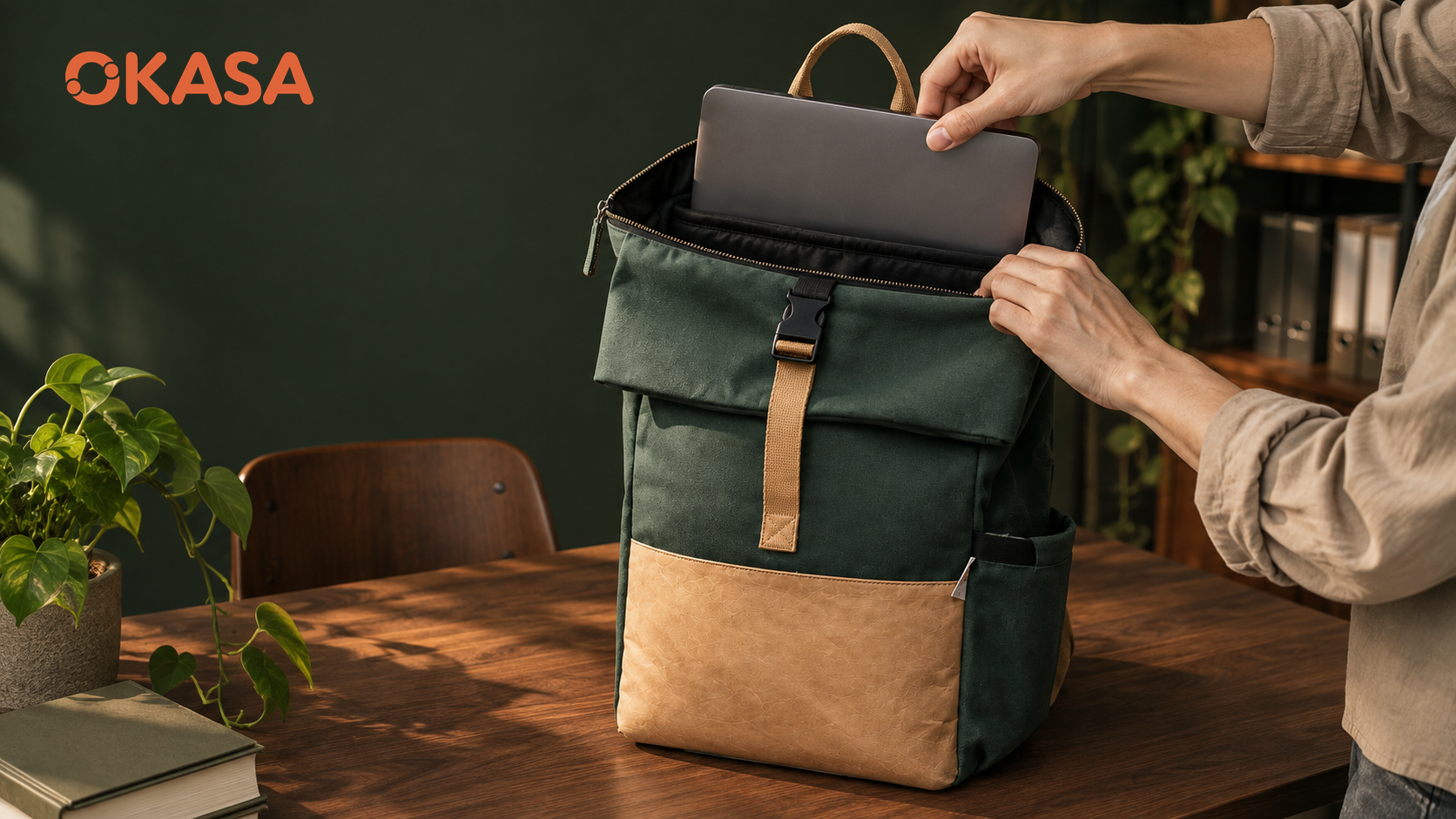
The B116 listing says it has a dedicated laptop compartment, but it does not publish a supported device size. A “15-inch laptop” is not a reliable dimensional standard; screen diagonal says little about the device’s actual width, thickness or protective case. Ask for the compartment’s usable width, height and depth, the entry opening, and the height of padding above the bottom. Check those figures on a sewn sample because seams, lining and foam change the space left after assembly.
Test at least two devices that represent the target users. One should be the ordinary office machine. The other should be the thicker machine or case likely to reveal the limit. Put it in the bag with the charging brick and notebook already loaded. Can the device slide in without catching at the roll-top seam? Can it be removed while standing? Does the closure fold naturally without pressing on the laptop’s top edge? An empty sleeve can appear generous until the rest of the load pulls the back panel inward.
Padding needs precise language too. “Foam padding” tells a buyer that material is present; it does not prove a drop rating. Look for coverage around the corners and bottom, and ask whether the laptop base is suspended above the outer bag base. Put the closed sample on a table with the laptop inside, without slamming it, and check how firmly the device meets that bottom. If the project requires impact protection, define a test and acceptance criterion separately rather than using “padded” as a guarantee.
The laptop sleeve should not steal the whole interior. With the device inside, add the other agreed items and use the front pocket. A charger, power bank and keys may cause pressure points against the laptop if the compartments are not separated thoughtfully. Ask the sample maker to show the pocket layout in a short video, then verify it yourself. The video saves unnecessary sample rounds; it does not replace a physical fit test.
Watch the closure during a normal week
A roll top is a sequence of movements, not only a silhouette. Open the sample, retrieve a cable, close it, carry it, and repeat. The product description lists a #5 nylon zipper and plastic buckle, while the photograph shows a folded top and center webbing. Confirm the exact opening and zipper path on the selected B116 version. Do not assume a zipper line is continuous or sealed simply because the catalog names a zipper.
Ask where the zipper ends, whether the puller can be gripped with one hand, and how many folds are needed for the intended profile. Check the center buckle when the bag is half full and near the upper usable fill line. It should engage without twisting the webbing or dragging the front panel out of shape. If the strap adjustment leaves a long loose tail, request a keeper or an agreed finish. This is both a visual and use issue, especially when the bag is worn on transit.
Run a plain-language closure test with someone who has not seen the product. Hand them the packed sample and ask them to open it, find the laptop, close it and place it on a table. Notice where they hesitate. If the process needs an explanation, the event kit may need a short insert or a different bag configuration. The objective is not to make the operator perform a laboratory cycle test in a corridor; it is to find friction before a thousand recipients encounter it.
Water claims deserve restraint. The materials may withstand an incidental splash differently from the zipper, stitching or folded opening. The published description does not establish that this bag is waterproof. If the marketing brief requests water resistance, specify the exposure, orientation, duration and acceptable internal result, then test the finished sample. Avoid printing “waterproof” on a hangtag because a fabric swatch shed a few drops. The most vulnerable path may be a seam or an opening rather than the canvas itself.
A suitcase handle changes the load path
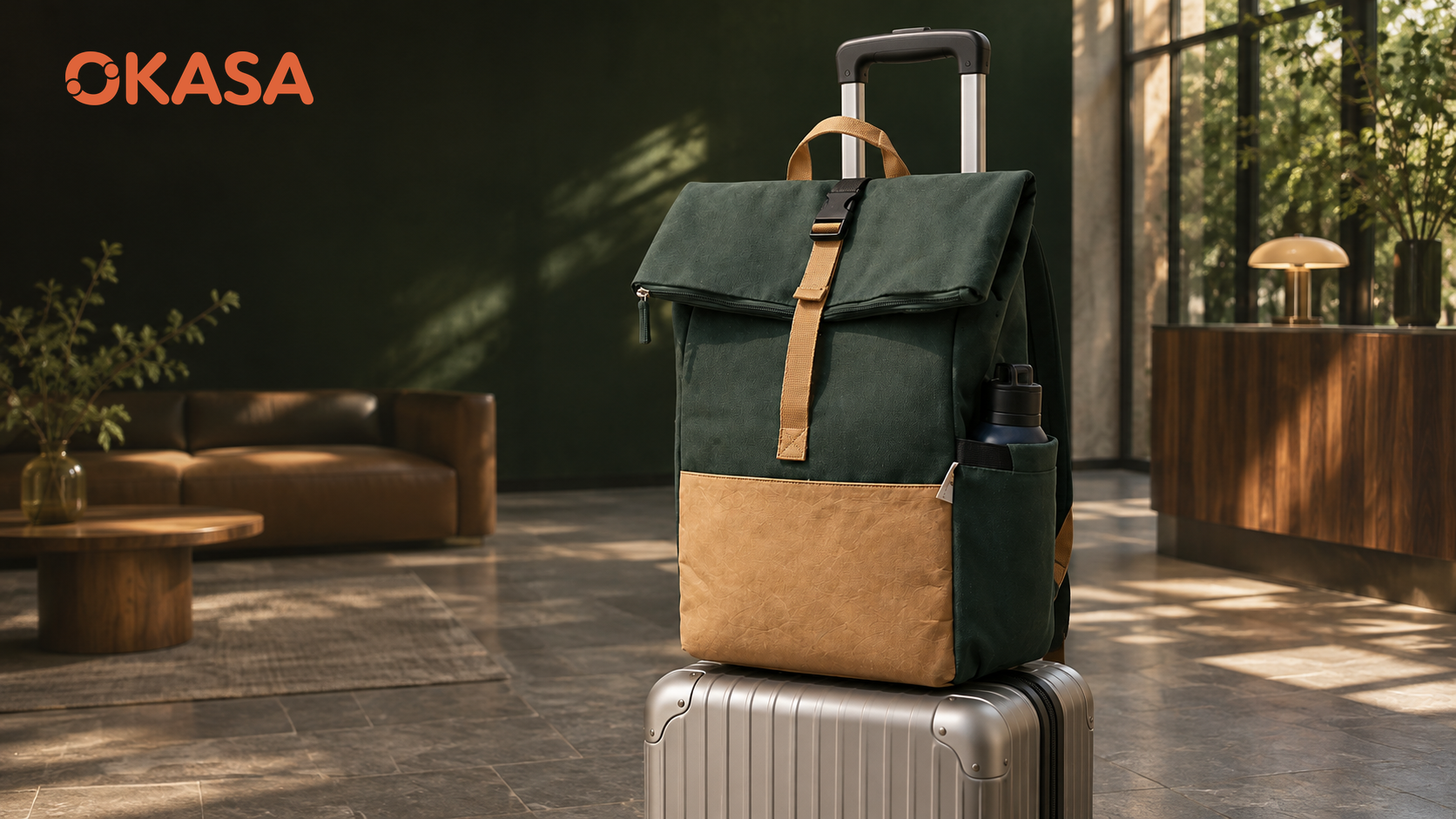
The trolley sleeve is a useful travel feature only when it fits the suitcase handles the recipients will actually use. Ask for its finished clear width, height, entry position and whether it has a lower stop or is an open band. Test it on at least two common carry-on handles, including one with a wider grip. Slide the backpack on when it is packed to the planned work-trip load. Pull the suitcase, turn a corner and lift it over a small threshold. Observe whether the backpack rocks, slides down or blocks access to the suitcase handle.
The load path changes in this mode. On the body, shoulder straps support the bag. On luggage, the sleeve and its seams resist movement while the suitcase rolls. An attractive rear strap is not the same thing as a stable trolley attachment. Photograph the approved fit from the side and rear. If the buyer has a standard corporate suitcase, send its handle dimensions or a physical example during development. That simple input can prevent a sleeve from being a decorative feature that works with only one sample case.
Also inspect the shoulder straps when the bag is on the suitcase. Do they hang into the wheels or brush the floor? Can they be tucked away, or will they need a simple keeper? The published B116 information gives two widths of cotton-poly webbing, 2.5 cm and 3.8 cm, without a full map of their locations. Record exactly which width is used at each point on the sample. The distinction matters in comfort, reinforcement and repeat orders.
When the bag is worn, test adjustability on people with different builds and coats. A broad strap can feel comfortable on one shoulder and dig into another if its foam or attachment angle changes. The sample should be packed, not empty. Note the strap length at two settings and whether the buckle creeps under the agreed load. There is no universal comfortable kilogram figure for a promotional backpack; there is a target load, a wear trial and a documented limit or warning if the program needs one.
Two surfaces need two decoration decisions
B116 has a visual contrast between dark canvas and a light washed kraft paper panel. That contrast is attractive precisely because the materials behave differently. A print method that looks crisp on smooth paper may sink into cotton weave or bridge over texture. A stitched patch can work well on canvas but may alter the hand feel or damage a more delicate panel. Put the actual mark on the actual production material before fixing the artwork in the catalog.
Start with what must remain legible after normal handling. Is the logo on the canvas front, the paper panel, a woven label, or the packaging? The answer changes size, color, placement and method. Ask OKASA to show a decorated sample with the approved orange and a second neutral option if contrast is uncertain. View it from a few meters away and close enough to see the edge. A logo that fills every available centimeter can look loud on a commuter bag; a small mark may disappear against textured green cloth. There is no universal placement rule, only a recipient context and a sample.
Keep logos away from high-stress seams, folds, zipper travel and the portion of the paper panel most likely to rub against a seat or floor. If the washed paper is to be printed, ask about adhesion, crease appearance, abrasion and acceptable natural variation after repeated bending. If embroidery is proposed on canvas, check the inside backing and whether it changes pocket use. For a long-term retail or corporate uniform program, record color tolerances and the approved material swatch, not only a Pantone number on screen.
The recycled-cotton story needs the same precision as the logo. The product page calls the canvas recycled cotton and lists other components, but that alone does not substantiate a claim that the entire backpack is “100% recycled,” “plastic free” or certified under a particular standard. Ask which component is recycled, its composition and percentage, and what evidence is available for the ordered material and production chain. Textile Exchange explains the distinction between a scope certificate and a transaction certificate; the latter relates to specified certified goods. Apply a certification logo or percentage claim only after the exact order, evidence and intended use have been checked. Textile Exchange chain-of-custody explanation and FTC Green Guides summary offer useful claim-control references.
Washed kraft paper is a material name, not a promise that the bag can be washed in a machine. Agree on the care statement after testing the finished mixed-material product. A care label that treats canvas, paper panel, lining, foam, webbing and decoration as if they were one fiber can mislead recipients and create avoidable complaints.
The sample review table procurement can actually use
The table below is a working acceptance plan. Values in the middle column are requests to put on the drawing or sample sheet, not specifications that OKASA has already guaranteed. A competent quotation can mark unavailable features as alternatives instead of silently treating every request as included.
|
Area |
Ask OKASA to document |
Test on physical sample |
Decision recorded |
|
Size and fill |
Open, standard-closed and packed dimensions; fill line |
Pack the agreed work-trip contents and close normally |
Approved usable load and profile |
|
Laptop compartment |
Finished opening and sleeve dimensions; foam placement |
Insert two representative devices with other contents inside |
Maximum approved device dimensions |
|
Roll-top closure |
Zipper path, fold count, buckle and strap adjustment |
Open and close repeatedly at two fill levels |
Approved closure sequence and appearance |
|
Trolley sleeve |
Clear width, height and seam construction |
Roll two suitcase types with the packed bag attached |
Approved handle fit and stability |
|
Materials |
Canvas composition, paper-panel specification, lining and webbing map |
Compare swatches and completed bag with the drawing |
Approved component references |
|
Branding |
Logo location, method, color, size and tolerance |
Inspect decorated bag under normal light and abrasion |
Signed artwork and decorated sample |
|
Packing |
Individual protection, carton quantity, labels and packed dimensions |
Check rub points and a representative shipment pack |
Approved packout and carton mark |
Do not turn this into an endless checklist of generic failures. Agree on the handful of issues that would cause the buyer to reject the bag and write how they will be judged. A wrinkled paper panel may be natural character within a defined range; a misaligned strap or a laptop sleeve too narrow for the agreed device is a different problem. Put photos of acceptable and unacceptable appearances alongside measurements. The supplier can then inspect against something concrete.
Build a quote that reveals what changed
Consider a hypothetical program of 1,800 backpacks in two colors for a staff travel launch. The number is an illustrative planning figure, not a published B116 MOQ or OKASA price. A useful RFQ asks for one-color and two-color options, each against the same bag specification, logo size, packing method and destination. If the team wants a woven label and a printed paper panel, ask for those decoration options as separate lines. Separate the cost of a decorated sample, any material change, individual protection, custom hangtag and freight basis.
The color split matters. A total order of 1,800 pieces is not necessarily the same production proposition as 1,800 in one color. Fabric dye lots, paper panels, webbing color, labels, setup and sorting can each be affected. Ask what minimum applies per color and per decoration, whether a mixed-color carton is possible, and whether a late change to the split resets the approval schedule. Avoid quoting “MOQ 1,000” as a universal property of B116 unless OKASA confirms it for the specified version.
Timelines should be calculated backward from the receipt date, not the day an inquiry is sent. Put space in the plan for swatches, decorated sample, laptop and suitcase testing, revision, production approval, in-process checks, packing and transport. The fastest first sample is not necessarily the fastest finished delivery if it leaves the key details unresolved. Ask for an approval calendar and a latest artwork lock date, then state what happens if materials or a component change after sign-off.
An OEM promotional products manufacturer can coordinate these decisions, but the quotation still needs a defined bill of materials and exceptions list. In promotional products sourcing China, two suppliers can quote the same exterior photo against different lining, foam, webbing or packing assumptions. Request a side-by-side specification response. The phrase promotional products manufacturer China is a search starting point; a buyer should select from the details of the sample and the supplier’s ability to control them.
When the backpack becomes a kit
The bag may be the gift itself, or it may carry other products. If it will contain stationery, ask a custom notebook manufacturer for the finished notebook thickness and corner protection. If the kit includes a bottle, a custom drinkware manufacturer should provide the exact filled size and closure details; test that vessel in the side pocket without assuming every 500 ml bottle has the same diameter or lid shape. Leave enough separation to keep condensation or a leak away from paper and electronics.
For a higher-value presentation, a custom corporate gift set manufacturer may coordinate the bag and contents. A custom gift box manufacturer needs the backpack’s folded packing dimensions, not the tall open dimension from the product page. Many bulk corporate gifting solutions are distributed through several offices, so carton labels and allocation by location can matter as much as the front logo.
The commercial brief can stay simple. A custom bag manufacturer should own the bag specification; a sustainable promotional products manufacturer should substantiate each material statement. If the campaign uses OEM corporate gift sets or private label gift sets, decide who inserts each item, who checks the finished pack and who pays for a carton opened to correct a late list. Those are assembly responsibilities, not marketing adjectives.
Compare two packout routes with an actual sample. A backpack shipped flat in a protective sleeve may save space but arrive creased. A filled backpack can present better but occupy more carton volume and add handling. Neither is automatically superior. Ask for the packed dimensions, gross weight, photos after a representative transport trial and any recovery time before the gift is presented. Do not approve the unboxing from an empty studio image.
A reply worth requesting
The first inquiry should give OKASA enough to make choices visible: B116 product link, target quantity and color split, recipient use, representative laptop dimensions, required contents, logo artwork, shipping destination, required receipt date, and whether bags are shipped alone or packed as kits. State which point is still open. A supplier can then suggest a sample route instead of guessing what “premium travel backpack” means.
Ask for a base quote and a changed option, both tied to a dated specification. For example, base may use the listed materials, one color and a single logo method. The changed option may add a second color, custom label and individual gift presentation. Request separate prices and timelines for both, plus a list of exceptions. If a feature such as a more protective laptop sleeve, wider trolley band or different closure requires redesign, it should be shown as an engineering change with a new sample, not hidden inside the original price.
Approval should leave a small record that can survive staff turnover: the physical sample, material swatches, measurement drawing, artwork proof, packing sample, accepted photos and quotation revision. A buyer who can send these back six months later can request a reorder without starting from a screenshot. Even if the factory says “same as last time,” confirm the canvas, paper panel, foam, buckle and zipper against that record; subtle substitutions can change the experience without changing the silhouette.
Questions that arrive late but matter early
Is B116 waterproof? The published description does not make a finished-bag waterproof claim. If rain exposure matters, specify and test the constructed bag, including seams, opening and zipper, under an agreed condition. Use marketing language that matches that evidence.
Will it fit a 15-inch laptop? Screen size is insufficient. Send the device’s width, height and thickness, including its case, and approve a sewn sample with the rest of the normal load inside. Ask for the usable compartment dimensions on the quotation.
Can the front paper panel take a logo? It may be a branding surface, but the method and durability need a decorated sample on the proposed material. Approve contrast, location, crease and abrasion appearance before bulk production.
Can the same bag work as a suitcase accessory? The listed trolley sleeve is a feature to test. Its clear width and stability with a loaded bag should be confirmed on representative suitcase handles. Do not infer universal fit.
Is the whole backpack made from recycled material? The listed canvas is recycled cotton; other components are specified separately. Ask for composition and evidence tied to the ordered version before stating a whole-product recycled percentage or using a certification mark.
How many can we order, and how long will it take? A catalog listing is not a live production quotation. Quantity, color split, logo process, packout, sample revision and capacity affect the answer. Send the specific brief and request a dated MOQ and lead-time response.
The point of this exercise is not to make a backpack complicated. It is to decide what the recipient will notice when the train is boarding, the laptop is needed and the suitcase handle is already extended. If those moments work on the approved sample, the visual promise of a roll top has a much better chance of surviving the bulk order.
Product and claim references
· OKASA B116 product description — published materials, components and features; confirm final configuration on sample and quotation.
· Textile Exchange chain of custody FAQ — distinction between company qualification and transaction evidence for certified goods.
· FTC Environmental Claims summary — claim wording and substantiation guidance for U.S. marketing.