

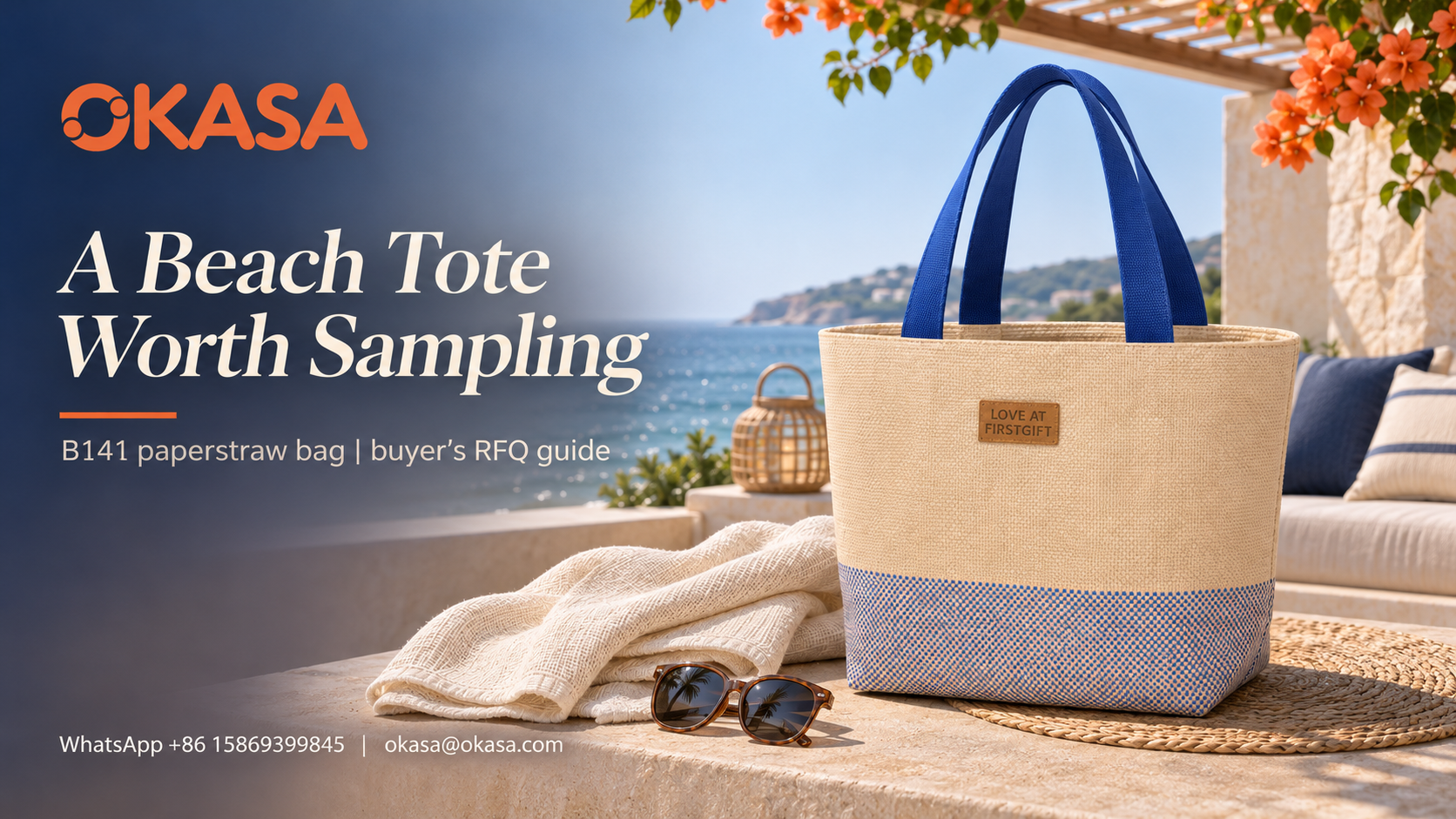
The photograph arrived with a short message: “Can we put our resort logo on this and have it ready for opening season?” There was no quantity, no list of what guests would carry, and no indication of whether “ready” meant at a warehouse, at the resort, or inside a guest room. A beach tote looks simple in a photograph. A bulk order has to survive a fuller conversation.
The bag in the photograph is OKASA B141, a paperstraw beach bag. Its broad opening, blue woven lower section and restrained kraft paper label make it a credible candidate for a resort welcome gift, summer retail collection or event package. The published specification is unusually useful for starting that conversation: it identifies the outer construction, lining, pocket, handle material and dimensions. It does not publish a load rating, water-resistance claim, minimum order quantity or production lead time. Those belong in a sample review and a written quote, not in an attractive guess.
What follows is a practical version of that conversation. The fictional email chain changes direction as the buyer discovers what a photograph cannot settle. The point is to let a procurement team send an inquiry that a supplier can price accurately, then compare a sample against the same brief.
Monday, 4:18 p.m. — the buyer's first email
We like the blue beach bag. We want 2,400 pieces for our coastal properties. Can you add our logo and quote the best price? Our opening is in June.
That email has a useful starting quantity. Nearly everything else is open. Are the 2,400 pieces one identical version or split among properties? Does “June” mean goods must leave China, reach a domestic distribution center, or be in rooms before guests arrive? Is the tote a stand-alone gift or a container for a towel, bottle and welcome card? A price for one interpretation can be misleading when the buyer has another in mind.
The B141 specification names a debossed kraft paper logo label. It does not promise every color, location or alternate decoration technique. A resort expecting a multicolor print across the woven face should say so before treating the photograph as a ready-made base.
The buyer can mark the 2,400-unit property split as provisional. The supplier can then explain what changes if each property needs its own logo or insert. The version count affects artwork, sampling, packing and perhaps the commercial minimum.
The product card pinned beside the inbox
Before replying, the merchandiser opens the B141 product specification and writes down the facts that can actually be checked. “Paperstraw tote” is too broad a purchasing description. The construction is a layered product with textile components, and its wide top is materially different from its bottom width.
|
Published B141 detail |
What the buyer can check on a sample |
|
Bottom width 30 cm × depth 12 cm × height 30 cm; top width 42 cm |
Measure the opening and base separately; put the intended towel or gift bundle through the opening. |
|
300 gsm paperstraw outer laminated with 30 gsm nonwoven backing |
Inspect the woven face, backing and edges; ask for the material statement used in the final specification. |
|
Peachskin fabric lining and one interior slip pocket |
Check lining attachment, pocket position and access with a filled bag. |
|
3 cm wide polyester-cotton webbing handles |
Check grip, handle placement, stitching and comfort with the actual proposed load. |
|
Blue mixed weaving on front and back, about 10 cm from the base |
Compare the front and back color placement against the approved sample. |
|
Debossed kraft paper logo label |
Review legibility, scale, label placement and finish with the actual resort artwork. |
Dimensions indicate whether the opening is promising, not carrying capacity or behavior with damp items. The published 42 cm top width does not mean every bulky 42 cm object will fit. Depth, lining and shape matter. Use a physical sample with the intended contents.
The blue section is woven into the lower front and back, rather than described as a removable print. That distinction matters for color review. A digital proof can show placement, but a material sample is better for judging how the mixed yarn reads in daylight and under resort lighting. The textured outer face and soft lining can also look different from a screen rendering. For a property with an exact brand blue, ask whether the pictured blue is accepted as-is or whether a color change is feasible, with its own quote and sample.
Tuesday — “What will guests actually put in it?”
A folded pool towel, a welcome card, sunscreen and their own phone and keys. We may add a bottle. We want guests to carry the bag from their room to the beach.
Now the bag has a job. A sample can be packed with the specific towel size, a real card sleeve and the proposed sunscreen container. The pocket can be tested with a phone or key card of the dimensions guests commonly use. A bottle changes the load and distribution of weight; if it is part of the gift, specify its filled or empty state during sampling. No responsible quote should translate that list into a certified load limit unless the supplier has an agreed test and result.
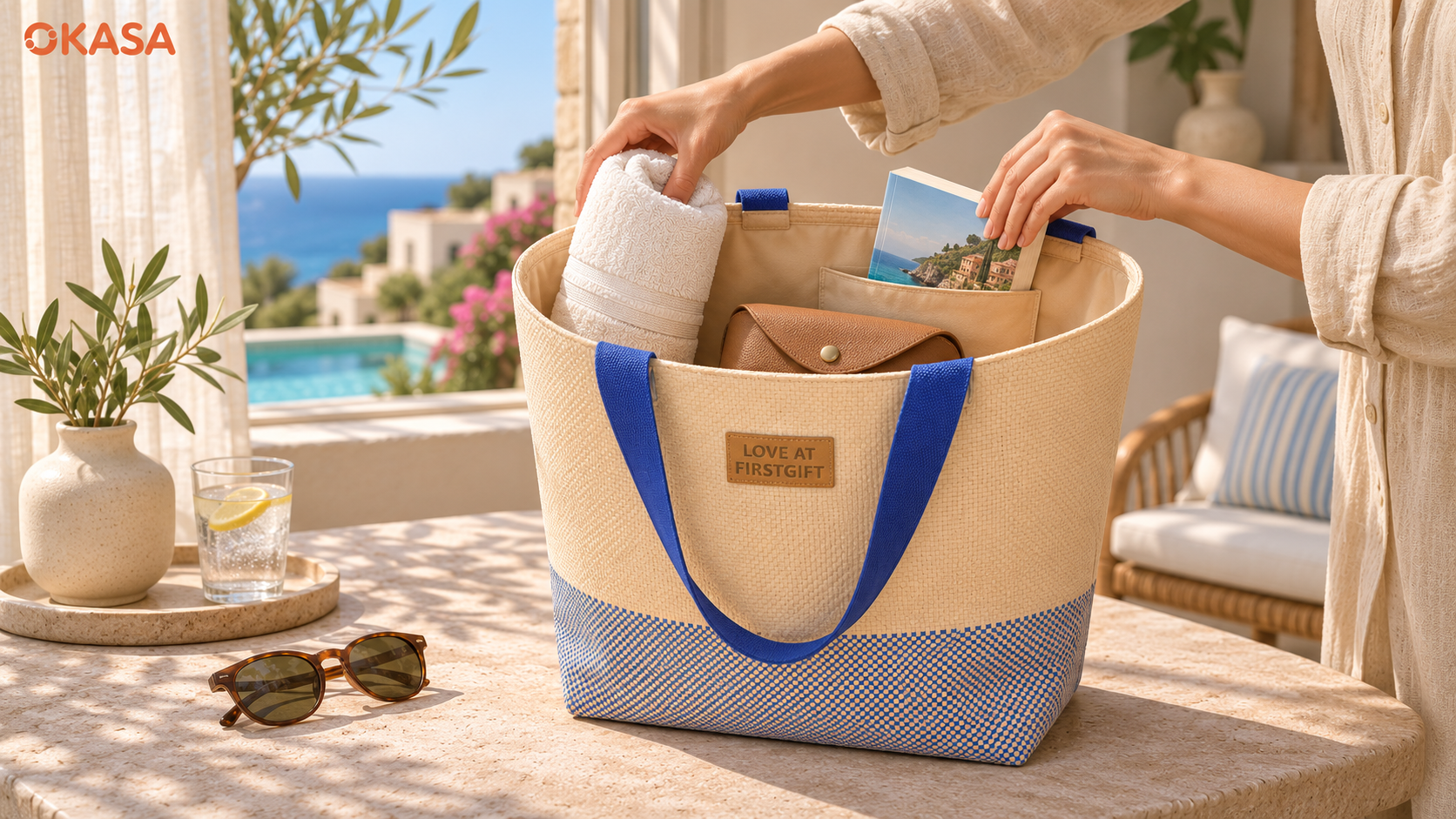
At the sample table, the buyer should take three photos: the empty bag standing upright, the filled bag viewed from the front, and the filled bag being carried at a natural height. The first shows proportion and finishing; the second exposes bulging or a distorted logo label; the third reveals whether the handle drop is comfortable over a shoulder and whether the tote brushes awkwardly against clothing. The product page gives handle width, not handle drop. Measure the latter on the sample and record it if the carrying experience matters to the program.
The towel should be dry for the first fit test. Beach and pool use can introduce moisture, sand and sunscreen residue, but the published product page does not claim waterproofing or a washable construction. If the resort wants guests to put a wet towel in the bag, that is a separate use case. Ask the supplier what care guidance is supportable for the finished materials and whether a liner or alternative bag would be more suitable. Do not convert a coastal photograph into a water-resistance claim.
Does the welcome card lie loose, sit in the slip pocket or attach as a hangtag? A mock room setup reveals whether it is seen. The tote can arrive empty, prepacked or packed flat for local assembly. Each route has a different quote and inspection point.
A margin note on the logo: subtle is a specification, not a fallback
The kraft label is one of B141's most useful visual details. A small debossed mark can fit a premium resort aesthetic where a large print might feel promotional. That does not mean a faint imprint is automatically acceptable. On a textured label, fine strokes, tiny lettering and low contrast can disappear at normal viewing distance. The buyer should supply vector artwork, set a minimum readable size, and ask for a physical proof using the planned label stock and debossing process.
Suppose the resort has a symbol, a wordmark and a property name. The first proof should show the exact lockup to be used, not an approximate “logo goes here” rectangle. If several properties share one master brand but use different names, the RFQ needs a version table. The supplier can then identify whether each version has a distinct tooling, sampling or packing cost. A universal label with a separate printed property card may be simpler, but only the buyer can decide whether that meets the brand standard.
Photograph the sample label at arm's length, read its smallest word in daylight and check for lifting or scuffing after normal handling. Confirm its position against the blue weave and handles. These checks can catch a proof that fails in a guest's hand.
For an OEM promotional products manufacturer, the artwork file is only one part of the instruction. The approved sample, label dimensions, location measurements, material color reference and packing method should all point to the same version. If a label revision is approved after the bag color, attach the new proof to the order record and retire the old one. “Use the latest artwork” is an avoidable source of disagreement when several files circulate.
Wednesday — the sustainability line gets crossed out
The marketing draft reads: “A fully biodegradable, plastic-free beach bag.” The buyer stops the sentence before it reaches a hangtag. The published B141 construction includes paperstraw laminated with nonwoven backing, a peachskin fabric lining and polyester-cotton webbing handles. The product page does not identify every polymer, the recyclability of the finished composite, a recycled-content percentage or a biodegradation test. The attractive natural-looking surface does not establish those claims.
A narrower statement is both more useful and easier to substantiate: “Textured paperstraw exterior with blue woven detail, a lined interior and a kraft paper debossed logo label.” If the campaign needs a specific environmental claim, request material composition, relevant test reports and the intended market's labeling requirements before approving the copy. The supplier can say which parts of the product the documents cover. A claim about one component should not be allowed to describe the entire assembled bag.
This is where the phrase sustainable promotional products manufacturer should lead to a real specification conversation. Ask what material choices can be documented, whether a different construction is available, and how a proposed change would affect appearance, durability and price. The buyer may decide the current B141 look is right without making an unsupported claim. Honest product language does more for a resort's credibility than a sweeping adjective on a tag.
The same caution applies to “reusable.” If the campaign emphasizes repeated guest use, approve a sample under agreed handling criteria and keep substantiation for customer-facing copy in each market.
The quote sheet has two columns now
The first supplier price arrives as a single amount per bag. It is not necessarily wrong; it is simply hard to compare. The buyer asks for a revised quote with the decisions above visible. The table below is a comparison format, not a statement of OKASA's prices, minimums or current availability.
|
Quote line |
Version A: tote only |
Version B: ready for guest room |
|
B141 bag and approved logo label |
Quantity and version stated |
Same bag and label version stated |
|
Welcome materials |
Excluded |
Card or hangtag dimensions, artwork and insertion stated |
|
Towel or bottle |
Excluded |
List each item, quantity, specification and supplier responsibility |
|
Packing |
Individual protection and master carton stated |
Assembly sequence, per-set protection and carton stated |
|
Sampling |
Bag and label sample, cost and approval path stated |
Full packed set and assembly sample stated |
|
Commercial terms |
Currency, trade term, location, payment and validity stated |
Same terms, with assembly and components separately visible |
|
Schedule |
Sample and production milestones stated |
Component arrival, assembly and dispatch milestones stated |
The distinction between a tote-only program and a packed gift set is larger than the difference in carton count. The second version needs a bill of materials, responsibility for shortages and a decision about whether the resort or supplier provides each component. It also needs a final assembled sample. A bag that looks right empty can bend differently when a rolled towel and bottle are loaded, and the label may be partly hidden by a hangtag. The buyer should approve the packed presentation as a whole.
If the property wants a separate rigid presentation box, ask a custom gift box manufacturer to quote a box sized to the filled bag or to the bag folded to an approved method. Do not assume the bag can be sharply folded without affecting its woven appearance. A sample should show the actual fold, insert and unboxing. For a simpler welcome kit, an outer carton or tissue wrap may suit the budget and guest experience better.
A custom corporate gift set manufacturer can coordinate the tote with other products and a common packout. The useful question is who owns the final approved set: the bag supplier, the gift assembler or the buyer's warehouse. The answer determines where defects are caught. If a towel arrives late, can the bag order ship separately? If the label changes, which team updates the packout photograph? Those are operational questions that belong in the RFQ while there is still time to solve them.
Thursday — the sample is put to work
Imagine the sample on a meeting table, next to the resort towel and a printed mock welcome card. No one has yet awarded the order. The buyer's team can now evaluate the same object from different jobs: a brand manager reads the label, an operations colleague packs the towel, and a guest-services colleague considers the room presentation. Their notes should be written on one sample sheet with the sample date and version, not scattered across separate messages.
The first inspection is visual. Is the blue woven section present on both front and back at approximately the published placement? Does the natural outer texture appear consistent enough for the intended program? Is the lining neatly attached around the opening and pocket? Are the handles aligned and comfortably attached? A woven product may have visual variation; the buyer should decide what range is acceptable from representative samples instead of demanding a photographic replica of every strand.
Next, pack the intended contents and carry the bag. Record the weight of the actual test load, how long it was carried, and any visible distortion. If performance criteria are important, agree a formal test method and pass/fail limits with the supplier before production. The product listing does not provide a load rating, so the sample exercise is for decision-making, not proof of an unstated capacity. The buyer can ask for handle-attachment and seam checks appropriate to the program.
Finally, review the packaging. Is each bag protected from rubbing against the next one? Does the label catch on adjacent units? Will the tote arrive in a shape that presents well after unpacking? Request carton dimensions, gross weight, units per carton and any insert or protective packaging details in the actual quote. Those numbers are logistics inputs and should be supplied for the chosen configuration; they cannot be inferred safely from the 30 × 12 × 30 cm product dimensions.
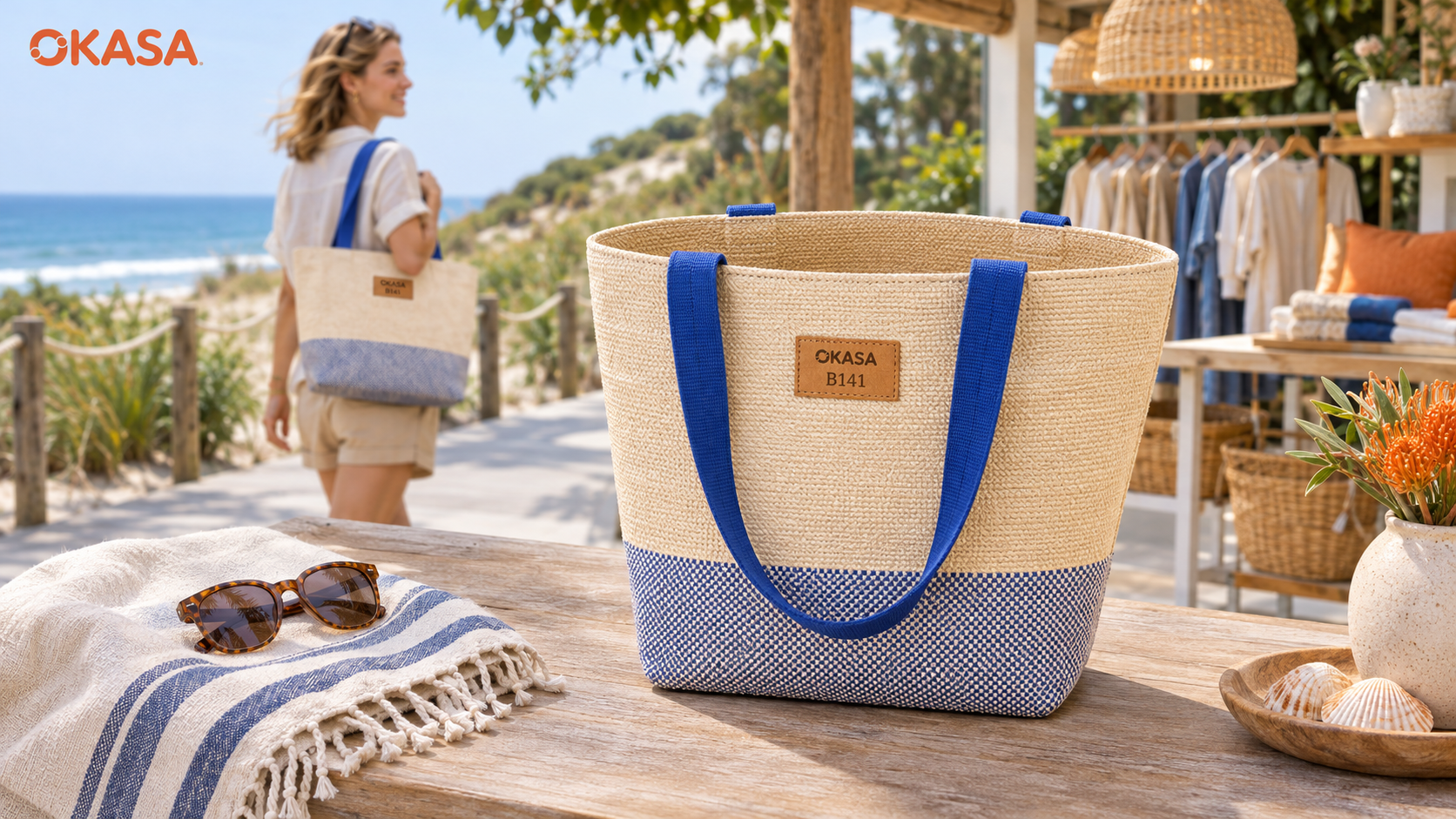
For promotional products sourcing China, sample approval is a checkpoint with consequences. The approved bag, approved label and approved packed set should be distinguishable. Give each a version number or dated signoff. Then ask how production inspection will compare finished units with those approvals. A clear photograph can support the record, but it cannot replace material swatches or a physical reference where feel and color matter.
The question the marketing team asks next
“Can we add a notebook and bottle to the welcome gift?” Yes, as a program concept. It should not be described as part of the B141 specification. A custom notebook manufacturer can propose a compact book that fits the bag and a cover that suits the resort palette. A custom drinkware manufacturer can advise on a bottle style, decoration and individual protection. The buyer should request actual samples and check fit with the towel in the bag. An empty bottle and a full bottle create different carrying loads, and a rigid bottle may press against the lining or label.
If the gift is for a beach opening, less can be better. A bag, useful towel and short destination card might serve guests more naturally than a dense assortment that strains the tote. If the program is for a corporate retreat, stationery and drinkware may have a clearer role. The decision should follow the audience and distribution moment. Bulk corporate gifting solutions work best when the content, branding and assembly are specified as one experience, with each component still visible as a cost and quality line.
This is also the moment to clarify whether the order is for room drops, a boutique retail shelf or an event handout. A boutique may need a barcode, price tag and individual retail presentation. A room drop may need a card and a packing orientation. An event handout may prioritize quick distribution from master cartons. One bag can support different programs, but the packaging and inspection brief should follow the actual channel.
Friday — the revised inquiry, ready to send
The buyer no longer asks only for “best price.” The inquiry below is designed to be copied into a contact request to OKASA. Replace the bracketed fields before sending. It gives enough detail for a qualified supplier response without pretending that the buyer has already decided every point.
Subject: RFQ — B141 paperstraw beach bag for [resort or brand], [quantity] units, [destination]
We are evaluating OKASA B141 for [guest room / event / retail] use. Please quote [quantity] units in [number] artwork versions, delivered to [named location] by [required arrival date]. Tell us the earliest feasible sample and production schedule; our target date is not an assumed commitment.
Bag: Please confirm the published 30 cm bottom width × 12 cm depth × 30 cm height, 42 cm top width, 300 gsm paperstraw outer laminated with 30 gsm nonwoven backing, peachskin lining, interior slip pocket, 3 cm polyester-cotton webbing handles, blue mixed weave on front and back and debossed kraft paper logo label. Identify any proposed change to these details.
Artwork: We will supply vector files for [logo and version names]. Please advise the recommended minimum deboss size, label dimensions, position, proof cost and approval process. We need a physical label sample for signoff.
Use and sample: The intended contents are [exact towel dimensions], [card], [sunscreen] and [optional bottle]. Please propose a bag sample and, if applicable, a complete packed-set sample. State any test method or load claim you can substantiate; we will not assume a published load rating or waterproofing.
Quote: Separate bag, decoration, sampling, additional components, assembly, packing and freight where applicable. State MOQ per version, price breaks, currency, trade term, production location, quote validity, payment terms, carton details and the lead time measured from approved sample and deposit or other agreed start point. Please identify which details still need confirmation.
That message leaves room for a supplier to recommend a better route. If a requested change affects the woven panel, the supplier should say whether it is possible and what sampling it entails. If the timeline is tight, a standard B141 configuration with a carefully approved label may be the sensible starting point. If the resort needs a different load, finish or color, it can compare a revised construction rather than silently treating the original bag as something else.
For buyers comparing a custom bag manufacturer with a broader promotional products manufacturer China program, the same rule holds: quote the object that has been described, and name every proposed substitution. A lower unit price is only useful if the material build, artwork, packing and delivery basis match. Ask for an itemized revision when any of those change.