

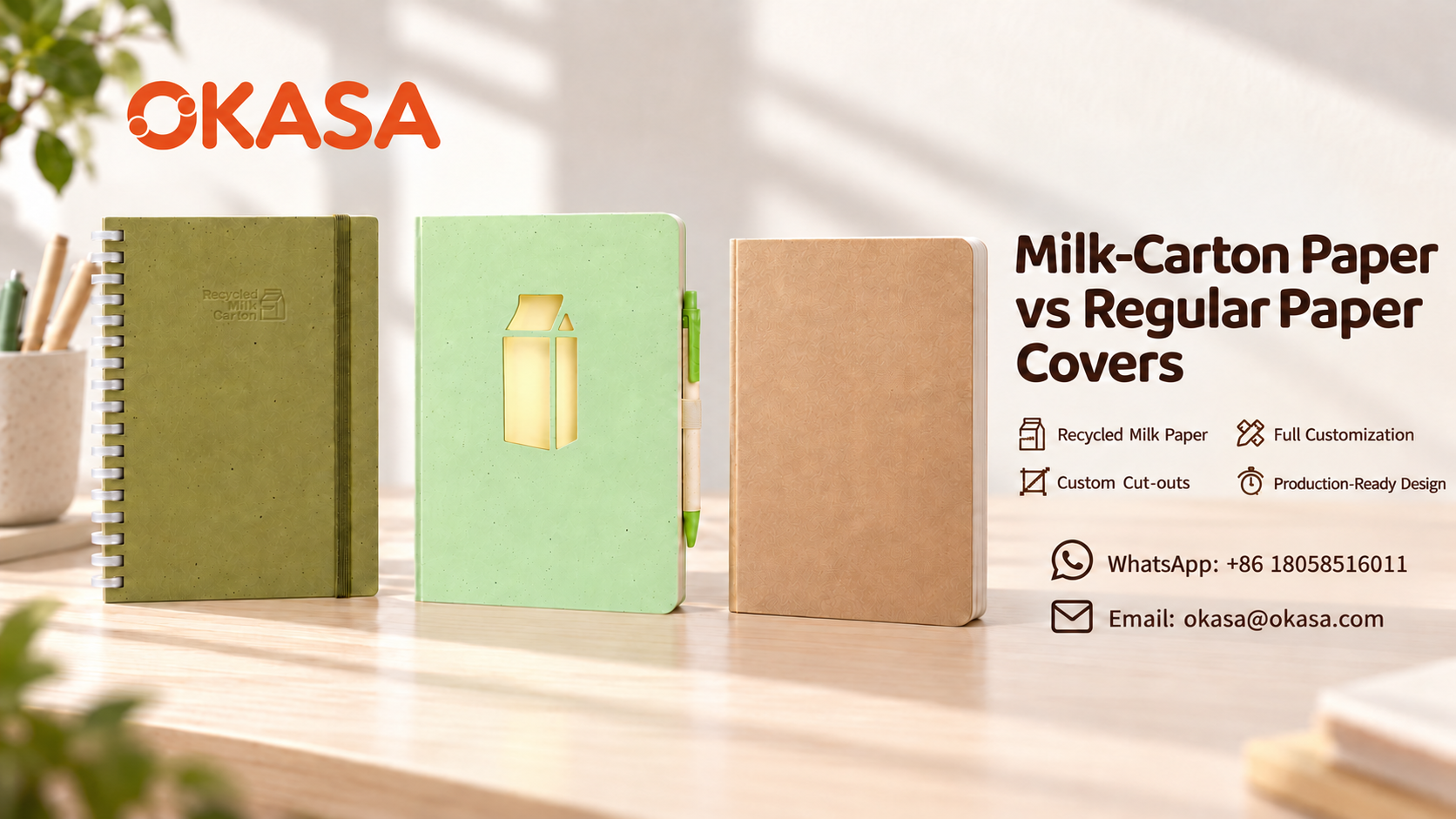
The wording on a notebook inquiry matters here. “Milk paper notebook” could lead a supplier to price milk-carton paper for the cover, the inner sheets, or both. OKASA's TNB761 is specific: 100 g milk-carton paper is laminated to greyboard for the cover; the blank pages are 70 sheets of 80 g silk-cotton paper. The cutout model lists 1.5 mm greyboard behind its recycled-carton cover and 80 sheets of beige 70 gsm ruled paper inside. Write both components on the brief; otherwise “milk paper” leaves the writing stock open to interpretation.
Why choose the recovered material? At a recycling mill, the cartons are broken down and their paper fiber is separated from the other layers. Mills can put the recovered fiber into another sheet. A cover using that fiber gives the original material another job and lets a brand explain a specific sourcing choice. The Carton Council describes the recovered fiber going into writing and printing paper, among other products. That account says something useful about the cover's origin. It says nothing by itself about the coil, board or inside pages.
A regular paper cover has its own advantages in a design brief. The supplier may offer stocks with different colors, coatings and print surfaces. An illustration that needs exact color reproduction might point the buyer toward one of those sheets. A small embossed mark and a cover whose material origin is part of the message might favor the milk-carton option. Those are reasons to ask for proofs of the actual artwork, not promises about every paper sold under either label.
For a fair sample request, I would send a small table to the supplier. Keep the notebook at 21 × 14.5 cm. Ask for a milk-carton cover and an ordinary paper cover, each on the same thickness of board, with the same binding and the same inside pages. Then ask for the unit quote at the intended order quantity. If the usual paper cover cannot take the same cutout or logo treatment, ask the supplier to state that before making samples. The point is to avoid paying for two books that differ in five ways and then trying to attribute the result to one cover stock.
When the samples arrive, set them beside the actual brand colors and handle both for a day. Does the logo stay readable against the cover? Does the cut edge look clean? Does the selected finish suit the artwork? Keep one photo of the two covers beside the color proof, with the logo and corners visible. Put the sample code and date in the frame. That small record is more useful at reorder time than a note saying “milk paper approved.”
For the carton material claim, the purchase order should name the cover stock precisely. The TNB761 specification says nothing about recycled content in its inner sheets or PE coil. On the product card, I would write “recycled milk-carton paper cover.” I would leave the coil and pages out of that claim, since the listing gives them separate specifications. A carbon figure would need a calculation for the finished order.
A cover comparison I would actually put in an RFQ
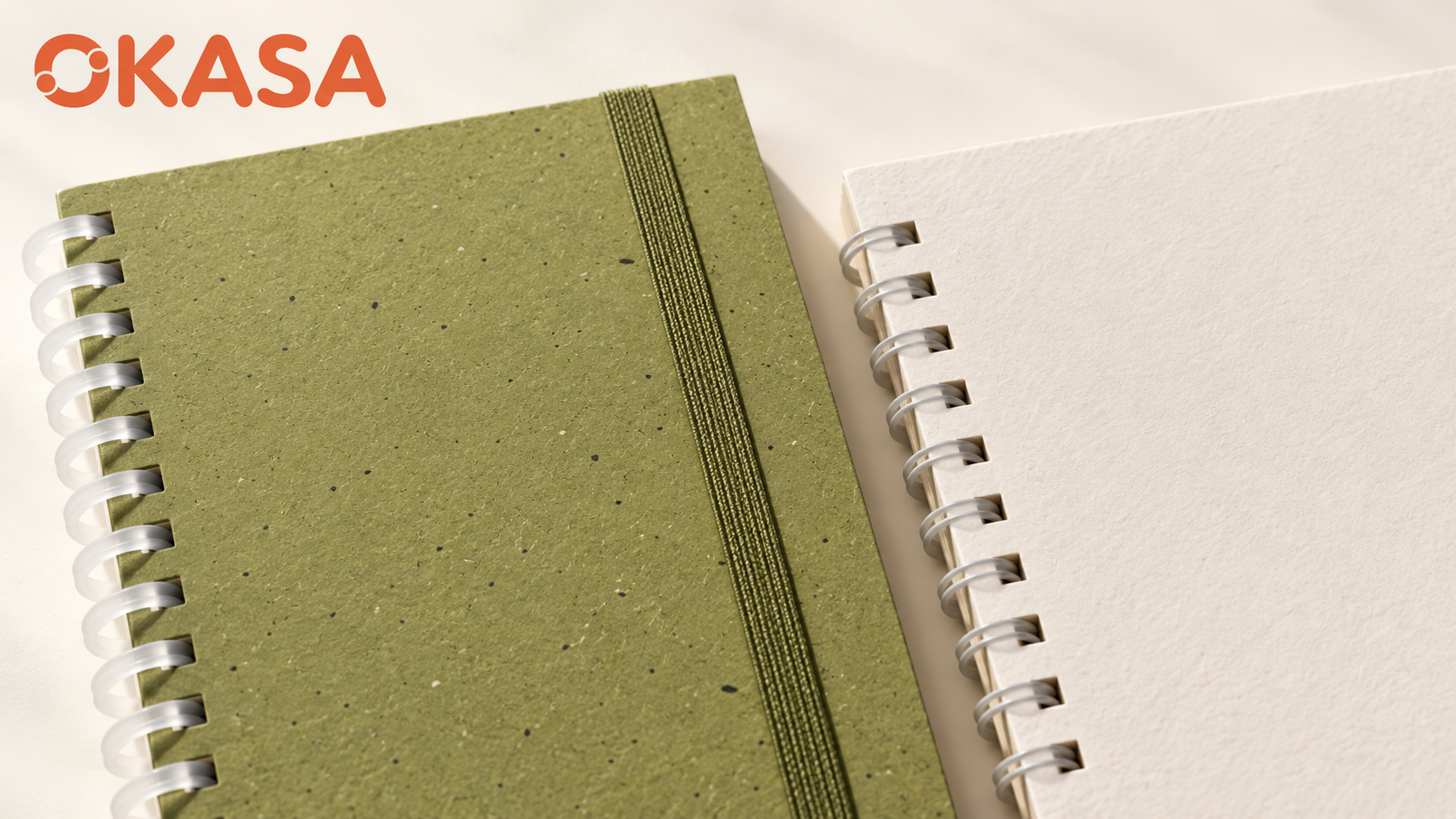
The two candidates need names more precise than “eco” and “regular.” I would write MC for the manufacturer's recovered-carton stock and RP for the standard paper the factory recommends. Both would wrap the same 1.5 mm board. Both would have 80 sheets of beige ruled paper, the same binding and the same unit packing. The page stock is an example for the comparison; TNB761 itself has 80 g silk-cotton blank pages and a different sheet count.
Question | MC cover | RP cover
What is the stock code? | Supplier to specify | Supplier to specify
What is the cover sheet weight? | Supplier to verify against swatch | Supplier to specify
What does the sample show? | Artwork and edge on recovered stock | Same artwork and edge on regular stock
What is the documented claim? | Cover fiber source and recycled-content basis | Fiber source or certification, if any
What is the quoted unit price? | Same quantity and delivery term | Same quantity and delivery term
What changes if the logo is embossed? | Plate cost and resulting proof | Plate cost and resulting proof
No invented price goes in that table. A buyer could fill it in after receiving two quotations. The two stock codes go next to their photographs so that somebody can find the quoted paper three months later. The RP sheet might also contain recycled fiber; its merchant should state that in the stock description.
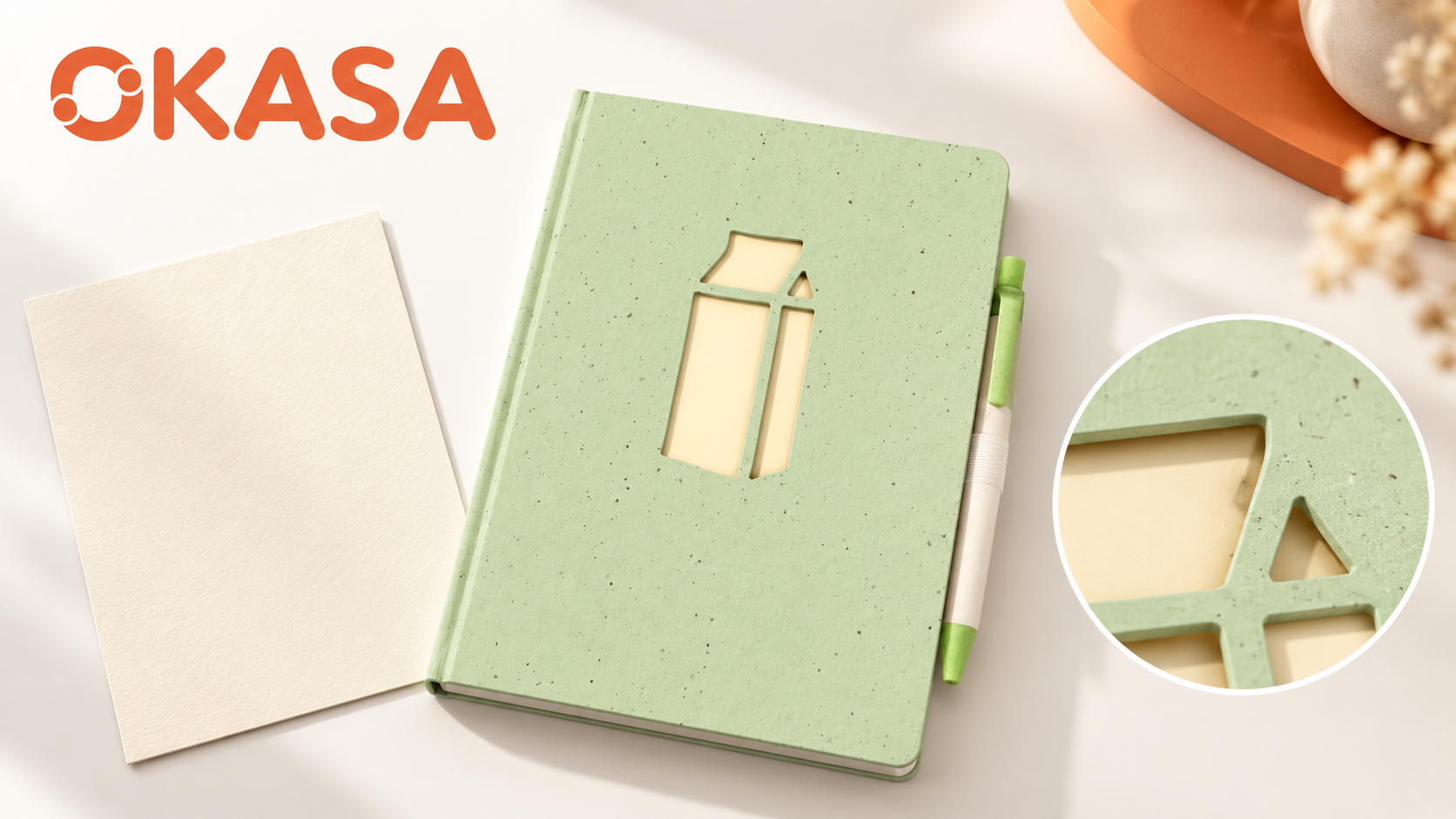
A photographic image across the cover would make me ask for a press proof on RP before deciding. The recovered-carton cover may look more at home with an emboss or a small mark. Those are starting directions for the art team. Actual paper stocks differ, so the proof has the final say. OKASA's cutout model provides a visible example: a light-yellow front page is seen through the opening in the recycled-carton cover. The feature makes the material story part of the cover's construction without asking the writing sheets to be made from the same recovered source.
There is also a language distinction in the buyer's marketing brief. “Made from milk cartons” may imply that every component of the notebook came from a carton. The cover is the part the OKASA listings identify. For this example, the product card could read: “Recycled milk-carton paper cover; 80 sheets of 70 gsm beige lined paper.” If marketing wants to add “60% recycled,” somebody first has to say whether 60% refers to the cover sheet by weight or to the assembled book and show the supporting paper record.
The quotation that tells the truth
Suppose the buyer plans 2,400 notebooks for a client event. That number is an example, not a minimum order claim. One quote says MC costs $0.18 more per unit, while another supplier's quote puts the difference at $0.09. Those figures would mean very little without the stock, construction, quantity and delivery terms behind them. I would not put either into public marketing copy as “the cost of milk paper.” The useful result is a line-by-line comparison from the supplier quoting the actual job.
I would ask for four lines on the price sheet: the two unit prices at 2,400 units, one-time artwork or die charges, physical sample costs and packed-carton details. Then I would ask for the same lines at 5,000 units if the program might repeat. On the 2,400-piece line, ask whether the emboss plate is included in the unit rate or billed once. A reorder using the identical mark may reuse that plate; the supplier should state its storage and reuse terms.
For an event shipment, I would request a dated sequence beside each stock: swatch sent, paper allocated, proof ready, artwork signed and goods packed. A sheet listed as “available” still may need an incoming color check. The schedule has to fit the actual approval steps; MC and RP could each be the faster option depending on inventory. The event date should appear above the stock options in the email, so the factory can flag a sheet that will arrive too late.
A price comparison I would keep on one page
Item | Milk-carton cover | Regular paper cover
Stock description | Maker's code and stated recovered-fiber basis | Maker's code, coating and fiber claim, if any
Board | Same board grade and thickness | Same board grade and thickness
Pages and logo | Fixed at 70 gsm beige ruling and the approved artwork | No substitutions without a new proof
Tooling | Die or emboss plate and whether it can be reused | The corresponding tooling line, if needed
Prices | 2,400-piece rate and 5,000-piece rate | Both rates at matching pack and delivery terms
Dates | Earliest swatch and finished-sample dates | Stock arrival and production start dates
The purchasing file would then show precisely why MC won or lost this job. The answer might be “the cutout die costs $X once,” or “we need a different ink on MC.” Those are separate decisions for the buyer to record, not attributes of all recovered paper.
If an annual program may reorder the notebook, keep the cover swatch with the final proof. That record also helps distinguish the carton-paper choice from a similarly colored ordinary sheet when a different buyer handles the next order. The paper name alone may not identify the exact stock.
To compare covers for a custom run, send OKASA the intended size, quantity, logo file and market. Ask for the two stock codes on a matched interior, with unit prices and the sample dates on the same quote.
A material story with a precise boundary
A milk carton is a layered package. Its fiber can be separated for another paper product where a suitable collection and mill process exists. That is the starting point for the cover story. The new notebook still contains other things. In TNB761, for instance, a greyboard backing supports the cover, a soft PE coil binds the book and silk-cotton writing paper fills it. The buyer should ask what the particular cover stock contains before turning the source description into a percentage.
For a campaign in the United States, I would review the wording against the FTC's Green Guides. They distinguish a claim about a component from a claim about a whole product. On a notebook card, “recycled milk-carton paper cover” identifies the part. “Recycled notebook” could be read more broadly. A final claim also depends on the actual supplier record; the product-page wording alone is a place to start an inquiry, not a substitute for documentation for the order.
The distinction matters to a designer, too. Suppose the front of the notebook carries an icon of a carton and the back carries a line about recovered fiber. If only the cover sheet has been documented, those words should point explicitly to the cover. A reader looking at the inside can then see ordinary writing paper without feeling that the copy hid something. The same practice helps sales staff give a short, accurate answer when asked what part is recycled.
A certification mark is a different project. FSC Recycled on an approved product label is a certification claim. A recycling-arrow illustration on a cover is not a substitute for it. Those marks are not interchangeable. FSC asks that a supplier of a final labelled product be certified and that the correct label be used. Write the exact FSC label request into the RFQ. Before it reaches the cover proof, the supplier needs to confirm the finished product is eligible and show how the mark will be approved.
Nor would I promise that the assembled notebook can be recycled anywhere a beverage carton can be collected. The finished cover may be mounted on board or finished with another layer; the coil is a separate component. Collection rules vary by place. The easier claim to support is what the cover was made with. If the customer needs a statement about the entire book after use, ask for an assessment of the final construction and destination market.
A specific environmental statement can still be interesting. One possible caption, subject to the supplier confirming the stock, reads: “Cover made with recycled milk-carton paper. Inner pages: 70 gsm beige lined paper.” The purchase file should contain the stock statement for the first sentence and the inner-paper specification for the second. An accompanying article can explain the recovery route in more space.
Which design brief suits each cover?
Picture two briefs on the same desk. The first has a photograph intended to run across the entire front cover; the supplier might recommend a particular coated RP sheet and show a press proof. The second carries a small event mark and a note about the source of the cover fiber; an MC sheet with a blind emboss could be worth sampling. Those are proposed treatments for different artwork, not test results.
For a gift set, I would place a sample notebook beside the actual box wrap and the other objects before approval. A carton-paper cover might provide quiet contrast against a colorful tumbler. A regular colored cover might tie the set together more neatly. This is a design decision that should be made with the set in view, not by counting how many times “sustainable” appears in a catalog description. If the box is still being designed, get the cover swatch into that process early.
What counts as ordinary paper in this comparison?
The word “regular” can hide several quite different cover sheets. In an inquiry I would name one actual candidate, perhaps the factory's stocked uncoated wrapping paper, and keep its code on the quote. If the designer later swaps in a glossy coated sheet, the comparison has changed. That may be a good creative decision, but it is a second comparison rather than a more favorable result for the first one.
An uncoated stock can be a pleasant choice for a restrained notebook with a small mark. The exact ink result will depend on that stock and the chosen process. A coated sheet may be proposed for a photograph or dense color; the coating, any additional protection and the way it wraps around the board are then part of the specification. A pre-colored stock might avoid a large solid printed area, but the buyer should check the swatch against the approved brand color. I would not claim that one of these will automatically outperform recovered-carton paper. The point is to stop “ordinary paper” from being treated as a material with one fixed finish and price.
There is an environmental wrinkle too. A paper sold as the factory's usual cover sheet might itself have recycled content or a certified fiber claim. The question for the buyer is what that particular sheet is, not whether the label “ordinary” sounds less responsible. In the MC column, request the carton-fiber description and its evidence. In the RP column, request the same kind of stock description. That lets the brand tell the actual sourcing story it purchased.
For a two-cover artwork review, I would print the same orange logo and a fine grey line on each proposed sheet. The orange tests the brand color; the fine line tests whether the decorative detail remains visible on that surface. Take the proofs to the gift box if one is planned. A material that looks understated against a white desk can read differently beside a saturated sleeve. These are observations to make on the physical proof, not claims already established by the product listing.
The two production routes should be noted next to their samples. MC might be embossed after mounting; RP might carry a printed image before the sheet is wrapped around board. If the factory proposes those routes, the quote should show each process and any plate or proof charge. A buyer should not call the resulting price gap a paper-only difference.
A sample record could be a single sheet of paper attached to the approved notebook:
Project: event notebook, A5 portrait
Sample ID: MC-02 or RP-02
Cover: supplier stock code, basis weight and approved swatch
Board: material and thickness
Interior: shade, ruling, basis weight and sheet count
Binding: type, color and position
Logo: final file reference, size, location and process
Package: individual wrap and carton count
Approval: date, person and any accepted visual range
The entries are examples of fields, not a ready-made OKASA specification. A cover approved as MC-02 with one logo file is a specific version. If the art team enlarges the mark, put a fresh artwork reference beside the next sample. The factory can then identify which visible mark belongs to the signed order.
Buyer questions that deserve a direct answer
Does the milk-carton cover change how the inside pages write? Not by itself. On OKASA's published TNB761, the cover sheet and the 80 g silk-cotton blank writing sheets are separate materials. On the cutout model, the inside is 70 gsm beige ruled paper. A customer concerned about pen show-through should test the specified interior, regardless of the cover choice.
Is carton paper automatically a better environmental choice than every regular paper cover? Carton fiber that becomes a cover has entered another use. To compare environmental impacts of two whole notebooks, the buyer would need details about RP too, including any recycled content, as well as the other components and production. The product pages do not supply that comparison.
Can the same logo process be used for both? Ask for one 28 mm emboss on MC and RP, with the same position measured from the top edge. If the factory proposes a printed mark on one, the buyer can review the proposed deviation on a revised proof. TNB761 establishes that OKASA offers an embossed carton-paper design; it does not certify the result on an unspecified RP stock.
Will the milk-carton stock cost more? The price sheet for the intended quantity will answer that for this job. Put plate or die charges on their own lines. The quote should identify each paper stock, any purchased-sheet minimum that exceeds the book quantity, and whether every notebook has its own sleeve. A per-book number without those notes can be a poor guide to the program's actual cost.
Can the brand print “100% recycled notebook”? The two OKASA product descriptions do not support that blanket statement. They specify milk-carton paper on the cover and other materials inside. If a different custom construction has documented recycled content throughout, its exact claim would have to be reviewed on its own records. For the products discussed here, identify the cover in the caption.
The choice at the end is quite practical. Select MC if the sourced material, proof, quote and documentation suit the campaign. Select RP if its finish or schedule better serves the approved artwork. Keep the MC and RP stock codes with the signed sample. For an inquiry to OKASA, send the intended page specification and artwork alongside a quantity and delivery window. Ask it to quote both cover papers on the same interior, then review the two proofs with the brand team.