

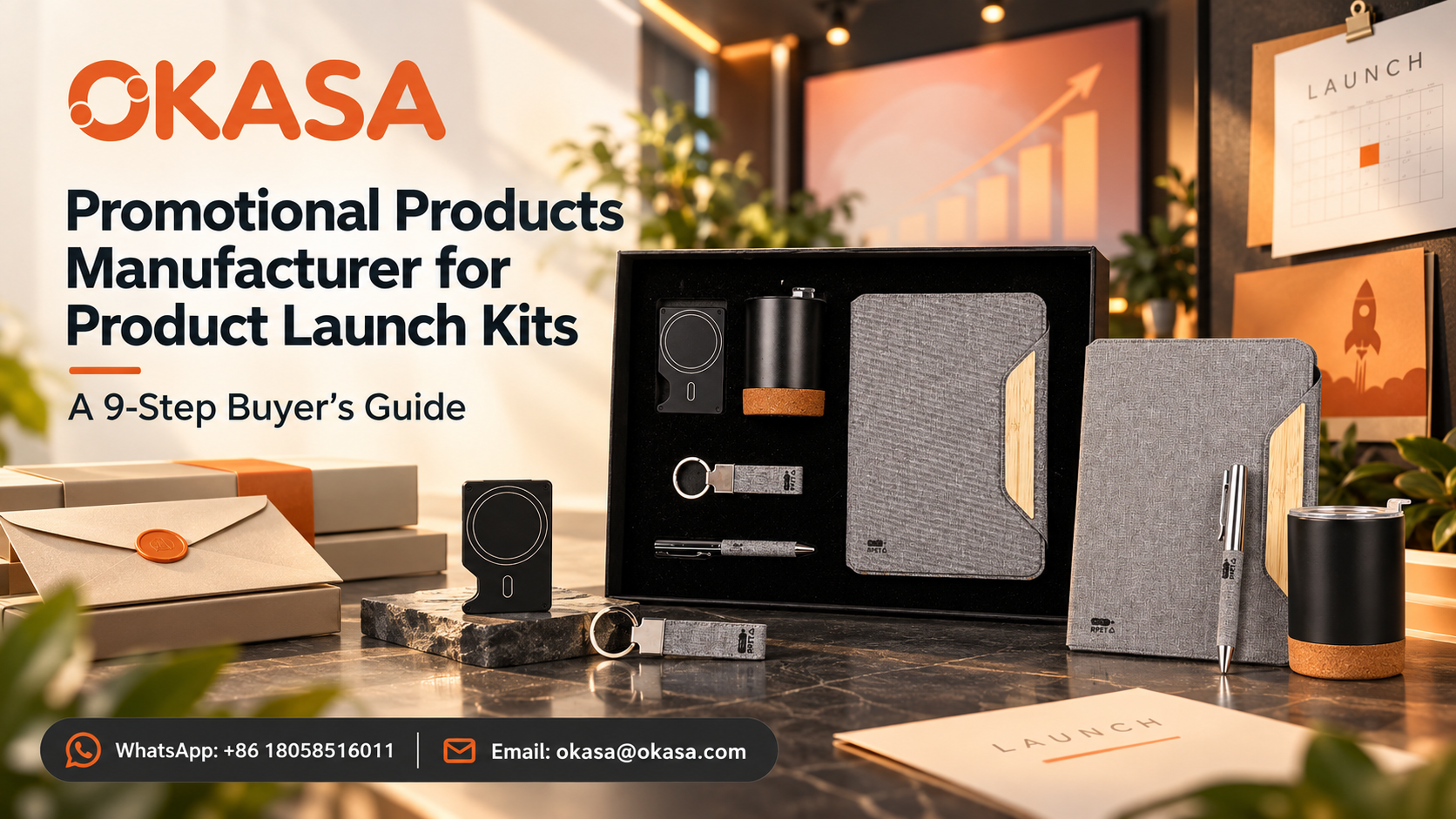
Image 1: OKASA product launch kit concept with the guide title, company logo, WhatsApp and email.
The launch meeting had been over for twenty minutes when somebody noticed the bottle. It was a good bottle, actually. The problem was the shade of blue: it belonged to last year’s campaign. Two hundred boxes were already waiting beside the loading bay, each one beautifully packed and completely wrong for Tuesday’s announcement.
Production may be innocent. In this case, three words in the brief—“premium gift set”—did the damage, since premium meant something different at every desk. Brand imagines a filmed unboxing. Purchasing sees a unit price. Logistics sees forty bulky cartons. The factory sees three artwork files carrying the same filename. All four people are right. They simply haven’t compared notes yet.
For this guide, picture a practical case. A technology company plans to introduce a new service in Berlin. It needs 60 press kits, 240 dealer kits and 90 sets for its own salespeople. The public date is fixed. Journalists may receive their parcels two days early, provided the outside gives nothing away. Dealers need a sales card in German or English. The internal group needs the same core products but a different note and no embargo sticker.
Already, the buying question has changed. Nice merchandise is now the easy part. The awkward questions concern shared parts, changing parts and the signature that releases a batch. Answer those questions, and opening day can look as simple as it was meant to look.
That is where an experienced promotional products manufacturer China becomes useful. The factory’s job is larger than putting a logo on stock items. Product dimensions determine the insert. Each surface limits the decoration method. Three packing versions have to remain three, right through dispatch, and the cartons cannot leave until the calendar says so.
What follows is the working side of the project: nine decisions that can be copied into an RFQ. Press mailers appear in the examples, as do dealer packs, prospect boxes, sales-training sets and event gifts. The products will change from one launch to another. The buying logic travels rather well.
Step 1: Before products, settle the recipient’s next move
On a blank page, put the audience names down the left. Now complete one short line beside each: “After opening the box, this person should…” A blank ending is a warning. The catalogue can wait.
A journalist might need to grasp one claim, find approved images and know whom to call. A dealer needs enough product language to introduce the offer at the next customer meeting. A prospect may be ready for a demonstration but not a dense technical brochure. The company’s sales team has another task again: speak about the launch in the same terms, on the same morning, in several cities.
Those differences do not require four separate creative projects. In the Berlin example, the notebook and drinkware could remain common. The press version receives a short embargo card and a QR link to media assets. Dealers receive a sales card and ordering route. Employees see talking points and the internal help contact. One visual family, three purposeful variations.
Use a working table before opening a catalogue:
|
Recipient group |
What happens after opening? |
Information inside |
Sensible physical role |
|
Press or creator. |
Accurate coverage or a product conversation. |
Release date, approved claim, images and contact. |
A clean arrangement, quick to photograph. |
|
Dealer or distributor. |
Presentation to an account. |
Positioning, range, order route and campaign support. |
Products for meetings or field visits. |
|
Customer or prospect. |
Demo, sample request or quotation. |
Benefit, proof point and next action. |
One useful reminder, not a bag of unrelated pieces. |
|
Internal sales. |
A consistent explanation from day one. |
Talking points, objections, timing and help route. |
A working set for training and calls. |
|
Event guest. |
Recall and follow-up after travel. |
One message, one destination and one contact. |
A compact gift that fits luggage. |
Try the “tell a colleague” test on every variation. Why will the recipient notice this difference? A translated card has an obvious answer. So does a notebook intended for dealer meetings. A second box size, requested because somebody liked more empty space, struggles to answer at all.
Late additions deserve the same test. Launch projects attract spare brochures, cables, coupons and samples during their final weeks. Space in a box is not an invitation. If the new piece does not support the action written on that first page, leave it out or send it through another channel.
Step 2: Put the public date and factory date on one sheet
Marketing calendars begin with the announcement. The production sheet starts somewhere else: with a settled brief. Artwork comes next, then materials and samples; making, checking, packing and freight follow. Trouble likes the gap between those two calendars.
Work from the recipient’s doorstep, not the factory gate. For Berlin, suppose the press parcels must arrive on Monday, one day before the announcement. Local courier sorting needs two days. Customs and international transport are allowed nine. Packed goods therefore need to leave the factory well before the week that marketing calls “launch week.” Add final inspection, assembly and production, then place the sample approvals in front of those activities. The calendar soon reveals the last safe day for a design change.
Write the evidence beside every milestone. “Artwork approved” is weak if nobody can find the approved file. A versioned PDF, dated email and physical color reference are far more useful. The same logic applies to the packed sample and dispatch release.
|
Milestone |
Person signing |
Evidence kept |
Trouble caused by delay |
|
Audience count fixed |
Program owner |
Quantity sheet by version |
Incorrect allocation of products, cards or boxes |
|
Specification fixed |
Buyer and supplier |
Signed specification and reference sample |
Price, fit or performance moves after quotation |
|
Artwork fixed |
Brand owner |
Print file, proof and version code |
An old logo or claim reaches bulk production |
|
Packed sample accepted |
Brand, buying and logistics |
Photos, dimensions and physical sign-off |
Assembly begins without an agreed opening experience |
|
Inspection closed |
Quality owner |
Report, defect decision and count |
Known faults travel into kitting or freight |
|
Dispatch released |
Logistics owner |
Labels, carton count and shipping instruction |
Early arrival, late arrival or the wrong destination |
Confidential launches need one extra conversation. May finished kits enter a regional warehouse before the news is public? Perhaps a journalist can receive one early, with the opening date printed inside. Turn the parcel over while discussing this. Project names have escaped on labels before; customs wording can be surprisingly chatty as well. Put the answer on the early calendar. After packing is several decisions too late.
Draw two cushions on the timeline. The first belongs before dispatch and pays for a corrected sample or late component. The second belongs to transport, where handover, clearance and local delivery can misbehave. If both are labelled simply “buffer,” nobody knows which one yesterday’s delay consumed.
When the calendar tightens, take novelty out before taking inspection out. A proven product color with one decoration method may save the date. A new coating, special component and elaborate sleeve cannot be wished through three sample rounds in four days.
Step 3: Give the kit one centre of gravity
Open boxes are easy to overfill on a spreadsheet. Five low-cost pieces produce a reassuringly long row. Open the lid, however, and they may look like five strangers. Pick a centre instead—one useful object, or one setting, that still makes sense after the launch card has gone into recycling.
For a connected-work product, a notebook or desk item may do that work. A travel service may point toward drinkware and a compact bag. An outdoor launch can live around a cap, bottle and notebook without pretending to be a desk set. Once the centre is chosen, every extra piece has to earn the space around it.
OKASA's TGS819 office gift set offers one possible direction for a modern-work brief. Its material notes read like a desk inventory: notebook—RPET with bamboo; cup—stainless steel over cork; keychain—RPET; tracker-card clip—aluminium. Now picture the four on a desk. That ordinary scene is the useful reference—not a shopping list with four ticks.
The TGS895 recycled gift set feels lighter and less office-bound. Its notebook mixes cotton with cork. Bamboo turns up on the white bottle and again on the sunglasses. Taken together, those materials feel at home in travel or leisure. Dealer roadshows call for another mood. Open the TGS872 recycled denim gift set and the first cues are denim: an A5 notebook and cap, accompanied by a large 850 ml bottle.
A catalogue reference starts the conversation; it cannot finish the specification. With a custom notebook manufacturer, the apparently small choices—size, binding, pages, paper, ruling, cover, closure, pockets and marking—are the product. Permanent training pages can work for the sales team. A message with a short shelf life is better kept on a card that slips out.
The brief for a custom drinkware manufacturer cannot stop at capacity. What kind of steel build is intended? Which lid and gasket? What finish, cleaning note and leak test apply? A six-ounce cup lives beside a keyboard. An 850 ml handled bottle may spend the day outdoors. Their shared category is about the least interesting thing about them.
A custom bag manufacturer is making something people will carry, not a flat background for a logo. Describe the dimensions and fabric build first. Add lining, straps, seams, hardware, likely load and packing method. If the remaining launch pieces sit inside, inspect that complete arrangement. Once folded, the printed mark may touch a bottle and rub during transport.
Four questions belong beside every shortlisted item. Will the recipient use it? Where does it fit the launch? Do the material and finish feel right? Is there honestly enough time to approve and make it? A doubtful answer costs nothing here. At final inspection it costs rather more.
Step 4: Price each real version instead of averaging a fiction
Berlin has 390 names on the plan, though “390 of the same” appears nowhere. The sixty press boxes use their own card and closer presentation. Two hundred and forty dealer kits divide by language. Ninety employee sets can move to offices in bulk, avoiding individual courier packs. One blended number tidies the quotation while concealing nearly every useful difference.
Begin with the confirmed recipients. Then add reserves for named reasons. A few blank cards may solve spelling corrections. A handful of complete press kits may cover courier damage. Dealer event stock could be held as finished sets because nobody is named. “Ten percent spare” tells less than three separate reserve lines with owners and release dates.
Products occupy only the first line of a landed-cost sheet. Other lines belong to marking, boxes, assembly, inspection, export cartons, freight, known duties, regional fulfillment and remakes. The overseas factory probably cannot guarantee a future local-courier bill. Purchasing can still insert a sensible allowance; leaving the square empty does not make the charge disappear.
|
Cost line |
What the quote ought to make clear |
A question worth asking |
|
Products |
Exact construction at the quoted quantity |
Is the bulk specification identical to the approved sample? |
|
Decoration |
Artwork versions, colors, positions and setup |
Which audience changes create another setup charge? |
|
Presentation |
Box, insert, sleeve, card and protective material |
Is this the price of loose parts or a finished set? |
|
Assembly |
Contents, version control and checking |
How is the first unit of each version released? |
|
Quality |
Product checks, pack checks and reporting |
What is included, and who decides the disposition? |
|
Logistics |
Delivery term, destination, dimensions and weights |
Can we compare freight before approving the box? |
|
Reserve |
Spare products, cards and completed sets |
Who owns them, and when may they be used? |
Buyers looking for bulk corporate gifting solutions should request two or three quantity bands. Ask for the confirmed release, a likely event addition and a realistic reorder. The answer exposes thresholds caused by material minimums, print setup and packing volume.
Do not force the media tier into the dealer price merely to obtain a prettier average. Handwork, individual labels and a rigid box may make those sixty units expensive. Fine—provided everyone can see why, and the complete program still fits the budget. A cheap-looking average is useless when the purchase order cannot reproduce it.
Step 5: Take the color file away from the screen
Here is a familiar sample-room moment. One orange is calm on the notebook, another nearly glows on the bottle, and the cap thread lands between them. Yet the reference number is identical. Paper, fabric, coating and thread have each had their say.
Place the master reference on the approval table. Each surface gets a note beside it: method, finished size, position, and any nearby piece it should sit comfortably with. “Exact match across all materials” sounds firmer, but it tells the sample room much less.

Image 2: A TGS895-inspired launch kit prepared for a media unboxing, with the OKASA logo visible.
There is an advantage to showing the whole arrangement to a custom corporate gift set manufacturer. Put the screen print, laser mark, embroidery and paper print side by side. Their working labels contain a filename, version, method, finished size and location. The identical code reappears on the proof and packing bill. “Logo-new-final” still does not count.
Dates and campaign phrases need not live forever on a good bottle. Put the company mark on the long-life item. Put the launch-specific line on a sleeve, band or card. If twenty sets remain after the event, the products are still useful and the dated paper can be replaced.
Names require a similar sense of proportion. A personally addressed press card makes the parcel feel deliberate, and a lost card is easy to remake. A name engraved on every object has a different consequence: earlier data, individual proofs and personalized spare stock. Sometimes that is worth doing. Most product launches are not improved by doing it everywhere.
Before release, somebody reads the printed piece aloud. Somebody else follows its QR code on an ordinary phone, outside the company login. Product name, claim, date, trademark line, language, contact: each gets a finger on the page. Last Thursday’s copy can look immaculate in today’s box and still be wrong.
Step 6: Draw the opening before engineering the box
Imagine the recipient’s desk. A plain courier parcel arrives first. Under that sits the presentation box, then the opening message, then the products. Four rectangles on a sheet of paper are enough to sketch this sequence. Nobody is grading the drawing.
For the press version, an embargo reminder belongs inside and high in the field of view. It does not belong on the public-facing courier label. The hero product should appear before loose accessories. A QR card needs enough room for a phone camera. Tissue may be useful, but only if it lifts away in one clean movement when somebody films the opening.
Give a custom gift box manufacturer the real products—or the closest production-intent samples available. Add weights, opening direction, box material, insert preference, finish, shipping route and outer-carton expectation. Catalogue dimensions have missed protruding handles, tall lids and loose straws before. A few forgotten millimetres are perfectly capable of holding a box open.
The press group may justify a rigid presentation box. Hundreds of employee kits may be better served by a compact mailer. Sometimes the inner pack becomes a bag that is used again; first, though, it must survive the route without dust or scuffs. The sensible answer changes with audience, route and quantity. The word “premium” settles none of those.
Now perform the corridor test. Close one completed set inside its shipping carton. Sideways first; then downstairs; finally onto an ordinary desk. Open it and notice what moved. Is the card trapped? Did metal scratch a printed surface? Is the lid bowing? Has the logo rotated out of sight? It is an unsophisticated test and a very productive one.
Camera presentation and courier protection are not enemies, but they do bargain. A fitted insert, a clean removable sleeve or one covered metal edge often settles the argument. Decorative filler usually adds more mess than security. The outer carton’s role is to deliver the presentation intact, not to become the presentation itself.
Step 7: Write the question on every sample request
A request reading only “Please send a sample” leaves the parcel unemployed. Write the decision on it instead: confirm bottle size; judge orange screen print; check the closed-box fit; approve the entire press-kit opening. Now the sample has a job before it travels.
Rough is perfectly acceptable for an early mock-up; only scale and product mix are on trial. Decoration has its own later sample. The last parcel contains the pre-production set. At that point the intended products meet their card, insert and final orientation, and the lid must close properly. Any temporary part wears a bright note, with the difference repeated in the approval record.
Do something with the sample. Record the press opening on a phone and take the dealer kit into a meeting room. Give the internal set to a salesperson with one request: “Show me the launch message.” A hesitation here is valuable. A flawless top-down photograph would have hidden it.
Claims about materials belong in the sample file as well. Ask a sustainable promotional products manufacturer which document supports which part. RPET on a notebook cover describes that cover. Bamboo trim describes the trim. Neither phrase quietly expands to cover an entire mixed-material set.
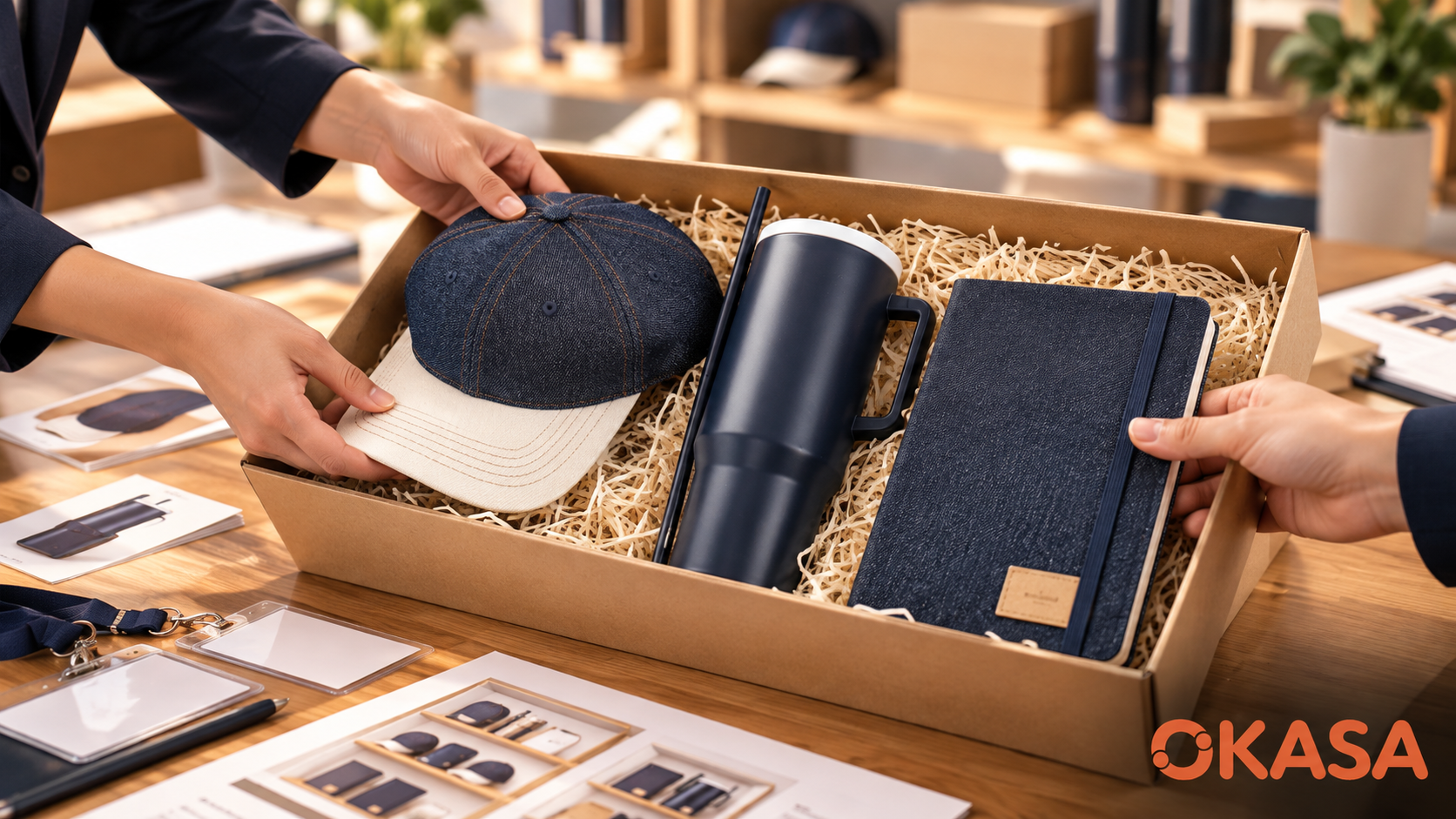
Image 3: A TGS872-inspired dealer kit with cap, notebook and large bottle during assembly and count checking.
The inspection list changes with the object. For a notebook, look at binding, paper, page order, cover and marking. For a bottle, the build, lid fit, finish, agreed leak check and decoration matter. Fabric brings seams, measurements and hardware. The box adds board, print, fit, closure and contents.
Keep the approval register short enough that people use it:
|
Approval subject. |
Reference kept. |
Decision owner. |
Review again when… |
|
Product. |
Specification and signed sample. |
Buying and quality. |
Construction, material or a component changes. |
|
Decoration. |
Proof and physical example. |
Brand owner. |
Method, size, position or color changes. |
|
Packaging. |
Dieline and packed sample. |
Brand, buying and logistics. |
Fit, route, insert or box build changes. |
|
Claims. |
Released words and evidence file. |
Responsible reviewer. |
Supplier, material or claim scope changes. |
|
Assembly. |
Bill of materials and packing photographs. |
Program owner. |
An audience version or insert changes. |
A proposed substitute deserves five answers: what, why, appearance, function and timing. Add cost and claim impact where relevant. The word “similar” can begin that note; it cannot approve it.
Step 8: Use dull codes and very clear release instructions
Assembly is where perfectly good parts can make a bad kit. On the line are three similar cards, a cable, a notebook and a bottle. The cable appears beautifully in the reference photo—but nowhere in the written list. By kit twenty, it is gone. From one metre away the cards look identical. That is enough for a wrong-box error.
Short codes help precisely because they are boring. In Berlin, the English press version could carry BER-PR-EN, while a German dealer box reads BER-DL-DE. The same code appears on three places—the work sheet, the count record and the carton label. The confidential name stays elsewhere.
Every code has a packing list beside it. Product references and pieces per kit come first, followed by artwork, card, accessories and facing direction. One completed set is enough to pause the line for comparison with the approved photographs. Later checks catch drift. The final arithmetic—packed, rejected and spare—must return to the starting count. Unexplained arithmetic should not travel.
With promotional products sourcing China, variable work can happen in several sensible places. Common products might all be made together, while named cards are inserted in China, at a European warehouse or by the final fulfillment company. There is no default winner. Put four facts side by side: the name-freeze date, data access, correction route and freight effect. “We always do it here” is not one of the four.
The recipient sheet is a delivery tool, not a copy of the company database. Carrier fields may be limited to name, address and telephone. Packing may call only for a kit code and display name. Leave sales notes and employee history behind. Before sharing, write down the transfer method, file owner, freeze hour and the date on which the data is deleted or retained.
An embargo card speaks to its recipient. The warehouse needs another message entirely. Put three dates in that message: earliest factory dispatch, earliest warehouse release and the allowed delivery window. Early parcels carry the opening date inside, in language nobody has to decode. The calendar names an owner for each release.
Step 9: Leave the factory no blanks to guess at
Keep page one almost conversational. Say what is launching and who opens it. Add the number of versions, their destinations and the date on the recipient’s calendar. Product ideas and brand files follow. The next pages cover the opening, material evidence, sample decisions, inspection and price format. Write “open to proposal” beside genuine choices. An empty field looks exactly like a forgotten one.
Ask the OEM promotional products manufacturer a blunt timing question: “Which part decides our finish date?” Possible answers include the wrapped box, custom fabric, tracker, embroidery, named cards or the sheer number of packing hours. Once the slow piece has a name, purchasing can protect it, change it or allow it the time.
Prices need their footnotes. Beside the numbers go currency, expiry date, payment terms and Incoterm. Below them go tooling, setup, samples, quantity tolerance, remedies, spares, storage and reorder assumptions. Carton measurements arrive early too. Otherwise a generous box may spend the product saving before the vessel sails.
|
RFQ block. |
Buyer supplies. |
Supplier returns. |
|
Program. |
Purpose, groups, versions and quantities. |
Feasibility notes and sensible shared components. |
|
Products. |
Function, material direction, color, branding and references. |
Exact construction, alternatives and limits. |
|
Packaging. |
Opening idea, contents, route and presentation level. |
Box build, insert idea and packed dimensions. |
|
Calendar. |
Receipt date, destinations and release rule. |
Dated sample, production, inspection and dispatch plan. |
|
Quality. |
Approval references and risk questions. |
Inspection method, records and change route. |
|
Commercial. |
Budget basis, trade term and requested format. |
Itemized price, setup, validity and exclusions. |
|
Reorder. |
Likely range and useful artwork life. |
Minimums, retained parts, timing and disclosure rule. |
After delivery, go back to the job written in Step 1. Did the correct versions arrive? Were they complete and undamaged? How many needed replacement? Dealers and salespeople can say which object stayed on the desk or in the bag. Lawful QR data may add another clue. Press coverage has too many causes to be credited to a gift box, but the box can still be judged fairly on its own assignment.
Finally, build the closeout folder while the details are fresh. Put the released specifications and artwork beside sample photographs, evidence files, approvals, packing instructions, inspection results, shipment counts and the problem log. A regional follow-up six months later will need that folder. It will not enjoy searching for an email called “final-final-v3.”
Questions buyers usually ask before placing the order
How early should sourcing begin?
Begin when the audience, destinations and public date are credible. A standard item with simple branding may move quickly; new colors, components, rigid packaging and several sample rounds take longer. Build from the recipient date backward and ask the factory to confirm the calendar against the actual specification.
Do press, dealers and employees need completely different kits?
In most programs, no. The notebook, bottle and visual language can stay together. What changes is the part with an audience reason: perhaps the card, language or one working tool. Extra versions split quantities and give the packing line more ways to be wrong.
Where can a name be corrected without remaking the gift?
A card, sleeve or removable band leaves room for correction. Engraving may still win for a small group, but the final-name date moves forward. Misspelling? Lost parcel? Put the remake owner and cost in the order before either one happens.
What stops launch details appearing too soon?
Neutral project codes are a good start. Check the outer carton and the description used for shipping, restrict the released artwork, and give every logistics party a dated movement instruction. The box is only one control; contracts and everyday working practice carry the rest.
Which sample matters most before bulk production?
Choose the packed pre-production set. It brings the intended products, decoration, insert, card, box and opening order into one object. Write down every temporary difference, then keep the signed record beside the production checks.
Can the same launch kit be reordered later?
Yes—if somebody kept the specification, artwork and component notes. On reorder, lay “last time” and “this time” beside each other, then mark any changed row that needs sampling. Print the event date on removable paper. The unused bottles and notebooks immediately become less awkward.
The opening email: what earns a place?
Start with the date, recipient groups, quantities, destinations and budget basis. Add the product functions that matter, brand files and the expected level of packaging. Mention confidentiality, material documents, testing and names if any apply. “Best price” can wait until there is something definite to price.
From launch idea to a kit ready for production
The finished box may look effortless. That is the nice illusion. In the background, somebody settled the recipient’s next action, the real deadline, the shared parts, the controlling sample and each release signature. The story arrives intact, and purchasing is spared the bill for avoidable mistakes.
OKASA’s sample table can bring together notebooks, drinkware, bags, boxes and coordinated sets. For a desk brief, a buyer might look first at TGS819. Travel and natural materials point toward TGS895; casual denim points toward TGS872. Another launch will suggest another mix. The practical reason for involving a custom corporate gift set manufacturer is simple: the product, box and packing sample can be discussed in the same room.
Send the public date, quantities by audience, destinations, target budget, brand assets and desired product functions. OKASA can return the technical questions, sample path and quotation structure needed to move the idea forward.
Request a product-launch-kit quotation: Contact OKASA with your schedule, audience versions, quantity, destination and budget range.