

Pens do not get much respect, do they. They are the cheapest line on a trade-show budget and, somehow, the easiest thing to get wrong. I say this as someone who has shipped a few thousand of them in my time.
I was at a registration desk once — actually I think it was two years ago, a fintech client in Berlin — and the giveaway pen just would not click. Line backing up behind it. Logo printed right where a thumb covers it. Three seconds of use and the whole sponsorship looked cheap. Anyway.
So, before you approve 5,000 of these, slow down a bit. The pen itself is simple. The order, honestly, is not.
When someone comes to me about this, here is roughly what I tell them. Pick the pen for the moment a person actually writes, not for the catalog photo. Test a real sample on their paper. The refill and the click matter more than the barrel does, in my experience, though people obsess over the barrel. Approve the logo where it will really sit. Write down any eco claim and make someone prove it. Get landed cost on the same packing and inspection basis, because quotes never line up otherwise. I probably sound like a broken record. Maybe I am.
Two OKASA pens, the TE892 and the TE886, I will use as examples. They are catalog references. Not a verdict on which one is better for you. And any numbers I throw out are illustrative until OKASA prices your actual order, which, fair warning, you should get before believing anything I say about cost.
1. Start with how people will actually write
Skip the color catalog for a minute. Picture the hand that picks the pen up. Honestly, this sounds like obvious advice, and it is — which is why almost nobody does it.
I have watched two orders fail for opposite reasons, which still bugs me. One was a trade show, 8,000 pens in open trays across four days, people writing standing up on glossy lead cards with a queue right behind them. The other was a sales-award thing, 1,200 recipients who found the pen on their desk and kept it for months. No single favorite works for both. Pretending otherwise just burns the budget. (I learned that one the expensive way, around 2019, and I have not repeated it.)
At a show, speed wins, plain and simple. The ink has to lay down on the very first stroke or people walk off with a half-written name. You also want a logo big enough to read from a few feet away, across a noisy desk. And skip the fancy box — it just slows the line down, and honestly people drop it on the table the second they grab the pen. The award program is the opposite situation. There, hand feel and finish and batch consistency matter, plus whether the refill is easy to replace later, because that person is using the pen every day and notices every little flaw. Or at least that is what the recipients in that 2019 program told me, and they were the ones actually using it.
Write one line about the use case before you pick colors. Something like "they fill out a two-minute form at a standing counter," or "it lives in a jacket pocket." If you happen to know the paper they will use, add that too — though you usually will not, and that is all right. Also say how the pen gets handed out: alone, clipped to a card, bundled in a pack, or mailed. The clip that works perfectly on a folder tends to do nothing useful in an open tray, and a grip designed for long writing sessions is wasted on a pen someone signs one thing with and forgets. Sounds trivial. It is not, once you are ordering thousands of the things.
This is also where the cheap choice backfires, and I keep meaning to bring it up earlier. Picking on unit price alone tends to leave you with pens that are over-packaged for a fast event, or too flimsy for a premium one. I would rather you wrote down the two or three things that make the moment work and then passed that to the supplier, instead of hoping the word "quality" does any work on its own.
2. Two pens I keep coming back to
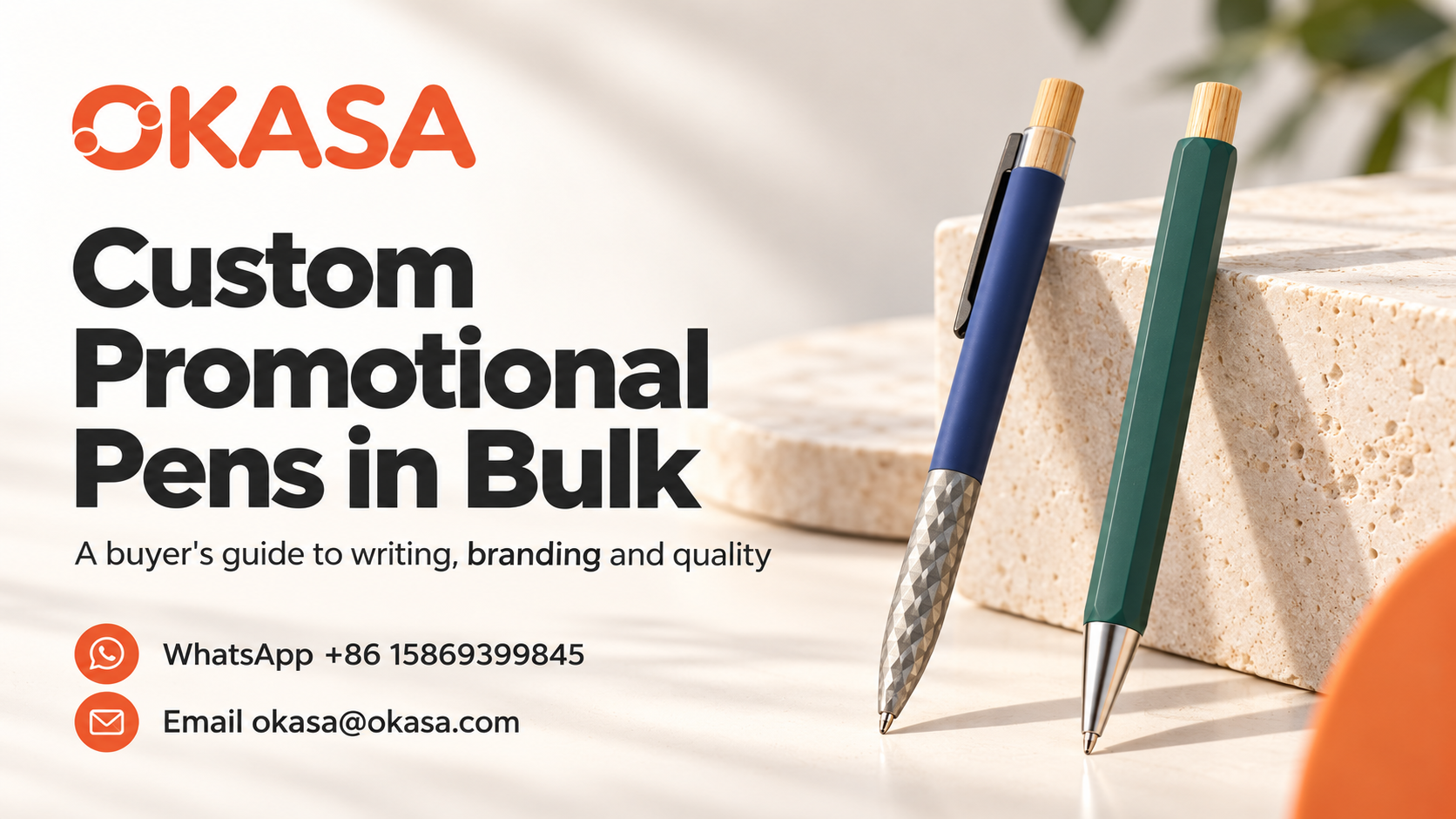
The TE892 is recycled aluminium, 140 by 9 millimeters, 13.5 grams. Push-button, rubberised finish, bamboo clip, diamond grip on the lower half. You feel the difference between the slim top and the textured bottom the moment you hold it — at least I do, and most people I have handed it to seem to as well, though one client preferred the opposite. Grip secure enough? Can you still read the logo when a hand is wrapped around it? And do fingerprints show under meeting-room lights? I cannot answer those for your buyers, only you can.
The TE886 takes a different route. Also recycled aluminium, but wider and hexagonal at 137 by 11 millimeters and 16.3 grams, with a bamboo pusher. Some hands love that extra width. Others fight it. The spec sheet will not tell you which camp your recipients fall into, and neither will I, because I cannot know your recipients. Put both pens in a buyer's hand, have them write the same sentence, and listen. "The 886 feels solid but the clip needs a look" — that is the kind of note you can act on. "I like green" just tells you a color. I am not sure why we remember the color comments and forget the useful ones, but we do.
On size they sit close, both near 140 millimeters and weighing 13 to 16 grams, give or take. Each accepts several decoration methods, laser included, inside a 55 by 7 millimeter window. Some older sheets show 35, so check the version you are working from. The TE892 is the slim, round one with the diamond grip low on the barrel; the TE886, by contrast, goes wider and hexagonal. On the TE892 the bamboo is a clip or an upper accent. On the TE886 it is the push-button that carries the bamboo. I mix those two up every time I talk about them, so honestly, check the sheet rather than trusting whatever I just said.
Confirm the finish, clip, grip, refill, and production color as one named version before you quote. If a rep swaps the refill during negotiation — and they will, it is their job to keep options open — you are no longer buying the pen you tested, even when the photo looks the same. I have been caught by this exactly once and it was annoying enough that I now write the refill code on a sticky note.
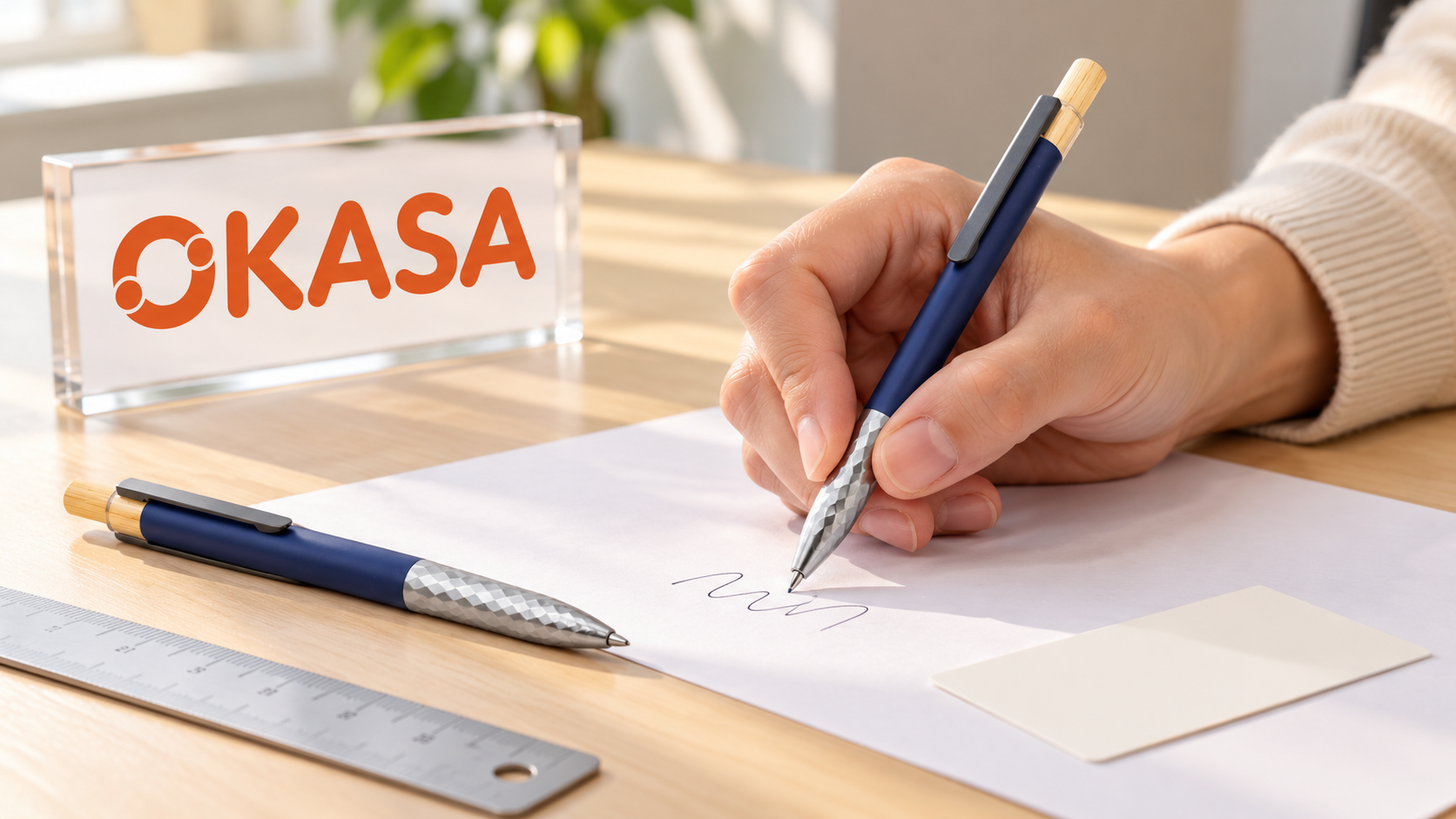
Illustrative usage scene based on OKASA product references.
Two pens, side by side
Numbers on a spec sheet never tell you which pen a hand prefers. The last row is the one that matters, the bit about what you actually do before committing. I made this table because I kept explaining the same comparison on calls.
|
What to compare |
What I would do |
||
|
Body |
Slim, round format with a diamond-pattern lower grip |
Wider hexagonal barrel |
I would write a full page with each, then notice which one tires the hand or slips on control. Sounds fussy. It is not. |
|
Bamboo detail |
Clip or an upper accent, as shown on the product page |
A push-button accent |
Take a close look at how the bamboo attaches, and whether the spot you want to decorate is actually free of it. |
|
Listed size and weight |
140 × 9 mm; 13.5 g |
137 × 11 mm; 16.3 g |
Put the final variant and its tolerances into the specification, so the quote and the sample agree. |
|
Branding |
Several methods; laser area 55 × 7 mm |
Several methods; laser area 55 × 7 mm |
Ask for a proof at true size on the actual barrel color, not on a separate swatch. |
3. The writing test you cannot skip
Nobody photographs the writing test, yet it is the first thing a recipient judges. There is no lab involved, either. What I do is hand the same sheet of paper to three or four people and watch what happens. The first volunteer scratches a few short lines onto the sheet. The next one manages half a paragraph before a stray thought interrupts them, and what they leave behind ends in a hurried signature. The ink either starts clean or it skips. A blob gathers at the corner of a letter. A line that looked fine at first turns shaky once the pen drops to an ordinary writing angle. And here is the detail people forget: roughly one person in ten writes left-handed, and a left-hander drags the side of their hand straight through the wet line, which surfaces problems a right-hander will never run into. A client of mine skipped that check a few years back. They still bring it up.
Test on the paper your event actually uses. Sample books are kind to pens. Coated stock is not nearly so generous, and I once watched a pen flow beautifully across a catalog page only to skip constantly on the glossy lead cards at a show. Porous recycled sheets misbehave in their own way, because the surface drinks ink instead of letting it sit. I keep a dated test sheet for every sample, with the sample ID and the refill spec written in the corner, and I would suggest you do the same. The moment anything about the pen changes — a different refill, say, or a new tip — the whole test runs again from the start. And before any purchase order gets signed, make sure you could name the refill inside the pen you just tried. If you cannot, something is wrong.
Some clients need documentary-grade writing. If that is you, put it in the RFQ and ask for evidence on the exact pen and refill. The relevant standard is ISO 12757. Its 2017 part deals with ballpoints for everyday use, while the older 1998 part, numbered 12757-2, is the one that covers documentary use — two different scopes sitting under one family name, which trips people up all the time. Nobody in my line of work interprets ISO clauses for a living, so when a tender depends on one, the fine print belongs with somebody qualified. And a neat signature in a meeting says very little about the stricter bar. Most ordinary promo pens fall short of it.
When you draft a promotional pen quality checklist, turn every line into an actual field that somebody has to fill in. Ink color. Tip size. The refill model, and whether it is replaceable. The writing result and the paper you used. A blue pen you photographed for the campaign shows up black if nobody wrote the choice down. That sounds obvious, and it is exactly the kind of slip that gets expensive at 5,000 units. I have watched it happen.
4. The bits that break first
Click the button thirty times. Does it return cleanly or catch? Then clip the pen to whatever a recipient would actually carry. My usual test involves a badge reel and a folded program, since those two tear and scuff before anything else does, and a clip that bends the card or scratches the finish is a fail on the spot. Look at the seam where barrel sections meet as well. A tiny step will not show in a product shot, but you will feel it every time the pen turns in your hand. Anyway, this is the part of the inspection nobody photographs.
Two details deserve a closer inspection than the catalog suggests. One is the seam on the TE892 where the diamond grip meets the smooth barrel, which a thumbnail will find quickly if the molding is off. The other is the hexagonal body of the TE886, which some writers use to orient their fingers and others find genuinely irritating, so roll it between your own fingers and decide. Bamboo adds another wrinkle, because grain and tone shift from unit to unit, far more than the catalog implies. Agree what variation you will accept and confirm how the accent attaches on the production sample. Three hand-picked photos will not define a full run, however carefully somebody chose them.
Where the pen lives decides what you check. Open trays need pens that will not roll or get mixed with a neighbor's stock. Field reps are a different case — their clip has to survive being thrown in a bag. The desk gift is where you can afford a nicer action and finish. Not every defect deserves the same attention, though. Cosmetic marks cost you nothing, while certain failures cost real money, and the factory will build its inspection plan around whichever problems it considers serious unless you say otherwise. A click mechanism that dies on event day is the expensive one. A clip that snaps inside a rep's bag is annoying but survivable, and a faint logo falls somewhere in between. Whatever worries you most is what the production check should focus on. Leave the decision to the factory and their priorities will take over, which rarely lines up with yours.
I stopped quoting cycle life and drop ratings years ago, at least for models that were never tested to an agreed method. A demo at sample stage tells you how two pens compare on that afternoon, and that is all it tells you, though plenty of buyers and salespeople treat it as a lifetime promise. What the exercise actually buys you is a short list: the failures that justify a formal check at production, versus the ones you can leave to a visual comparison with the approved sample.
5. Your logo is smaller than you think
The first thing I ask for is the company name printed at its real size. Physically, on paper, with a ruler on the desk and a barrel held up next to it. Nine millimeters is tighter than it sounds, and you only feel that once a real barrel is in your hand. On a monitor at 300 percent zoom everything reads fine. On paper the same lockup usually comes out looking like a small stamp somebody pressed in the wrong place.
Design teams resist this and I keep making them do it anyway. Three candidates at arm's length, one after another, the full legal name first, then the short wordmark, then the little symbol that legal signed off on years ago. Whatever you can still make out from a meter back is the artwork that gets printed. Marketing usually prefers the full name. That is a separate conversation, and it usually ends with the wordmark.
Decoration on these two pens comes down to four routes, and the laser one carries a fixed window of 55 by 7 millimeters. That number does not move with the barrel color. The result inside it changes, sometimes a lot. Laser removes the coating; no ink is involved, and the tone that comes back is whatever sits underneath. A barrel reading near-black throws back a bright, sharp mark. A greyer barrel off the same pallet can swallow the same artwork until you have to hunt for it. Both outcomes showed up in one delivery I received last spring, and I stopped trusting color swatches after that.
Silk print is a different animal. It can get much closer to the exact brand color, but the ink then has one particular surface to live on, and whether it stays there through a trade-show season is a question no PDF answers. The abrasion test settles it. Two or three finished barrels, rubbed with something close to what a pocket lining would do, and ten minutes later you know whether the ink holds.
Position needs actual numbers: where the mark starts, in millimeters off the click end; where it ends up relative to the clip; the maximum height and length the print area allows. All three belong in the spec, not in a conversation.
Then there is the check that costs nothing, and it is slightly silly. Drop a finished pen on a desk any old way, walk to the doorway, and squint back at it. From that distance the logo is either visible or it is not. When it is not, that placement dies right there.
Once that is settled, the artwork travels over as vector files with brand-color references riding along. When the finished sample comes back I do the photographing myself, standing wherever a recipient would stand first. Anything printed on the underside of the barrel is invisible by design, and that money is simply gone. Pocket carry adds one more twist, since the clip decides how the barrel hangs, and the side facing outward is the only side worth printing.
Start with five or six samples out on the table at once, and never the polished single piece the rep chose. One pen from a carton says nothing about the 4,995 behind it. Deciding what counts as a reject works best before any sample exists, while nobody has spent a weekend defending one. A small color wobble that only studio light catches will bother exactly nobody. A crooked mark visible from across the room goes back, and getting that rule onto paper early saves the argument.
Add barrel colors and the work multiplies. Green, blue and black each take the decoration differently, so every color in the run gets its own contrast check. Blue gives us the most grief of the three. Fifteen years in and nobody has explained why.
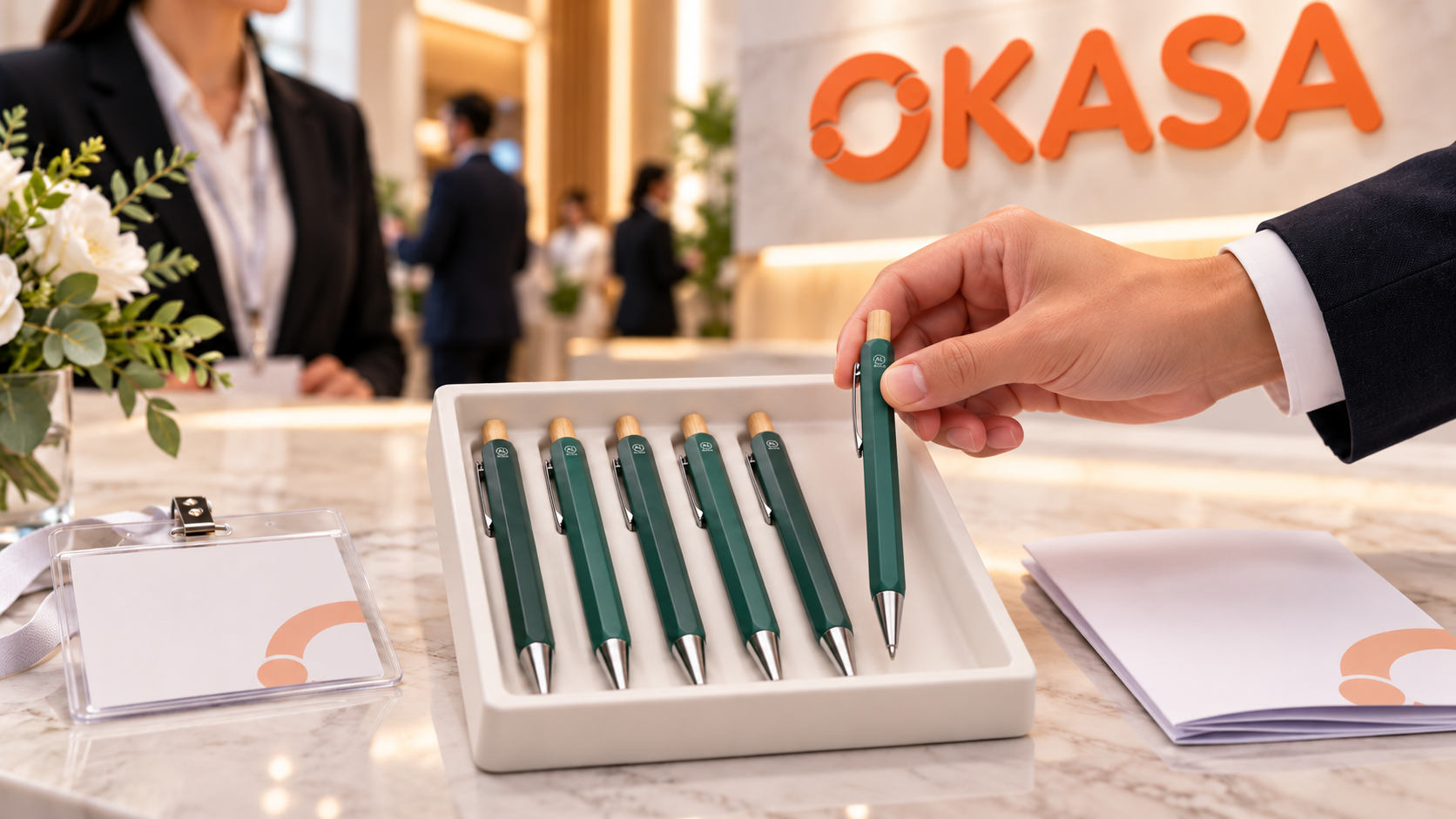
Illustrative usage scene based on OKASA product references.
6. About those recycled claims
Both catalog pages describe a recycled-aluminium barrel with bamboo details. That is a fair place to start a sustainability story, and the barrel is one part among several, which is where the story starts to wobble if you leave it there.
Inside sits a refill with its own materials, made on its own line somewhere. Then there is the mechanism around it, the coating on the outside, the clip, and the shipping box. None of those share a sourcing path. Which means an environmental claim in your copy has to manage two things at once, naming the exact component it describes and producing evidence for the version you ordered. Volume does not help a claim. Five thousand units is no truer than one unit was, and bulk orders of recycled aluminium pens live under that same rule.
Under the U.S. FTC Green Guides, a product that is only partly recycled needs qualified language. Which means the supplier's material declaration has to be in your hands early, well before any claim appears on the pen or in the campaign copy. What wording is even allowed shifts from market to market, and it shifts with the claim itself. So route the draft through compliance early. Reviews that arrive after three people have already signed off tend to end in rewrites, in my experience.
A bamboo accent cannot carry a green claim by itself. The catalog makes that detail look meaningful, and it is meaningful as a design touch. It is not evidence, though, and the page blurs that distinction. I stood near a campaign a few years back that put its entire sustainability angle on that one clip. The cleanup ran for weeks. Nobody on the team looks back at it warmly.
Longevity belongs in this section and almost never gets checked. Does the refill come out at all? Will the person who reorders next year, possibly somebody entirely different, know which refill fits without calling you first? The finish has its own job, surviving however many months of pockets and desks a working day throws at it.
There is an awkward truth sitting in the middle of all this. The pen that survives a year in somebody's bag does more for your sustainability story than printed labels ever did, and none of it needs the word sustainable anywhere. Lifespan promises are a different matter. I hold off on those unless there is measured data behind the number, and I would suggest you do the same.
One habit, and then this section is finished. Keep the claim sheet away from the design brief. The sheet wants three columns: what the supplier claimed, whatever evidence actually arrived, and the exact wording together with the markets where that wording is valid. That third column is the one teams skip, and it is the one that matters at review time.
Here is how the failure happens. It starts with a purchasing note, worded carefully and qualified down to one component. Weeks later the brochure describes the whole product in those same words, minus the qualifiers. Nobody did that on purpose. The note traveled between teams and lost its hedges somewhere along the way.
Catch the whole thing at the artwork stage and the fix is one phone call. Once the cartons have printed, the same fix shows up as an invoice, and not a small one.
7. Compare total delivered cost, then decide whether the pen stands alone
Ask for prices at the quantities the buyer might actually order, but keep the specification identical between tiers. A 2,000-piece quote for a decorated pen and a 10,000-piece quote for an undecorated stock version are not a meaningful price curve. Request the unit price, setup or tooling charges where applicable, sample and courier charges, packaging cost, carton count, inspection scope, lead-time assumptions and freight basis. Confirm whether the quoted quantity is a single color and one imprint or a split across several variants.
|
Cost line |
Standalone event pen |
Pen within a presentation program |
Clarify in RFQ |
|
Product and refill |
One approved pen/refill version |
Same, or a premium variant |
Is the ink and mechanism identical to sample? |
|
Decoration |
One logo position or agreed alternative |
Possibly matching marks across products |
Which method, size, colors and setup fees? |
|
Packing |
Bulk carton or simple sleeve |
Individual presentation, insert or kit labor |
Who assembles and checks each pack? |
|
Distribution |
Venue delivery or warehouse stock |
Multiple recipients or destinations |
Who labels, splits and ships cartons? |
|
Contingency |
Event replacement stock |
Replacement units and repeat-order reference |
How many spares are budgeted? |
If the pen is a companion to a writing product, a custom notebook manufacturer can help size the loop, test the pen against the chosen paper and coordinate colors. If the client wants a desk program with a reusable bottle, involve a custom drinkware manufacturer only after the pen itself is settled; the drinkware should have its own performance and branding approval. A custom bag manufacturer may become relevant for a field team whose carry pack needs a pen compartment. These are optional extensions, not default additions to every pen quote.
Presentation changes the price model. A custom gift box manufacturer should receive a real pen sample and the rest of the intended contents before quoting an insert. A custom corporate gift set manufacturer can coordinate a pen-led set, but the price should distinguish its products, branding, box and assembly. Call the combined offer bulk corporate gifting solutions only when the quote actually covers a coordinated program. Otherwise a simple pen order may be the better commercial fit.
8. Keep your samples straight
People use the word "sample" for three different things, and the mix-up causes more trouble than any defect ever has. A stock pen shows form and function, nothing more. A decorated sample is where your logo and finish get tested. The pre-production sample carries the agreed spec right before volume begins. Label all three, and let the order record say which one governs which trait. Ink that came from one pen and artwork that came from another deserves a written note. And a photo without a revision date has burned me before, so now I ignore those.
An OEM partner needs a compact spec sheet from you. Model and color reference at the top, then material and finish, refill identity, tip and ink color, the mechanism, the decoration drawing, approved position, packing, carton marks, destination, target quantity, sample status. On the schedule side, artwork approval, sample confirmation, manufacturing, inspection, dispatch, and arrival should each get their own line. A delivery date promised before the artwork is signed is a wish, honestly. Whether you are a custom metal pens manufacturer vetting a partner or a buyer handling OEM pen sourcing China, the trail is what keeps the order honest. Most delays I have traced came from one skipped step somewhere in that list.
Units for inspection should come out of more than one carton, and each one gets the same treatment: writing start, button, clip, coating, imprint position, ink color. The quantity and color mix get checked against the packing list. Wherever a signed approval sample exists, that is the reference, full stop. The rep's earliest prototype looks shinier and matches nothing you agreed to, so keep it out of the comparison. A defect-and-replacement rule should exist on paper before the shipment leaves. Afterward there is only arguing.
For China sourcing, state destination and trade term so the quote compares cleanly. A Chinese maker can fold design and adjacent categories into one conversation, but you still own the refill, the decoration approval, and the final inspection. Where it is made does not replace a traceable spec, and I would not let anyone tell you otherwise.
Keep one more file for reorders: final artwork, the approved pen, refill code, finish, a packing photo, the inspection result. Six months from now somebody will type "same as last time" into an email. Without that file, the phrase means something different to every person who reads it.
9. Write the RFQ like you mean it
One page is enough for a first inquiry, and pretending every detail is already settled only creates problems. Say whether the job is trade-fair, office, or premium work. Give the quantity by color, the logo art, the destination, the in-hand date, the model if one is relevant, the ink color, the packaging, and whether a decorated sample is needed. Anything still undecided should appear as an actual question. A blank on the form gets filled in by whoever sees it first, and that person is not you.
A shape that works, roughly: "About 5,000 pens for a November conference in Germany, split between two barrel colors. We are comparing TE892 and TE886. Quote a one-color logo and a laser option, confirm refill specs and sample costs, show bulk packing separate from individual sleeves." Nobody in that example is real and none of the prices are OKASA's, yet the supplier now has something to compare. The alternative, "send best price for metal pen," has landed in my inbox more than once. It never leads anywhere useful.
Questions buyers ask before a bulk pen order
What is the MOQ? That depends on the model, the color split, the decoration, and the packaging, and no catalog page sets a single MOQ for every configuration. Send the quantities you have in mind and ask for confirmation on the specific version. A cleaner answer does not exist, unfortunately.
Can the pen be refilled? Ask for the exact refill model and a demonstration on the ordered pen itself. Two refills that look identical are not always interchangeable. Where future replenishment matters, availability deserves a question too, since the refill you like today can vanish from the catalog by next year.
How do we know the logo lasts? Choose the method and surface, approve a decorated sample, and agree on an abrasion check that reflects real use. A digital proof settles placement alone. Adhesion and engraving contrast need the physical test, every single time.
Can two colors ship at one price? Sometimes. Splitting colors moves the per-color minimum, the setup, the packing, and the schedule, each in its own direction. Ask for the exact mix to be priced against a single-color order, and the gap will be right there on paper instead of hiding in a budget later.
What if we later add a notebook or gift box? A revised bill of materials comes first, then a packed sample. Pen retention, box fit, assembly labor, and the true delivered unit cost all need confirming. The original pen quote almost never covers those services, and the gap tends to surface at the least convenient moment.
What backs up an environmental claim? The component gets named, the wording gets fixed, evidence gets requested for the ordered version, and a review for the destination market happens before anything prints. This is the one question worth repeating, since getting it wrong costs more than money.
The pen is small, yet the decision deserves more precision than it usually receives. Hand OKASA the use case, the sample references, the quantity, the artwork, and the delivery constraints, and the reply that comes back can compare real options instead of guessing at what premium means. A pen brief and a quote request cost five minutes. The alternative costs a campaign.