

Picture the sample meeting. Cover color? Right. Logo? Crisp. The book has just enough heft to read as a thoughtful gift. Good.
Then someone writes on page one.
The pen catches near the coil. Ink ghosts through to the back. The thing won't stay flat on a crowded meeting table. None of it was in the quote — because the quote said "A5 notebook, 80 pages, custom logo." Six words. That was the whole specification.
A line like that doesn't give a factory what it needs to build the experience you're picturing. And it makes two prices impossible to compare fairly. One shop may hear "80 sheets." The other, "80 printed sides." One prices a paper-faced board; another, wrapped fabric. Fronts look identical. Behavior in a training room, a tote bag, or after a month of daily abuse? Different story.
This guide starts where the recipient does — at the open book. We work backward: writing surface, then binding, cover, sample, and finally the purchase order. Goal is a spec you can actually use and a quote you can check.
One honest caveat. The little scenes below are buying situations, not stories about a specific OKASA customer or promises about a real production run. The product references are OKASA's published models; final materials and construction still get confirmed in your own quotation and approved sample. Always.
First, watch what happens after the cover opens
You'll learn more in five minutes of real use than from a long menu of decoration options. Put the sample on the kind of desk or lap it'll actually live on. Open to the middle. Write with the pens the program's handing out. Turn a page. Try writing near the inside edge. Close it, reopen it, a few times. Then drop it in the bag or gift box it'll travel in.
Watch where your hand goes. A conventional double-wire coil lies flat nicely — but the wire eats writing room right at the spine. For a left-hander, a wider inner margin often matters more than a slightly thicker cover. (Counterintuitive, the first time you see it.) A soft coil? Handling and look shift again; check the coil actually resists deformation in the packing it'll ship in. A bound book — ask how easily it opens, and whether you truly need a flat spread. Outside a real use case, there is no "best binding." There just isn't.
OKASA's published TNB763-02 A5 coil notebook is a good example of a spec with real teeth: a 300 g special-paper cover with an EVA pen case, 70 sheets of 70 g beige ruled stock, black metal double coil, published size 21 × 14.5 cm. Those numbers aren't a stand-in for holding one. They tell you what to test — does the pen case wreck stacking? Does the coil clear the page edge? Does the ruled stock suit the buyer's usual pen?
Then there's TNB762 sugarcane-cover soft-coil notebook: 70 blank sheets of 80 g bagasse paper, bagasse-paper cover on grey board, transparent green soft coil. Two different propositions. The useful comparison isn't "70 g vs 80 g." It's ruled vs blank. Paper surface vs writing instrument. Metal vs soft coil. And how the cover protects the book once it's carried around.
The five-minute use test
Hand the sample to someone who didn't pick it. No instructions — just "take notes for three minutes." Watch where they turn it. Whether they prop a page with the other hand. Whether they use both sides. Then flip to the back of their writing.
This isn't a lab result. It isn't a certification. It's a fast way to find out if the proposed build matches the job the product has to do.
And it quietly rewrites the RFQ. A sales team may care most about a lay-flat surface. A leadership gift may weight a particular cover feel higher. An event notebook might need a pocket for the schedule. None of that fits inside the word "premium." Premium is what people say when they haven't decided yet.
Paper weight is a number, not a writing test
Gsm. Grams per square meter. That's all the number measures — paper mass per area.
Somehow it ends up doing three jobs in every paper conversation. Predicting feel. Predicting durability. Predicting how a gel pen behaves. It predicts none of them. I've handled two sheets at the same grammage where one let a rollerball glide and the other dragged like sandpaper. Different finish, different opacity, different bulk. The person writing feels every bit of it. Your quotation lists none of it.
And the vocabulary mess. People say "bleed" for everything, and that's where projects go sideways.
Actual bleed-through means the ink physically went through the sheet — you see it, sometimes feel a slight ridge, on the back. Show-through is milder; the writing is just visible from the other side while the ink never left its page. Feathering is the line wandering into the fibers until the edge goes fuzzy. Hold a page up to a bright window and perfectly good paper will show writing. That's not bleed. But watch what happens next: the buyer calls it bleed, the supplier "fixes" it by jumping to a heavier, pricier stock — when the real problem was the ink. Wrong problem. Solved expensively.
So bring pens. Actual ones.
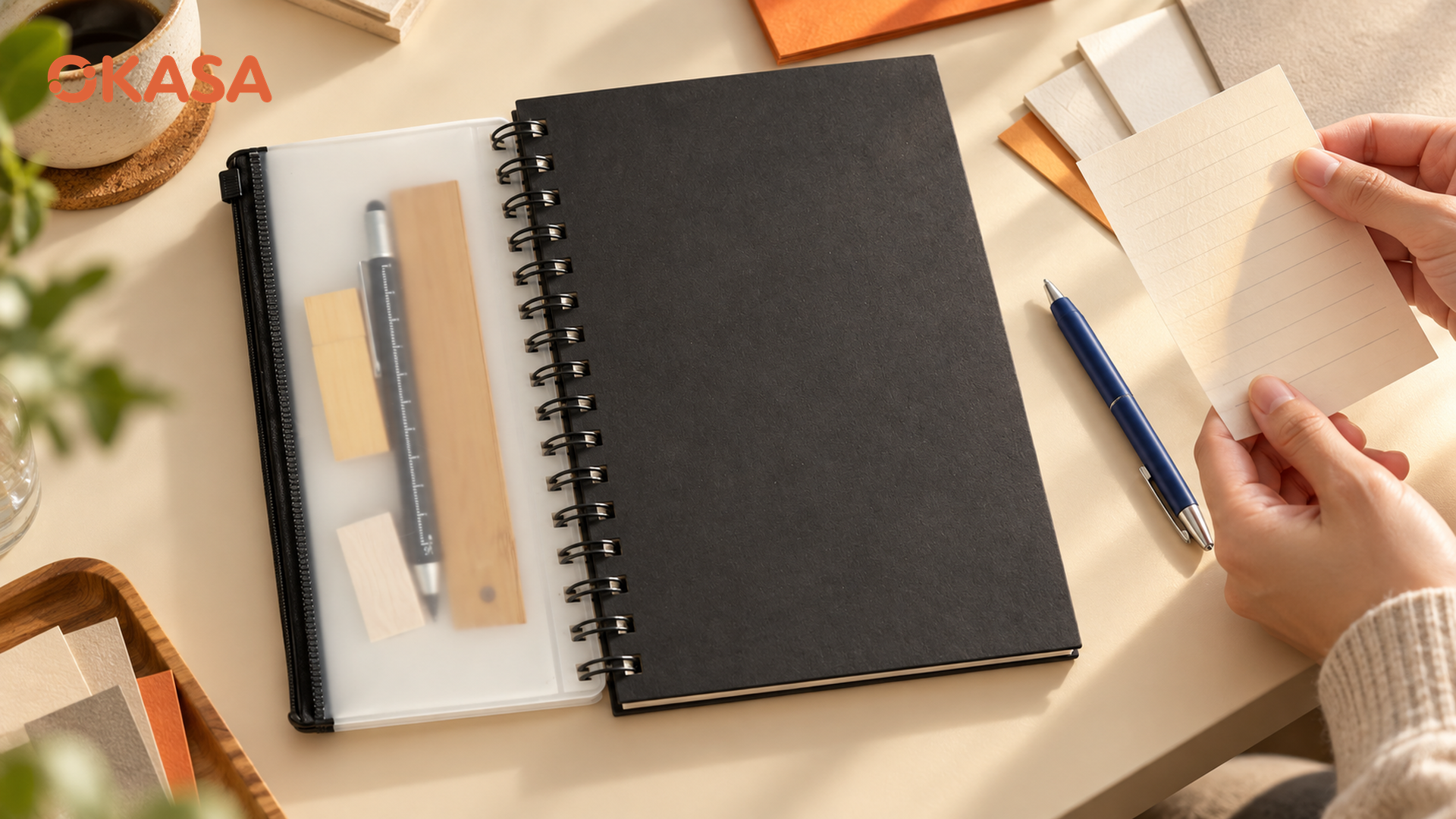
A ballpoint. A gel. Whatever marker or fountain pen your audience will really use — they'll smuggle in their own anyway, you know this. Write a few lines at normal speed. Then wait before flipping the page. Nobody fans pages dry in a meeting room; ink that sets fast matters every bit as much as a page that looks opaque. Judge it under desk light, where the book will actually get read — not the phone flashlight.
One more thing. If the program ships with a pen, test that pair together. A good paper and a good pen can still be a bad couple.
Color next. Beige reads softer and cuts glare; white handles small diagrams and colored notes better. Natural fiber stock throws flecks and tone shifts — charming in one program, a QC complaint in the next. So ask the supplier one direct question: does this reference sample represent bulk tolerances? If consistency matters, lock the acceptable color and texture range against retained samples. Not "natural beige." That phrase means whatever the person looking at it wants it to mean.
Recycled, bagasse, milk-carton, RPET. Nice words. They describe one component — and a notebook has several.
Which part actually holds the claimed material? Is there a percentage anywhere? What paperwork comes with your order, specifically? The cover can say recycled while the inner paper, coil, glue and packaging say nothing at all. FSC claims live in their own lane: a label on a finished product rests on chain-of-custody certification, so verify the supply chain and the permitted claim before anything goes to print. FSC's own explanation is the place to start. A supplier's one-line material description is not a certificate. Don't let anyone treat it like one.
"80 pages" can mean two completely different books
Here's a scenario that ends arguments only after money is spent. An RFQ goes out: "A5, 80 pages, lined." Supplier one reads 80 printed sides. Supplier two reads 80 sheets — 160 writable sides. Guess which book is thicker, heavier, and pricier to print and ship. Right. The dispute surfaces when the sample lands, which is the worst possible moment.
So write the numbers separately. Sheets. Writable sides. Printed sides. Both sides of 80 sheets usable? Put down "80 sheets / 160 writable sides." Front matter, a map, a calendar — count those on their own. Inside covers printed or blank? Do endpapers count? Do inserts use a different stock? The sample should confirm the sequence, not just the total.
A5 is a handy planning anchor, but published dimensions drift a little around that label. ISO 216:2007 defines trimmed A- and B-series sizes; a finished notebook also carries a cover, edge trim, and binding that change the footprint. If it must fit a sleeve, box, or bag pocket you already have, give the maximum finished dimensions and compare the physical sample. ISO 216 covers trimmed writing-paper sizes. It is not a promise that every product sold as "A5" shares identical outside dimensions.
|
Decision to record |
A vague RFQ says |
A usable RFQ says |
Check on the physical sample |
|
Writing stock |
"Good paper" |
Stock reference, gsm, color, surface, ruling and permitted alternatives |
Write with the intended pens on both sides |
|
Page quantity |
"80 pages" |
80 sheets, 160 writable sides; inserts listed separately |
Count sheets and verify printed sequence |
|
Page layout |
"Lined" |
Line spacing, margin, ink color, blank zones and artwork proof |
Write near the coil and the page edge |
|
Binding |
"Spiral" |
Metal double-wire or selected soft coil, color, diameter and position |
Turn pages, lay flat, check snagging |
|
Cover |
"Hard cover with logo" |
Facing material, board thickness, finish, logo method and size |
Examine corners, flex and abrasion |
|
Packing |
"Individual pack" |
Sleeve or wrap, protective layer, carton count and orientation |
Pack and unpack a finished sample |
Money hides in nearly every row. More sheets, more stock and freight weight. Wider print area, new artwork and extra plate or setup work. A special cover can drag in material minimums or a longer lead time; a pocket, more assembly. So ask for a base option plus named alternatives. Then the price gap belongs to a decision you can see — not some mysterious "upgrade."
Binding has a job; the cover has another
Easy mistake: choosing binding by how a closed book photographs. Recipients don't live with the closed book. They live with the open one. A meeting notebook has to survive a narrow table. A training journal gets opened and slammed shut all day. A travel notebook gets crushed between a water bottle and a laptop. Put those conditions in the brief first — then ask for a binding recommendation. Not the other way around.
Coil-bound? Ask about coil material, color, diameter, finish, placement. Whether a pen clip or pouch fights page turning. Look closely at the ends of the metal wire and at how the book is packed — a protruding end catches on a fabric liner or scratches whatever sits next to it. And one diameter doesn't fit every page count. Thicker paper, more sheets? Then compare actual assembled thickness and turning clearance in a real sample. Not on a spec sheet.
The cover is a protective structure first, branding surface second. A paper-faced board takes an embossed mark differently than fabric or PU. A textured cover can look great with a modest one-color mark and fall apart — visually — with tiny reversed-out lettering. Corners wear first. Always corners. If the book rides in a gift set, check where it meets a bottle, pen, or insert. Sold alone? Think about the carton, then the distributor's shelf. Both punish weak covers.
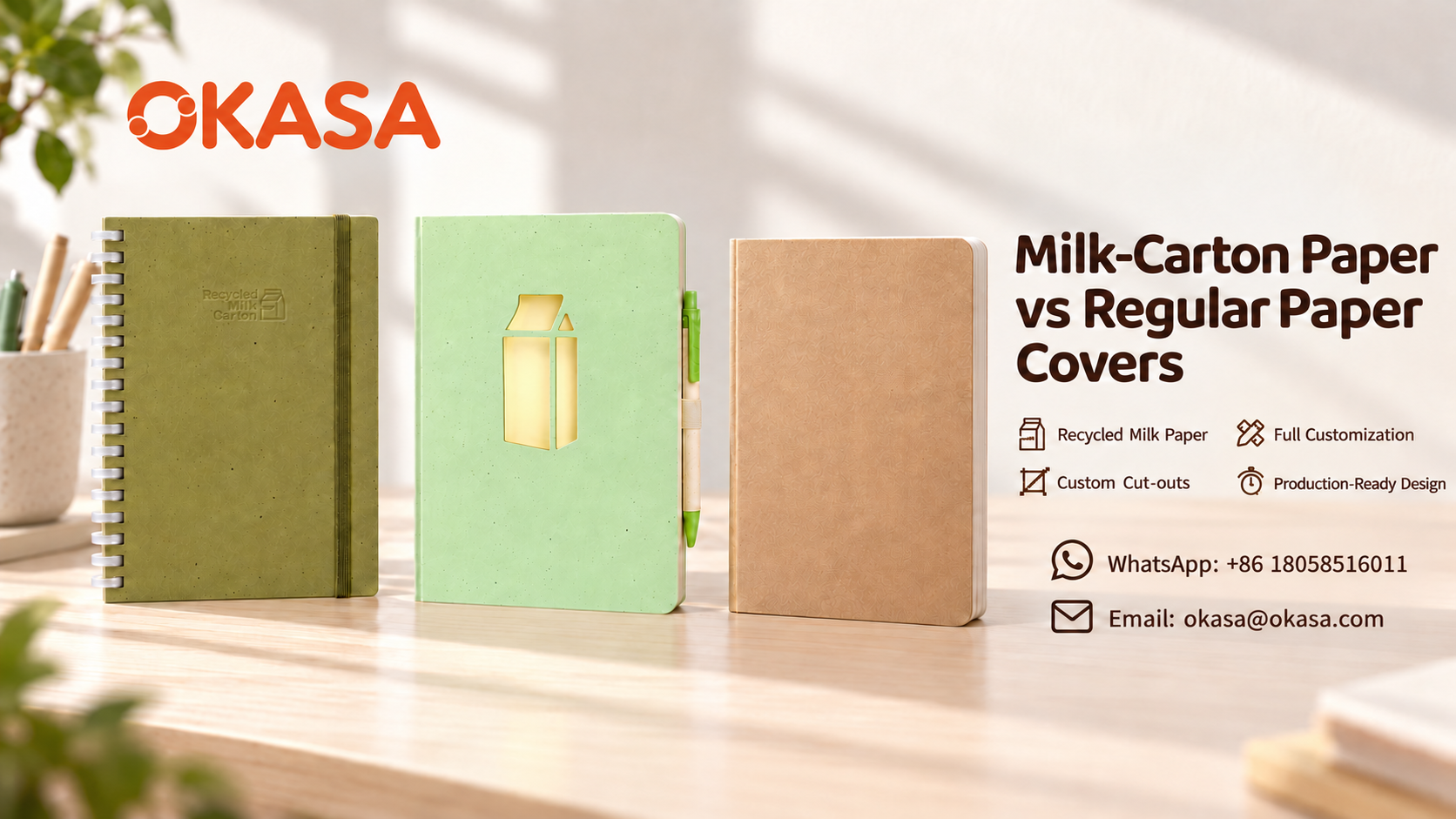
OKASA's TNB772 milk-paper-cover notebook shows why this matters: a circular cut-out in the cover reveals the logo on an inner page, 80 sheets of 70 gsm beige ruled stock. That one detail changes the artwork file, assembly alignment, and the sample check. A logo you see through a window has to be positioned against the finished construction — not against the cover artwork alone.
This is the reason artwork approval and functional approval should be separate signatures. A PDF confirms spelling, position, color intent. It cannot prove page turning, corner strength, ink behavior, or a window's alignment once the cover's mounted. Sign off a production-representative sample for the physical things that affect use. Keep that approved sample, and write down any change after it.
The buyer's sample table
When several departments weigh in, sample review slides into a debate about taste. Fast. A short observation record pulls it back. Lay out a representative reference. Write with the intended pen on pages near the front, middle, and back. Drop the notebook into its planned sleeve, bag, or box. Photograph any problem next to a ruler or a second sample. Write down what needs to change, who approves it, and which version the supplier quotes. One sheet. That's the whole system.

And skip the vague stuff. "Approved with changes" tells nobody anything. Page stock changes? The writing test reopens — simple as that. Sheet count changes? The coil or spine needs another look. Cover material changes? Logo finish and color reference need fresh sign-off. A real sign-off sounds like this: "Artwork proof A approved; page stock B and coil C to be resampled; final packing pending." One line. Purchasing and production now see the same state. That's the point.
Rejecting a sample is its own discipline. Name something observable. "Gel ink transfers after 20 seconds on the reverse of the test page." "Pages catch on the inner coil turning from the back." Hand a supplier that, and they can respond — different stock, wider inner margin, revised binding. "Feels cheap" might be true. It changes nothing, though. Nobody knows what to fix, and nobody can check the next sample either.
Last thing on samples: they should ride the same route as bulk goods. Sits in a rigid box? Review it in that box. Handed out at a conference? Try pulling it fast while standing — really, do this once, it's revealing. A tidy unboxed notebook still flops as a gift if the packaging bends a corner or the pen holder rubs the box wall. Where item and presentation touch, check them together.
A quote you can actually compare
A useful quotation names the exact option, quantity, artwork, and packing basis. One-time development or setup cost, kept apart from unit price. Freight listed on its own — or the delivery term defined in writing. Ask what's inside the sample fee, and whether a later material change triggers a new sample. Then, only then, line up two unit prices. Before sheet count, inner paper, binding, cover, logo process, and packing all match, a price comparison is just guessing with extra steps.
MOQ deserves the same suspicion. A stock cover with one-color marking can run a completely different minimum than a special cover material, custom-dyed coil, printed inner layout, or fully bespoke build. No single MOQ describes every custom notebook — anyone who quotes you one without asking questions is guessing. Send the quantity you have in mind and flag which specs can move. A good manufacturer then offers a practical base construction plus a more customized alternative. Without pretending they're the same product.
Here's a buying brief you could send as the inquiry. Illustrative template — not a record of an OKASA project:
We need 2,000 A5-format training notebooks delivered to [destination] by [in-hand date]. Please quote 80 sheets / 160 writable sides with a cream ruled inner stock, a double-wire binding, and an orange cover with a one-color logo. Include the finished outside dimensions, stock and binding references, individual protection, export carton quantity, sample timing and price for a 70 g versus 80 g inner-paper option. Our recipients will write with supplied gel pens; we'd like to approve the paper and an assembled sample.
See what it doesn't do? It doesn't dictate a manufacturing route. It doesn't claim a test standard nobody defined. It asks for comparable options and hands the factory enough context to suggest better ones. Which is exactly what a strong first inquiry should pull off.
Where the notebook sits in a wider program
Most paper-and-binding calls actually get made inside a bigger promotional order. Notebook joining a set? Then a custom corporate gift set manufacturer should review open dimensions and packed thickness against the other items. Standalone stationery program? Start with a custom notebook manufacturer and send the brief above. Bottle pairing? A custom drinkware manufacturer joins the packing conversation. Carry kit? Now a custom bag manufacturer needs to test pockets, load, and abrasion. Every extra item changes the answer a little.
Materials cross categories too. After a sustainable promotional products manufacturer? Ask for component-level material and claim docs. Working with a custom gift box manufacturer? They'll want the finished notebook's thickness and corner clearance. An OEM promotional products manufacturer can develop a non-catalog configuration — but the approved paper, binding, and artwork still need written control, no exceptions. In promotional products sourcing China, multi-item quotes get easier to compare once each component has a defined sample and packing basis; the same goes for bulk corporate gifting solutions. Evaluating a promotional products manufacturer China partner? One question does a lot of work: how do the notebook sample, logo proof, and final carton spec stay in sync?
Links above lead to OKASA's relevant product families. Entry points for discussion — not proof that every configuration described here sits in stock.
Questions worth answering before the PO
70 g or 80 g paper? Start with the pens, page count, feel, target price. Test both candidate papers with the same layout and the same pens — same everything. Grammage alone won't settle the writing experience. And the choice may nudge finished thickness and freight either way.
Can a notebook be "A5" if the cover is larger? A5 describes a paper format, that's all. Confirm finished dimensions, especially if it must drop into an existing box or sleeve. The sample is the fit test. No sample, no fit test — it's that blunt.
Does a recycled or plant-based cover make the whole notebook sustainable? No. Name each component separately. Ask for whatever material evidence exists, and don't stretch a cover claim to paper, binding, and packaging without support. Planning a certification mark? Clear the exact claim and supply-chain conditions first. Before print, not after.
What must be approved before bulk production? Artwork proof first — content and position. Then an assembled sample: color, paper, binding, writing, cover, packing. Record the approved version and any open exceptions. Change the stock or construction later and the affected checks reopen. Yes, again.
Why are two A5 quotes so far apart? They may be pricing two different books. Ask for a line-by-line spec, pin the base construction, list options for paper, sheet count, cover, binding, logo, packing. Compare on the same delivery basis. Now the gap means something.
Can notebooks go inside a mixed gift set? Yes — if the actual items are tested together. Protect cover corners and printed surfaces, check movement inside the box, confirm finished weight and dimensions. A notebook photographed alone tells you nothing about how the finished set ships. Nothing.
Send the notebook you want people to use
The strongest RFQ doesn't open with a long adjective list. It opens with a small scene. Who writes in it. Which pen. Where the book travels. How long it has to last. From there, paper, page count, binding, cover, packing turn into things you can quote and sample — instead of things you argue about later.
Send OKASA your target quantity, destination, in-hand date. The recipient and the use. Your logo file. Any product reference you like, plus one note about the writing feel you're after. Already have an approved notebook? Add a photo and its sheet, paper, and binding details. Ask for a base quote and the alternatives you genuinely need to compare. Then the reply addresses a real product. Not an attractive, incomplete label.