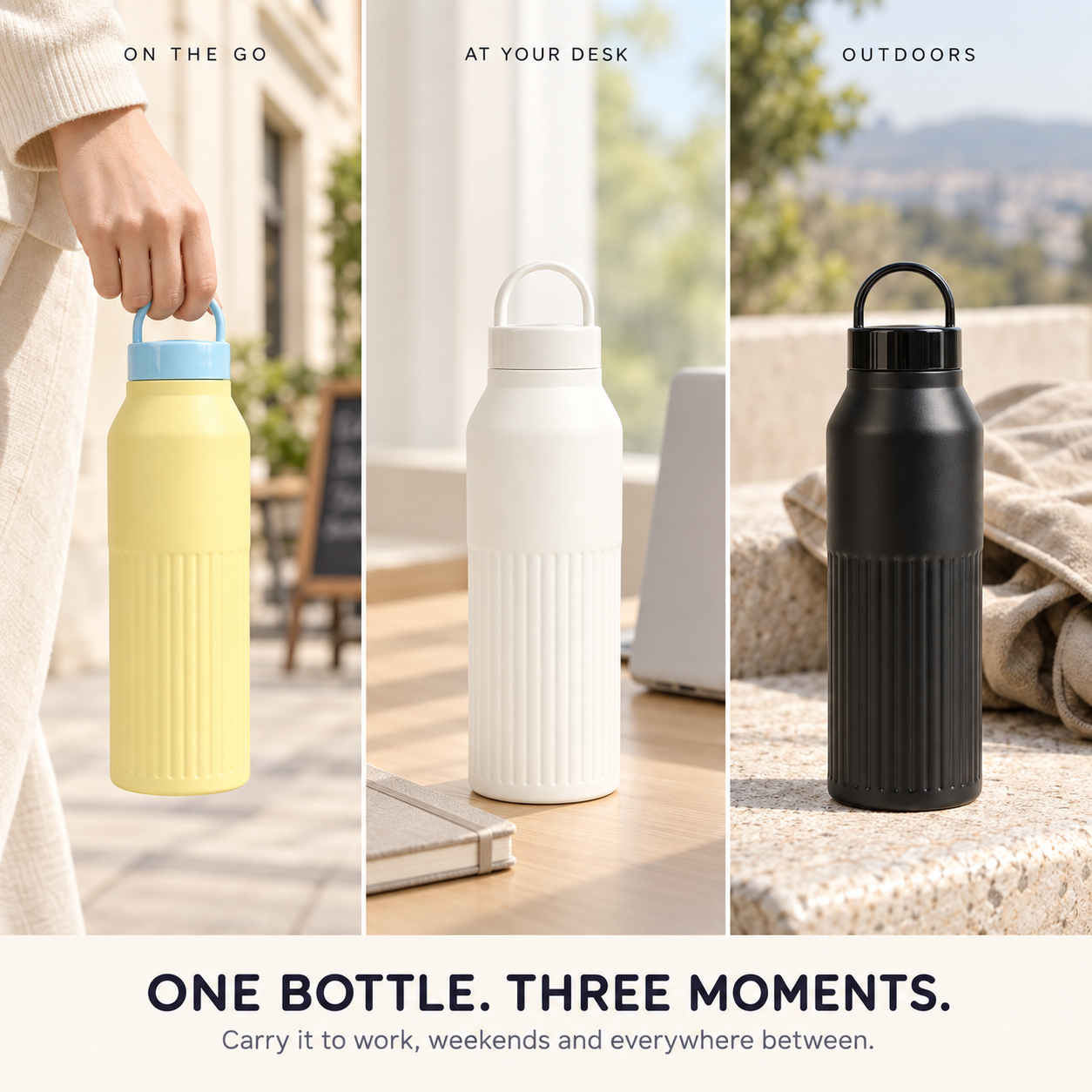


A distributor rarely receives a clean, production-ready brief. More often, the first message looks like this: “We need 2,000 gifts for a conference. Maybe a notebook, bottle and bag. Logo attached. Can you quote by Friday?” That is enough to start a conversation, but nowhere near enough to place an order.
The gap between that first email and a shipment-ready specification is where most of the work sits. A bottle changes the depth of the box. A larger logo may rule out a decoration method. A new bag color can add material lead time. One late sample can push the entire set into air freight. None of these issues is dramatic on its own. Put five or six of them together and a “simple gift set” becomes a small supply-chain project.
That is why choosing a promotional products manufacturer in China is less about finding the lowest first quotation and more about finding a team that can keep details connected. Product, branding, sampling, packing, inspection and delivery all touch one another. The supplier does not need to make every component under one roof, but someone has to own the final result.
This guide is for promotional distributors, corporate gift agencies, importers and procurement teams that buy repeatedly. It focuses on the parts of sourcing that tend to create rework: unclear briefs, non-comparable quotations, sample comments that disappear in chat threads, packaging designed too late, and timelines that begin from the factory ship date instead of the customer’s required arrival date.
1. Start with messy brief you actually received
A catalogue is useful once the boundaries are clear. Before that, it can make a buyer’s job harder. Hundreds of product photos encourage people to compare shapes and colors before anyone has agreed on the job the merchandise must do.
A trade-show giveaway has one set of pressures: it needs to travel well, show the brand quickly and stay inside a sensible landed cost. An executive gift is different. Presentation matters more, the tolerances are tighter, and the box may be part of the perceived value. An onboarding kit has another problem again: several useful items must feel like one program, often with individual cards or destination labels.
A short brief works better than a long mood board when it includes the awkward details. Quantity. Where the goods need to arrive. The actual date they need to be there. Budget range. Artwork status. Any material preference. Whether the buyer expects a retail-style gift box or simply safe individual packing. If the quantity is still moving, say so and request two or three price breaks.
One distributor we can imagine receiving a request for 1,500 welcome kits might initially write “notebook + tumbler + tote.” After a ten-minute clarification call, the real brief could become: 1,500 sets, Germany, delivery before 8 November, warm neutral palette, one-color logo, no plastic presentation tray, individual name card added locally. That second version is quotable. The first is only a direction.
A practical opening brief
| Field | What to specify | Why it matters |
|---|---|---|
| Use case | Event, onboarding, loyalty, resale or executive gift | Changes the product and packaging standard |
| Quantity | Expected order plus price breaks | Determines process, MOQ and cost structure |
| Branding | Logo file, colors, position and desired effect | Avoids quoting an unsuitable decoration method |
| Arrival date | The date goods must be received, not dispatched | Allows production and freight time to be planned backwards |
| Destination | Country, postcode and delivery arrangement | Affects packing, freight and documentation |
2. Decide whether you need a factory, a trading partner or a program manager
The word “manufacturer” is used loosely in promotional sourcing. Some suppliers operate a focused factory. Some coordinate a network of specialist plants. Others combine manufacturing, product development, packaging and project management. None of these models is automatically wrong. The right model depends on the order.
If you need one established notebook in a large quantity, a specialist custom notebook manufacturer may offer the most direct process control. If your program includes a notebook, a bottle, a bag and a fitted box, coordinating separate suppliers can create hidden work. You must align colors, collect samples, consolidate goods, check quantities and solve packaging conflicts. In that situation, a partner with cross-category project management may be more valuable than four separate low unit prices.
Ask who makes each component, who owns the final specification and who is responsible when two components do not fit together. A useful answer is specific. The supplier should be able to explain which parts are made internally, which are produced by long-term partners, where final inspection takes place and who approves the packed set. Vague claims such as “we can do everything” do not describe a control system.
For distributors, accountability matters more than labels. You need one project owner who maintains the approved artwork, sample comments, packing list and delivery plan. If responsibility is divided, write the division into the purchase specification before paying a deposit.
3. Build a product architecture before requesting prices
A coherent promotional range normally has three layers. The first is the anchor item: the piece that carries the most perceived value, such as a bottle, backpack or premium notebook. The second is the supporting item, selected for daily usefulness. The third is the presentation layer, including sleeves, inserts, tissue, a mailer or a rigid box. The right balance gives the buyer a strong opening experience without filling the set with items that will not be used.
For example, an eco-oriented program can pair an eco notebook made with recycled milk-carton paper with a reusable drinking vessel and restrained kraft-style packaging. A travel program can begin with a recycled cotton roll-top backpack, then add a notebook or bottle that fits its internal volume. An office kit can use the TGS918 office gift set as a starting point and adapt colors, logo methods or printed communication for the campaign.
Do not choose every component independently. A large bottle may force a deeper box, which increases volumetric freight. A thick notebook may make a bag look underfilled. A dark powder-coated surface may need a different logo method from a fabric cover. Product architecture considers these relationships before quotation, when changes are still inexpensive.
A good custom corporate gift set manufacturer should offer substitutions rather than treating a set as fixed. Ask which notebook size, bottle capacity, pen material or bag color can change without rebuilding the whole package. This is especially useful when the end buyer wants a distinctive result but has a firm budget.
4. A low quotes is not always a lower - cost order
Two quotations can look close while covering different products. “A5 hardcover notebook” may mean different paper, board thickness, binding and packing. Two 500 ml tumblers may use different steel combinations, lid structures or surface finishes. A tote can change price simply because one quote includes lining and reinforced handle points while the other does not.
The easiest way to expose this is to stop comparing the headline unit price. Put the specification beside it. Dimensions, materials, construction, logo process, number of print positions, individual packing, master-carton quantity, sample cost and the freight basis belong in the same comparison.
Here is a common distributor problem. Supplier A is 4% cheaper. After sampling, the buyer learns that the quote excluded the gift-box insert and included only one print position. Supplier B looked more expensive because both were already included. By the time the numbers are normalized, Supplier B is actually lower. Nothing dishonest happened; the quotes were simply not comparable.
| Cost element | Question to ask | Common omission |
|---|---|---|
| Product | What material and construction does the unit price include? | A lower-grade component quoted under a similar description |
| Branding | How many positions, colors and setup charges are included? | Mould, screen or plate fee added later |
| Packaging | Is individual protection and the final gift box included? | Insert, sleeve or transit protection excluded |
| Inspection | What inspection stages and reports are included? | Only a visual check after packing |
| Freight | What Incoterm, destination and chargeable weight apply? | Comparing EXW with delivered pricing |
Keep one “comparable cost” column in the sourcing sheet. It will never predict the final landed cost perfectly, but it quickly shows which low quotations are low because work has been omitted rather than made more efficient.
5. Treat decoration as an engineering decision
A logo is not simply placed onto a product. It interacts with surface energy, texture, curvature, heat, pressure and use. Screen printing may suit a flat, simple mark. Laser engraving creates a durable result on compatible metal surfaces. Debossing can look refined on certain covers but may lose small details. Embroidery adds texture to fabric, although fine lettering and tight curves need simplification. Heat transfer can reproduce more color but must be tested on the chosen fabric and finish.
Share vector artwork whenever possible. State the required print color using an agreed reference, but remember that a printed ink, coated metal, woven fabric and dyed paper will not look identical under every light. The sensible goal is controlled visual harmony, not an impossible promise of perfect cross-material sameness.
Ask the supplier to mark the logo position and dimensions on a proof. Check orientation when the product is used, not only when it lies flat for photography. A tumbler logo should face the intended viewer when held. A bag logo should remain visible after filling. A notebook mark should not collide with elastic, stitching, pockets or magnetic straps. Packaging artwork must respect folds, seams and barcode areas.
If branding is central to the campaign, approve a decorated physical sample rather than relying on a digital mock-up. The mock-up confirms placement; the sample confirms the real result.
6. Use sampling to remove uncertainty, not to collect souvenirs
Sampling should answer a list of questions. Start with an existing product sample when you need to judge size, weight, material and construction. Move to a logo sample when the decoration method or color is important. Request a full pre-production sample when several custom elements interact, such as a fitted gift box with multiple products.
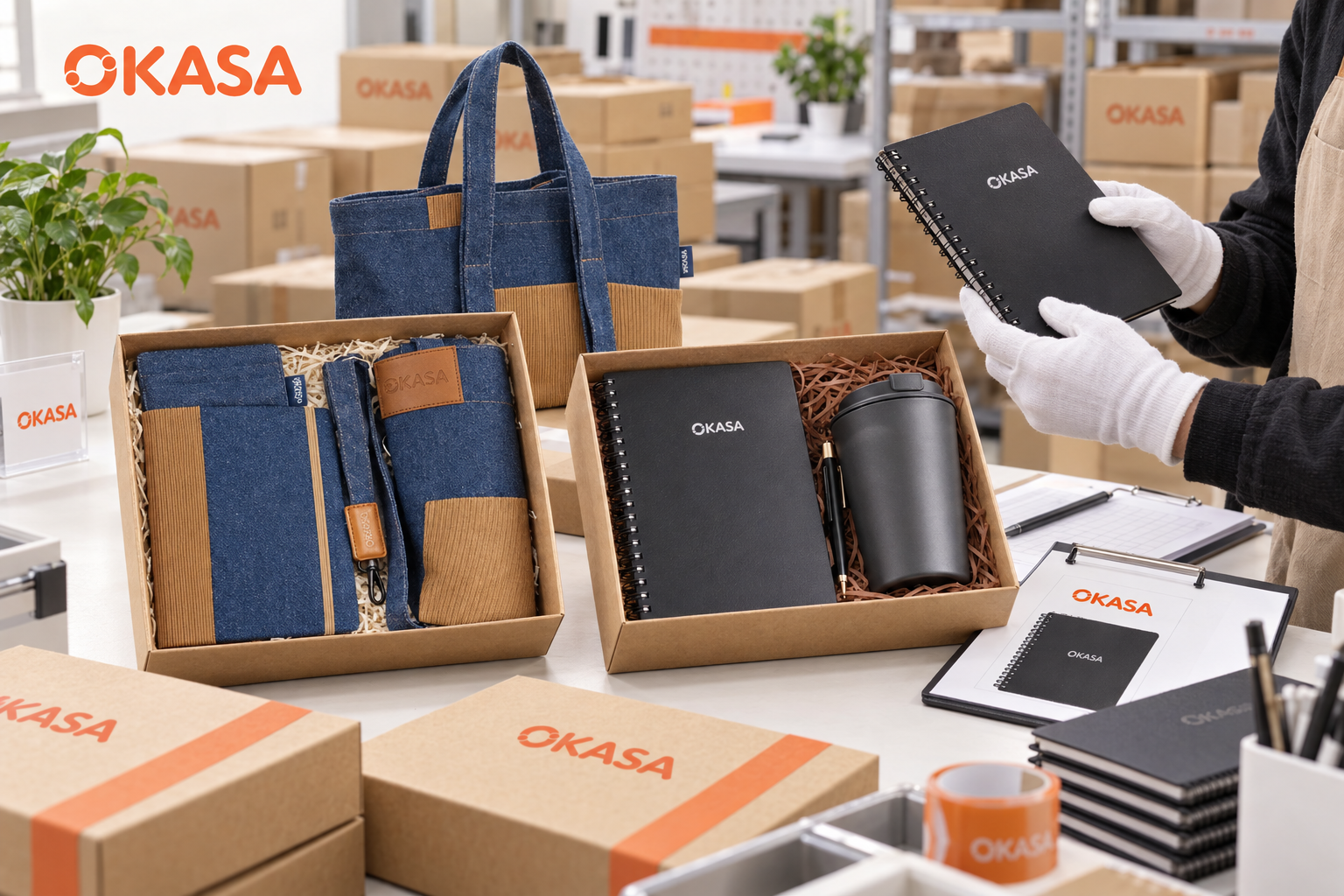
Do not approve a sample with comments scattered across emails and chat messages. Create one numbered approval record. Photograph the sample from consistent angles, mark each requested change and state whether the next action is “revise and resample” or “revise for production.” This distinction matters. If a visible change affects function, color or fit, a new sample is safer. If it is a minor text correction already proven on the same process, a revised artwork proof may be enough.
Your approval checklist should cover product appearance, dimensions, materials, function, logo size, logo position, logo color, packaging fit, printed text and overall workmanship. For drinkware, inspect lid engagement, surface coating and internal cleanliness. For notebooks, check cover alignment, binding, page order, print registration and writing feel. For bags, check seams, handles, zippers, lining and load-bearing points. For boxes, test opening, closing, insert retention and transit protection.
Keep one approved reference sample. It becomes the physical standard during production inspection and dispute resolution. Words such as “navy,” “soft touch” or “premium” leave room for interpretation. A signed sample is much clearer.
7. Evaluate notebook manufacturing beyond the cover
Notebooks are familiar products, which can make buyers underestimate the number of variables. A professional quotation should identify finished size, cover material, board thickness, inner-page paper, page count, ruling, print colors, binding, endpapers, ribbon, elastic and individual packing. If the notebook must lay flat or act as a stand, the structure should be sampled in the intended material.
Paper choice affects more than cost. Shade changes the visual mood; weight affects show-through; surface influences writing feel; grain direction can influence how pages turn. For a corporate program, ask who will use the notebook and with what writing instruments. A conference pad designed for quick notes does not need the same specification as a premium journal intended for long-term use.
Cover materials also behave differently under branding. Textured paper may hide very fine printed detail. Fabric can shift during application. Recycled materials may show natural variation that is part of their appeal but should be explained to the buyer. A structured product such as the A5 linen hardcover notebook with a magnetic strap and detachable stand needs both visual and functional approval.
When working with a custom notebook manufacturer, ask for a tolerance range on size, page count, color and logo placement. Inspect the first production units before the entire run is packed. A cover problem discovered early is manageable; the same problem discovered after individual boxing is expensive.
8. Evaluate drinkware as a system
Drinkware combines body material, insulation structure, surface finish, lid components, seals and packaging. Capacity alone is not a sufficient specification. Confirm the interior and exterior material, wall construction, coating or raw finish, lid material, drinking mechanism, gasket, accessory and individual protection. If the item is intended for hot or cold use, the supplier should state the intended function clearly rather than letting marketing language replace technical detail.
A custom drinkware manufacturer should review whether the logo method suits the surface. Powder-coated bodies can create strong contrast with laser marking, while printing may be appropriate for colored artwork. Curved surfaces restrict print area and can distort large designs. Lid inserts, silicone rings, handles and straps add branding opportunities, but they also add components that must be color-matched and inspected.
For a multi-item gift set, confirm that the bottle or tumbler is restrained inside the box. Movement during transport can damage both the coating and adjacent products. Test the packed set in the orientation in which it will be shipped. A presentation that looks perfect on a sample-room table may fail after repeated carton handling.
Use the eco notebook and tumbler gift set as an example of how material story, daily utility and box presentation can support one theme. It is a starting point, not a rule: capacity, notebook construction, color, logo method and packaging can be discussed according to the project.
9. Evaluate bags at the stress points
Bags are often judged by fabric description and appearance, but failures usually begin at stress points: handle attachment, zipper ends, shoulder-strap connections, internal seams and loaded corners. Ask the custom bag manufacturer how these areas are reinforced and how the product is tested for its intended load.
Specify fabric composition and weight or denier where relevant, lining, padding, zipper size, puller, webbing width, buckle material, seam construction and finished dimensions. If a laptop compartment is claimed, provide the target device size. If the bag needs to fit a gift set, test the actual set inside it. A few centimeters can change usability and carton efficiency.
Brand position should be evaluated on a filled bag. Panels curve, pockets expand and handles can cover artwork. Embroidery may need backing; printing may need a smooth panel; patches introduce stitching and edge requirements. The most attractive mock-up is not always the most durable production choice.
For recycled or natural-looking materials, agree on acceptable variation. Buyers may appreciate a material story, but they should not be surprised by shade or texture differences. Clear expectation-setting protects both the distributor and the end brand.
10. Design the gift box around logistics as well as appearance
A box is part of the product experience and part of the freight bill. Its dimensions influence material use, carton count, chargeable volume and damage risk. Begin box development only after the selected products and their packing orientations are reasonably stable.
A custom gift box manufacturer should discuss board structure, wrap paper, printing, lamination, insert material, opening style, closure, product clearance and transit protection. Foam can hold products precisely but may not fit the sustainability story. Paperboard or corrugated inserts can be more easily communicated as paper-based, but their structure must be designed for the product weight. Shredded paper creates a handcrafted look yet needs volume control and may shift in transit.
Request both the external box dimensions and the master-carton plan. Calculate how much empty space is being shipped. A slightly tighter layout can reduce freight without making the set feel crowded. Conversely, reducing space too aggressively can create pressure points that scratch a bottle or bend a notebook.
Packaging artwork deserves its own proof. Check the front, sides, base, inside message, barcode, recycling marks and any legal copy supplied by the buyer. Confirm which elements are printed, stamped, labelled or applied as a sleeve. If the program has multiple recipient groups, consider a common box with variable cards instead of multiple box versions. That can simplify MOQ and inventory.
11. Ask what “sustainable” means for this exact order
Sustainability claims should be specific enough to verify and modest enough to remain credible. “Eco-friendly” by itself tells a buyer very little. Ask which component uses recycled or alternative material, what proportion is claimed, what documentation is available, how the product is packed and whether the product is designed for repeated use.
A sustainable promotional products manufacturer should be able to separate material facts from marketing language. A notebook may use a cover containing recycled coffee waste while its inner pages and binding have separate specifications. A bag may use recycled cotton canvas with other materials in zippers, webbing or trim. A bottle may be reusable stainless steel but still require protective packaging. Honest component-level descriptions are more useful than broad claims.
Sustainability also includes avoiding unnecessary items, reducing oversized packaging, choosing durable construction and ordering quantities that the campaign can genuinely use. The greenest-looking set can still create waste if half the stock remains after the event. Begin with use, longevity and quantity; then select the material story.
If documentation is important to the end customer, request it during quotation, not after production. State the required standard, issuing body, validity and whether the document must cover the material, factory, finished item or chain of custody. Similar-sounding documents may cover different scopes.
12. Build a quality plan before production starts
Quality control is not a final inspection event. It begins when the specification is written. The approved sample, artwork and tolerance sheet define what inspectors should check. Without them, inspection becomes subjective.
For multi-item programs, use three control points. First, check key incoming materials or components: paper, covers, fabric, metal bodies, lids and packaging board. Second, inspect early production output after machines, colors and artwork are set. Third, perform a pre-shipment inspection on finished, packed goods. The exact method depends on order size and risk, but the principle is consistent: find problems while correction is still possible.
Create a defect list before inspection. A critical defect affects safety or legal compliance. A major defect affects function, branding or customer acceptance. A minor defect is cosmetic and limited. Agree on the sampling method and acceptance criteria with the supplier or inspection company. Do not wait for a failed inspection to debate what “acceptable” meant.
For assembled gift sets, reconciliation is essential. The quantities of notebook, bottle, pen, bag, insert, card and box must match. Define how extra components are handled. Ask for packed-set photos, carton marks, carton counts, gross and net weights, and carton dimensions before shipment booking.
An OEM promotional products manufacturer adds value when the approved standard flows through product, decoration and packing teams. The distributor should not have to rediscover the specification at every stage.
13. Plan lead time backwards from the required arrival date
“Delivery date” can mean sample completion, production completion, port departure or arrival at the buyer’s warehouse. Write the required arrival date and destination first. Then build a reverse schedule that includes artwork confirmation, sample production, sample transport, approval, material preparation, mass production, inspection, rework buffer, export handling, freight and destination delivery.
Do not treat every day as interchangeable. Public holidays, peak shipping periods, custom-material lead times and buyer approval delays all affect the plan. A supplier can control production, but not the number of days the buyer takes to approve artwork. Put response deadlines on both sides.
When the timeline is tight, reduce complexity deliberately. Choose an available product color, use a proven decoration method, retain standard components, simplify packaging or ship a small urgent portion by air and the balance by sea. Hidden shortcuts are dangerous; agreed simplifications are project management.
Ask for a milestone schedule with named outputs, not only “20–35 days.” A range is useful for early planning, while a live order needs dates: artwork approved, sample dispatched, material ready, production start, inline inspection, packing complete and shipment ready.
14. Protect distributor margin by controlling changes
Margin is lost through small unrecorded changes: a larger logo, an extra print position, a new box insert, split packing, a later delivery method or repeated sample rounds. Each change may be reasonable, but the accumulated cost can erase the commercial value of the order.
Use a simple change-control record. State the requested change, reason, effect on cost, effect on schedule and approval date. Do not let an informal message become a production instruction unless the specification is updated. When several stakeholders are involved, nominate one person to approve commercial changes.
Keep contingency visible. A distributor quote can separate the base product, branding, packaging, freight estimate and optional services. This helps the buyer understand where value is created and makes later adjustments less confrontational. It also prevents the product price from absorbing every service cost.
For repeat programs, compare actual costs with the first estimate. Record sample rounds, rejected units, extra packing labor, freight variance and time spent coordinating. The best supplier is often the one that lowers total project effort across several orders, even if one line item is not the absolute lowest.
15. Use one sourcing file as the project’s source of truth
A multi-category order generates artwork, quotations, photos, sample comments, inspection records and packing details. If files are scattered across email and messaging apps, teams easily use an outdated version. Create one project folder and one master specification.
The master file should include item codes, descriptions, quantities, approved colors, logo methods, logo sizes, logo positions, individual packing, set packing, carton details, approved sample references and revision dates. Add a thumbnail beside each item. The visual check catches mistakes that text alone can miss.
Name artwork files with the product, position and revision. “Bottle_logo_front_v3_approved.ai” is safer than “final-new-2.ai.” Mark obsolete versions clearly. Ask the supplier to return a combined production proof showing every branded surface before mass production begins.
This discipline is particularly important for bulk corporate gifting solutions, where the same program may ship to several warehouses or countries. Add destination quantities, carton marks and documentation requirements to the master file. Treat every split shipment as part of the same controlled project.
16. Questions to ask a promotional products supplier in China
Use the following questions during qualification. You do not need the longest answer; you need a clear, verifiable one.
- Which categories do you manufacture or manage regularly? Ask for recent, relevant examples rather than a catalogue containing unrelated goods.
- Who owns the final specification? Identify the person responsible for artwork, sample comments, packing and schedule.
- What changes at different order quantities? MOQ may affect color, material, logo process and custom packaging.
- How do you approve color? Clarify references, sample stages and tolerance across different materials.
- What is included in the quotation? Confirm branding, setup, individual packing, gift packaging, inspection and freight basis.
- What samples are available? Separate stock samples, logo samples and full pre-production samples.
- How is production quality checked? Ask what is inspected before, during and after production.
- How are multiple items consolidated? Confirm arrival checks, quantity reconciliation, assembly and packed-set inspection.
- What documents can you provide? Match documentation to the buyer’s market and claim requirements.
- What happens if inspection finds a problem? Agree on containment, rework, replacement and schedule communication.
For promotional products sourcing China projects, responsiveness matters, but speed alone is not proof of control. A thoughtful supplier may ask more questions before quoting. Those questions often prevent expensive assumptions later.
17. A practical supplier scorecard
| Area | Suggested weight | Evidence to review |
|---|---|---|
| Specification and technical clarity | 20% | Detailed quotation, drawings and tolerance discussion |
| Sample quality and revision control | 20% | Sample accuracy, comment tracking and approval record |
| Cross-category coordination | 15% | Product fit, color harmony, consolidation and packing ownership |
| Quality-control plan | 15% | Incoming, inline and pre-shipment control points |
| Commercial transparency | 10% | Clear inclusions, setup charges and Incoterms |
| Schedule management | 10% | Milestones, risk communication and recovery options |
| Communication | 10% | Accurate answers, response ownership and revision discipline |
Adjust the weights to the project. For a regulated or technically demanding item, quality and documentation may deserve more weight. For an event with a fixed date, schedule control becomes critical. The point is to prevent a single attractive unit price from dominating the decision.
18. How OKASA supports multi-category promotional programs
OKASA works across notebooks, drinkware, bags, gift sets and related presentation solutions. That category mix allows a distributor to discuss the campaign as one connected brief. The goal is not to force every buyer into a standard bundle. It is to identify a suitable base product, test customization, coordinate the components and build packaging around the approved program.
For buyers searching for a promotional products manufacturer China partner, this approach reduces handoffs. Notebook, drinkware and bag options can be reviewed beside the gift presentation instead of after it. Samples can be compared together. Logo size and color can be evaluated across surfaces. Packing can be planned with the actual components rather than estimated from drawings alone.
Start with the relevant product families:
- Custom notebooks for meetings, events and branded stationery
- Notebook and drinkware combinations for corporate gifting
- Custom bags and backpacks for travel and daily use
- Office gift sets with coordinated packaging
- Sustainable gift-set directions with material-led stories
If you already have a product concept, send the target quantity, delivery country, required arrival date, logo artwork and budget range. If the concept is still open, send the campaign purpose and recipient profile. Both are useful starting points for a quotation.
19. FAQ for distributors and corporate gift buyers
What information is needed for an accurate quotation?
Provide the item or product direction, quantity, destination, required arrival date, logo file, logo position, preferred color, packaging requirement and any documentation needs. For a multi-item set, state whether you want one supplier to assemble and inspect the finished set.
Can products in a gift set be changed?
In many projects, yes. Products, colors, materials, decoration and packaging can be discussed around the campaign. The effect on MOQ, tooling, sample cost and lead time depends on the change. It is usually more efficient to begin with a proven structure and customize the elements that matter most to the buyer.
What is a typical MOQ?
MOQ varies by product, material, color, logo process and packaging. Standard-color products with simple branding may allow a different quantity from fully custom production. As a planning reference for many corporate-gift projects, buyers often discuss quantities around 1,000 units, but the correct figure should be confirmed for the exact specification.
How long does production take?
Lead time depends on sample approval, material availability, order quantity and customization. Many programs are planned around a production window of approximately 20–35 days after final approval, while complex structures or custom materials may require longer. Freight time must be added separately.
Should I approve a physical sample?
Approve a physical decorated sample when appearance, function, color, fit or packaging is important. Digital proofs are useful for confirming layout, but they cannot fully represent texture, coating, print adhesion, structural fit or how products feel together.
Can several product categories ship together?
Yes, provided consolidation responsibility is agreed in advance. Define where components arrive, how they are checked, who assembles the sets, how shortages are handled and what final inspection is performed. Confirm carton quantities and marks before booking freight.
How do I compare suppliers fairly?
Compare the same written specification and include branding, setup, packaging, sampling, inspection and freight basis. Use a scorecard that also considers technical clarity, sample accuracy, quality control, schedule management and communication.
Conclusion: buy a controlled program, not a collection of unit prices
The strongest promotional sourcing programs are built before production begins. The buyer defines the campaign, the supplier writes a comparable specification, both sides approve physical standards, and the quality plan follows those standards through packing. This method does not remove every risk, but it makes risks visible early enough to manage.
A distributor should expect more from a supplier than a fast quotation. Expect clear questions, realistic options, documented approvals and ownership of the interfaces between products. That is where a multi-category partner can create value: not by claiming to make everything, but by making sure the selected items work together as one deliverable.
Whether you need a notebook, drinkware, a bag, a custom box or a complete corporate gift program, begin with the recipient and required arrival date. Then work backwards through product, branding, sample, inspection and logistics. The result is easier to quote, easier to approve and far more likely to earn a repeat order.
Planning a custom promotional products program?
Send OKASA your product mix, target quantity, delivery country, required arrival date and logo. We will help you review suitable products, customization and packaging for a clear quotation.