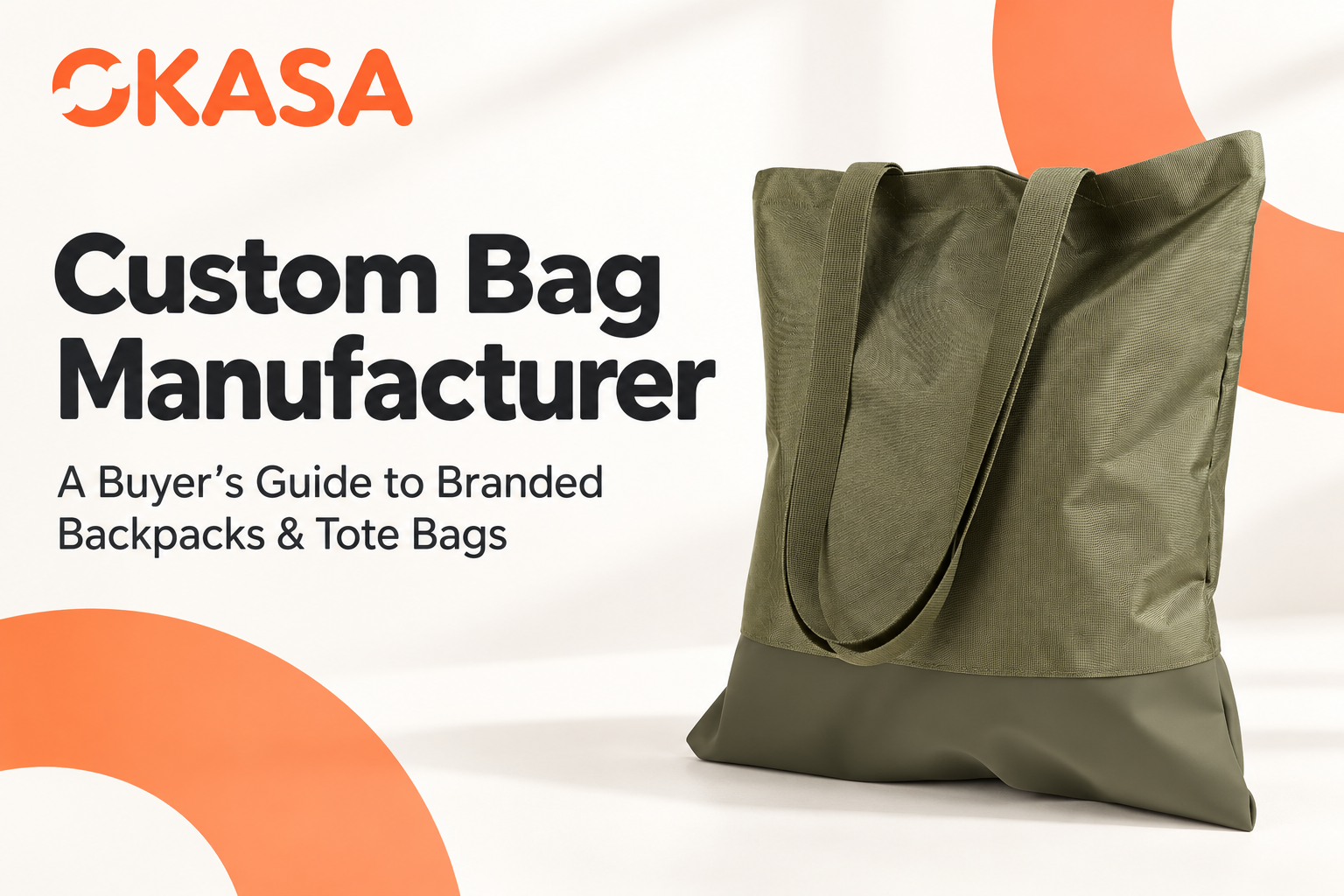


A buyer once sent us three fabric codes and one question: “Which one is the good nylon?” The options on the quotation read 200D, 400D and 600D. At first glance, choosing the largest number seemed reasonable. Then we looked at the job. The bag had to carry a notebook, a bottle and a small electronics pouch, yet the quotation described only the denier. There was no finished fabric weight, no coating detail, no handle construction and no load target.
The 200D vs 400D vs 600D wrinkled nylon comparison is useful only when it is tied to the finished fabric, bag construction and intended load.
That kind of quotation is common. Keep the denier on the sheet, but do not let it make the decision by itself. The number gives no answer about seam slippage, the shape of a loaded tote or the way fine artwork crosses an uneven surface. A 600D label can still hide weak sewing. A well-built 400D bag can be the more dependable product for its intended job.
Distributors, procurement teams and brand owners usually meet these numbers while comparing custom bag quotations. Here, 200D, 400D and 600D are treated as places to begin sampling, not as grades stamped “good, better, best.” By the end, you should be able to tighten the specification, challenge a weak sample and place competing offers on the same footing.
200D vs 400D vs 600D wrinkled nylon: the short answer
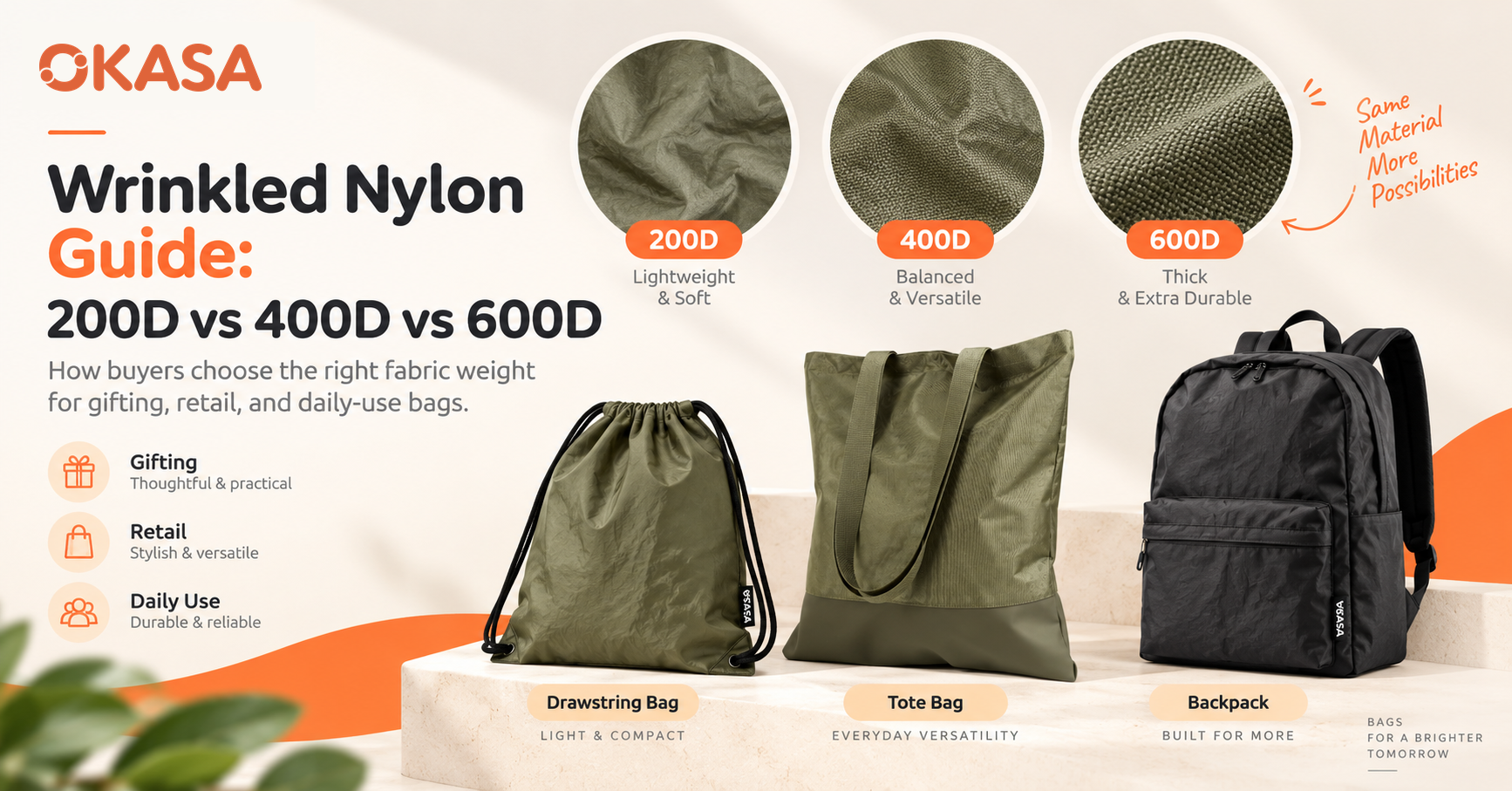
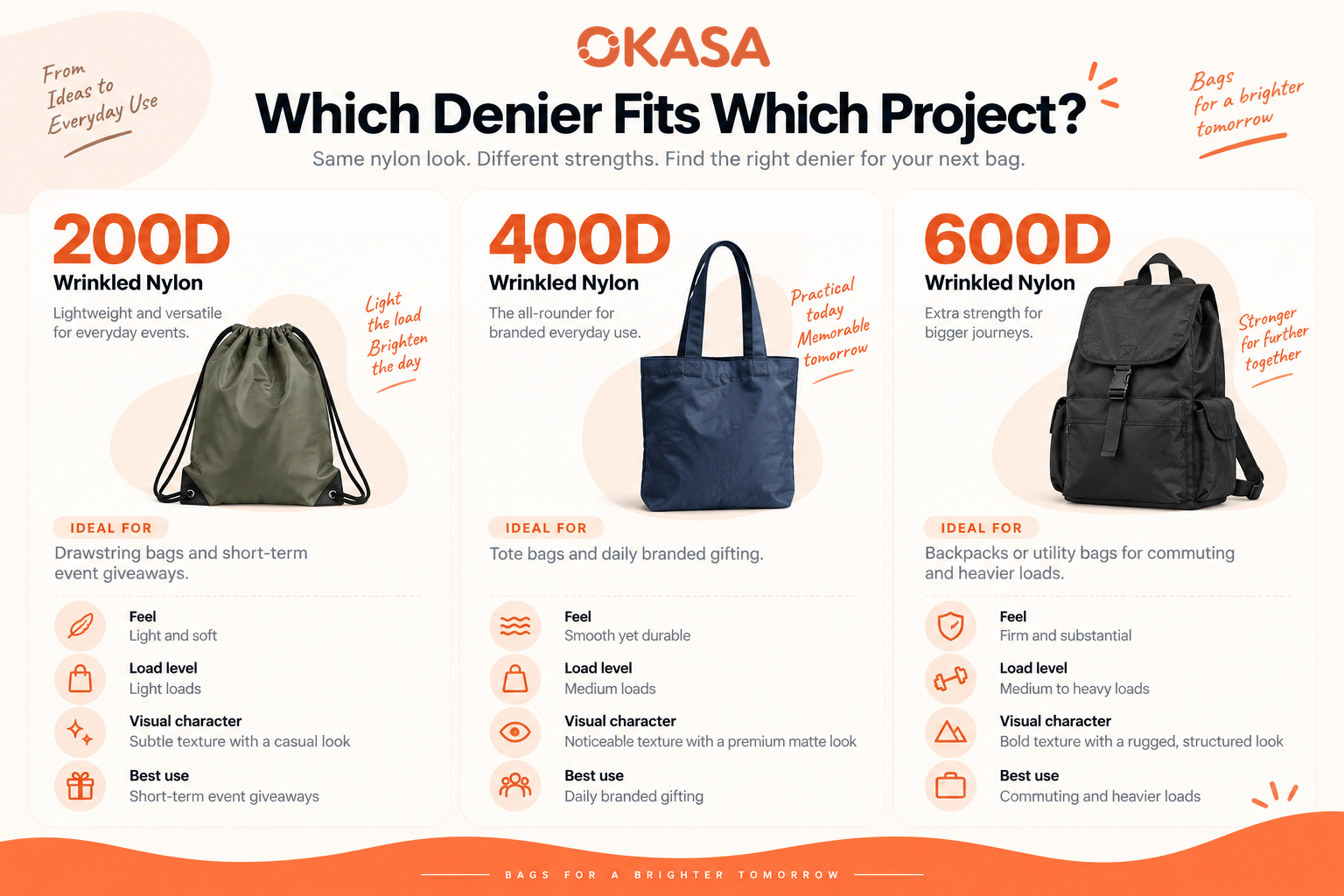
Start with 200D when low packing volume and a soft hand matter most. It is often suitable for event drawstring bags, shoe bags, simple organizers and foldable promotional pieces. Ask for stronger reinforcement wherever cords, handles or corners concentrate the load.
Start with 400D for an everyday tote, a branded carry bag or a light backpack. This is often the easiest sampling point because it can give a bag visible body without making it unnecessarily stiff. OKASA’s B108 tote is a useful 400D washed-nylon reference. Its result comes from the fabric plus the rolled opening, reinforced handles and lower film-spliced panel.
Consider 600D when the project needs more structure, carries a heavier load or faces repeated abrasion. Backpacks, utility bags and travel pieces are common examples. Do not approve it from the fabric name alone. Pack the real contents, carry the sample and inspect the stress points afterwards.
| What the project needs | Begin with 200D | Begin with 400D | Begin with 600D |
|---|---|---|---|
| Typical objective | Low bulk and a soft hand | Balanced body and packability | More structure for repeated use |
| Useful first sample | Drawstring or foldable bag | Tote or light backpack | Backpack or utility bag |
| First risk to check | Seam slippage and opacity | Handle and panel construction | Stiffness, abrasion and carton volume |
This table is a sampling shortcut, not a substitute for a product specification. The same denier can behave differently when the weave, coating, finished weight or sewing method changes.
What the D number actually measures
What does the number measure? Imagine weighing a continuous 9,000-metre length of yarn. Its mass in grams is the denier value, so a nominal 200D yarn weighs 200 grams over that reference length and a nominal 600D yarn weighs 600 grams. Buyers who need the technical basis can consult ASTM D2260 yarn-number conversion tables and ISO 2060 for yarn linear-density measurement.
For a bag buyer, the practical point is more important than the formula: denier describes the yarn, not the finished fabric by area. A quotation that says “400D nylon” has not told you the fabric GSM. It has not told you how tightly the yarns are woven, what sits on the back of the cloth or how the cloth has been washed and finished.
GSM is the mass of finished fabric per square metre. Weave describes how the yarns interlace. A coating can alter opacity, hand and water behaviour. Calendering or washing can change the surface again. All of those fields belong in a careful material review.
| Specification field | What it describes | Why a buyer needs it | What it does not prove |
|---|---|---|---|
| Denier | Yarn linear density | Helps compare yarn coarseness within a similar material family | Finished GSM or complete bag strength |
| GSM | Finished fabric mass per square metre | Helps explain body and material usage | Yarn size, weave or seam performance |
| Weave | Arrangement of warp and weft yarns | Affects surface, drape and stability | Fibre content or coating |
| Coating and finish | Treatment added during finishing | Affects hand, opacity and resistance to light moisture | A waterproof finished bag |
| Construction | Panels, seams, reinforcement and hardware | Determines how the bag manages a real load | Material composition |
If two suppliers quote “the same 400D” but provide different GSM, coatings and reinforcement, the prices are not comparable yet. Ask both suppliers to describe the nominated material on the same basis. Then examine swatches under the same lighting and make the samples to the same drawing.
Why two fabrics marked 400D may not look alike
Put two 400D swatches on a desk and the difference can be immediate. One may be crisp, shiny and almost paper-like. Another may be matte, soft and heavily wrinkled. A third may look similar from the face but reveal a smooth coating on the back. These are not cosmetic details when a bag is being branded and packed in volume.
The gap can come from yarn construction, yarn spacing, weave, finished GSM, dyeing, washing, calendering or coating. Lamination changes the material again. Colour depth can shift between treatments, and the way a fold recovers after a week in a carton may also change.
A responsible custom bag manufacturer should therefore offer a physical swatch and a finished sample rather than asking you to approve a denier number in a message. The swatch helps with colour and handfeel. The finished sample reveals what happens at seams, edges and decorated areas.
What 200D is good at and where it needs help
200D earns its place when the bag should stay light and compact. A drawstring bag going into ten thousand event packs does not need to feel like luggage. A foldable organizer should fold without fighting the user. A shoe bag may need breathability and easy packing more than a rigid silhouette.
The material can also reduce carton bulk. That matters when the purchase price is only one part of the landed cost. A small saving in packed volume, repeated across a large order, may matter more than a minor change in the factory unit price.
Light material does expose weak decisions quickly. Cord exits can tear if the reinforcement is too small. A pale colour may show the outline of the contents. Seams can pucker when stitch tension is poorly set. A large, dark print may look different after the bag is filled because the fabric stretches across the contents.
For a 200D sample, load the bag with the actual event contents. Pull the lower corners and cord exits by hand. Check the seam allowance from inside. Photograph the empty and loaded bag from the same angle. If the design uses a large logo, approve the artwork on the nominated production colour rather than on a convenient white swatch.
Why 400D often works for everyday branded bags
Many buyers settle on 400D for daily-use totes and lightweight backpacks. That is not because the number sits neatly in the middle. It is because a suitable 400D article can provide enough body for a useful bag while remaining easy to fold, sew and pack.
The wrinkle can be visible without turning the surface into a heavy relief. The fabric can support a tote opening and still move naturally when carried. For gift programmes, it also gives enough presence to feel like a product rather than disposable packaging.
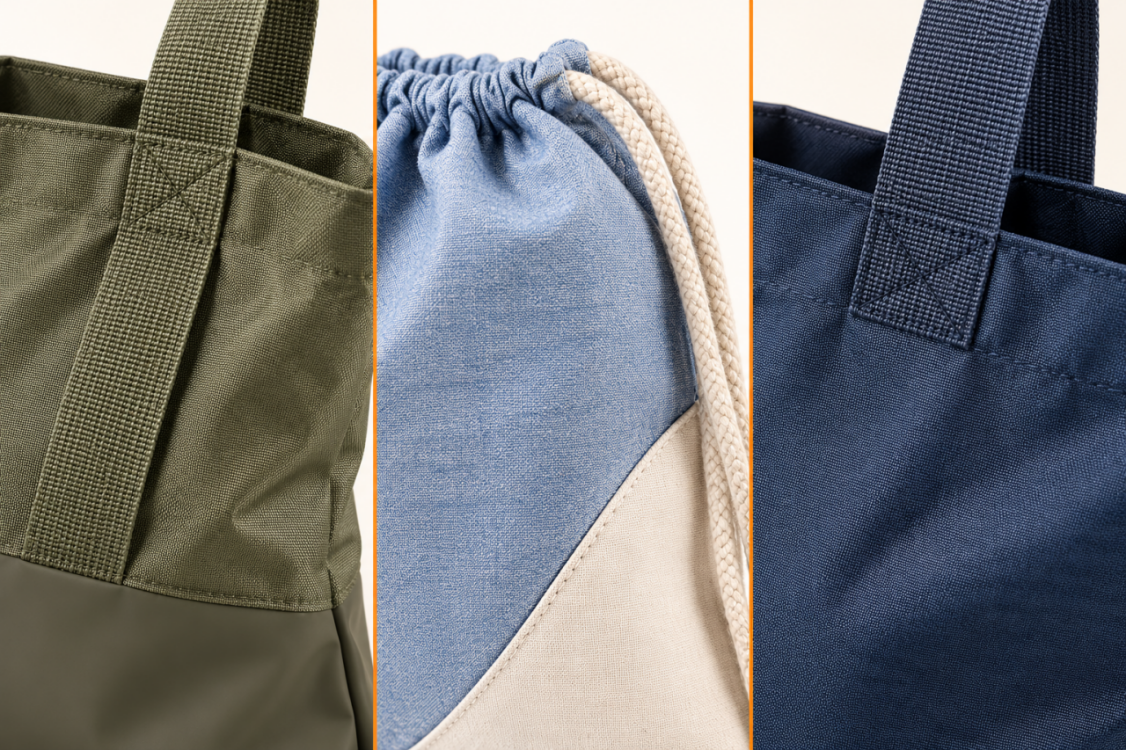
OKASA’s B108 shows how this works in a real construction. The current reference uses a 35 × 40 cm body, 2.5 × 65 cm handles, cross-stitched handle reinforcement, a rolled opening edge and a film-spliced lower panel. The B108 product information lists both a 400D washed-nylon option and a 900D nylon option. Those details matter because the handle box stitches and opening finish influence how the tote feels under load.
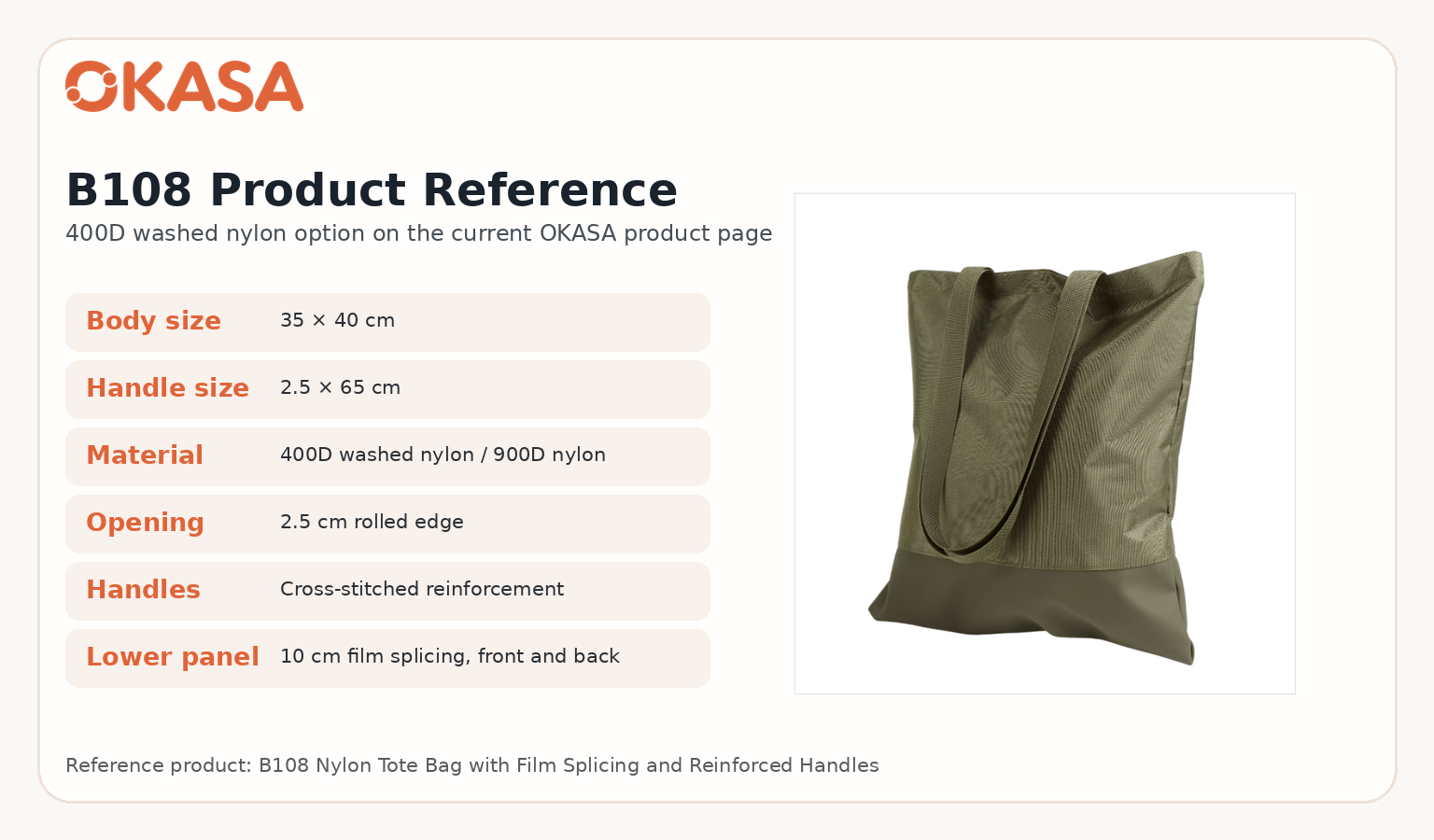
A 400D tote with careless handle attachment may fail before a lighter bag with properly planned reinforcement. During sample approval, look at the whole load path: contents press on the base, force moves through the body panels and the handle attachments carry it to the user’s hand or shoulder.
When 600D is worth the extra body
600D is a reasonable direction for a backpack, travel organizer, duffel or utility bag that faces repeated handling. Within a comparable material family, it will normally feel firmer than a lighter option. That body can help panels keep their shape and can support pockets, webbing and larger areas of decoration.
There are costs. Firmer cloth occupies more space when folded. Thick seam intersections are harder to turn cleanly. The bag may recover slowly from a compressed carton. A dense or coated face can also change ink adhesion and the appearance of heat-transfer film.
Those drawbacks may be acceptable for a commuter backpack. They are difficult to justify for a one-day giveaway carrying a brochure and a T-shirt. Ask what failure the heavier material is meant to prevent. If nobody can name the failure, make a lighter sample as the control.
Buyers searching for an OEM backpack manufacturer should send the expected contents and working load with the drawing. “Heavy duty” is too vague for development. “Carry a 15-inch laptop, charger, notebook and bottle for a 5 kg working load” gives the sample room a usable target.
Wrinkled nylon is a finish not a performance certificate
The irregular surface is popular because it gives a plain bag character. It can hide minor handling marks and photograph well in lifestyle settings. It also makes a stock silhouette look less generic without adding several decorative panels.
The look does not prove strength, waterproofing or recycled content. Those are separate questions. Water performance depends on the face and back treatment, seam construction, needle holes, closures and the opening. A nylon shell with an open top is not a waterproof bag, regardless of the denier.
Use precise language in the specification. If the requirement is resistance to brief drizzle, describe that exposure and agree how the sample will be checked. If the contents must stay dry during prolonged rain, the project needs a more demanding construction review, including seams and closures.
Denier also says nothing about whether the yarn is virgin or recycled. If the campaign includes a recycled-content claim, record the fibre composition, the percentage being claimed and the evidence required by the destination market and the buyer’s own policy.
Let the load decide the cloth
Product names are poor specifications. An unlined event backpack carrying a few light items can succeed in a lighter cloth; meanwhile, an open tote filled with catalogues may need far more reinforcement than its plain shape suggests.
| Bag or programme | Sensible first sample | Reason for starting there | Approval check |
|---|---|---|---|
| Event drawstring bag | 200D | Low bulk for distribution | Corner pull and loaded carry |
| Foldable organizer | 200D | Soft hand and compact packing | Seam, opacity and fold recovery |
| Corporate gift tote | 400D | Balanced everyday feel | Handle attachment and loaded shape |
| Light backpack | 400D | Useful body without excessive bulk | Strap, zipper and pocket cycles |
| Travel or utility bag | 600D | More body for repeated handling | Abrasion, seam and packing test |
| Structured kit bag | 600D | Supports additional panels and pockets | Full pack-out sample |
An employee gift tote carrying a notebook, drink bottle and cable pouch should be tested with those items. The loaded sample will show whether the mouth collapses, the base distorts or the handle angle becomes uncomfortable. It will also show whether the bag still presents the logo clearly.
Test the logo on the production fabric
Wrinkle texture interrupts a flat printing surface. Fine lines can break across the high and low points. A transfer film may reflect differently from the surrounding cloth. Embroidery can pull a soft panel inward if backing and tension are not controlled.
Screen printing is often suitable for simple artwork and practical quantities. Heat transfer can handle more detailed graphics when the fabric and coating tolerate the process. Embroidery, woven labels and rubber patches create different looks and bring their own minimums, setup work and sewing requirements.
Do not approve a logo from a sample printed on smooth polyester when the bulk order uses wrinkled nylon. Ask for a strike-off on the actual fabric or approve the complete pre-production sample. Record artwork version, colour reference, size, position and the accepted method. This is particularly important for custom corporate gifts with logo, where the bag may need to match notebooks, drinkware or packaging in the same programme.
A useful sample is something you can try to damage
A sample should answer questions, not sit untouched in a meeting room. Fill it. Carry it. Open and close it. Copy the factory’s proposed packing fold, place the folded bag under light pressure overnight, and inspect the surface again the next morning.
For a tote, pay close attention to handle attachment, the opening edge and lower corners. For a drawstring bag, test the cord exits and the points where the cords join the base. For a backpack, add zipper cycles, shoulder-strap pulls, pocket checks and a comfort trial with the agreed load.
| Checkpoint | Simple sample action | Record after the check |
|---|---|---|
| Loaded shape | Pack the intended contents | Distortion, opening and logo presentation |
| Handle or strap | Carry at the target working load | Twist, stretch and attachment condition |
| Seams | Repeat carry and pull cycles | Slippage, broken stitches and puckering |
| Logo | Rub and flex the decorated area | Adhesion, cracking and edge quality |
| Closure | Open and close repeatedly | Pull force, snagging and alignment |
| Pack-out | Compress in the proposed fold | Crease recovery, transfer and carton fit |
On a larger order, sign and date the approved sample and attach a short record of the agreed checks. Store the matching material and logo approvals with it. Photos are useful for location and dimensions; they cannot preserve handfeel, zipper resistance or a slight colour difference. Inspectors still benefit from having the physical reference beside the bulk goods.
What changes the price besides denier
The material label is only one part of the quotation. Bag dimensions change cutting yield. Pockets, linings and internal dividers add sewing time. Wide webbing costs more than a basic self-fabric handle. Custom buckles, zipper pullers and labels may each carry their own minimum order.
Decoration affects both setup and unit cost. A one-colour screen print follows a different cost structure from embroidery or a multi-colour transfer. Individual polybags, paper sleeves, hangtags, barcode labels and gift boxes add packing work. Small colour splits can be expensive even when the total order looks healthy.
Carton volume deserves its own line in the comparison. A low factory price can be misleading if the stiffer bag uses considerably more shipping space. Buyers managing factory direct corporate gifts should compare the landed cost and the programme requirements, not only the first unit price in the quotation.
Write an RFQ that produces comparable quotations
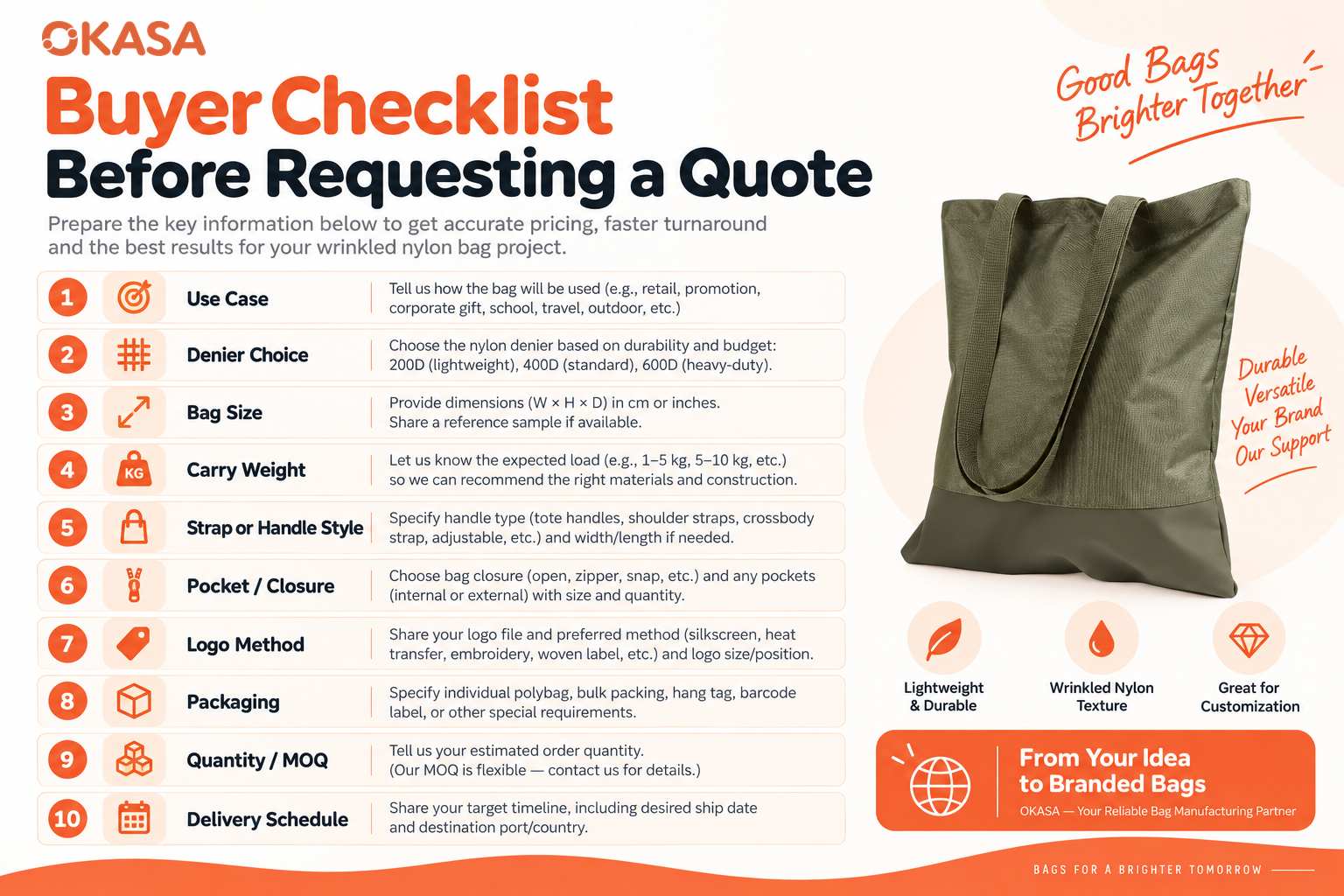
A detailed request does not need to be long. It needs to remove the guesses that change cost or performance. Begin with the use case and the contents. Add the target quantity by colour, approximate dimensions, expected working load, preferred denier range, bag style, handle or strap direction, pockets, closures, artwork, packing, destination and required in-hand date.
State which decisions are open. A note such as “400D preferred; please also quote a lighter construction if it passes a 4 kg carry check” gives the supplier room to engineer the offer. “Best quality at best price” gives the development team almost nothing to work with.
If you are comparing a corporate gift manufacturer China programme, ask who controls the bag factory, who approves materials and who holds the reference sample. When the same order also contains notebooks or drinkware, identify the party responsible for colour coordination and final assembly.
Common mistakes that are easy to avoid
- Treating denier as a finished quality grade. It is a yarn measurement and needs supporting fabric and construction details.
- Comparing incomplete quotations. Two prices cannot be compared until coating, GSM, handles, reinforcement, hardware and packing are aligned.
- Testing the bag empty. A real load changes the seam stress, handle angle and appearance.
- Approving artwork on another fabric. Wrinkle, coating and colour change how a logo prints and reflects light.
- Assuming heavier means more sustainable. Durability may improve, but material use, actual service life, recycled-content evidence, packing and freight also matter.
Questions buyers often ask
Is 600D always stronger than 400D
No. With otherwise comparable yarn, weave and finish, 600D will usually have a coarser yarn and may feel more substantial. The finished bag can still be weaker if the seams, reinforcement or hardware are poorly designed. Compare samples under the intended load.
Does 400D mean 400 GSM
No. Denier concerns yarn linear density. GSM is the mass of finished fabric per square metre. Put them in separate fields on the specification.
Can 200D work for a promotional bag
Yes. It is often a sensible choice for compact giveaways, shoe bags, organizers and foldable bags. Check seam slippage, opacity and loaded shape before approval.
Which denier should I use for a corporate gift tote
A 400D construction is often worth sampling first because it can balance body and packability. The right decision still depends on the contents, working load, handfeel, logo method, price and carton volume.
Can a wrinkled nylon bag carry a detailed logo
It can, but the chosen method must suit the actual fabric. Fine screen-printed lines may break across the texture. Heat transfer may add a different sheen. Embroidery can distort a soft panel. Approve the logo on production material.
What should I send an OEM promotional products manufacturer
Send the bag use, intended contents, size, quantity by colour, target load, preferred material direction, logo files, packing, destination and required date. Add reference photos, but label them clearly as construction requirements or visual inspiration. A good OEM promotional products manufacturer should reply with questions and assumptions rather than quietly filling gaps.
Where the OKASA B108 fits
B108 is not a 200D versus 400D versus 600D test bag. It is a practical 400D washed-nylon reference that shows how a material choice works with reinforcement and a mixed-material lower panel. Buyers can review the B108 nylon tote bag and use it to discuss body size, handle length, opening finish, panel construction and logo position.
If the first decision is nylon versus another fibre family, read OKASA’s RPET vs nylon vs cotton guide. That comparison should come before denier when the project has a material policy or a specific recycled-content requirement.
Final recommendation
Choose the lightest construction that has a realistic chance of passing the job, then prove it with a finished sample. Use 200D when compact packing and flexibility lead the brief. Start around 400D for a balanced everyday tote or light backpack. Move toward 600D when additional structure, repeated handling or abrasion exposure justify the change.
After the first shortlist, stop judging the bag by one number. Review the weave, GSM, coating, seams, handles, closures, decoration, packing and actual contents together. That is how a material code becomes a dependable custom product.
For a 200D vs 400D vs 600D wrinkled nylon decision, send OKASA the intended use, quantity, target size, preferred denier direction, artwork and delivery date. The team can review missing details, propose a sample route and prepare a clearer quotation.