

304 vs 201 Stainless Steel in Custom Drinkware What Buyers Should Know
A bottle specification that lists “stainless steel” is not complete enough for a sourcing decision. Buyers need to know which grade is used in each component, how that component is formed and finished, and what the approved product must withstand in normal use.
In many double-wall drinkware designs, the inner vessel and outer shell perform different jobs. An OKASA product may specify food-grade 304 stainless steel for the inner layer and 201 stainless steel for the outer layer. That does not mean one grade is universally “good” and the other is “bad.” It means the complete construction must be reviewed component by component and then verified on the finished sample.
Buyer quick answer
· Ask for the stainless-steel grade by component, not as one general material statement.
· Confirm the inner vessel, outer shell, base, lid, gasket and coating as separate specification lines.
· Evaluate forming, welding, cleaning, corrosion exposure and finish together with the grade.
· Approve a complete decorated sample and convert it into measurable inspection criteria.
· Do not infer performance from the grade number alone; request tests that match the intended use.
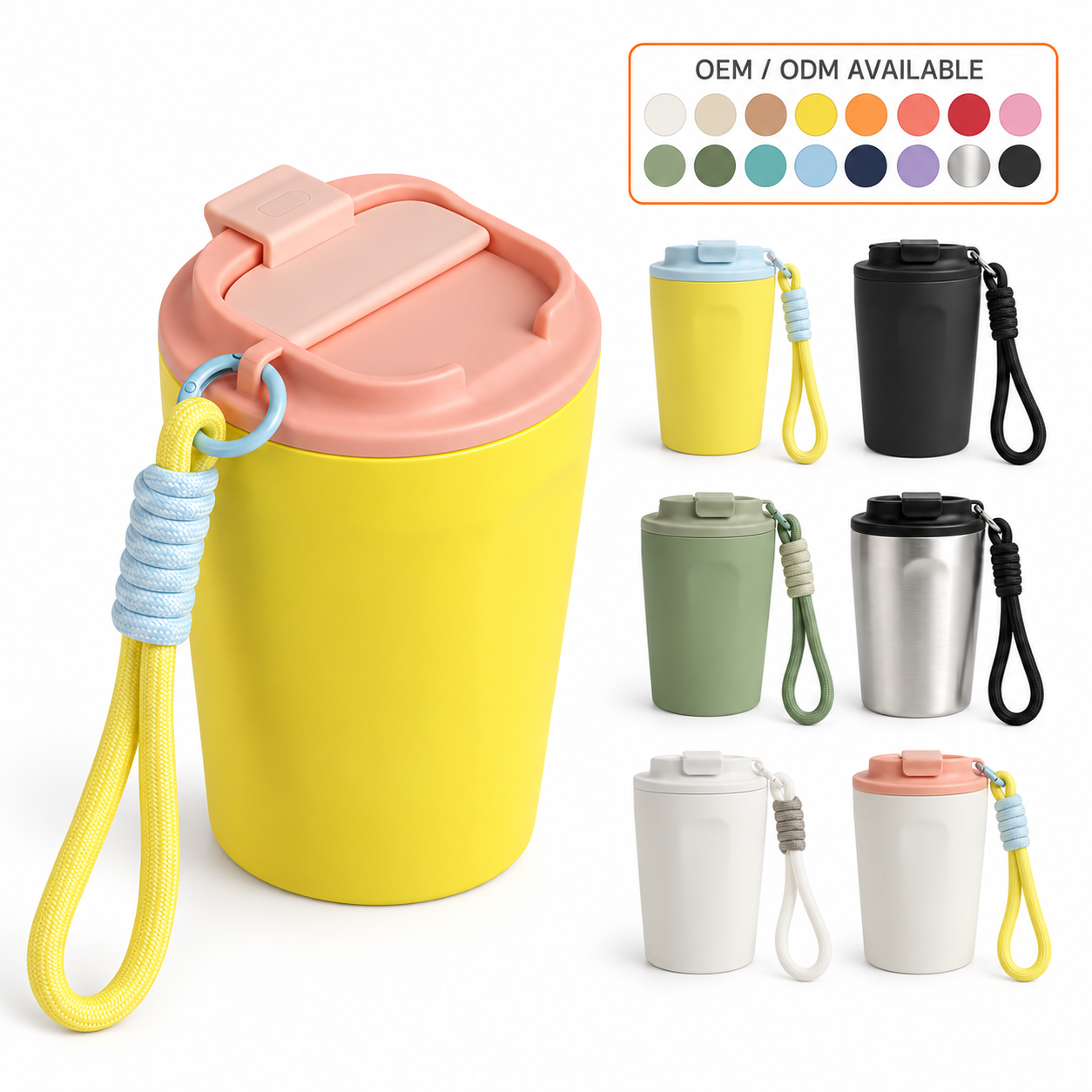
Official OKASA D015 product image.
Suggested ALT: OKASA D015 stainless steel coffee cup with carrying rope
What the grade numbers tell you and what they do not
304 and 201 are austenitic stainless-steel grades, but their alloy compositions differ. Grade 304 is widely specified where corrosion resistance and fabrication performance are important. Grade 201 uses a different alloy balance and can be selected for structural or exterior components when the product design, finish and exposure conditions make it suitable.
The grade designation is only one part of the product. Sheet thickness, forming quality, weld condition, surface cleaning, coating preparation and handling can all affect the finished result. A technically correct grade can still perform poorly if the construction or process is not controlled.
|
Decision area |
Inner vessel |
Outer shell |
|
Primary role |
Contains the beverage and forms part of the thermal structure |
Protects the vacuum body and carries the exterior finish |
|
What to specify |
Grade, thickness, seams or welds, finish and cleaning |
Grade, thickness, forming, coating or polish and dent tolerance |
|
What to approve |
Interior appearance, odor, cleanability and relevant performance tests |
Color, texture, adhesion, scratches, dents and logo position |
|
Common mistake |
Accepting “stainless steel inside” without a grade |
Choosing by appearance without confirming the base material and finish |
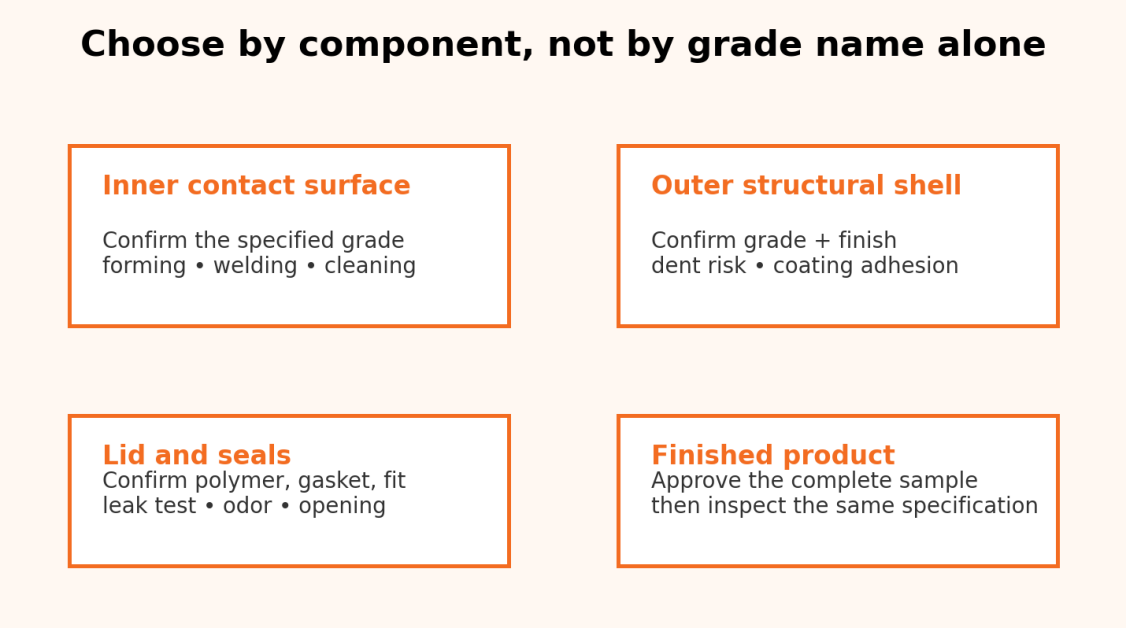
Component based decision framework for custom drinkware.
Suggested ALT: Diagram showing how buyers should specify inner vessel outer shell lid seals and finished drinkware
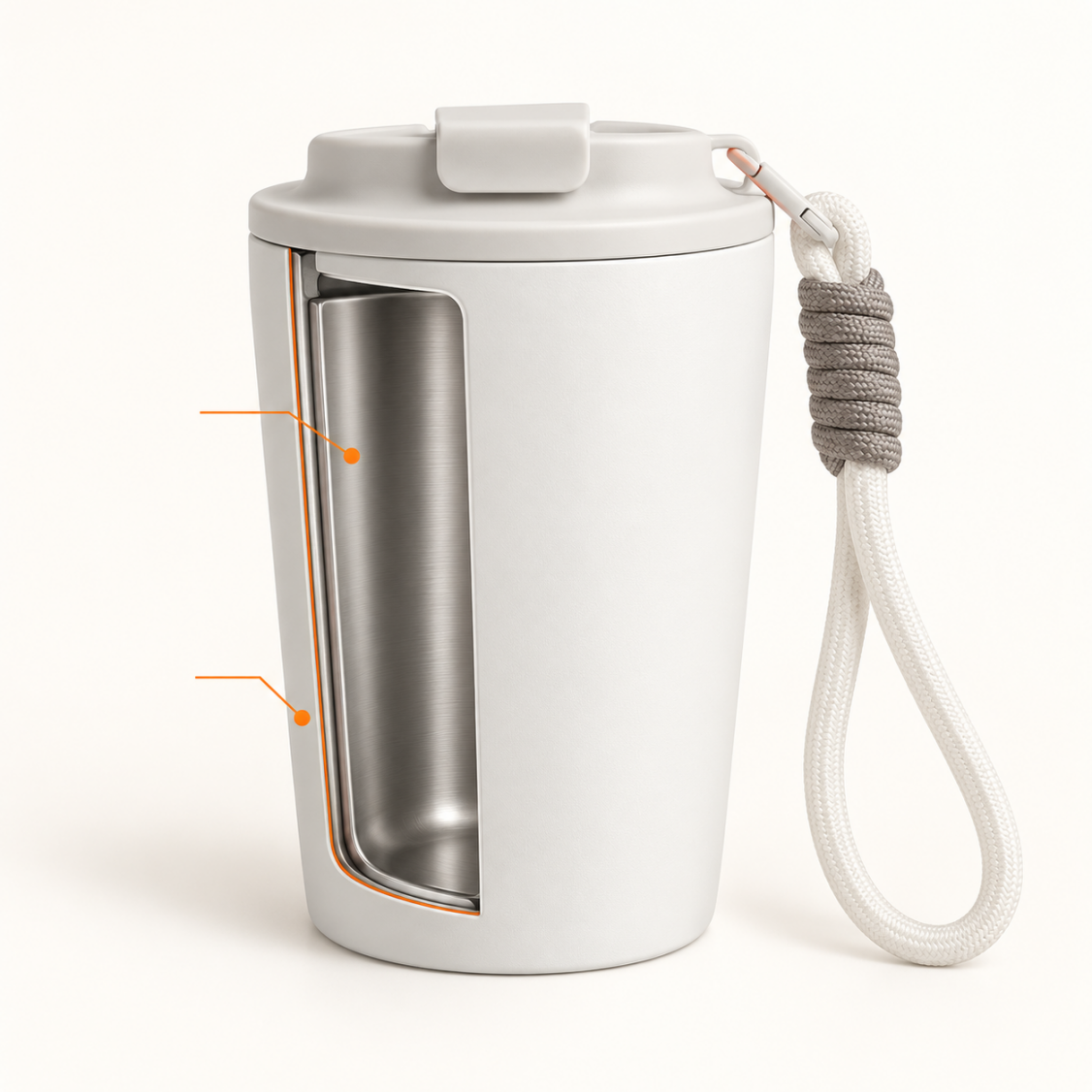
Suggested ALT: Illustration of inner and outer stainless steel layers in an OKASA style coffee cup
Why 304 is often specified for the inner layer
The inner vessel has direct and repeated contact with the beverage. It also passes through forming, welding and cleaning operations before assembly. For this reason, many drinkware specifications identify 304 for the inner layer. Buyers should still confirm the complete construction rather than treating the grade as a substitute for product testing.
Ask how the interior will be finished, cleaned and protected before packing. Review seams and difficult-to-clean areas on the sample. If the product will be used with particular beverages, temperatures, washing routines or market requirements, communicate those conditions before the test plan is agreed.
Why 201 may be used for an outer layer
The outer shell performs a different job. It provides structure, protects the vacuum body and receives the visible surface treatment. When 201 is specified for this component, the buyer should focus on whether the complete shell and finish are suitable for the intended environment.
For a powder-coated or painted bottle, approve color, texture, adhesion and resistance to handling on the real substrate. For an uncoated stainless-steel exterior, the visible finish and expected exposure become even more important. A change from coated to raw metal is therefore not only a color change; it may require a new material and process review.
The lid and gasket need their own specification
A stainless-steel body does not make the complete bottle leak-resistant or easy to use. The lid material, thread or closure, gasket, drinking opening and assembly tolerances determine how the product opens, seals and cleans. Record each material and confirm whether parts are removable, replaceable or suitable for the intended washing method.
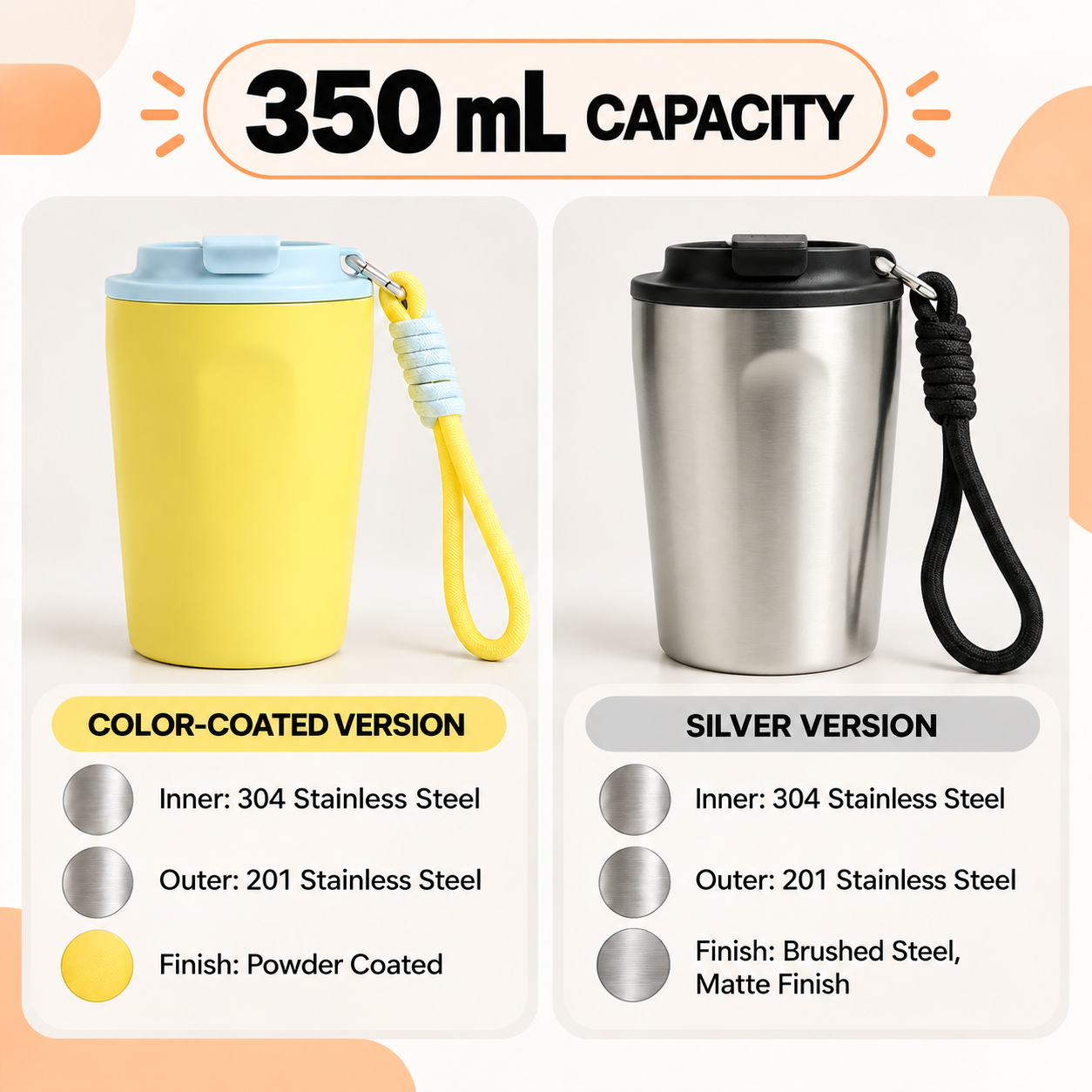
Official D015 image showing the lid, rope attachment and finished surface.
Suggested ALT: Close detail of OKASA D015 lid carrying rope and powder coated surface
Five tests to discuss before bulk production
1. Leak test under the agreed orientation and duration, using the final lid and gasket.
2. Thermal performance test using an agreed starting temperature, time interval and measurement method.
3. Coating or decoration test matched to expected rubbing, washing and handling.
4. Visual and dimensional inspection covering dents, scratches, mouth shape, lid fit and logo alignment.
5. Any market-specific material, migration or compliance testing required for the destination and intended use.
A test name without a method can create false confidence. The purchase specification should identify the sample condition, test method, duration, acceptance limit and responsible party.
How to compare two supplier quotations
A lower quote may describe a different product. Place the component specification next to the price and check whether both offers include the same grades, thicknesses, lid system, coating, logo method, packaging and inspection scope. If any field is missing, ask for clarification before comparing unit prices.
|
RFQ field |
Information to provide |
Evidence to approve |
|
Body construction |
Inner and outer grades, capacity and required performance |
Material record and finished sample |
|
Surface |
Color reference, finish and texture |
Approved color sample under agreed lighting |
|
Branding |
Artwork, size, position and method |
Decorated sample and placement measurements |
|
Closure |
Lid material, gasket and opening method |
Function and leak-test result |
|
Packing |
Individual pack, protection and carton requirement |
Pack-out sample and carton specification |
An OKASA product example
The OKASA D015 coffee cup is a useful construction reference. Its official product information specifies a 304 stainless-steel inner layer, a 201 stainless-steel outer layer, a 350 ml capacity and a powder-coated finish. The product also includes a matching carrying rope. A buyer can use this configuration as a starting point, then confirm the exact color, branding, lid, testing and packaging for the project.
The same component-based approach applies to other OKASA drinkware. D016 stylish sustainable drinkware also specifies a 304 inner layer and 201 outer layer, while the lid, finish, dimensions and intended use differ. Similar material lines do not make two products interchangeable.
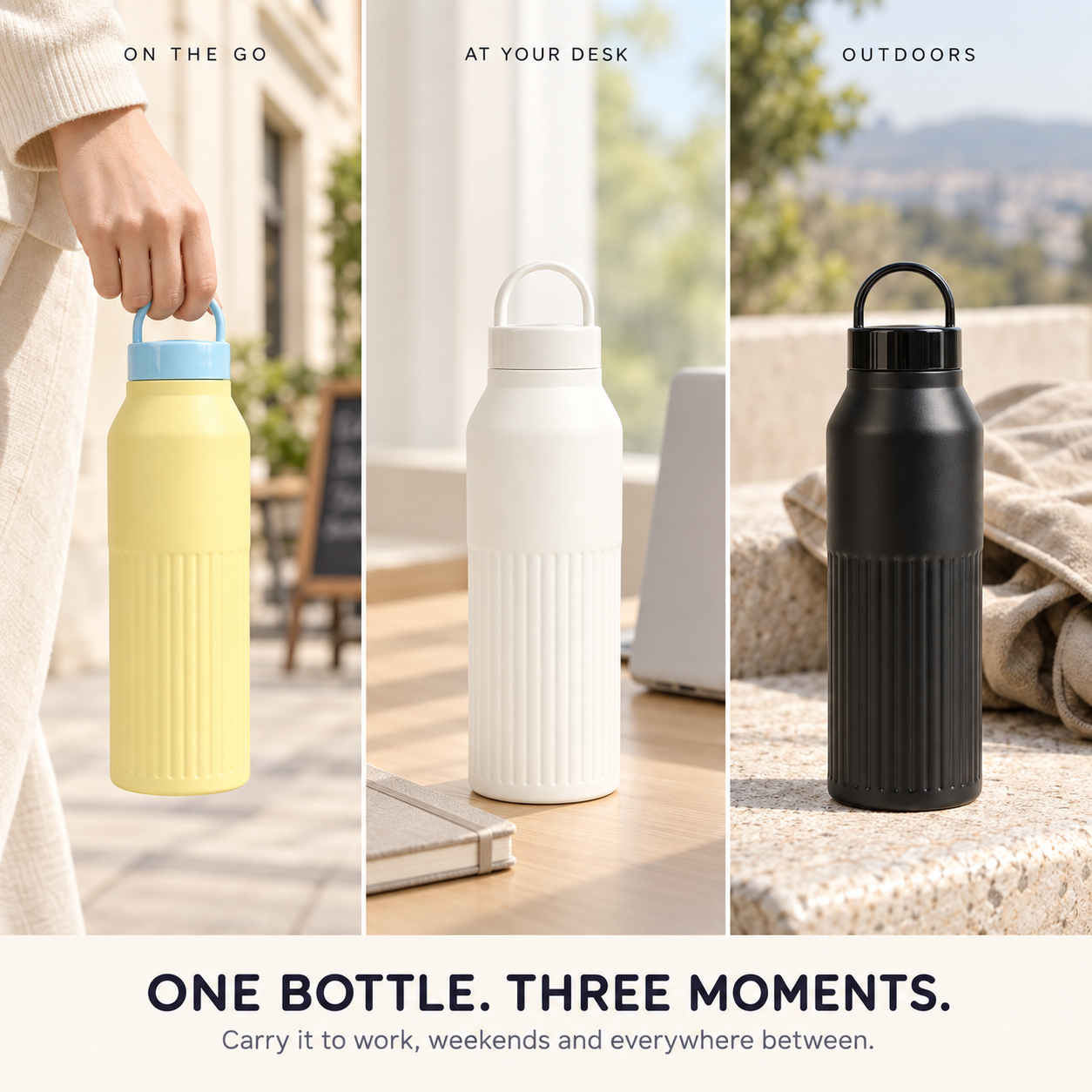
Official OKASA D016 image providing a second drinkware construction reference.
Suggested ALT: OKASA D016 stainless steel bottle with handle and coated exterior
Frequently asked questions
Is 304 always better than 201 for every part of a bottle
No single grade answers every design question. The component role, forming route, finish, exposure and target specification all matter. Confirm why a grade is used in that component and verify the finished product.
Can the same logo process be used on coated and raw stainless steel
Not automatically. Coating type, surface texture, curvature, artwork and durability requirements can change the suitable process. Approve the logo on the final surface.
Is a material certificate enough to approve the order
No. A material record supports identification, but it does not prove lid fit, leak resistance, coating quality, decoration or packing. Use it as one part of the approval file.
Prepare a clearer custom drinkware request
Send OKASA the target capacity, component specification, finish, lid preference, quantity by color, logo artwork, destination and required arrival date. Ask the team to confirm a feasible construction and the samples or tests needed before bulk approval.