

A buyer says, "We need 1,000 gift sets." On paper, that sounds straightforward. Then the details arrive: two bag colors, one notebook cover, two logo versions, a printed gift box, and a card in three languages. The order is still 1,000 sets, but the factory no longer sees one simple run.
That gap between the buyer's total quantity and the factory's production quantities is where MOQ questions usually begin.
For a custom corporate gift set, the minimum may come from the product, the material, a color run, the branding process, the box, or even the way the finished sets are assembled. One component can be perfectly workable at 1,000 pieces while another part of the same project needs a larger batch. So the most useful question is not just, "What is your MOQ?" It is: "Which part of my specification is setting the MOQ?"
That question gives both sides something practical to work with. A procurement manager can decide what is fixed and what can move. A corporate gift set manufacturer can suggest changes without quietly changing the whole brief.
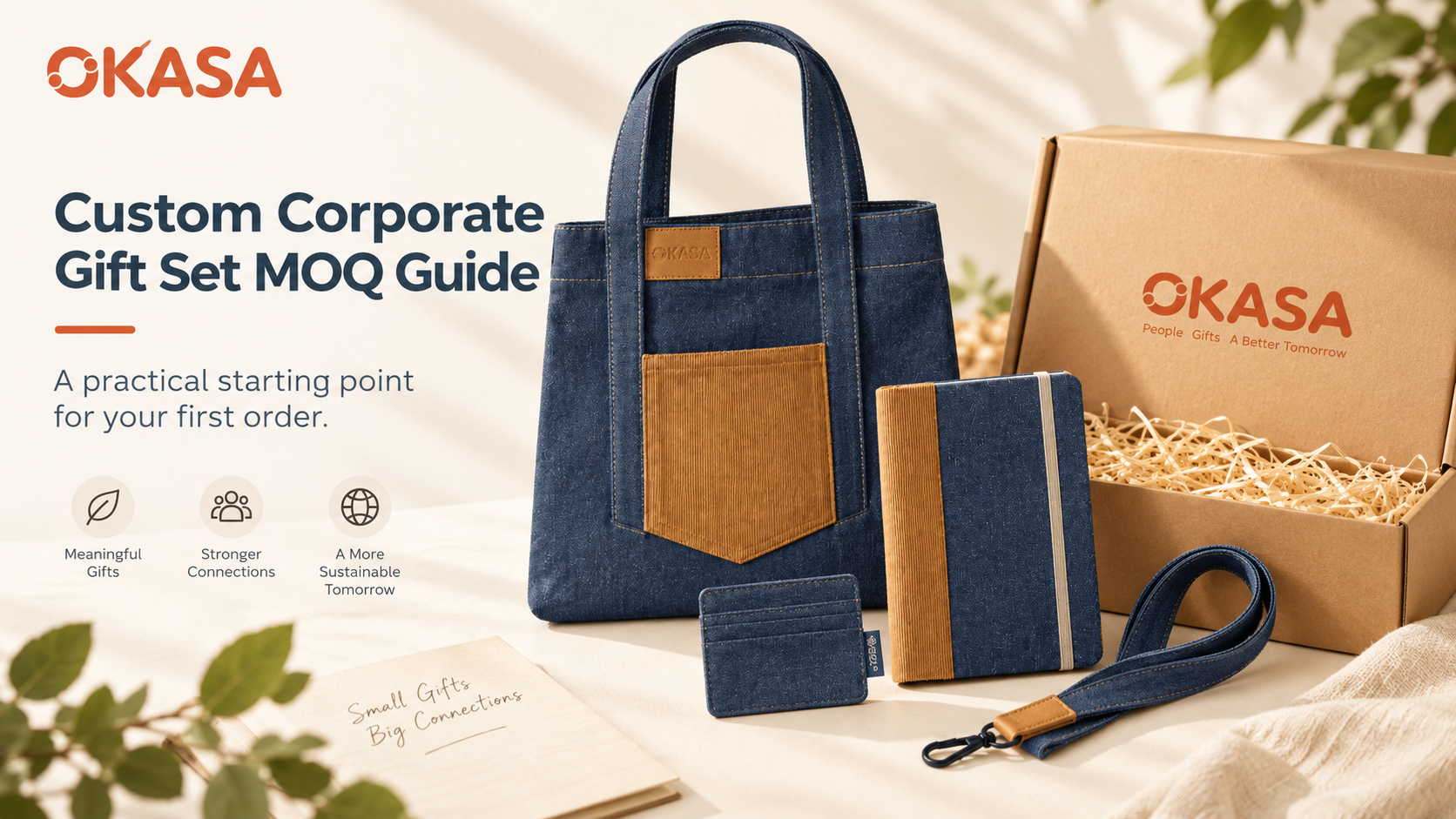
The OKASA TGS880 denim and corduroy gift set is a helpful example because it combines several products in one presentation: a notebook, tote bag, cardholder and lanyard, packed as a gift set. The quantities and prices used below are examples for purchasing decisions. They are not a confirmed MOQ or quotation for TGS880.
1. Ask what the MOQ actually covers
MOQ sounds precise, but a quotation can use the term in several different ways. One supplier may mean 1,000 finished sets. Another may mean 1,000 pieces of each product. A third may be referring only to a printed box or one color run.
Before comparing prices, get the scope written down. A useful line is:
"This MOQ covers ___ complete sets, with ___ product combination, ___ color allocation, ___ logo version and ___ packaging."
It looks almost too simple, but it prevents a lot of later confusion.
Take a 1,000-set project. Supplier A may be quoting one color and one customer logo. Supplier B may also show 1,000, but the price could be based on standard products with the gift box charged separately. Supplier C may include the box but require each tote-bag color to meet its own minimum. The number in the MOQ column is the same; the job behind it is not.
For a multi-product project, split the set into individual lines before negotiating. With TGS880, that means listing the notebook, tote bag, cardholder and lanyard separately, then adding the box, filler and assembly. If a customer's mark appears on more than one component, note the artwork, approximate size, placement and preferred appearance for each item.
This is where a custom corporate gift set manufacturer should add value rather than simply repeat a number. Some changes create a new setup. Others do not. A second print color can mean another screen or print run. A different fabric shade can affect material purchasing. Changing a message card may be much easier. The answer is process-specific, which is exactly why it should be confirmed rather than guessed.
If a quote still gives only one unexplained MOQ, ask what is driving it. "The printed box sets the minimum" is useful. "Each powder-coated bottle color needs its own run" is useful. A bare number is not.
Once the production constraint is clear, pricing makes more sense too. A smaller run can cost more per unit because setup cost is spread over fewer pieces. A larger run can lower the unit price but increase total spend. Those are commercial decisions, not the same thing as a production minimum. Our corporate gift set cost guide looks at that side separately.
2. Understand how a manufacturer arrives at the minimum
There is usually no single "MOQ machine" inside a factory. The minimum tends to emerge from several practical limits that meet in one project.
Start with the product itself. Using an existing notebook, bottle or bag construction is different from changing the shape, material, size, hardware or tooling. Both can be described as custom, but they do not require the same work. Printing a logo on an existing tumbler is one type of order; developing a new lid is another.
Branding can become the next bottleneck. Screen printing, laser engraving, debossing, embroidery and full-color printing all have different setup logic. A method that works well for 5,000 pieces may not be the best choice for a short first run. That does not make it a bad method; it just means the decoration process has to be considered with the volume.
Packaging sometimes surprises buyers most. The products may all fit the requested quantity while a rigid box, molded insert or printed sleeve pushes the project higher. A simple stock-size box with a branded card can be easier to manage, but even that needs confirmation. "Standard" does not mean "available in any quantity."
One practical way to discuss this with a manufacturer is to ask for the "binding minimum" - the requirement that currently prevents the order from going lower. If the box is the binding minimum, changing the bag color will not solve the problem. If a custom fabric color is the issue, a simpler box will not help much either.
This is also a better way to compare a corporate gift set supplier or manufacturer. The lowest advertised MOQ may simply reflect a more standardized offer. A higher MOQ can sometimes include more customization. Compare the specification behind the number, not only the number itself.
3. Does your total quantity hide several smaller orders?
A buyer may have 1,000 sets in the budget and still end up with production groups of 500, 250 or less. It happens as soon as the total is divided by color, logo, office, market or campaign version.
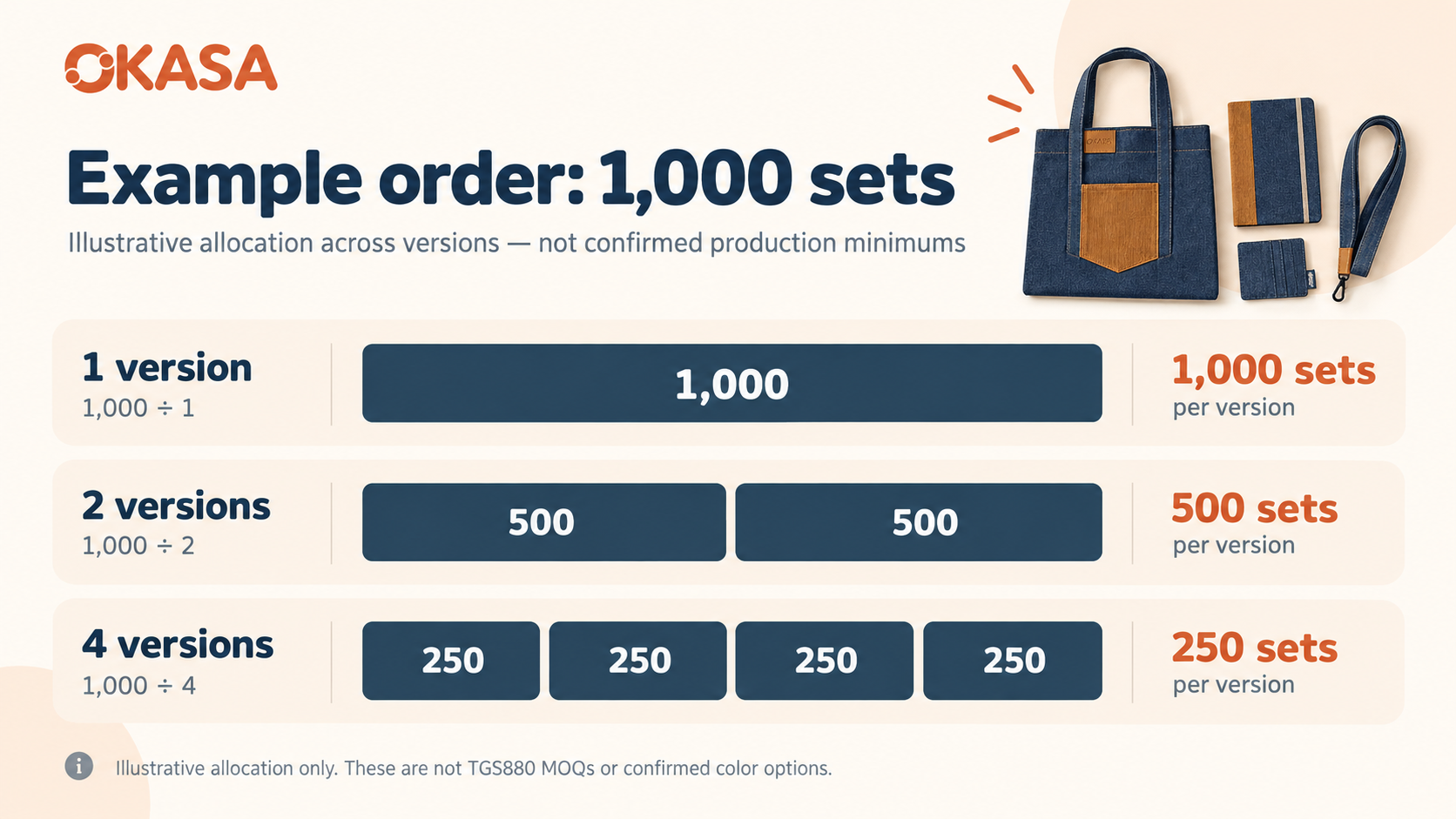
Consider a planned purchase of 1,000 employee welcome kits as an example. Each kit uses the notebook, tote bag, cardholder and lanyard combination shown in TGS880. The buyer is considering three allocations:
| Proposed allocation | Quantity per finished version | Question to ask |
|---|---|---|
| One color combination and one logo | 1,000 | Can all sets follow one specification? |
| Two color combinations, one logo | 500 | Does each product color meet its own minimum? |
| Two color combinations, two logos for each | 250 | Which production steps can be shared across versions? |
The 1,000-set total is an illustrative purchase quantity, not a confirmed TGS880 MOQ. The 500- and 250-set figures show allocation only. The color combinations are hypothetical, not confirmed options for this model.
The important detail is that a finished "version" is not always the same as a factory production run. Some work can be shared. Some cannot.
For example, the notebook body might be produced in one batch while customer logos are applied later in two versions. A single box structure could serve several markets while only the card language changes. By contrast, two fabric colors may require separate material batches, and two pieces of artwork may need separate decoration setups and checks.
Tell the supplier about the split before approving the quote. Do not wait until sample approval to reveal that the 1,000 sets will become four groups of 250. That can change the sample plan, the unit cost, the workable branding method and sometimes the production schedule.
Global projects deserve extra attention here. If the same program goes to offices in the US, Europe and Asia, ask whether every market truly needs a different physical product. Sometimes the local difference can sit in the card, sleeve, label or printed message while the core set stays the same. That reduces complexity without making the gifts feel identical or generic.
There is no prize for creating more production versions than the campaign needs. Keep the differences recipients will notice and value. Standardize the parts they will not.
4. Check the packaging before approving the products
Packaging is easy to leave until late because the products feel more important. In a gift set, that is a mistake. The box is part of the product experience, but it is also a manufactured component with its own material, print, structure, dimensions and minimum.
The original TGS880 presentation uses loose paper shred filler rather than a fitted die-cut insert. If a project needs a custom insert, a different filler, a sleeve, a printed lid, magnetic closure or a completely new box size, put that requirement on the quotation as its own line.
The packaging section should answer a few practical questions: What is the minimum for the box? Is the insert included in that quantity? Can an existing size be used? Does a printed sleeve or label carry a separate minimum? And, most importantly, how many complete gift sets will the packaging order support?
That last question matters because product and packaging quantities do not always match neatly. A product run might be 1,000 pieces while the box supplier needs more. If there are surplus boxes, decide in advance what happens to them. Are they delivered, stored, discarded, or carried into the next order? If the supplier stores them, confirm ownership, storage time and condition rather than assuming they will remain available indefinitely.
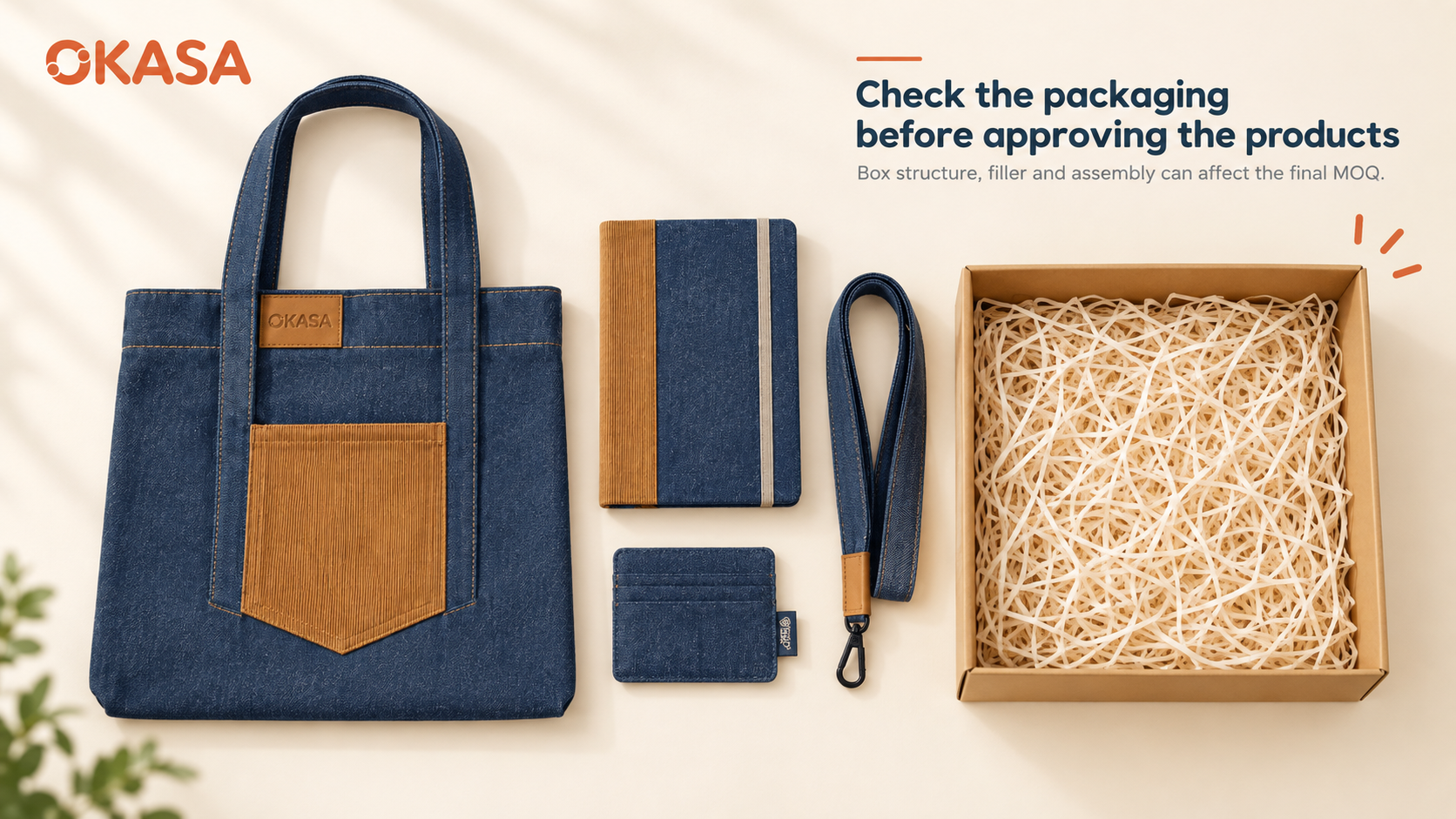
For a B2B project, ask two separate questions: Does the packaging look right? Can it also be produced, assembled and shipped efficiently at this quantity? A good corporate gift set supplier should be able to discuss both.
5. If your quantity is below the minimum, compare possible changes
Being below MOQ is not always the end of the project. It does mean the brief needs priorities.
Before asking for alternatives, divide the specification into two groups: things that must stay, and things that can change. A must-keep point might be a product function, approved material, brand color, compliance requirement, delivery deadline or logo position. Everything else can be treated as negotiable until the supplier explains the trade-offs.
Then ask the manufacturer for alternatives around the flexible details.
| Detail you could reconsider | Alternative to request | What still needs confirmation |
|---|---|---|
| Several product colors | One shared color combination | Available quantity and acceptable appearance |
| Branding every component differently | A consistent mark with campaign-specific messaging elsewhere | Process suitability and separate setup charges |
| A new box size or structure | An existing structure that fits the selected products | Insert, protection, finish and packaging minimum |
| Different product combinations for each team | Shared core items with a different card | Recipient needs and packing accuracy |
These are options to investigate, not promises that a lower MOQ will be available. An existing catalogue design is not proof of ready stock. Have the supplier confirm availability and the minimum for the exact proposed configuration.
What makes an alternative useful is that the trade-off is visible. You should be able to say, "We keep the bottle finish and logo position, but use one shared color," or "We keep the products and move the campaign variation to the message card." That is a decision. "We changed some things to reach MOQ" is not.
Shortcuts can also create new problems. Removing an insert may reduce packaging cost but increase movement and damage. Choosing a cheaper branding process may look fine in a mock-up and perform poorly on the real surface. Accepting any available stock color can make the final set feel disconnected from the campaign.
A lower minimum only helps if the finished gift still does the job.
If the product mix is not fixed yet, use our corporate gift set selection guide before locking the specification. It is usually easier to build a set that fits the volume than to force a rigid list of products into a quantity that does not suit them.
6. Should you order more to get a lower unit price?
Sometimes the larger run is the right answer. Sometimes it only makes the quote look better.
For illustration, suppose otherwise comparable offers are 1,000 sets at US$18 each and 2,000 sets at US$14 each.
|
Order option |
Product total |
|
1,000 sets × US$18 |
US$18,000 |
|
2,000 sets × US$14 |
US$28,000 |
The lower unit price requires US$10,000 more and leaves 1,000 additional sets to use or store.
These prices are hypothetical and explain the calculation only. They are not quotations for TGS880 or any other OKASA product, or market benchmarks; freight and any separately charged items are excluded.
The eye naturally goes to the US$4 saving per set. Procurement has to look at the other side as well: another US$10,000 committed, more cartons, more storage and more risk if the artwork, product or campaign changes.
If the same program runs several times a year and the extra sets already have a use, producing more can be reasonable. A one-time event is different. So is a seasonal campaign, a dated message or a brand refresh that may make the surplus obsolete.
Ask why the higher quantity is cheaper. The reason could be setup, material purchasing, printing efficiency, packaging utilization or assembly. Once you know that, a middle quantity may become possible. The best option might be 1,200 or 1,500 sets rather than a jump straight from 1,000 to 2,000.
7. Treat repeat orders as a separate agreement
"We will probably reorder" sounds encouraging, but a forecast is not a purchase order.
A manufacturer cannot confidently reserve material, packaging and capacity for a future batch that has not been committed. Buyers should be equally cautious about assuming that a second order will automatically repeat the first order's cost, lead time and component availability.
For a genuinely recurring program, discuss the repeat-order plan as its own commercial arrangement. In some cases, a manufacturer may be able to produce a committed quantity and release deliveries in stages. If so, the details need to be written down: total committed volume, payment timing, release schedule, storage period, ownership of remaining goods, storage of packaging, final delivery date and what happens if the artwork changes.
Continuity deserves a separate question too. Paper shade, fabric color, coatings, hardware and packaging materials can vary between production periods. If the next batch has to match the first one closely, define the reference sample and acceptable variation while the first order is still fresh.
There is a simple discipline here: keep forecast, committed production and released delivery as three separate numbers. That avoids overbuying while giving the supplier something realistic to plan around.
8. Compare manufacturers on the clarity of the answer, not only the MOQ number
Search results and product pages make it tempting to rank suppliers by the smallest MOQ displayed. For a first shortlist, that is understandable. For a final decision, it is weak evidence.
Send the same brief to each potential custom corporate gift set manufacturer and pay attention to the questions you get back.
Does the supplier ask how the quantity is divided by color and artwork? Does it separate product MOQ from packaging MOQ? Does it point out what can be standardized? Does it explain the sample route? Does it flag a difficult deadline early? Or does every request get a quick "yes" with no conditions attached?
Specific answers are usually more useful than optimistic ones.
"1,000 sets is okay" leaves a buyer with very little to approve. By comparison, "1,000 complete sets is workable if the notebook and tote use one color combination, the customer logo is one artwork version, and the existing box structure is retained; a custom insert needs separate confirmation" gives the buyer a clear choice.
For OEM work, clarify which parts are being produced to the customer's specification. For ODM work, clarify which existing supplier design is being adapted and how far the changes go. In either case, ask what is standard, what is modified, and which modification creates a separate minimum. A precise bill of materials and packaging brief is still necessary.
A reliable manufacturer does not need to make every request sound easy. It needs to make the workable route understandable.
9. What to send with your MOQ inquiry
A vague inquiry usually produces a vague answer. "Please quote 1,000 gift sets" tells a supplier the total quantity, but almost nothing about the production plan.
Start with complete-set quantity and show the split. If 1,200 sets are divided into three colors, give the quantity of each color. If two offices need different artwork, show that too. The factory cannot evaluate a split it has not seen.
Next, share product links or reference photos and point out the details that actually matter. If the bottle capacity is fixed, say so. If the lid can change, say that too. Buyers often spend time protecting specifications that were never important in the first place.
Send usable logo artwork where possible and indicate the expected placement. If you do not know the correct decoration method, describe the result you want. "Small, subtle and tone-on-tone" gives the supplier useful direction without forcing a process that may be wrong for the material.
Show the packaging direction early. A reference image, sketch or short note is enough to start. Explain whether the set needs to be compact for mailing, premium for VIP gifting, easy to hand out at an event, or robust enough for distribution through several offices.
Then add destination and required arrival date. Production time by itself is not the full schedule. The supplier has to work backward through sampling, approvals, manufacturing, assembly, inspection and transport.
Finally, include any material, testing or documentation requirement that is mandatory for your company or market. Finding that out after product selection wastes time on both sides.
A useful MOQ inquiry can be summarized in seven lines:
- Complete set quantity and quantity split by version.
- Product links or references and the features that must remain fixed.
- Flexible alternatives you would consider.
- Logo artwork, placement and visual preference.
- Packaging requirement and assembly expectation.
- Ship-to country and required arrival date.
- Required material, testing or documentation conditions.
At the end of the inquiry, ask for two answers. First: is the original specification feasible at this quantity? Second: if not, what would the manufacturer change first?
The second answer is often where the real sourcing conversation starts.

Frequently asked questions
Can different products or colors be combined to meet one MOQ?
Sometimes, but only when the supplier confirms that the relevant production steps can be shared. Adding a notebook, bottle, bag and box together does not automatically create one manufacturing quantity. Each item may have a different material, production or decoration threshold.
Colors work the same way. If 1,000 finished sets use four product colors, the factory may need to evaluate 250 units of each color rather than treating the project as one 1,000-piece run. The exact answer depends on the product and process, so the color split should be shown on the quotation.
Does buying a sample mean I can place a small production order?
No. Sampling and mass production answer different questions.
A sample may confirm dimensions, function, material feel, logo appearance or packaging fit. It does not automatically prove that the approved specification can be manufactured economically at a very small quantity.
Ask what kind of sample you are buying: stock sample, decorated sample, packaging prototype or pre-production reference. Then ask which production minimum applies when that reference moves into bulk manufacturing.
What is OKASA's MOQ for my gift set?
There is no single honest number for every possible set. The products, quantity split, colors, branding method and packaging all affect the answer.
Send the intended configuration and ask for the MOQ against that exact combination. If one part of the brief pushes the quantity above your plan, ask what change would remove the constraint with the least effect on the final result.
What should I ask a corporate gift set manufacturer before I compare prices?
Ask what the MOQ covers and which part of the specification is setting it. Then ask what happens when the order is split by color or logo, whether packaging has its own threshold, what sample route is recommended, and whether final assembly is included.
Also ask the supplier to state any assumptions in the quotation. An assumption left hidden at the quotation stage often becomes a cost change later.
Can a manufacturer combine OEM products with stock items in one gift set?
Potentially, yes. It can be a sensible approach when one main product needs deeper customization and the supporting items do not. The exact combination still has to work across quantity, branding, color, lead time and packaging.
In other words, mixing stock and custom items can reduce some constraints. It does not remove the need for coordination.
Plan your first gift set order with OKASA
A workable MOQ begins with a clear specification, not a number copied from a listing.
Tell us how many complete sets you need, how the quantity is divided, which products and brand details must stay, where the order is going, and when it needs to arrive. If you are considering TGS880, include the model number and product page so the team can review the requested configuration.