

A dark-green bottle lands on the conference mood board. The event team imagines it on a train home. Procurement signs the color and nearly signs the whole thing. In this imagined sample review, Mara opens the cap with her thumb. Ben plans to pack the closed bottle sideways beside his laptop. He will not carry it upright in a cup holder. I would put Ben's question at the top of the supplier note, with the proposed gift-box drawing attached.
For a bulk buyer, I would give the closure its own page in the brief. It is a moving part, a surface people touch and clean, and usually the tallest part of the finished pack. A small change there can alter the use claim, carton height and replacement plan. This guide takes three OKASA catalog references and works through the questions I would ask before signing one for a custom order. It is a hypothetical buying exercise; no performance result for a particular batch is being claimed.
Three references on the meeting table
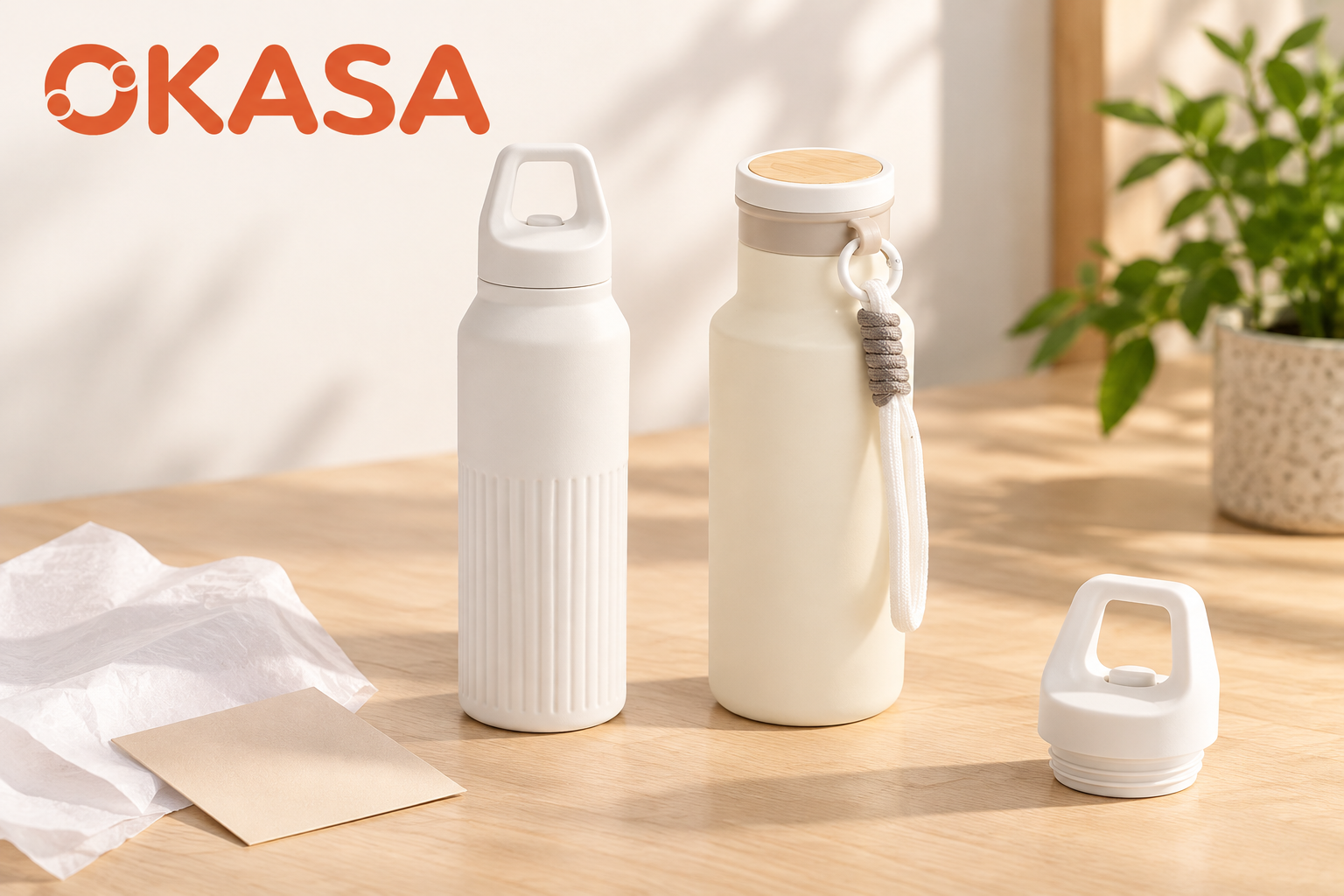
D001 and D014 catalog forms placed beside a sample card for closure review.
The D001 catalog reference measures 74 × 268 mm and holds 530 ml, according to OKASA. I would give the box designer both numbers and a finished cap sample; a millimeter on top can matter to the insert. The matte body, button action and finger loop are visible in the reference. In our imagined review, Mara uses the button and Ben initially presses the rim. I would ask them to show the supplier how they each closed it. The answer matters more here than a polished video of the intended movement.
D014 leads with its cap trim. Its PP lid carries bamboo-strip accents. OKASA lists the bottle at 68 × 255 mm, with a 304 stainless inner wall and 201 outer wall. The bamboo strip brings D014 into a natural-material gift palette. I would nevertheless take the top apart with the supplier at the sample meeting and put its seal and drinking surface on the table. The recipient sees the strip first and uses the hidden assembly every day.
TGS919 is a complete kit reference rather than a third lid mechanism to rank. The page shows a powder-coated 350 ml tumbler with a smooth silicone ring, alongside a notebook in a kraft box. OKASA specifies 304 stainless on its inner wall and 201 outside. The page leaves the exact cap less clear than D001’s. For a custom kit, I would write the cap taken from the signed physical tumbler into the order sheet rather than pointing only to a set photo. A photograph of a set cannot settle that point.
For this article, imagine 1,800 gifts for a regional sales meeting. Most go into backpacks after the event; some stay on desks. Half the recipients will fly home. The working brief says “custom insulated drinkware, dark green, small front logo, paperboard gift presentation.” The first brief has no heat-retention number, leakage trial or care card. At the meeting I would draw three columns for session use, train carry and gift-box opening, then put each requested claim under the moment where it matters.
The use claim comes before the lid sketch
A desk cup may only need to resist a small bump. A commuter bottle may be expected to ride upright in a side pocket. A buyer who says “leakproof” might mean that a filled bottle survives an hour on its side inside a fabric bag. The buyer can put the proposed gift-card wording on the sample ticket and show it to the supplier. The sample ticket needs the intended tilt, fill mark, drink temperature and length of the carry trial. A manufacturer can then say what it can support and what needs a trial.
The one-hand appeal of D001 is easy to understand at registration or between meetings. I would pass a filled sample to several colleagues and watch them use the actual button, rather than asking if they like it. One might reach for it naturally. Another may need two hands to secure it again. If a lock, protective cover or travel position is proposed for a custom version, request a complete physical sample showing that configuration. Do not borrow a claim from a different cap because the bottle body looks similar.
D014 looks calm beside a kraft notebook. Its bamboo-accented PP top draws the eye, yet the little junction between strip and plastic is where I would spend time. I would place two caps side by side and look across their edges, then wash one according to its proposed care card. Has the trim changed? The supplier can lay out the hidden seal pieces separately at the sample meeting. The buyer might ask, “Which of these parts touches the drink?” and let the supplier answer over the laid-out cap.
The 350 ml tumbler in TGS919 shares a rigid kraft box with the notebook. Ben's imagined unpacking starts with the bottle while the book remains in its recess. His fingers need room around the cap. I would measure that space on the insert before signing a new box layout. The team can observe that moment. A small card may solve confusion, though its position in the box needs a mock-up. This kit is a different occasion from handing someone a bottle for a commute.
Put the same beverage through the samples
Cold water is enough for the first trial. Use a fill mark on the vessel and place white tissue beneath it after use. A fresh wet spot can be dated and photographed. For hot drinks, the supplier first has to identify whether this exact version is intended for that temperature; only then should anyone plan a careful use session. 'Insulated' appears on many catalog pages, but it says too little about the drinker's contact with this lid. The specific care and use sheet should travel with the physical proof.
The trial record might fit on the back of a sample ticket. Put the fill mark and the opener's initials there. After showing two colleagues the closure, I would leave the bottle on the table and ask them to close it again during a normal conversation. One may leave the button halfway. That is worth photographing. A short note such as 'Ben heard no click' gives the factory a better problem to solve than a vague score of three out of five.
I would keep a photograph of the lid in each position under its sample code. A removable gasket needs its own photo after it has been taken out according to the supplied card. The sales team overseas can point to that image when describing a wet spot. Keep the signed bottle in the sample cabinet. The photograph carries its cap code and date, which prevents the revised orange mark from being matched to an obsolete lid.
A note about leakage language
Put the draft box copy next to the quotation and the actual sample. On the copy someone has typed 'leakproof'; on the quote the supplier may have described only an upright splash trial. I would mark up the printed drafts in orange ink. The intended train journey gives the supplier a concrete condition for its trial; the result will determine which draft wording survives. One dry afternoon in the office is useful feedback, but it cannot carry a broad travel promise for a production lot.
For Ben's tote question, I would fill the vessel to the agreed line, close it as an ordinary recipient would and set it sideways on white paper for a stated period. A second operator repeats the closure. The supplier may propose a movement step and a different acceptance limit; both should be written on the ticket before the trial. Any wet paper gets photographed with the sample code and operator's name. The white sheet shows exactly where a drop appeared.
The desk-use version could be described beside a keyboard rather than inside a travel bag. The sample ticket can state upright use, and the care card can repeat the supported wording. Ben's train journey would then require a different bottle. This may cost the project a fashionable 'leakproof' headline, but it keeps the promise tied to what was actually approved.
Where the lid meets the mouth
I would drink from the proof, set it down and look under the lip. A little retained water might be there. The cap may leave the mouth feeling narrow even though the neck looked generous in the photograph. Ben can take the next drink without hearing my verdict. He writes 'rim feels crowded' on the back of the sample tag. That short phrase is more useful than my theory about the insert. The actual insert and seal can make the drinking opening feel quite unlike the drawing.
Mara rinses her cup at the office sink. Ben forgets his in a suitcase overnight. Give each the proposed care card and a sample cap. Mara follows the draft instructions, removes the seal and reseats it. Ben notices the groove under the spout and tries to reach it with the supplied cleaning advice. I would photograph both moments for the factory. Their confusion should be written directly on the card draft. A care instruction that sounds clear in a factory meeting can be difficult at a sink.
The phrase 'dishwasher safe' would be premature on this mock-up. Its steel wall is only one part of the gift. The powder coating, front mark, PP cap, seal and bamboo trim all meet the cleaning routine differently. I would ask the supplier to show the care wording it can support for this completed sample. Put that on the card, not a claim borrowed from an undecorated steel body.
What goes on the RFQ page
The RFQ should open with Ben's sideways tote and the intended drink. Then I would attach the exact finished dimensions, body build, coating reference, cap action and the visible trim. I would staple the proposed seal diagram, care card and box layout behind that first page. The orange mark gets a full-size drawing showing the area clear of the grip. Mark D001's button, D014's cap accent or TGS919's kit arrangement only where that feature is wanted. A factory can write a proposed alteration in the margin instead of hiding it inside a generic offer.
A blank quotation cell does not become an included feature by silence. An unknown seal material or pack height gets a question mark in red. At the sample meeting, the supplier can write its answer next to the mark and sign the proof code. The table then records an actual choice instead of implying that all catalog options have been quoted.
|
Buyer question |
D001 active bottle |
D014 accent bottle |
TGS919 kit tumbler |
|
Opening action |
Button and threadless operation on catalog model |
Confirm complete PP lid action on sample |
Confirm exact lid on custom tumbler |
|
First user question |
Can recipients open and close it naturally? |
Is closure clear and bamboo trim easy to care for? |
Does the recipient understand its desk or travel use? |
|
Claim to approve |
Orientation and movement trial for intended carry |
Supplier-supported closure and care claims |
Use claim for chosen tumbler in kit |
|
Pack drawing |
Finger loop and maximum height |
Lid trim and cap clearance |
Notebook, tumbler and insert clearance |
|
Quote detail |
Mechanism and any spare components |
PP cap and bamboo accent |
Vessel, lid, ring and assembled box |
The price comparison should keep decoration and pack-out visible as separate lines. A button mechanism and a decorative PP cap are different constructions; I would not attribute every price difference to the lid without seeing the steel build and body finish as well. At this stage the shortlist is for physical review, not a winner declared from a spreadsheet.
A sample can fail without looking broken
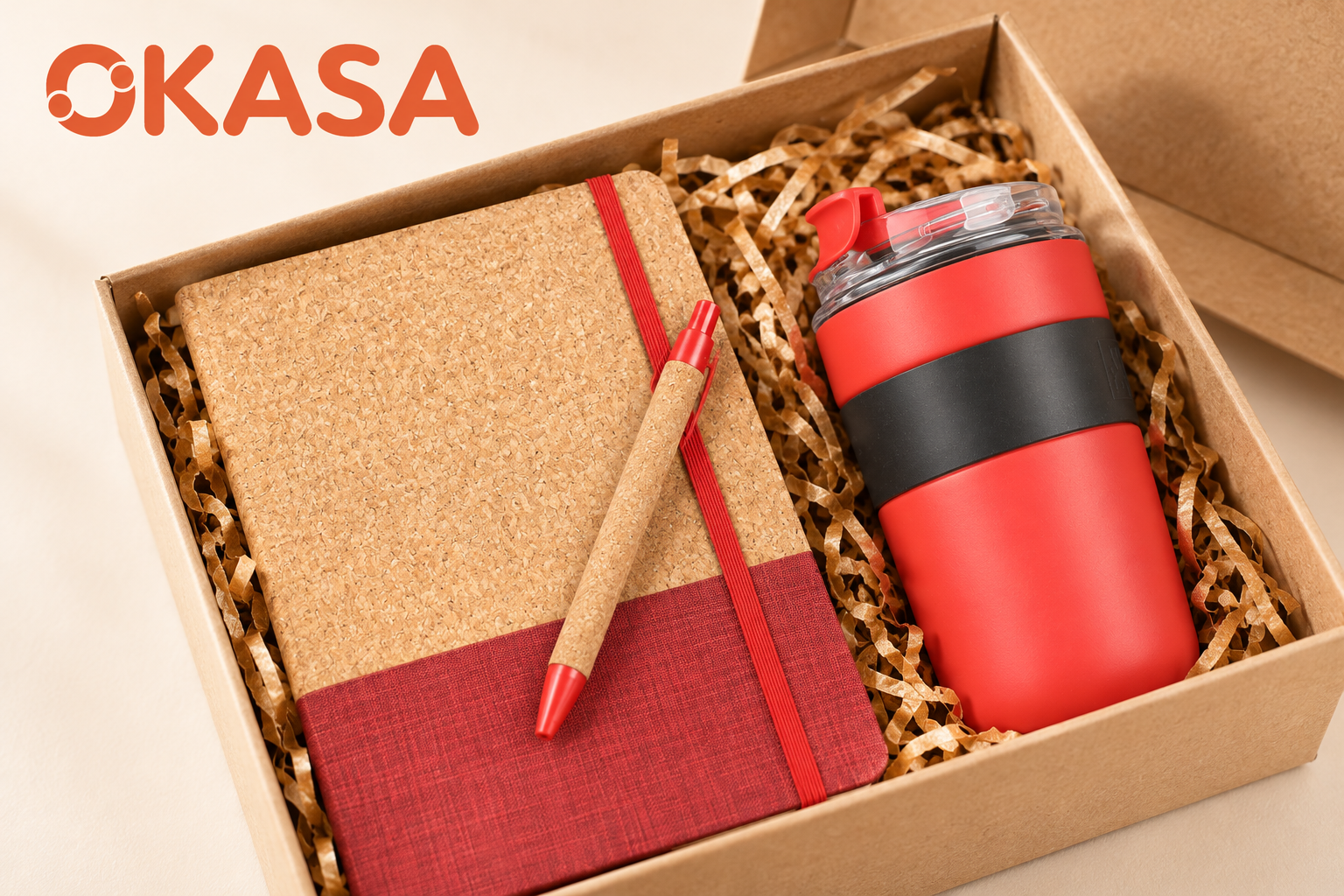
TGS919-inspired kit view for checking cap and notebook clearance.
The first carton of samples reaches the buyer with two dark-green bottles and a loose cap in tissue. Before the meeting, I would put a piece of tape under each base and on its matching lid. A cap that goes onto both necks during a quick demonstration has proved very little. The factory's assembly record, not an accidental fit at the conference table, must define the approved pairing.
One reviewer can use the D001 button for several ordinary drinks, then hand the bottle to someone who has never seen it. I would watch for the moment each person believes it is shut. One guest feels a click; the other keeps pressing. I would hand that disagreement to the supplier with the bottle. Then I would pull the loop in the manner the recipient is likely to use and ask the supplier to put that use in the cap specification. A photograph of the loop suspended from one finger is not a load test.
D014's bamboo decoration creates a joint I would inspect from the side. Run a thumb around the trim after washing the sample according to its care card. Is there a rough corner or a patch that holds moisture? Put a close photograph and the cap itself on the supplier's desk. The problem can be discussed in terms of this actual edge rather than an adjective such as 'premium.'
The TGS919 format brings the notebook into the inspection. I would close a made-up gift box, carry it to the next room and open it on a table. If the tumbler cap has touched the notebook edge, point to that place on the insert drawing. There is still time to make the cut-out deeper. The printed box sleeve should wait until the complete fit has been signed.
When a finish change becomes a cap change
Suppose the brand team asks for a deeper green coating on Monday and a new cap on Friday. I would use two change tickets. The Monday ticket covers color and any effect on artwork. Friday's ticket goes back with the cap and vessel on the table. I would ask the factory to mark the neck and seal on its drawing, then send a closed sample in the proposed box. Only then can the art and packing files move to a new approved version.
Spread five D014 caps on a white sheet: their bamboo grain will likely vary. Put several caps beside the intended body color and decide what range the client can accept. If the PP changes shade as well, approve that separately. One unusually attractive catalog photograph is a poor production color standard; a signed group of physical pieces can show the acceptable spread.
A logo approved on a flat body drawing can behave strangely in a hand. I would put the decorated bottle in the brand manager’s hands. The manager opens it, and the thumb lands directly over part of the orange mark. With the cap settled in its normal position, photograph the vessel at eye level. That is the view I would attach to the signed artwork, along with the ordinary flat dimensions.
The spare-part question
The event organizer may ask for extra caps. Get an answer from OKASA while ordering: can it supply a complete cap for this exact neck, a seal, or only a finished spare bottle? Put any available part code and minimum on the purchase sheet. If the answer is complete bottles only, the client can reserve some from the order. This is easier to settle now than after someone has lost a cap on a trip.
Perhaps the distributor keeps complete spare gifts in its warehouse. Put the production code on its paperwork and leave one signed unit on the sample shelf. A future replacement request can be matched to that unit, even if the display box has no technical label.
If loose caps are unavailable, the client can price finished extras. Storage and the route for sending one to a recipient need a named owner before anyone promises replacement in campaign copy.
The quote has to name the closure
I would request a line drawing or exploded view of the chosen lid, with material names and part references. The quotation can state the base bottle, the exact cap assembly, decoration, individual pack, box insert and any optional components. It should say whether a custom cap color requires a separate minimum or setup. That information is more useful than a single “custom bottle” unit price that cannot be traced to the sample.
A higher cap may add millimeters to the gift box and master carton. Ask for the final height measured with the closure in place. The TGS919-style notebook kit is especially sensitive to the arrangement: a revised cap can make an existing insert too shallow. I would price the assembled configuration, not only the vessel, and ask for carton dimensions after the proof is approved. Freight estimates made from an undecorated bottle photograph are provisional.
The timeline should start at a named approval. Artwork can be ready while the cap color, sealing method or box insert is still under review. Put a date against the final physical lid, finished bottle and packed set. If the client changes the closure after signing the color, the schedule needs a new version. A short email that says “same delivery” is not a substitute for checking material availability and re-sampling time.
A receiving check that follows the user's hand
When the first bulk cartons are ready, the inspector should have the signed sample and its cap code. I would begin with appearance: color, scratches, print position, bamboo-strip edges if applicable, loop attachment and carton marks. Then use the closure as a recipient would. The chosen test method can include a defined fill, closures by different operators and the agreed orientation. Record the number of units and cartons examined; do not call a handful of casually opened bottles a lot test.
I would leave one vessel dry and use another for repeated drinks. A faint track of liquid on the second cap may not appear on the first. If the cap becomes easier to close after use, record that too. The agreed inspection sheet must tell the factory whether such observations are acceptable for the claim on the gift box. Write the pass line beside the method before the factory starts filling cartons.
At the packing table I would open a box from an early carton and another from a late one. A paper rub against the cap can show up at the notebook edge. Note which carton supplied the affected set and photograph the insert. The closure test might pass while this gift still looks damaged on arrival.
An approval record a new colleague could use
The approval sheet for this hypothetical job might carry a D001-inspired bottle code, an art revision, a cap code and an insert drawing. I would write the 530 ml catalog reference next to the proposed custom capacity, then leave a clear line for the actual signed dimension. A replacement cap request can be matched to the cap code. A new box can be matched to the insert drawing. The system works because the physical sample and files can be found, not because the code format is clever.
D014 would need its accepted bamboo-strip range and care card attached to that sheet. For TGS919, label the tumbler cap itself on the sheet; the gift-set photograph does not show its construction. The next buyer can then compare a reorder proof with the signed gift and write down what has changed.
|
Record |
Signed reference |
Bulk check |
Owner |
|
Cap action |
Lid L-03 |
button seats |
buyer |
|
Seal |
Part G-02 |
fit and wetness |
QA |
|
Care card |
Copy C-01 |
card in box |
brand |
|
Gift fit |
Insert P-02 |
no contact |
packing |
|
Logo |
Art A-04 |
size and facing |
brand |
A short inquiry for the actual project
To ask OKASA for a proposal, I would send the event date, 1,800-piece quantity, destination, target capacity, gift contents and logo artwork. Add one photograph of the notebook that shares the box. Then name the feature worth sampling: the D001 button, D014 cap accent or TGS919 presentation. The recipient's likely carry position belongs in the same note. The reply should name the cap, proof and pack price.
A promised trip inside a backpack belongs in the opening sentence of that note. The supplier can respond with its proposed closure, test method and any limits. If the team wants a decorative lid and a desk gift, it can say that too. Either answer will be more useful than an unspecific request for “premium leakproof bottles.” Once the sample arrives, the buyer can decide with evidence in hand and send a focused request for a revised proof through OKASA's inquiry page.