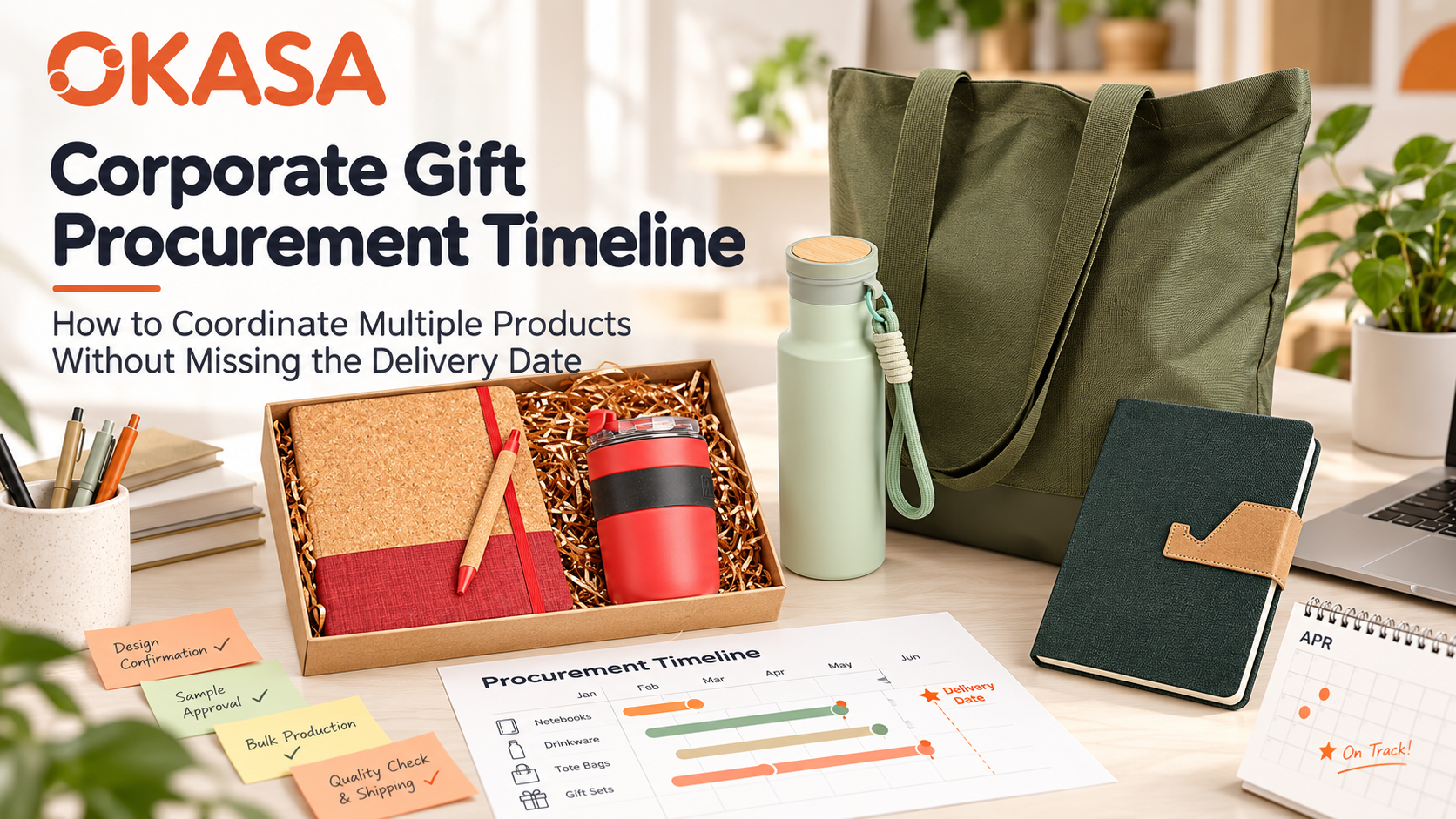


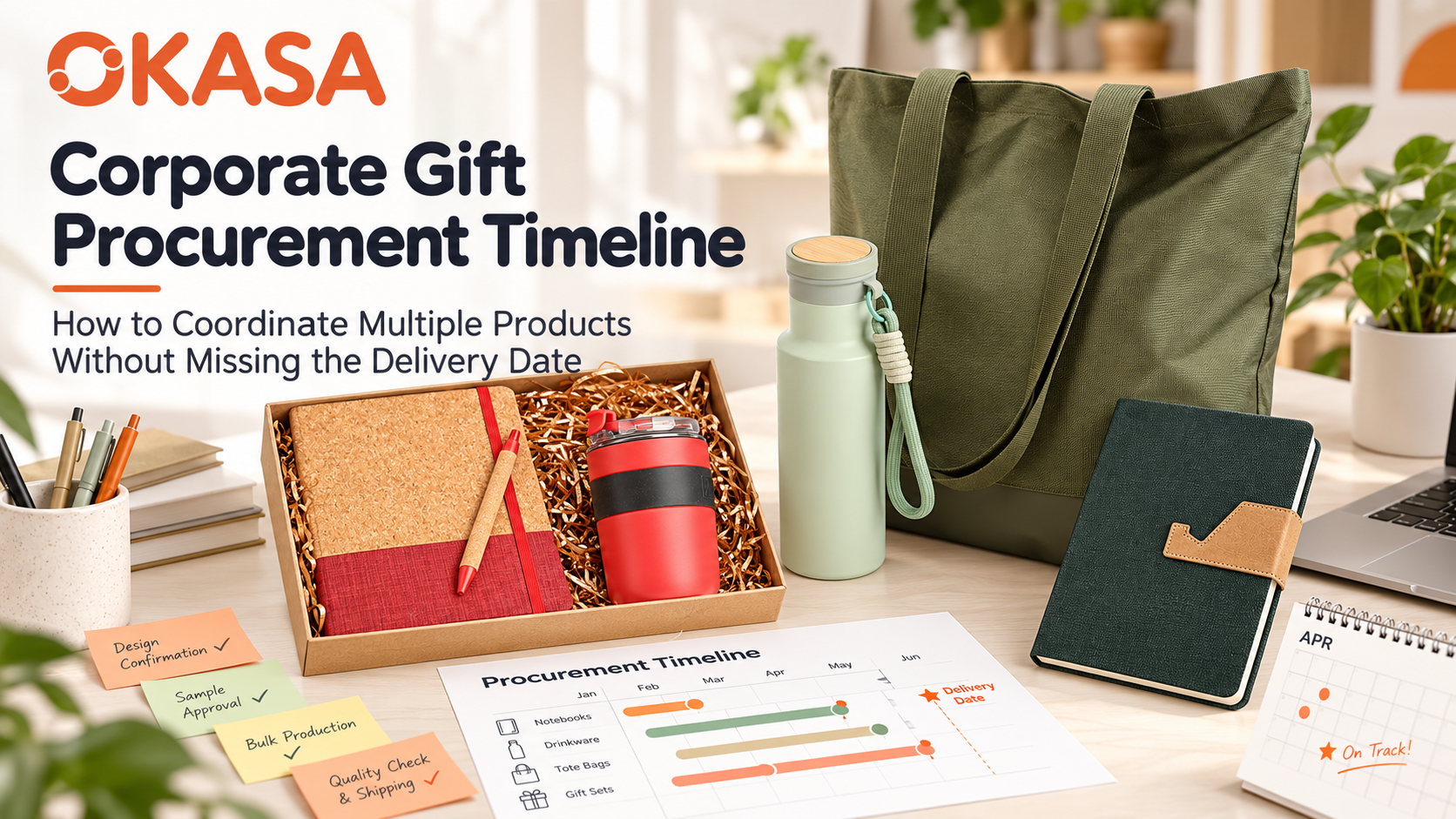
A corporate gift order becomes a scheduling problem the moment it contains more than one product. A bottle may need one coating line, a notebook may depend on paper and cover material, a tote bag may have a separate fabric batch, and the gift box cannot be finalized until the finished dimensions of everything inside are confirmed. If all four items must arrive together, the project does not move at the speed of the fastest component. It moves at the speed of the slowest unresolved decision.
The safest planning method is to work backward from the required in-hand date and build one shared critical path. Buyers should separate the date they want to distribute the gifts from the date the goods must reach their warehouse. Customs clearance, local delivery, allocation and event setup all need time of their own. Once that final receiving date is fixed, the supplier and buyer can place artwork approval, samples, materials, production, inspection and shipment on a realistic calendar.
This guide explains that process in nine practical steps. It is written for buyers managing drinkware, notebooks, bags, presentation boxes or complete gift sets, especially when several components must share one color story and arrive as one program. It does not promise a universal lead time. Instead, it shows what controls the schedule, which decisions can run in parallel and where a few days of buyer delay can create a much larger delivery risk.
The Short Answer Build the Schedule Before You Approve the Product
For an initial planning discussion, send the supplier six pieces of information first: target quantity, destination, required in-hand date, product categories, branding scope and packaging concept. The product specification will grow during development, but those six facts allow the project team to identify the likely critical path.
A simple stock-color bottle with one logo can move differently from a custom-colored bottle. A standard notebook with a printed mark is not scheduled like a notebook with a new cover construction. A tote selected from an existing pattern usually has fewer development dependencies than a bag requiring new hardware or dimensions. A rigid gift box may have a short physical production time yet still begin late because the insert cannot be approved until every component is stable.
The early schedule should therefore show conditions, not just dates. “Production starts after deposit” is incomplete if the artwork, colors, sample and packaging dimensions remain open. A stronger milestone reads: “bulk material release after commercial confirmation, final artwork approval and signed pre-production sample.” That wording makes responsibility visible and prevents both parties from counting time from different starting points.
A Practical Timeline at a Glance
The table below is a planning model, not a fixed OKASA quotation. Actual timing depends on the chosen products, customization, quantity, test scope, season, destination and transport method.
|
Project phase |
Buyer decision or input |
Supplier output |
Main schedule risk |
|
Commercial brief |
Quantity, destination, in-hand date and budget position |
Feasibility review and initial route |
Starting with an incomplete deadline or unclear scope |
|
Product selection |
Preferred categories, functions and acceptable alternatives |
Recommended models and specification options |
Comparing products that follow different production routes |
|
Quotation |
Confirmed assumptions and delivery basis |
Itemized commercial offer |
Hidden exclusions or mixed Incoterms assumptions |
|
Artwork and color |
Vector files, logo rules and physical color references |
Layouts, print limits and color plan |
Slow feedback or conflicting stakeholder comments |
|
Sampling |
Written list of what each sample must prove |
Stock, decorated or pre-production samples |
Treating an appearance sample as full approval |
|
Material release |
Final specification and approval record |
Purchasing and production schedule |
A custom component with a longer minimum or lead time |
|
Bulk production |
Controlled change process |
Completed components |
Late changes after materials have been committed |
|
Kitting and inspection |
Pack-out instructions and defect criteria |
Assembled, checked and packed order |
One late item holding every finished item |
|
Shipping |
Confirmed consignee and documents |
Export handover and shipment |
Booking, customs or final-mile time omitted from plan |
Step 1 Fix the Real In-Hand Date
The distribution date is not the warehouse receiving date. If a conference begins on October 20, the buyer may need the goods by October 10 for counting, allocation and transport to the venue. If the gifts will be mailed to individual recipients, the central warehouse may need them even earlier. A project with ten regional offices needs enough time for the master shipment to be divided and forwarded.
Start with the date the goods must be physically available for the buyer’s next operation. Then add a buffer based on consequence. A replenishable internal gift can tolerate a different risk from a public launch or fixed event. Avoid using the buffer to hide unresolved decisions. Keep it visible as management time rather than silently asking the supplier to compress production.
The destination must be precise. “Europe” does not give the supplier enough information to estimate transport or documentation. State the country, city or named place and whether the quotation should be EXW, FOB or another agreed delivery basis. If several destinations are involved, identify where the order will be split. A factory can pack by office, department, sales representative or campaign only when the allocation rules are known before final pack-out.
Buyers working with a custom corporate gift set manufacturer should also decide whether all sets must be identical. A single composition is easier to control than three regional versions with different inserts, labels or language cards. Variation is possible, but it belongs on the timeline as real work.
Step 2 Build the Program Architecture
Before discussing decoration, define what is being purchased. Separate the program into components and name the owner of each decision. A typical multi-product gift may contain drinkware, a notebook, a bag and a presentation box. The buyer may also require a greeting card, barcode label, protective mailer or region-specific insert. Those small items can become schedule blockers when nobody owns them.
Use one master bill of materials. Each line should state the item name, model, quantity, specification revision, artwork file, color reference, packaging role and approval status. The purpose is not to create bureaucracy. It is to stop teams from approving “the green version” when several green products and several artwork versions are circulating.
Choose a lead product for the visual system. In some programs the drinkware carries the dominant brand color while the notebook and bag remain neutral. In others the bag is the main reusable item and the smaller products follow its fabric tone. This decision helps the supplier prioritize color matching and prevents every component from competing for attention.
The program architecture should also identify substitutes. If the event date is fixed, buyers benefit from pre-approving a practical fallback: a stock coating instead of a custom bottle color, an established notebook format instead of a new construction, or a standard gift box with a printed sleeve instead of a fully bespoke rigid box. A fallback is not an admission of poor planning. It is a controlled decision made before the project is under pressure.
Step 3 Freeze a Quoteable Specification
A photograph is not a production specification. For each component, record the attributes that affect material, process, testing and packing. A custom drinkware manufacturer will need capacity, wall construction, food-contact materials, lid type, surface finish, color, logo method, performance expectations and individual packaging. A bottle chosen from an established model may still have several commercially meaningful options.
For notebooks, record size, cover material, board, paper weight, sheet count, ruling, binding, accessories and branding. OKASA’s A5 linen hardcover notebook with magnetic strap and detachable stand, for example, is listed at 21 × 15 cm with a linen fabric cover laminated to 1.5 mm greyboard, 80 sheets of 70 gsm ivory paper and a stitched hardcover construction. Those details tell a custom notebook manufacturer far more than “premium A5 notebook.”
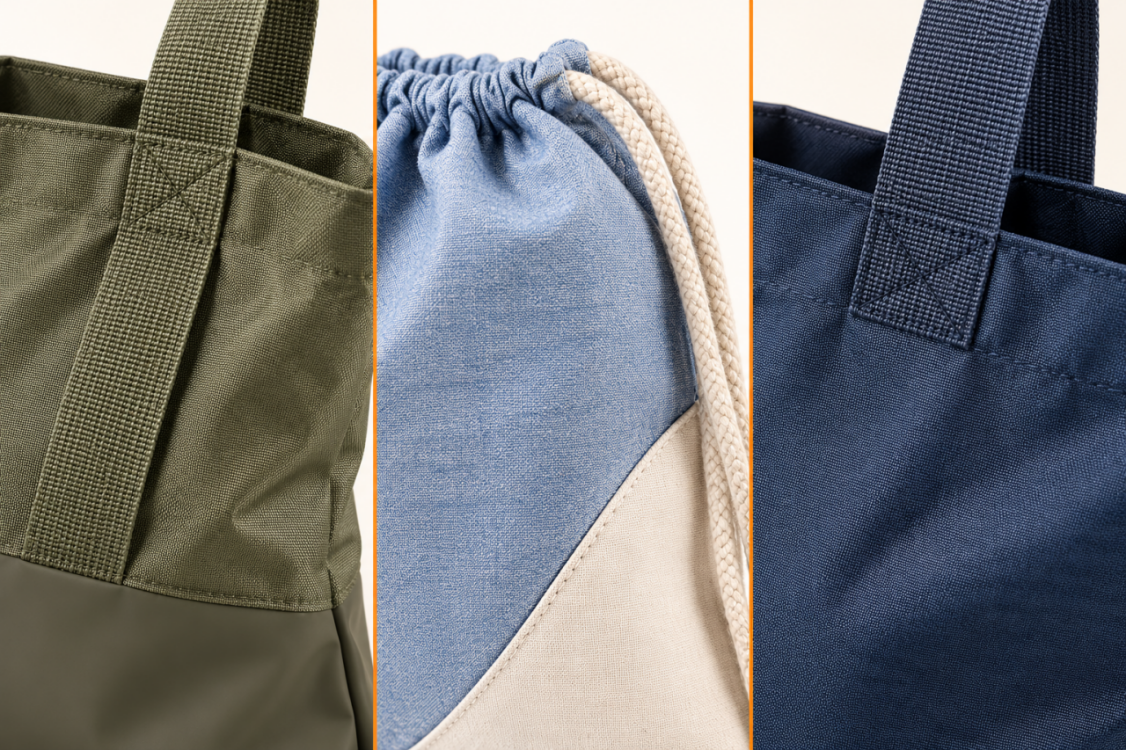
For bags, define finished dimensions, fabric, construction, handle material, reinforcement, closure, pockets and load expectations. OKASA’s B108 nylon tote bag is published in 900D nylon or 400D washed nylon with a CK film-spliced section, a 35 × 40 cm body and cross-stitched handles. A custom bag manufacturer needs those construction decisions before a reliable sample or schedule can be offered.
Finally, define the package from the inside out. A custom gift box manufacturer needs the finished size and weight of every item, the desired presentation order, protection requirements and transport route. When product dimensions are still changing, the box design should remain provisional. Printing a beautiful insert before the bottle or notebook is fixed is an expensive way to save no time.

Approving the shared specification early keeps products, colors and deadlines aligned
Step 4 Map Dependencies and Find the Critical Path
Not every task has to wait for the previous task. While the buyer reviews a stock sample, the designer can prepare artwork layouts. The supplier can check packaging concepts while confirming material availability. Shipping estimates can be modeled before the final carton dimensions exist, provided they are clearly marked as estimates.
Other tasks are truly dependent. A fitted insert cannot be finalized without product dimensions. Final carton cube cannot be confirmed without the finished pack. Certain laboratory tests require representative materials and colors. A pre-production sample cannot represent bulk production when the chosen material has not been secured.
Draw the dependencies rather than relying on a list of dates. The critical path is the longest chain of dependent work that determines the earliest possible completion. In a gift set, the slowest component is not always the most complex product. A simple printed card can become critical if copy approval arrives late. A bag can be finished while a bottle coating is still pending, but kitting cannot close until both are available.
|
Component |
Work that may run in parallel |
Work that must wait |
Typical trigger for release |
|
Drinkware |
Artwork layout, existing-model sample, compliance review |
Dedicated color and final decoration |
Approved model, finish, color and artwork |
|
Notebook |
Page layout, cover concept, accessory review |
Final cover production and branding |
Approved material, construction and artwork |
|
Bag |
Existing fabric check, print-area review, load-test method |
Custom material cutting and full assembly |
Approved fabric, color, dimensions and sample |
|
Gift box |
Structural concept and visual design |
Fitted insert and final carton calculation |
Stable finished product dimensions |
|
Printed inserts |
Copy drafting and translation |
Final print run |
Approved copy, language and quantity split |
|
Kitting |
Work instructions and line planning |
Final assembly |
All components received and released |
Step 5 Control Artwork Color and Sample Decisions
Most schedule drift happens in approval, not on a machine. A supplier may return a layout within a day, then wait a week while different departments debate the logo size. That lost week does not disappear because the original quotation showed a four-week production estimate.
Appoint one approval owner on the buyer’s side. Stakeholders can comment, but one person should consolidate feedback into a controlled response. Ask reviewers to mark comments against a checklist: product, color, logo, position, function, package and copy. “Looks good except make it more premium” is not an approval instruction.
Give every sample a defined job. A stock sample can confirm scale, grip, general construction and usability. It cannot approve a custom color or decorated surface. A logo sample may prove placement and technique without representing the final package. A pre-production sample should be tied to the current specification and artwork revision. If it contains a deviation, record that deviation instead of assuming everybody will remember it.
Color requires special discipline across materials. Powder-coated metal, dyed fabric, printed paper and natural cork reflect light differently. A shared Pantone reference does not guarantee that they will look identical. The practical goal may be a coordinated family rather than a perfect instrumental match. Decide which item is the color anchor, review physical samples under consistent light and document an acceptable range.
When working with an OEM promotional products manufacturer, ask for a single approval register across categories. The register should show what was sent, the revision, the date, the buyer’s decision and any remaining conditions. It becomes the reference when a late stakeholder asks why a certain shade, logo size or accessory was selected.
Step 6 Release Materials Without Losing Change Control
Commercial confirmation is not the same as production readiness. The buyer and supplier should agree on the exact release gate. A deposit may authorize purchasing, but the team still needs approved specifications and artwork. If the supplier orders custom material before those decisions are final, a later change may create waste, additional cost or a complete restart.
The release record should name the specification version, artwork version, quantities, allowed overrun or underrun, approved samples and known exceptions. Changes after release need a short impact review covering cost, material already committed, sample validity and delivery. This keeps an apparently small request—such as moving a logo or changing an insert—from quietly disrupting the whole plan.
Buyers seeking promotional products sourcing China often manage time-zone differences and several internal decision makers. Use a fixed approval window. If feedback is due Wednesday, schedule the review meeting before Wednesday rather than forwarding samples on that day. Courier tracking should be part of the timeline, and digital layouts should be reviewed while physical samples are in transit when that work can safely overlap.
Avoid asking the supplier to “start everything” while major choices are open. A controlled partial release can work when the risk is understood. The factory might secure an existing bottle body while the logo layout is being finalized, or reserve standard paper while the notebook cover artwork is in review. The supplier should state what is reversible and what becomes a financial commitment.
Step 7 Manage Bulk Production by Milestones
One lead-time number is not enough for a multi-product order. Ask for milestone visibility: material arrival, component production, decoration, assembly, packaging readiness, kitting start, inspection and shipping handover. The buyer does not need daily factory messages. It needs updates at the points where a delay can still be managed.
A milestone update should report the planned date, current status, new risk and required decision. “Production is ongoing” says almost nothing. “Bottle coating is complete; notebook covers are due Friday; gift-box insert waits for final bottle height confirmation” gives the team something to act on.
For bulk corporate gifting solutions, component quantities also need reconciliation. If 3,000 sets require 3,000 bottles, 3,000 notebooks and 3,000 cards, the kitting plan must address normal process loss and replacement stock. A shortage of ten cards can hold ten otherwise complete sets. Confirm whether spares are shipped loose, used for replacement or retained under another instruction.
Quality checks should occur during the process, not only at the end. Early decorated pieces can reveal a registration problem. A first packed set can expose an insert that is too tight. Initial carton measurements can show that freight assumptions need revision. Correcting those issues before the full run is packed costs less time than opening every finished carton.
The buyer should resist unnecessary late status calls that interrupt work without improving control. Agree on the report rhythm at order placement and create an exception rule: routine updates arrive at milestones; any issue affecting specification, cost or delivery is reported immediately with options.
Step 8 Plan Kitting Inspection and Allocation as Production Work
Kitting is not simply putting items in a box. It includes receiving, counting, checking, arranging, adding inserts, applying labels, closing the package, packing export cartons and reconciling finished quantities. Multi-version programs may require different language cards, office labels or product colors. Each version needs a clear work instruction.
Prepare a golden packed sample. It should show the orientation of every item, protective materials, insert position, card direction, label location and closing method. Photograph it from useful angles and connect it to the pack-out revision. This sample helps production, quality control and the buyer discuss the same finished result.
Inspection criteria should cover individual products and the assembled set. A bottle can pass its own appearance check while the final set still fails because the wrong notebook was packed beside it. Count errors, mixed versions, reversed inserts and damaged presentation surfaces are set-level defects. Define critical, major and minor defects before inspection rather than negotiating them after a problem is found.
Allocation deserves equal attention. If cartons must be prepared for six offices, provide a matrix showing destination code, set version, carton quantity, label copy and any language difference. Keep recipient names and personal addresses out of the factory workflow unless direct fulfillment is part of the agreed service and the data process has been reviewed. For most B2B orders, shipping in controlled regional batches is simpler than asking the manufacturing line to manage individual recipients.
A qualified promotional products manufacturer China partner should be able to explain where components are counted, how mixed versions are separated, when the final set is inspected and how carton labels connect to the allocation list. Those answers are often more valuable than a promise that kitting is “no problem.”
Step 9 Protect the Shipping Date With a Decision Ladder
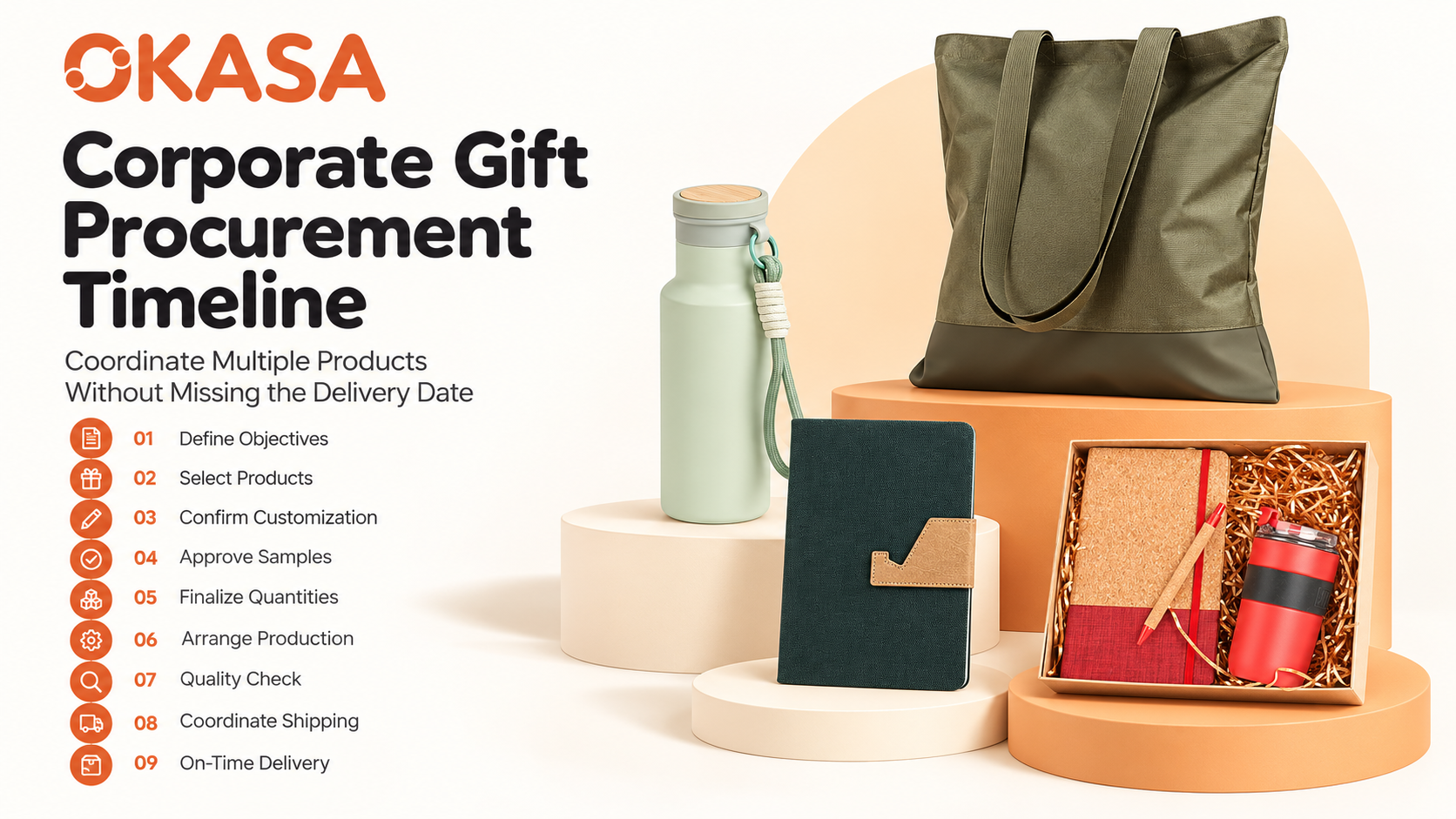
The project needs a plan for what happens when time becomes tight. Build a decision ladder while alternatives are still available. The first response should protect the product and delivery outcome, not immediately pay for faster freight.
For example, if a dedicated coating cannot meet the schedule, the buyer may choose an approved stock color. If a custom rigid box is late, a standard protective box with a branded sleeve may preserve presentation. If one accessory is delaying the full set, the buyer may remove it, ship it separately or move the entire program—depending on how essential it is to the recipient experience.
Set a last responsible decision date for each fallback. A stock-color route is useful only before bulk coating begins. Air freight helps only if production finishes with enough time for booking and customs. Splitting a shipment can protect an event quantity while the balance moves by a slower method, but it adds handling and document complexity. The commercial team should compare these options with actual quantities and dates rather than using emergency phrases such as “please expedite.”
Shipping documents also belong on the critical path. Confirm the consignee, notify party, product descriptions, carton data and document requirements before the goods are ready. A finished order waiting for instructions is not on time. Buyers should ask when final carton dimensions and weights will be available, because those figures influence booking and landed-cost estimates.
A Worked Example for a 3000 Set Program
Imagine a distributor preparing 3,000 corporate gifts for a customer with a fixed campaign launch. Each set contains a stainless-steel bottle, A5 notebook, nylon tote and printed message card. The products are packed in the tote rather than a rigid presentation box, then placed in a protective export carton by regional quantity.
The distributor first fixes the warehouse date, then gives the supplier two weeks of receiving and regional allocation time before the launch. During product selection, the buyer accepts existing bottle and notebook structures but requests coordinated colors and one logo on each item. That choice avoids new body tooling while keeping the program visibly customized.
The stock samples and artwork layouts run in parallel. The buyer approves the tote construction early but delays the final bottle color by four days. Because the project calendar shows coating on the critical path, the team immediately reviews the consequence. They choose the already-approved sage option rather than moving every later milestone.
While bulk components are in production, the buyer supplies the regional allocation matrix and final message-card copy. The supplier creates a golden packed sample, confirming how the bottle and notebook sit inside the tote and how the card faces the recipient. An early pack check reveals that the bottle cord could press against the notebook edge, so a simple protective wrap is added before full kitting begins.
The final inspection checks the products, decoration, set composition, regional labels and carton counts. Because the shipping documents were drafted earlier, the order can move to handover after release. No single tactic made the project successful. The result came from visible dependencies, fast approvals and a fallback decision made before the schedule became an emergency.
How to Compare Supplier Timelines
Do not compare quotations only by the total number of days. One supplier may count from deposit, another from sample approval, and a third from material arrival. Convert each offer into the same milestone structure.
|
Timeline question |
Supplier A |
Supplier B |
Supplier C |
|
What must be approved before material release? |
|
|
|
|
Which component controls the critical path? |
|
|
|
|
Are stock and decorated samples included? |
|
|
|
|
Does timing include packaging production? |
|
|
|
|
When are final carton dimensions available? |
|
|
|
|
Is final kitting included in production time? |
|
|
|
|
What inspection point is planned? |
|
|
|
|
Which Incoterms rule and named place apply? |
|
|
|
|
Does the estimate include booking or transit time? |
|
|
|
|
What fallback route is available if approval slips? |
|
|
|
The strongest schedule is not automatically the shortest. It is the one whose starting conditions, dependencies and responsibilities are clear. A supplier offering an unrealistically compressed calendar may simply have omitted sample approval, custom material, packaging or inspection.
Why Multi-Category Sourcing Can Simplify the Schedule
Coordinating several independent factories gives the buyer direct control, but it also creates more interfaces. Product dimensions, colors, delivery dates and carton data must converge somewhere. If the factories ship separately to another kitting location, the buyer must manage receiving and shortages across all of them.
An OEM promotional products manufacturer with several relevant categories can reduce those interfaces by coordinating product development, packaging and final assembly through one project plan. This does not remove the need for specifications or inspection. It changes who manages the handoffs.
The same principle applies to a sustainable promotional products manufacturer. When environmental claims are part of the program, evidence must be linked to the actual materials and components in the order. The timeline should include document review early enough to correct a mismatch before the marketing team publishes a claim.
For buyers needing a complete presentation, a custom corporate gift set manufacturer can also test the assembled user experience rather than treating each product as an isolated line. The published OKASA eco notebook and tumbler gift set, for example, combines a notebook, 350 ml stainless-steel tumbler and kraft gift box. It demonstrates why component fit, visual balance and pack-out belong in one approval process.
Frequently Asked Questions
How early should a corporate gift project begin?
Begin as soon as the quantity, destination and in-hand date are known. The required window depends on product complexity, customization, samples, testing, season and transport. A multi-product program should have more planning time than a repeat order of one established item. Ask the supplier for a milestone schedule based on the actual specification instead of relying on a generic lead-time statement.
What usually causes the largest delay?
Uncontrolled approvals are a common cause. Late artwork, unclear color decisions, changing packaging copy and multiple reviewers can hold material release. Custom components may also create a longer critical path. The project plan should show which buyer decision is needed next and what later work depends on it.
Can production start before the pre-production sample is approved?
Sometimes a supplier can release standard or reversible materials, but the risk must be explicit. Starting custom material or decorated bulk production before approval may create waste or rework. Agree in writing on what can begin, what remains open and how a later change affects price and delivery.
Should every product have the same color?
Not necessarily. Metal, fabric, paper and natural materials do not present color in the same way. A coordinated palette can look more intentional than forcing an artificial match. Choose one color anchor, use physical references and approve acceptable variation for each substrate.
When should the gift box be approved?
The visual concept can begin early, but fitted inserts and final dimensions should wait until the products are stable. Use real or production-representative samples to check fit, protection and opening sequence. Final carton calculations also depend on the completed individual package.
How can a buyer shorten the timeline safely?
Use established product structures, stock materials or colors, focused decoration and standard packaging where they meet the brief. Run independent tasks in parallel, give reviewers fixed deadlines and approve practical fallbacks early. Avoid removing inspections or approving features that have not been represented in a sample.
What information should be included in the first inquiry?
Send the target quantity, destination, in-hand date, preferred products, branding scope, packaging idea, market requirements and acceptable alternatives. Add artwork and physical color references if available. Clearly label which items are fixed and which are open to supplier recommendations.
Can OKASA coordinate notebooks, drinkware, bags and gift packaging?
OKASA presents notebooks, drinkware, bags, packaging and gift sets across its range. Send the project composition, quantity, destination, date and artwork requirements so the team can review an existing-model route, a coordinated customization route or another practical combination.
Final Inquiry Checklist
Before asking for a formal schedule and quotation, prepare:
· Required warehouse date and final distribution date.
· Delivery country, city and preferred delivery basis.
· Total quantity and any regional or language splits.
· Product categories, preferred models and acceptable alternatives.
· Specification requirements for every component.
· Artwork files, logo rules and decoration locations.
· Physical color references and the lead color product.
· Sample types and the question each sample must answer.
· Packaging, card, label and barcode requirements.
· Market, testing and documentation requirements.
· Final inspection expectations and defect priorities.
· Allocation matrix, carton labels and spare-quantity rules.
· Buyer approval owner and response deadlines.
· Fallback choices for color, product, packaging and freight.
A useful inquiry gives the supplier enough information to expose the critical path. It does not need to answer every design question on day one. State the delivery constraint, the products, the decisions that cannot move and the areas where alternatives are welcome. OKASA can then return a schedule that connects samples, production, kitting and shipping instead of offering a single lead-time number without context.
Product References
· OKASA Eco Notebook and Tumbler Gift Set
· OKASA A5 Linen Hardcover Notebook with Magnetic Strap and Detachable Stand
· OKASA B108 Nylon Tote Bag with Film Splicing and Reinforced Handles
· OKASA Multi-Purpose Paper Tube Packaging