

Custom Bag Manufacturer: How to Source Branded Backpacks and Tote Bags
Buyer quick answer: A capable custom bag manufacturer should be able to turn a use case into a controlled specification, not simply quote from a photo. Before comparing prices, define the bag type, dimensions, expected load, fabric construction, lining, hardware, branding method, quantity, destination market and required delivery date. Then ask each supplier to quote against the same brief, make a sample from the proposed materials, document the approved construction and inspect the finished order against that reference.
That sounds straightforward. In practice, many bag projects go wrong before sewing begins. A buyer asks for a “600D backpack,” a “waterproof tote,” or an “eco bag” and receives several quotations that look comparable. They are not. One supplier may price a lighter fabric, another may exclude a lining, and a third may assume a simpler logo or thinner webbing. The lowest number may describe a different product.
Why write this guide? Because the awkward questions arrive after a quote looks cheap: What was left out? Who approved that zipper? Why does the bulk fabric feel different? Promotional-product distributors, importers, brand managers and corporate-gift buyers hear those questions often. The notes below follow a bag from the first rough brief to a sealed shipping carton. Along the way, we will look closely at fabric, sewing, logos, samples, inspection and compliance. We will also decide whether the bag belongs on its own purchase order or inside a larger merchandise set.
1. Start with the job the bag must do
A useful sourcing brief starts with the intended job, not a material name. “A conference tote for a notebook and bottle” gives a factory more direction than “nylon bag.” “A commuter backpack for a 15-inch laptop, charger, bottle and light jacket” is better than “business backpack.” The job determines capacity, load points, pocket layout, closure, padding, handle construction, expected wear and the tests that matter.
Write one plain sentence before you request a quotation. Include the user, use scenario, typical contents and expected service life. That sentence will help you reject features that add cost without supporting the project. It will also expose missing requirements early. A foldable event tote and a retail-style travel backpack may share a fabric family, but they should not share the same construction brief.
| Project question | Why it changes the bag | Evidence to request |
|---|---|---|
| What will the user carry? | Defines volume, load, base structure and handle or strap reinforcement. | Dimensioned drawing, capacity check and proposed load test. |
| Where will the bag be used? | Changes closure, coating, cleanability, pocket access and appearance. | Material swatches and a finished functional sample. |
| How long should it remain in use? | Affects fabric, seam, hardware and branding durability. | Construction specification and agreed test methods. |
| What must be branded? | Determines printable area, surface preparation and artwork limits. | Logo mock-up, strike-off or decorated pre-production sample. |
| Which market receives it? | May change chemical, labeling, packaging and children’s-product obligations. | Market-specific compliance plan and relevant test reports. |
| How will it be distributed? | Influences individual packing, carton size, crease control and delivery routing. | Packing proposal, carton data and drop or transit checks if needed. |
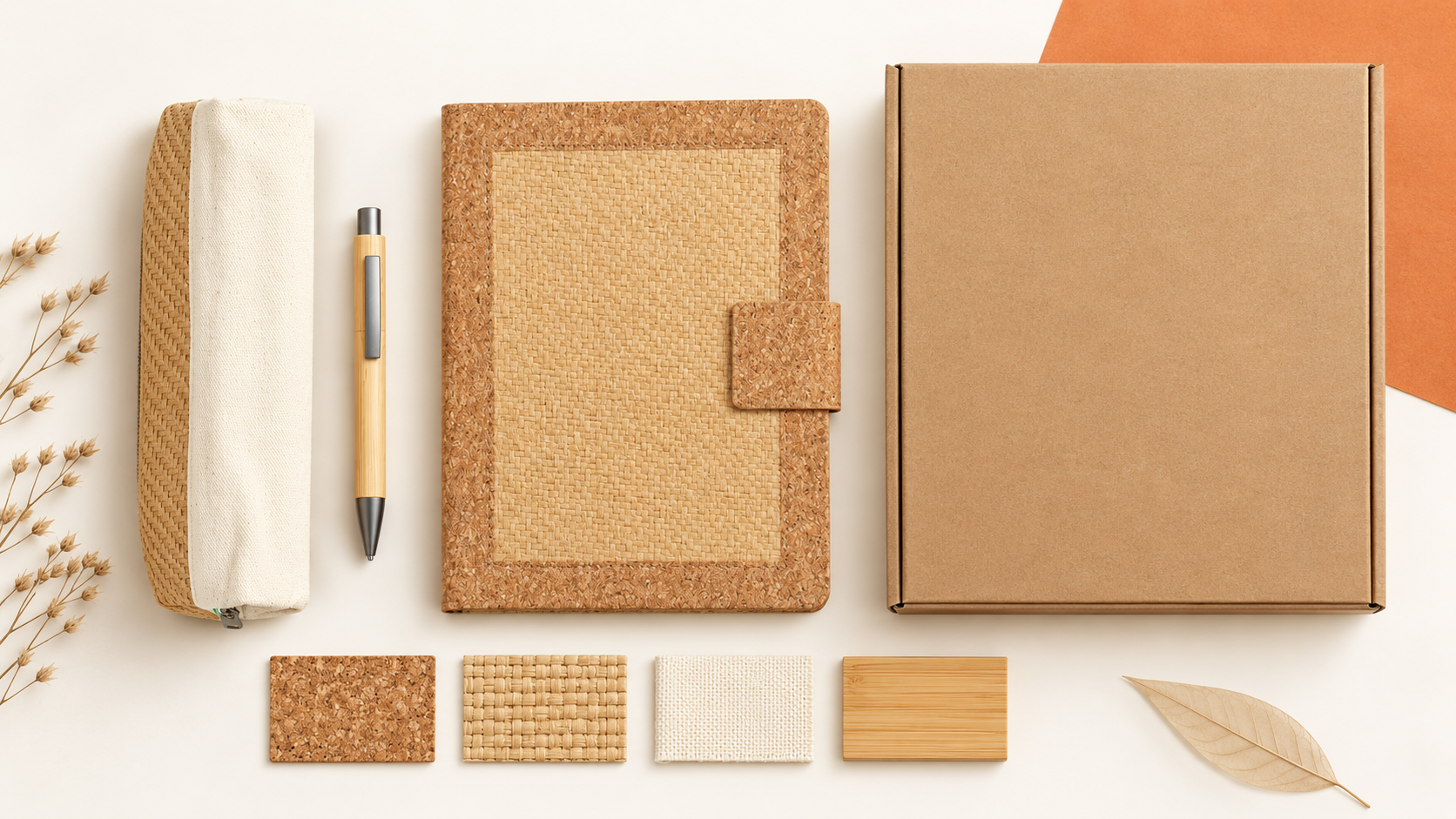
When notebooks, bottles or packaging sit beside the bag, one brief to a custom corporate gift set manufacturer can remove a surprising amount of coordination work. Colors can be reviewed together. The same artwork version can follow every component. Packing trials happen with the actual contents. This arrangement does not excuse a shortcut, though. Sign off the notebook, bottle, bag and box one by one before approving the assembled set.
2. Turn the idea into a quotation-ready specification
Reference photographs help at the start. They show taste, proportion and a general direction. They cannot tell a sewing line what to cut. I have seen near-identical bag photos hide different linings, cheaper thread, lighter coatings and much less reinforcement. Ask for a written specification beside the price. Leave an unresolved field visibly open and give it an owner; a blank buried in an email tends to become an assumption.
Put the finished dimensions and the measuring points at the top of the sheet. Next record the shell, lining, fabric construction or weight, shade reference and finish. List the handle first, then the webbing, zipper, slider, buckle, foam and reinforcing pieces. Add the pocket drawing, seam and binding notes, logo position, labels, individual packing and carton plan. Finish with the approvals and inspection checks. A one-page sheet may be enough for a simple tote; a technical backpack will need more.
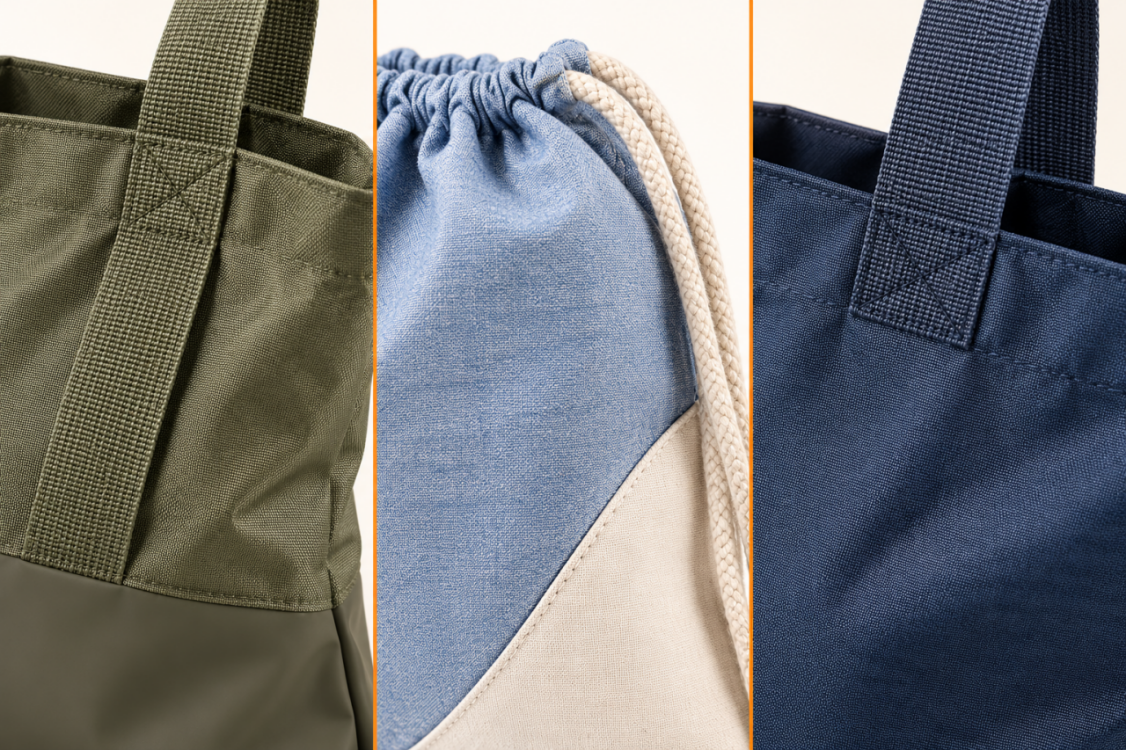
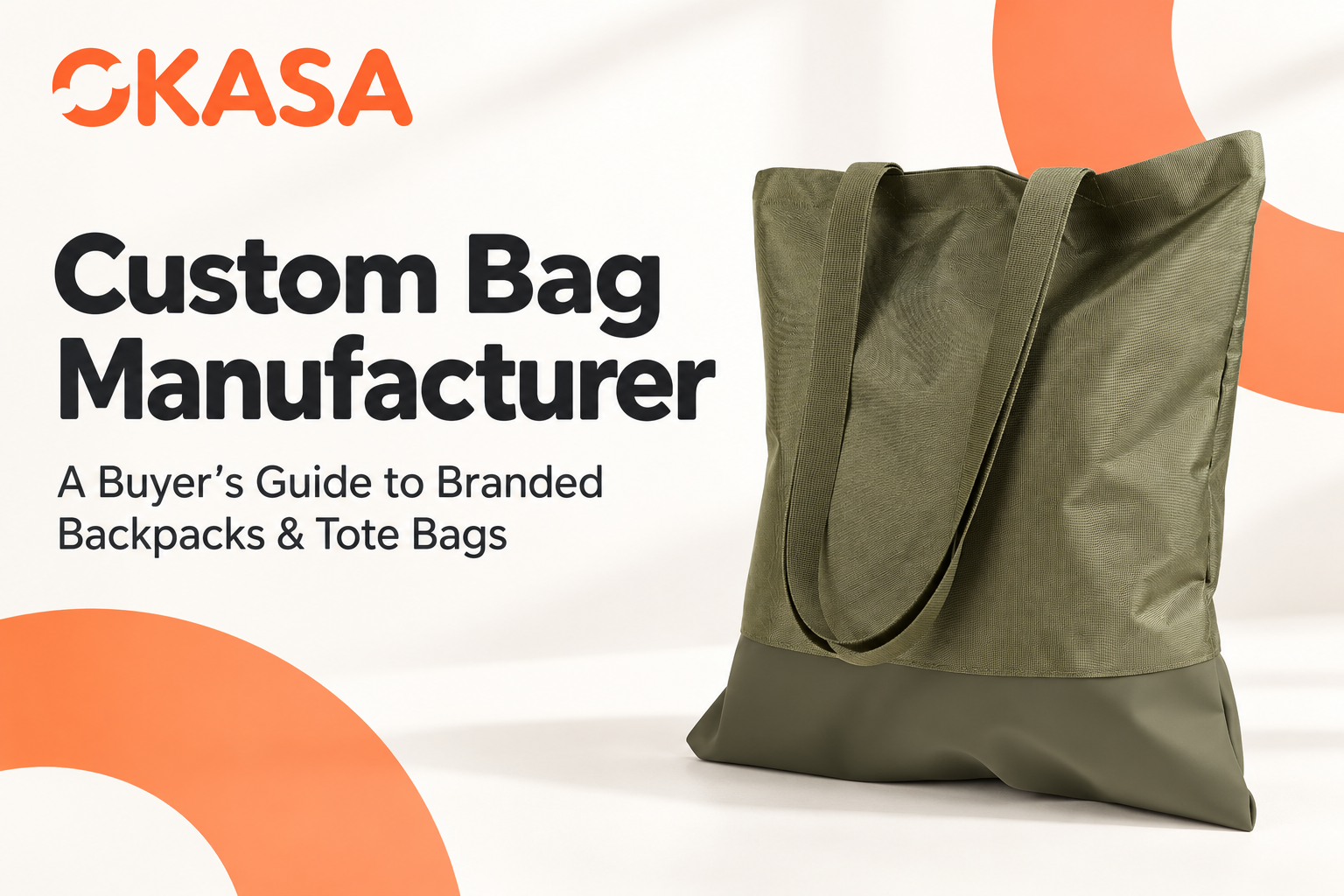
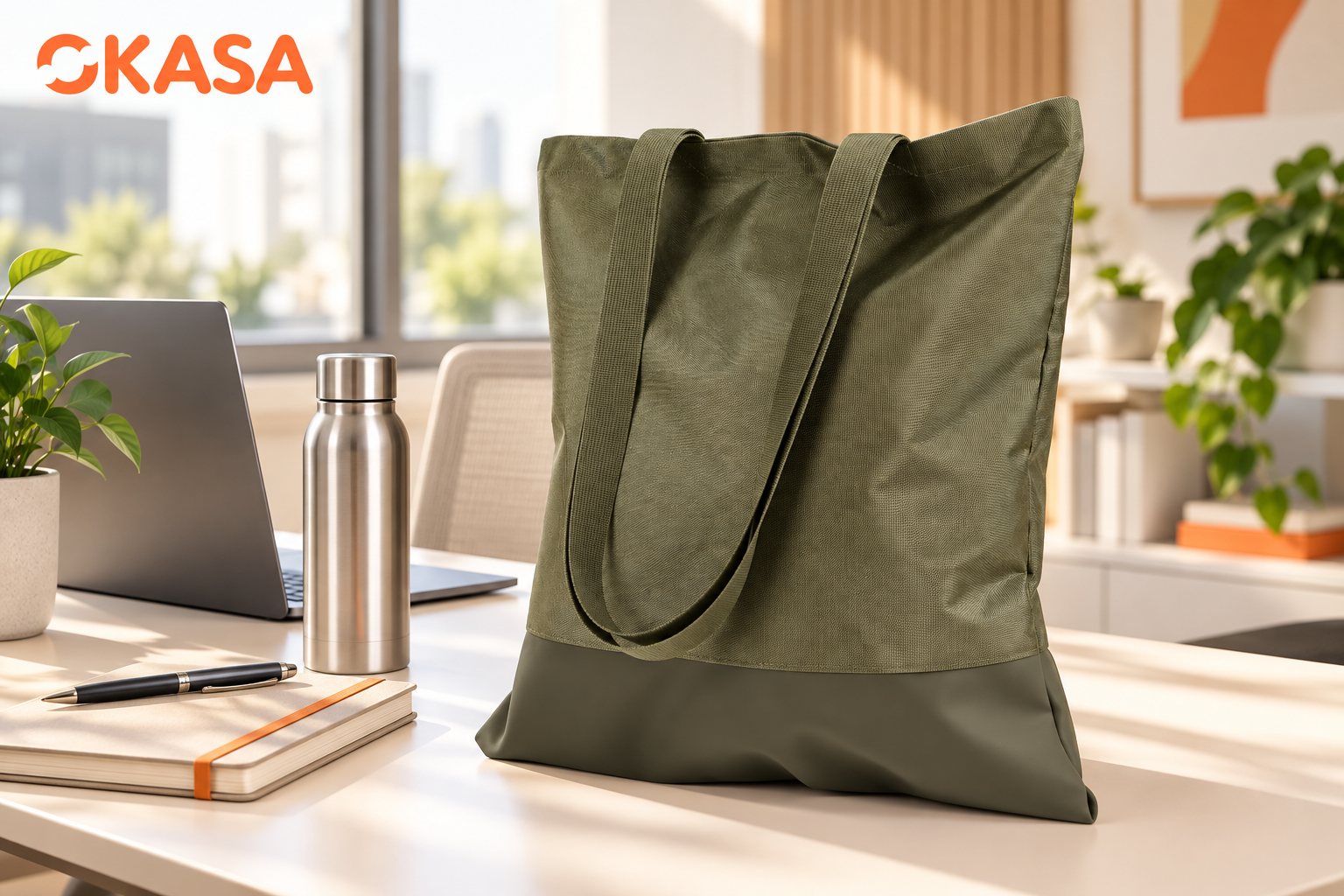
Take the OKASA B108 tote. Its upper body is soft olive nylon. Long handles run down the face instead of stopping near the opening. A darker film-spliced panel covers the lower zone, where desks, floors and hands create repeated contact. Calling it a “nylon tote” misses those choices, and a quote based on that short phrase can easily describe another bag.
3. Specify fabric beyond the fiber name
“Polyester,” “nylon,” “cotton” and “RPET” are family names, not finished recipes. Rub two nylon swatches between your fingers and the point becomes obvious. Yarn and construction change the hand. Weight, weave and coating change it again. Lamination, finishing and shade add another set of variables. “600D” may look reassuring in a quote, but it will not tell you which seam opens first or whether the coating keeps a hard fold after three weeks in a carton. Put the candidate swatches on the same table and judge them for the same bag.
A cotton quote often leads with fabric weight. Keep that figure, then ask about the weave, fiber mix and finish. With nylon or polyester, ask the mill or factory to name the proposed construction and send a piece you can handle. Water claims need a scene and a test: light rain on a walk is not the same as a bag left on wet ground. Coated cloth may shed droplets while needle holes, seams, zippers and an open top let water inside. Write “water-resistant” or “waterproof” only after the team agrees what the word must mean.
| Material route | Often chosen for | What the buyer should specify | Common sourcing mistake |
|---|---|---|---|
| Nylon | Lightweight totes, packable bags, technical backpacks and travel accessories. | Construction, denier or weight, weave, coating, finish, color and finished-product test. | Assuming the word “nylon” proves durability or waterproof performance. |
| Polyester | Promotional backpacks, event bags and broad color or cost programs. | Yarn and fabric specification, backing or coating, abrasion target and shade reference. | Comparing quotations without confirming whether lining and backing are included. |
| RPET polyester | Projects that require a recycled-content story and traceability. | Claimed recycled percentage, applicable certification scope, chain-of-custody documents and claim wording. | Treating an RPET label or logo as proof for the ordered material and transaction. |
| Cotton or recycled cotton | Natural-touch totes, drawstring bags, casual retail styling and broad decoration options. | Composition, weave, finished weight, shrinkage expectations, colorfastness and care. | Selecting by GSM alone without reviewing handles, seams and expected load. |
| Mixed-material construction | Premium looks, reinforced contact zones and distinctive brand storytelling. | Every material, joining method, edge finish, compatibility and care requirement. | Approving the front appearance while ignoring delamination, edge wear or color transfer. |
Buyers who need recycled-content verification should review the documentation route before artwork approval. Textile Exchange explains that the Recycled Claim Standard and Global Recycled Standard establish requirements for third-party certification of recycled materials and chain of custody. GRS also includes additional processing-related social, environmental and chemical requirements. This does not mean every product using the term RPET is automatically covered by a certificate. Confirm the certified organization, material scope, claim percentage, transaction documentation and wording that will appear on the product or packaging.
This is where a careful sustainable promotional products manufacturer earns trust. Ask two different questions. First: can the recycled claim be supported for this order? Second: will the finished bag work? A long-lasting bag might be a sensible purchase even when it carries no recycled-content claim. An RPET bag can have sound documentation and still need better stitching at the handle.
4. Judge construction as a load path
A bag fails where force travels through the structure. The fabric panel is only one part of that path. A shoulder strap transfers weight into webbing, stitching, reinforcement and the body panel. A tote handle loads the attachment area repeatedly. A laptop sleeve adds concentrated weight near the back panel. A zipper opening can distort when the bag is overfilled. Reviewing construction as a load path is more useful than asking whether the material is “strong.”
On a tote, pull back the handle and look at the part that enters the body. How wide is it? How far does the stitching continue? What sits behind the outer fabric? On a backpack, spend time at the top of each shoulder strap, the bartacks, the top handle and the base. Put a real laptop in the sleeve. Fill the main compartment, then try the bottle pocket again. Slide the trolley sleeve over more than one luggage handle. Small fit problems are obvious in use and nearly invisible in a supplier presentation.
| Construction area | Likely risk | What to approve or test |
|---|---|---|
| Handle or shoulder-strap attachment | Stitch pull-out, local tearing or uncomfortable load concentration. | Reinforcement layers, stitch pattern, seam allowance and loaded-use test. |
| Base and lower corners | Abrasion, seam opening, puncture or loss of shape. | Material combination, corner construction, seam and packing recovery. |
| Zipper opening | Slider jamming, tape distortion, teeth damage or difficult access. | Zipper size, tape, slider, puller, end stops and repeated operation. |
| Internal pockets | Incorrect usable size, sagging or stress on the lining. | Actual device fit, seam reinforcement and opening dimensions. |
| Coated or laminated panels | Peeling, cracking, blocking, edge wear or heat damage during branding. | Flexing, adhesion, edge finish and decoration trials. |
| Binding and seam allowance | Fraying, exposed raw edges or inconsistent appearance. | Binding material, width, stitch control and inside workmanship sample. |
Do not accept vague phrases such as “reinforced stitching” without seeing what is reinforced and how. A clear supplier can show the proposed cross-section, sample the stress point and explain the inspection method. This is one of the most useful differences between a vendor who is merely forwarding a price and a team that understands development.
5. Match the branding method to the surface
Open the same logo file beside four materials: smooth coated nylon, open-weave cotton, padded polyester and a laminated bottom panel. It will not print or stitch the same way on all four. Heat can mark one surface. Dense embroidery can pull another into waves. Dark fabric can swallow a thin ink layer. Choose the process after touching the material and reviewing the artwork, not from a generic decoration chart.
Screen printing can suit bold artwork and appropriate fabric surfaces, but ink coverage, mesh choice, curing and fabric movement affect the result. Heat transfer can reproduce more detail, although temperature, pressure and film edge must be tested on the real material. Embroidery gives a durable stitched effect, but dense designs can pucker light fabric or distort padded areas. Woven or rubber patches may create a retail-like look and can simplify consistency across several materials, while adding a component and attachment process.
| Branding method | Good starting use | Approval questions |
|---|---|---|
| Screen printing | Simple logos, larger quantities and suitable flat panels. | Ink type, opacity, curing, bleed, edge quality and rub resistance. |
| Heat transfer | Detailed or multicolor art on compatible fabrics. | Press marks, coating response, adhesion, film hand feel and wash or flex behavior. |
| Embroidery | Premium textile identity and durable stitched branding. | Stitch count, backing, thread color, puckering and clearance from seams. |
| Woven label | Small repeated identity with a soft textile look. | Edge fold, readability, color, position and attachment method. |
| Patch | Retail styling or one badge used across different bag materials. | Patch material, molding or print detail, thickness and stitch or adhesive attachment. |
| Metal badge | Premium programs where weight and hardware are acceptable. | Finish, edge, corrosion resistance, backing and contact with contents. |
Approve the decoration on the exact production material and color. A digital mock-up confirms scale and position, not physical performance. For a demanding design, use a strike-off or decorated panel before the complete sample. Keep the artwork version, Pantone or agreed color reference, size, position tolerance and approved photo in the production file.
6. Build the sample process around decisions
A sample is valuable only when the team agrees what it proves. A rough prototype may confirm size and pocket layout but use substitute material. A color sample may confirm fabric and logo but omit production packing. A pre-production sample should represent the approved construction closely enough to become the reference for bulk production and inspection.
For a complicated bag, do not ask one sample to settle every question. Begin with swatches and a component card. If the shape or pocket layout is still uncertain, make a plain construction sample first. Add the logo after the panel and its surface have been chosen. The last sample before bulk needs companions: the current specification, final artwork, color references and packing instruction. Photograph the points that people are likely to interpret differently. Write down any accepted deviation. “Same as sample” is a fragile instruction when the sample is on another desk, the email thread has 60 replies and production starts three weeks later.
- Swatch approval: Put the shell, lining and webbing beside the zipper and buckle. Mark the chosen side and shade on each piece.
- Structure approval: Pack the sample with the actual laptop, notebook and bottle. Measure the pockets again after the bag is full, and wear it long enough to notice the strap.
- Branding approval: sign off method, color, size, position, edge quality and surface response.
- Function approval: load the bag with realistic contents, operate closures and examine stress points.
- Appearance approval: review sewing, symmetry, panel alignment, wrinkles, shade and overall presentation.
- Packing approval: verify folding, protective materials, labels, carton arrangement and recovery after unpacking.
A capable custom notebook manufacturer and a custom drinkware manufacturer will follow similar approval logic for their own materials and processes. When those products are packed with the bag, align the approval gates. The bag pocket must fit the notebook, the bottle pocket must fit the proposed drinkware, and the final gift packaging must protect every item. Cross-category compatibility should be checked physically, not assumed from separate dimensions.
7. Compare quotations on the same commercial basis
Put two prices side by side only after the scope underneath them matches. One quote may include the logo screen, lab test and individual sleeve; another may stop at an undecorated bag in a master carton. Ask the salesperson to mark every included line: sample, artwork setup, tooling, dyed material, decoration, labels, packing, cartons, testing, inspection and export paperwork. Record the currency, price-validity date, quantity break, payment terms, Incoterm and named place on the same comparison sheet.
MOQ is usually not one fixed number for the entire bag. Fabric mills, stock colors, custom dyeing, webbing, zippers, molded hardware, patches, logo processes and packaging may each have their own economic minimum. A factory may technically sew a small quantity but face excess material, repeated setup and a high per-unit cost. Ask which component creates the minimum and whether a stock-material route can support a smaller trial without changing the approved quality target.
| Quote line | What to confirm | Why it matters |
|---|---|---|
| Base bag | Complete written specification and included components. | Prevents a cheaper quotation from representing a simpler bag. |
| Branding | Method, colors, positions, setup and approval sample. | Artwork complexity can materially change cost and lead time. |
| Material color | Stock color versus custom dye; shade standard and minimum. | Custom color may control the true MOQ. |
| Testing and inspection | Tests, laboratory, sampling plan and reinspection responsibility. | A low price may exclude required verification. |
| Packing | Individual pack, inserts, labels, master carton and pallet if needed. | Packing changes presentation, freight volume and damage risk. |
| Freight basis | Incoterm, named place, shipment mode and quote validity. | Factory price and landed cost are different decisions. |
For buyers using bulk corporate gifting solutions, assortment complexity can be as important as total quantity. Three bag colors with two logo versions create six variants. If each variant uses different packing or inserts, the factory must control twelve or more combinations across production and assembly.Consolidating the color palette or keeping one logo route may reduce changeovers and error risk more effectively than negotiating a small unit-price reduction.
8. Evaluate the manufacturer, not only the sample
A good sample proves that one unit can be made. It does not prove that the supplier can control material intake, cutting, sewing, decoration, assembly and packing across a full order. Supplier qualification should therefore examine the operating system behind the sample.
Follow one sample through the operation. Who writes its technical file? Which mill supplied the cloth? Is the logo printed in the building or sent across town? Watch what happens when fabric arrives, when the first sewn unit comes off the line and when an inspector finds a recurring fault. If printing, embroidery or coating is subcontracted, put a name beside approval and another beside corrective action. “Our partner handles it” is not yet an answer.
Match the paperwork to what can actually go wrong. A stock-color tote with one print is a lighter review than a backpack built around dyed fabric, molded hardware, an electronics pocket, three logo positions and retail packing. A folder full of unrelated certificates adds little. Keep the document that covers the exact factory, material, process, product or shipment now under discussion.
| Qualification area | Useful buyer question | Stronger evidence |
|---|---|---|
| Development | Who converts our brief into the technical file? | Named owner, sample checklist, drawings and revision control. |
| Material control | How do you verify fabric, shade and components before cutting? | Incoming inspection record, approved swatch and lot identification. |
| Production control | What is checked on the first units and during sewing? | First-piece approval, inline checkpoints and defect records. |
| Subcontracting | Which steps leave the facility? | Approved subcontractor list, responsibility map and incoming recheck. |
| Change control | How are approved changes recorded? | Numbered specification, artwork version and signed sample record. |
| Final release | Who authorizes packing and shipment? | Final inspection report, packing verification and release responsibility. |
A cross-category OEM promotional products manufacturer can be useful when one campaign includes bags, drinkware, notebooks and packaging. The buyer should still ask which factory or process makes each item and how the program owner controls specifications across them. “One-stop” should describe coordinated responsibility, not obscure the supply chain.
9. Create a measurable quality plan
“Good quality” is not an inspection instruction. Convert expectations into measurable checks and an agreed defect classification. Dimensions, logo position, color, components, workmanship, function, packing and quantity should all have a reference and tolerance. Define which issues are critical, major or minor for the specific project.
ISO 2859-1:2026 describes sampling schemes indexed by acceptance quality limit for lot-by-lot inspection by attributes. Buyers commonly refer to AQL-based sampling, but the sampling plan, inspection level and acceptance criteria must be selected for the actual risk and contract. An AQL number is not a universal definition of quality, and a passed sample inspection does not mean every unit was examined. Critical safety or compliance requirements may need different controls or 100% verification.
For bags, a final inspection can include quantity and assortment; material and color against approved standards; finished dimensions; seam and stitch workmanship; handle and strap attachment; zipper and buckle function; pocket dimensions; branding; appearance; packing; carton marking; and agreed functional checks.Test methods and sample sizes should be decided before mass production, especially when the result could affect shipment release.
A practical defect-classification example
- Critical: a condition that could create a safety or legal risk, or another project-defined zero-tolerance issue.
- Major: wrong material, unusable closure, broken strap, seriously incorrect logo, missing component or a defect likely to make the buyer reject the product.
- Minor: a limited appearance or workmanship issue that does not materially affect intended use but falls outside the agreed standard.
Those categories need project-specific examples. A small stitch deviation may be minor on an internal binding, but a visible crooked topstitch beside a premium logo can become major for a retail-facing campaign. Create a defect library with photographs when appearance is important. It gives inspectors, suppliers and buyers the same reference.
10. Confirm compliance before production
Compliance depends on destination, product category, intended user, materials and claims. Do not ask for a generic “certificate for the bag.” Tell the supplier where and how the product will be sold or distributed. A children’s backpack can face requirements that do not apply to an adult conference tote. Food-contact rules may matter for a bottle included in the set but not for the bag. Chemical restrictions can apply to coatings, prints, plastic parts, metal hardware and other accessible materials.
For products placed on the EU market, REACH obligations concerning substances in articles can be relevant. The European Chemicals Agency provides guidance on Candidate List substances in articles and related supplier duties. The precise obligation depends on the substance, concentration, role in the supply chain and use. Treat the official rule and competent professional advice as the source, not a reused laboratory report for a different material or product.
For U.S. children’s products, CPSC requirements can include total lead content and certification obligations. The CPSC states that accessible components of children’s products are subject to the applicable total lead limit and that manufacturers or importers must certify covered children’s products. A corporate tote intended for adults and a school bag designed for children should not share an unexamined compliance assumption.
Build a bill of materials that links each risk to the relevant component. Then decide whether evidence should be a supplier declaration, material certificate, transaction document, laboratory report or finished-product test. Check that reports identify the correct material, color, product, method, date and applicant. A report with a familiar logo is not automatically applicable to the goods you are buying.
| Compliance question | What to establish | Common mistake |
|---|---|---|
| Destination market | Countries, sales channel and importer responsibilities. | Using one test package for every market. |
| Intended user | Adult, child, age grading and foreseeable use. | Deciding requirements from the buyer’s industry rather than the product’s intended use. |
| Material and component list | Fabric, coating, print, plastics, metal, labels and packaging. | Testing only the main fabric. |
| Environmental claim | Exact claim, percentage, certification scope and transaction evidence. | Printing a recycled logo before verifying authorization and documentation. |
| Report applicability | Correct product, color, material, method, date and responsible party. | Accepting a report for a similar item. |
11. Design packaging around presentation and logistics
A soft bag looks easy to pack until a hard fold leaves a pale line across the coating. Metal parts can press into the next unit, fresh print can transfer, and long handles can knot together. A structured backpack may fill a carton with air while a tote lies almost flat. Picture the first ten seconds after the recipient opens the parcel. From that moment, work backwards to the fold, sleeve and master carton.
Have the factory photograph each fold. Note the tissue or sleeve, any moisture-control material, label position and units per carton. Add carton dimensions, gross weight and the pallet pattern when pallets are part of the route. Then pack a real sample and leave it closed for several days. Does it recover when opened? For an event order, repeat the trial with the actual insert and handout method, not only a warehouse stack.
When the bag forms part of a premium set, a custom gift box manufacturer or integrated packaging team should confirm internal dimensions, fixing method, product order, abrasion protection and shipping volume. A beautiful rigid box may increase dimensional freight and handling risk. A folding carton may reduce volume but provide less structure. The right choice follows the delivery route and recipient experience, not a universal “premium” label.
12. Build a realistic project timeline
Lead time begins before mass production. Brief clarification, material search, custom color, component development, artwork, sample rounds, testing, production booking, inspection and transport all consume time. The supplier’s quoted production days should state the starting condition: deposit received, artwork approved, sample approved, materials ready or another defined milestone.
Create a reverse schedule from the required arrival date. Include time for buyer review and corrections, not only factory activity. If the campaign date cannot move, identify the last safe date for approving material, logo and pre-production sample. Decide which features can be simplified if an approval slips. Air freight may rescue transit time, but it does not repair an unapproved construction or unavailable custom material.
| Stage | Buyer output | Supplier output | Release gate |
|---|---|---|---|
| Brief | Use case, quantity, market, budget range and arrival date. | Questions, feasibility review and proposed route. | Written scope accepted. |
| Quotation | Comparable commercial assumptions. | Itemized quote, MOQ, timeline and exclusions. | Supplier and development route selected. |
| Material and artwork | Color and brand files. | Swatches, components, mock-up and process advice. | Material and decoration direction approved. |
| Sampling | Consolidated comments. | Sample, specification and revision record. | Pre-production reference approved. |
| Production | Approved documents and timely decisions. | Material control, first piece, inline checks and status. | Bulk completed for final inspection. |
| Release | Inspection decision and shipping instruction. | Report, packing data and shipment documents. | Goods released for dispatch. |
13. Calculate landed risk, not only landed cost
The purchase price is only the first number. Imagine discovering a weak zipper after every bag is sewn, or opening mixed cartons two days before an event. Rework, repacking, emergency air freight and a customer claim can erase a saving very quickly. This does not mean choosing the highest quotation. It means knowing which risks remain with the buyer and which ones the supplier has priced, controlled or accepted.
Model product cost, setup and tooling, sampling, testing, inspection, individual packing, export packing, inland transport, international freight, insurance, duty, tax where applicable, destination handling and contingency. Then add schedule and quality questions beside the numbers. Which assumptions remain open? Which component has the longest replenishment time? Who owns a failed inspection? How quickly can the supplier reproduce a custom color?
For companies using promotional products sourcing China, the most useful partner is not necessarily the one that offers the widest catalog. Look for a team that makes unknowns visible, documents decisions and coordinates responsible factories. That is especially important when the project mixes bag sewing with metal drinkware, paper products, printing and gift-box assembly.
14. Use a supplier scorecard that reflects the project
A scorecard helps a team compare evidence consistently. It should not hide a non-negotiable failure. A supplier with an attractive price should not pass if it cannot support a mandatory compliance requirement or delivery date. First set the gates; then score the acceptable candidates.
| Area | Suggested review | Red flag |
|---|---|---|
| Specification control | Clear written materials, dimensions, components, tolerances and revisions. | Quotation depends mainly on a photo and informal chat. |
| Bag construction knowledge | Can explain load paths, reinforcement, seams, lining and component choices. | Uses “strong” or “premium” without measurable detail. |
| Sampling | States what each sample proves and records deviations. | Changes material or construction without disclosure. |
| Quality system | Incoming, first-piece, inline and final controls match project risk. | Only promises a final check after all units are packed. |
| Compliance | Asks about destination and user; maps evidence to components and claims. | Sends unrelated certificates as a universal answer. |
| Communication | Names owners, responds to technical questions and confirms changes. | Answers critical questions only with price or lead time. |
| Commercial clarity | States MOQ drivers, exclusions, terms and timing assumptions. | Low quote with missing setup, packing, testing or freight basis. |
If your organization needs a broader promotional products manufacturer China relationship, evaluate the system at program level as well. Ask how new categories are onboarded, how approved colors and logos are shared, how documents are stored, how orders are consolidated and how the team handles several delivery destinations. A reliable program can save repeated development work, but only if individual product control remains visible.
15. Send an RFQ that produces comparable answers
A strong RFQ reduces assumptions. It also signals that the buyer is prepared to make decisions. Suppliers can spend more time improving the product route and less time guessing. Use the following fields as a starting point.
- Company and project name, with one contact for consolidated questions.
- Bag type and intended use.
- Reference images, clearly labeled as inspiration or a required construction reference.
- Finished dimensions and measurement method.
- Expected contents, maximum working load and important fit requirements.
- One line for the shell and another for the lining. Attach the color reference, describe the coating and state the exact recycled-content claim, if there is one.
- A marked drawing for the handle, shoulder strap, zipper, buckle and pockets. Point to the padding and every reinforcing piece.
- Logo files, branding method preference, colors, size and positions.
- Required quantity by color and artwork version, plus forecast if relevant.
- Individual packing, labeling, master-carton and pallet requirements.
- Destination country, intended user and known compliance requirements.
- Sample type, testing and inspection expectations.
- Required arrival date, destination and requested Incoterm.
- Quotation breakdown, validity, payment terms and stated exclusions.
Ask each supplier to list assumptions and alternatives. If the first design misses the budget, put the options on the table. Perhaps a stock shade replaces a custom dye, or one pocket is removed. Show the saving beside the change. That is far better than finding a missing lining or lighter reinforcement only after the low quotation has been approved.
16. Using OKASA for a bag-led merchandise program
A bag order at OKASA can stay a bag order, or it can become the anchor for a wider kit. The same project team works with notebooks, drinkware, gift sets and packaging. It can review the brief, discuss a workable construction, coordinate the decoration and arrange samples before bulk production. When other items join the project, the bag is checked against them instead of being developed in a separate lane.
The value of that model is coordination. A custom bag manufacturer must control sewing and soft-goods details. A notebook supplier must control paper, cover, binding and print. A drinkware supplier must control metal, coating, lid and relevant testing. Packaging then has to hold the finished items without damage. One program owner can connect those decisions, but approval remains evidence-based at component level.
For private-label development, begin with what is fixed and what can change. A new silhouette, exclusive hardware and custom-dyed material create more distance from an existing model. They also bring extra sample rounds, tooling risk and higher minimums. For a first order, a proven construction with a chosen fabric, pocket, shade and logo can be the smarter route. Ask the project team to price both paths and explain the calendar for each.
Frequently asked questions
The following answers cover the points that buyers most often need before they can issue an RFQ or approve a development route.
What information does a custom bag manufacturer need for an accurate quotation?
Begin with the bag and its job. Add dimensions, what it will carry and the working load. Then attach the shell, lining and component notes, logo files, quantity by color or artwork, destination, packing request and arrival date. Leave an open point labeled as open, and ask the factory to write its assumption beside it. Two prices can be compared only after those assumptions match.
What is a normal MOQ for custom backpacks or tote bags?
There is no single reliable MOQ for all bags. The practical minimum can be controlled by fabric availability, custom dyeing, webbing, zipper color, molded parts, logo process, packaging and the number of variants. Ask which component sets the minimum. A stock-material route may support a smaller trial, while custom color and exclusive components usually need a larger commitment.
How long does a custom bag project take?
The schedule depends on material sourcing, number of sample rounds, testing, production capacity, inspection and transport. Ask the supplier to show stages and state when production lead time starts. Plan backwards from the required arrival date and include buyer approval time. A simple stock-material tote can follow a shorter route than a custom backpack with dyed fabric and new hardware.
Is 600D always stronger than 300D?
No. Denier is one yarn-related specification and does not determine finished bag strength on its own. Weave, yarn quality, coating, fabric weight, seams, reinforcement and the complete construction matter. Compare proposed fabrics for the same use and test the finished bag at the agreed load.
Does RPET automatically make a bag sustainable?
RPET may support a recycled-content objective, but the claim should be verified and considered with durability, design, packaging, transport and intended use. Confirm the recycled percentage, certification scope or other required evidence, transaction documentation and permitted claim wording. Do not treat an RPET label alone as proof.
How should buyers approve a logo on a bag?
Start with a digital layout for position and size, then approve the decoration on the actual production material and color. Review color, opacity, edges, adhesion or stitch quality, fabric distortion and durability. Record the artwork version, measurements, color reference and approved sample.
What quality checks matter most for backpacks?
Key checks usually include finished dimensions, usable compartment size, shoulder-strap and top-handle attachment, base and seam workmanship, zipper and buckle function, pocket fit, padding, logo, appearance and packing. Add product-specific load, cycling or abrasion checks where the risk justifies them. Agree methods and acceptance criteria before production.
Can a trading company manage a bag order effectively?
The label alone does not decide capability. A trading or sourcing team can add value if it controls specifications, approved factories, materials, samples, quality and communication transparently. A factory can also perform poorly if development or change control is weak. Verify who makes the goods, who owns each process and how the responsible party proves control.
Should the buyer arrange third-party inspection?
That depends on order value, risk, supplier history and internal resources. Independent inspection can provide useful release evidence, but it does not replace a clear specification or in-process control. If using an inspector, give them the approved sample, defect definitions, measurement method, sampling plan, packing requirements and authority for handling unclear findings.
How can a buyer reduce cost without weakening the bag?
Start by reducing unnecessary variants, using available material colors, simplifying hidden construction that does not affect function, coordinating one branding method and improving carton efficiency. Protect the load path, user comfort, required compliance and the visible brand experience. Ask the manufacturer to show the effect of each value-engineering option instead of making silent substitutions.
Prepare a bag RFQ that a factory can act on
Send OKASA the use case, dimensions, expected contents, preferred materials, color, branding, components, quantity by version, destination and required arrival date. The team can review the brief, identify missing decisions and recommend an appropriate sample route. If the bag belongs in a gift set, include the other products and packaging so fit, color and assembly can be checked together.
For buyers seeking a long-term promotional products manufacturer China relationship, the first RFQ is also a useful operating test. Look at the questions you receive, the clarity of the specification and the way risks are explained. A good sourcing conversation should leave fewer assumptions than it started with.