

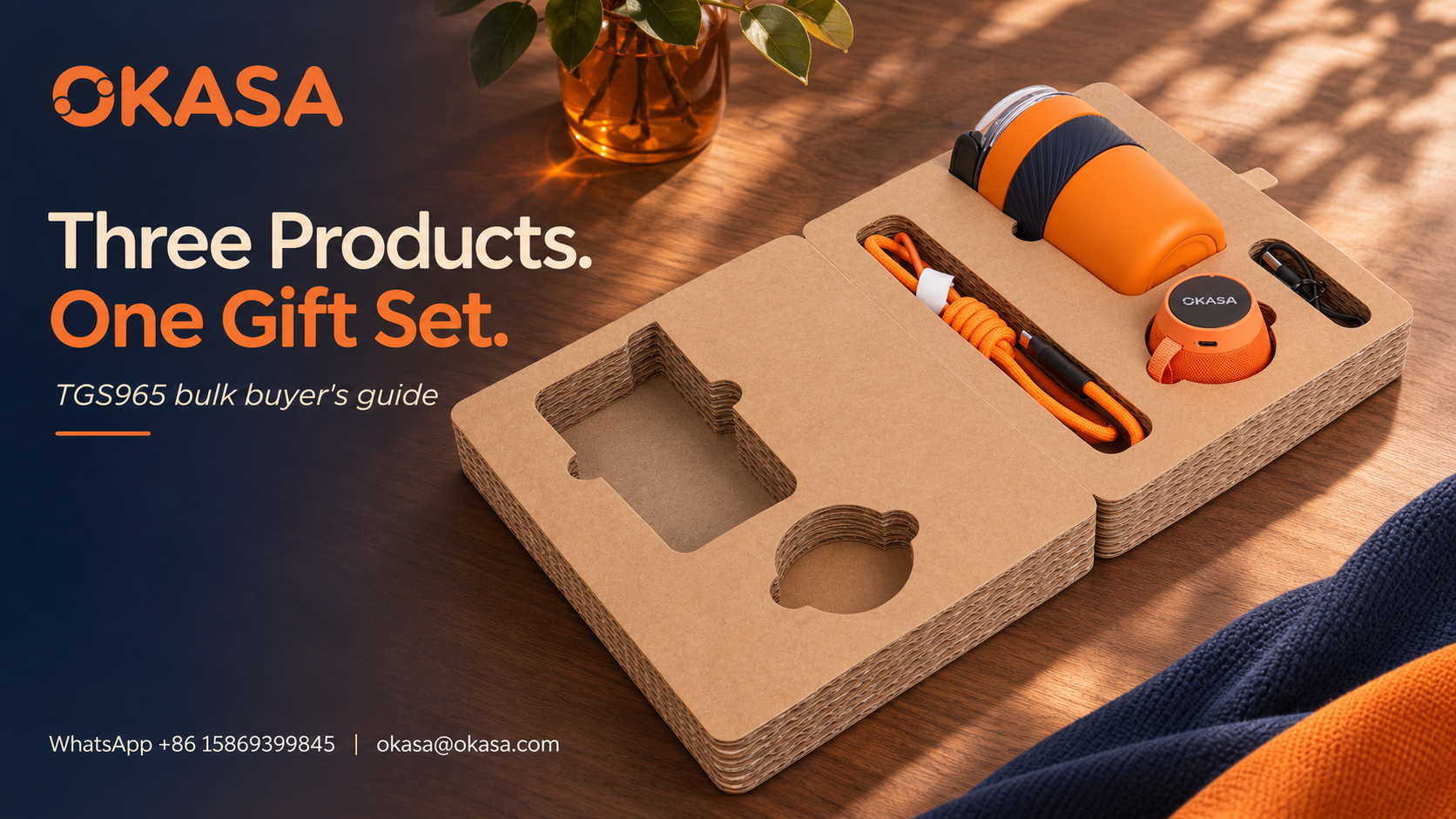
Hero image alt text: Open OKASA TGS965 book-style corrugated gift set with orange coffee cup, braided USB-C cable and compact magnetic speaker, alongside title, logo, WhatsApp and email.
Put a gift box on a conference table and ask three people what they see. The brand manager sees one campaign. The recipient sees three things to take home. Procurement sees three distinct product specifications, plus a fourth specification for the box that holds them together. That difference is where many otherwise attractive corporate gift projects become difficult to quote.
The OKASA TGS965 corporate gift set is a useful example because its components are not interchangeable decorative pieces. It contains a 1 m braided USB-C to USB-C cable with a carabiner, a compact illuminated magnetic Bluetooth speaker, and a 350 ml stainless steel coffee cup. The presentation box is built from layers of corrugated board with cut compartments and opens like a book. The product page shows orange and black set variants. A purchaser can evaluate the program as one coordinated gift while still approving the cable, speaker, cup and packaging on their own terms.
This article follows a sample through four ordinary moments: opening the box, plugging in the cable, trying the speaker, and living with the cup. It then returns to the less photogenic work of artwork, packing, documentation and delivery. No hypothetical price or performance result is presented as an OKASA offer. The goal is a specific brief that produces a useful quote and a sample that answers the buyer’s real questions.
The first minute belongs to the box
Imagine the recipient opening TGS965 at a desk. A book-style panel swings away, exposing the products in individually cut recesses. The sequence is important. A cable can look tangled if its coil is too loose, a cup can dominate if its lid is not seated properly, and a small speaker can disappear if its cavity is too deep. These are packout questions, not necessarily defects in the individual products.
The published construction is layered corrugated board with custom-cut slots. That is a tangible design choice. It gives the buyer a way to ask for a complete sample in the exact box structure. It does not, by itself, establish carton strength, drop performance, recycled content or a universal environmental claim. If the program is going to mail thousands of sets directly to recipients, the buyer must also define an outer shipping pack and a transit test appropriate to that route. A presentation box photographed on a table is not automatically a mailer.
The first sample review should be deliberately mundane. Close the box, lift it as a recipient would, turn it once, set it down and open it again. Did every component remain seated? Is the cable easy to remove without pulling its connector against a rough corrugated edge? Can a recipient take out the cup without forcing the lid? Are the box edges comfortable to handle? Photograph the open and closed states. Mark which detail is the approved packout rather than relying on a single flattering image.
For a custom gift box manufacturer, the drawing needs more than outer dimensions. It needs the actual component samples, cavity allowance, opening direction, board build, decoration artwork, protective materials and master carton plan. If a buyer changes the coffee cup after the insert has been cut, the revised cup needs a new fit check. “Same capacity” does not mean the same diameter, lid height or silhouette. The box is a part with its own revision history.
A fact sheet before the meeting becomes a mood board
The table below separates information published on the TGS965 product page from the things a buyer still has to approve. It is intended as a working sheet for an inquiry, not a laboratory report or a commitment to supply a particular variant.
|
Component |
Published TGS965 specification |
Buyer’s decision or sample check |
|
Braided cable |
1 m total length; TPE with braided covering; USB-C to USB-C; up to 60W at 20V / 3A with compatible equipment; 56 g; carabiner |
Check connector fit, coil, carabiner, actual device and charger combination, marking and applicable documentation. |
|
Speaker |
ABS + RPET; 60 × 50 × 42 mm; Bluetooth 6.0; 5W; 300 mAh battery; about 2 hours playback; USB-C charging; lighting and magnetic attachment |
Test pairing, controls, charging, mounting on an intended surface, audio at a useful level and market documents. |
|
Coffee cup |
350 ml; 304 stainless interior, 201 stainless exterior; powder coating; silicone ring |
Review lid fit, drinking experience, coating and branding, food-contact documents and care guidance. |
|
Presentation box |
Layered corrugated board; book-style opening; custom-cut product compartments |
Approve loaded fit, artwork, opening sequence, outer protection, carton configuration and transit route. |
The numbers can make a draft look complete too early. A quoted 60W cable is not a wall charger. A 5W speaker power figure is not an acoustic measurement for every room. “About two hours” playback is a published approximate figure, not a promise under every volume, lighting or battery condition. A 350 ml cup capacity says nothing by itself about leak resistance or heat retention. Each line is useful because it defines what to verify next.
The orange and black variants also need an explicit choice. A mixed-color order can be attractive for departments or regional programs, but the minimum, artwork setup and packout count may apply differently to each variant. Ask the supplier to quote a single-color scenario and a split scenario separately. Then procurement can compare the cost of choice with the administrative work of producing, labeling and distributing several versions.
The cable earns its place on the first workday
There is a simple test for a charging accessory: can the intended recipient use it with a device and power source they actually own? The TGS965 page describes a USB-C to USB-C braided cable rated up to 60W at 20V / 3A when used with compatible devices and charging equipment. The condition matters. The set listing does not say that a charger is included. Nor does it promise that every USB-C device will draw 60W or that the cable adds fast charging to a device that does not support it.
For an employee welcome program, identify the common device groups before ordering. Are most employees using USB-C laptops, tablets or phones? Are chargers already provided at the desk? A cable can be useful even when it is not the main gift, but it is less convincing if recipients have nowhere to plug it in. A test matrix should name the device and charger models, the expected use, the observed result and who performed the test. The product listing provides a starting rating; the sample test addresses the buyer’s environment.
Inspect the physical cable as a gift component too. The carabiner is intended as an attachment point, so check how it opens and how the cable sits when clipped to a bag or lanyard. Review the braid for loose strands near the connector housing, the coil for ease of unwrapping, and both connector ends for consistent orientation and finish. If a label or logo is requested, ask where decoration can go without crowding the functional parts. Do not infer a load-bearing rating for the carabiner from its appearance.
This is the sort of detail an OEM promotional products manufacturer should clarify before artwork approval. A graphic mockup can make the cable look longer, thicker or more rigid than the physical sample. Request a photo of the approved cable beside a ruler and another in the box recess. If a different color or length is proposed, name it as a new configuration with its own quote and sample, rather than silently treating it as TGS965 unchanged.
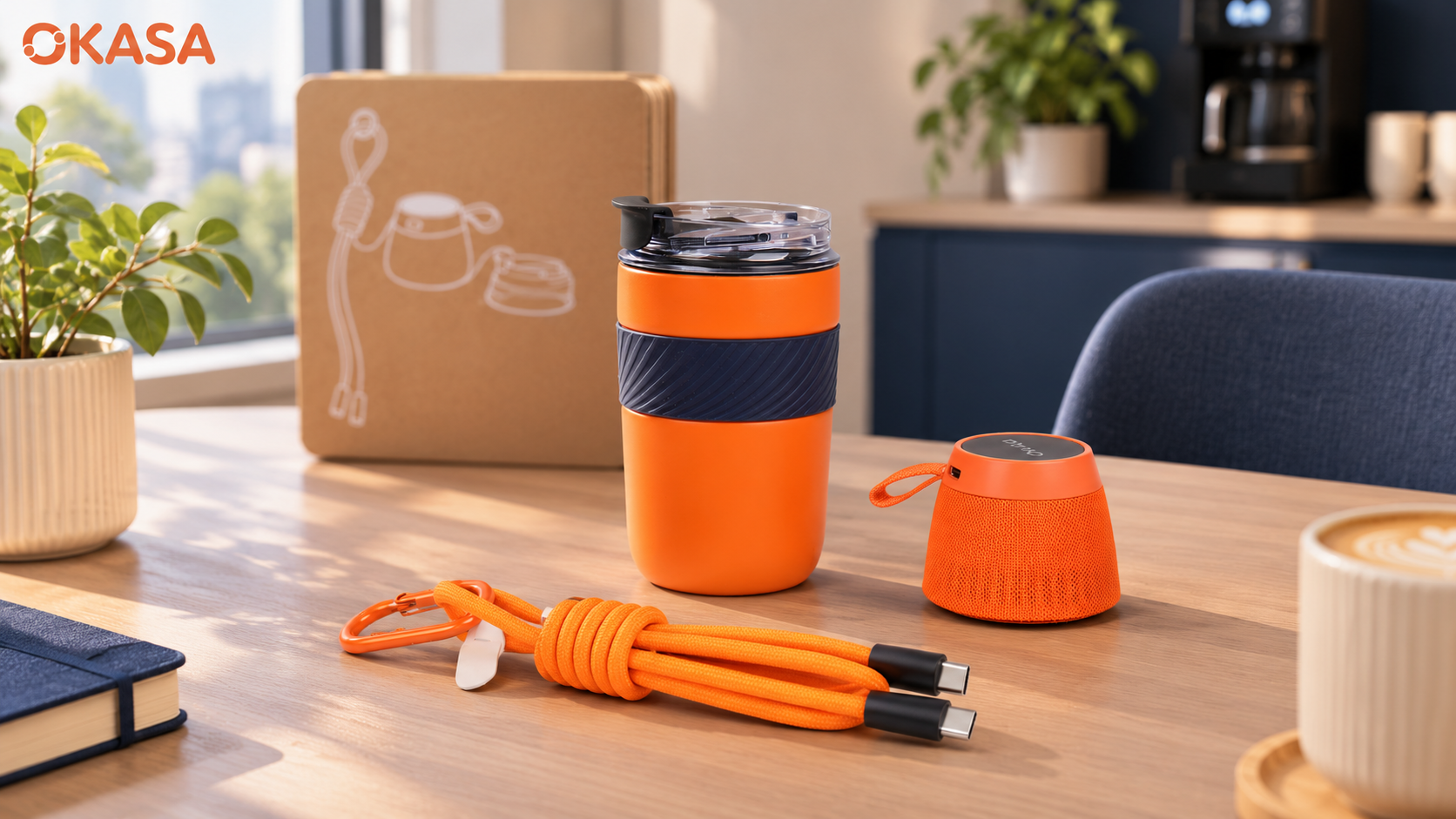
Scene image alt text: Orange TGS965 coffee cup, compact speaker and braided USB-C cable used as separate desk accessories in an office break area, with OKASA logo.
The speaker has a different definition of “works”
The compact speaker is listed at 60 × 50 × 42 mm, 5W output, Bluetooth 6.0, a 300 mAh battery, USB-C charging, lighting, magnetic attachment, approximately two hours of playback and wireless connection within 10 m. Those are published model details. They do not make it a conference-room sound system, a phone charger or an accessory that will attach securely to every surface.
At the sample table, pair it from a device the audience commonly uses. Listen at a realistic desk distance. Turn the lighting on and off if those controls are offered on the sample. Observe how long it takes to charge under the supplied or recommended charging arrangement, and record the playback setting used in any runtime exercise. The site’s approximate two-hour figure needs context if the campaign plans to repeat it in marketing. A recipient may care more about clear controls, sensible volume and reliable pairing than the maximum listed radio range.
Treat the magnetic function with care. Test it on the actual intended surface, and make sure the speaker is not placed where it can fall onto a person, fragile equipment or a drink. If the brand campaign imagines attaching it to a phone or computer, ask for a demonstrated compatible setup rather than inferring device compatibility from the word “magnetic.” The marketing image should show a use that the approved sample can reproduce.
The speaker also changes the commercial paperwork for the set. It contains a rechargeable battery, and the destination market and shipping route may call for product, radio, battery, labeling or transport documentation. The published listing does not identify a complete set of certificates. Ask OKASA which records apply to the exact sample and the intended destination, and have the buyer’s compliance or freight team review them. Requirements vary by market and mode of transport; a generic certificate file is not an answer unless it matches the item and route.
One visual point is easy to miss in an approval chain. A tiny speaker can be hidden by a huge logo or crowded instruction text. Agree where the brand mark belongs: on the speaker, box, sleeve or insert. Some programs may use a restrained mark on the device and a fuller story inside the box. The buyer should see a real decorated sample and a complete packaging proof before deciding.
The cup will be judged after the event
Gift sets are often evaluated at the unboxing moment. A cup has a longer test: the recipient uses it days later, perhaps after the speaker has been put away. The TGS965 coffee cup is listed at 350 ml, with 304 stainless steel inside, 201 stainless steel outside, a powder-coated surface and a silicone ring. Those specifics are more helpful than “premium stainless cup.” They still leave questions about the lid, cleaning, leakage, temperature retention and the exact decoration route for a new logo.
Take the sample to an ordinary desk and use it the way the recipient will. Can a person lift the lid without dislodging the silicone ring? Does the drinking opening feel comfortable? Does the cup stand securely next to a laptop? Does the coated surface show marks after routine handling? If the marketing team wants a claim such as “leakproof,” “dishwasher safe” or “keeps coffee hot for hours,” ask for a corresponding supported specification and test. None of those claims follows automatically from the listed 304/201 construction.
The surface decoration is another physical approval. Powder coating changes the look and feel of a logo compared with bare stainless steel. Ask for the proposed process on the actual curved cup, then check legibility at arm’s length and after ordinary handling. The silicone ring crosses the body visually; a mark that looks centered in a flat artwork file may appear too close to it on the real product. Decide whether the cup, the box or both should carry the main brand message.
If a buyer asks a custom drinkware manufacturer for an alternative cup, the swap should be evaluated against this box. Keep the size, lid, coating and packed orientation visible in the new bill of materials. A taller tumbler can turn an orderly book-style presentation into a bulky shipping carton. A different lid may need a new recess or additional protection. The cup specification and the insert drawing need to move together.
Three approval tracks, one final signoff
A common error in multi-product gifting is approving the beautiful assembled sample while leaving technical questions open for the components. Another is approving every item separately, then discovering that the products scuff one another or shift inside the finished set. TGS965 needs both views. A useful approval record has separate rows for the cable, speaker, cup and box, followed by a final row for the assembled set.
|
Approval track |
Evidence to request |
Who can use it |
|
Function |
Cable compatibility exercise; speaker pairing and charging; cup lid and use trial |
Product owner and procurement |
|
Brand |
Artwork proof on each chosen surface; color reference; decorated physical sample |
Brand team |
|
Market and shipping |
Relevant item documentation, labeling and battery/shipping review for destination |
Compliance and logistics |
|
Packout |
Approved insert, opening order, protective materials, carton and assembly sample |
Operations and fulfillment |
This is not a claim that every possible test is mandatory for every shipment. The buyer chooses acceptance criteria based on destination, channel and claims being made. The supplier then quotes and samples against those criteria. A certificate should identify what it covers, who issued it, which version was tested and whether it applies to the intended market. Artwork should have a controlled version. A physical sample should be labeled as a reference for that version, not left as an anonymous object on someone’s desk.
The set can be orange or black according to the listing. If both are ordered, decide whether each has the same logo method and packaging artwork. A dark logo on the black cup may disappear; a white logo on the orange speaker may be too small for detail. Those are practical design observations to check on samples, not universal rules. There may be a good reason to simplify decoration on one item and give the book-style box more of the storytelling work.
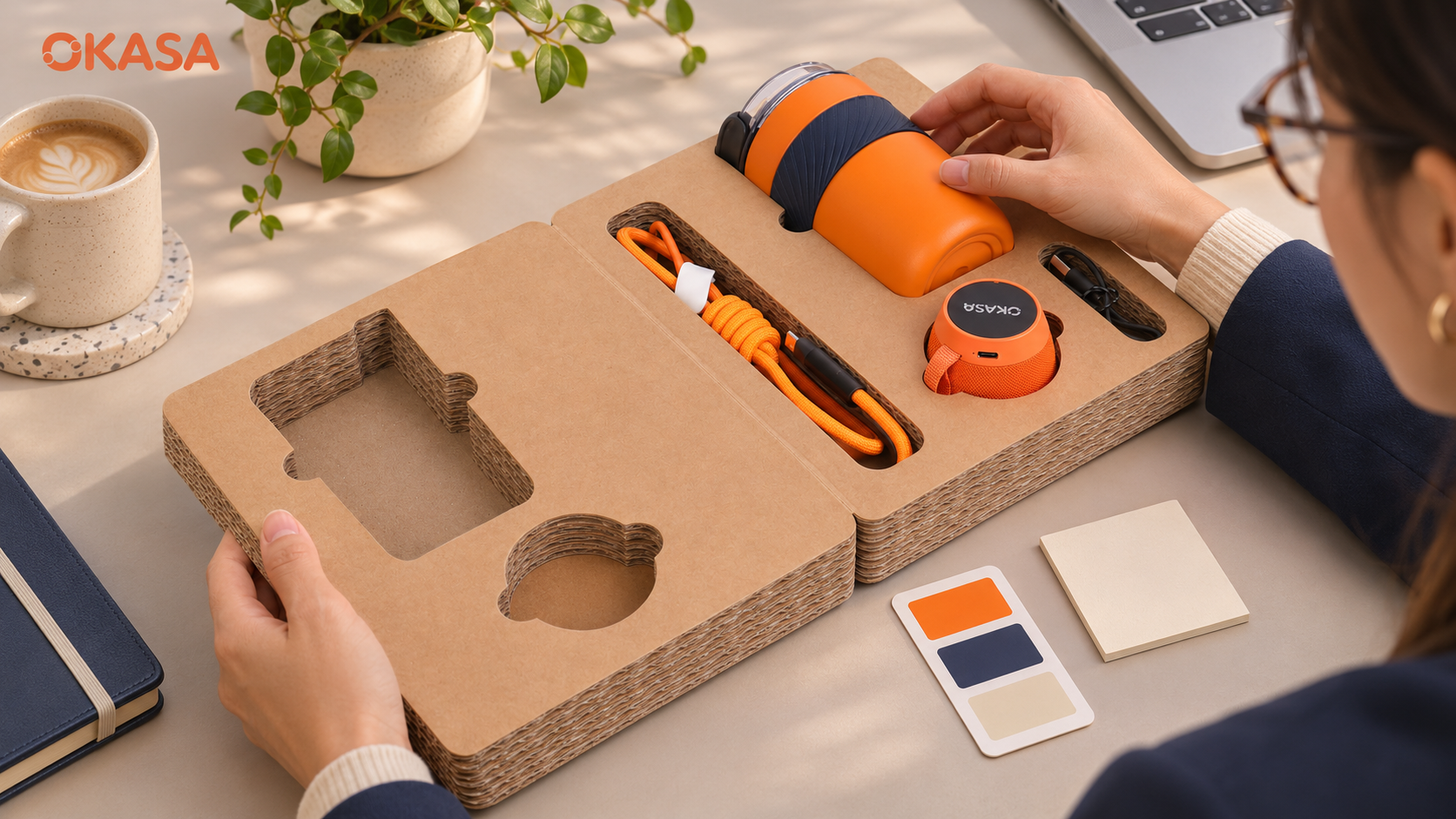
Scene image alt text: Buyer examining an open TGS965 corrugated book-style set with cut compartments for cup, cable and speaker, with OKASA logo.
The order can be larger than the gift
Suppose a campaign plans 3,000 sets across three offices. That number is only an illustrative planning example. It does not establish OKASA’s minimum order or price. If 1,000 sets are needed at each office and every office wants a different message, procurement should ask whether the version break happens on the box artwork, on product decoration, on an inserted card, or on all three. A standard component set with different cards may be simpler to control than three separately decorated speakers and cups. The right choice depends on the brand requirement, not on a rule that one method is always cheapest.
The bill of materials should show quantities per finished set and total quantities by version. Include the cup, speaker, cable, any separate charging accessory if confirmed in the final specification, box, instruction materials, protective pieces and outer carton. Ask who performs the final count. If 3,000 speakers and 3,000 cups arrive but only 2,970 approved cables are available, the number of complete gifts is 2,970 until the shortage is resolved. This simple arithmetic is why a custom corporate gift set manufacturer should quote the finished set and show its components.
For bulk corporate gifting solutions, delivery means a named handoff point and a date. “Needed in May” could mean cartons ready to leave the factory, cartons at a distributor, or gifts on employee desks. State the destination, whether delivery is to one warehouse or many addresses, the packaging required for that distribution, and which party handles final fulfillment. Get the schedule in milestones: artwork receipt, component samples, final sample approval, production start, assembly, inspection and dispatch. The supplier can then explain which milestone controls the deadline.
A promotional products manufacturer China quote should also make the trade term, currency, validity, payment terms, sample charges and freight assumptions explicit. Without that basis, two prices per set are not comparable. Ask whether the quote includes all printed materials, individual protection, assembly, testing requested by the buyer and master cartons. If one line is provisional, label it. The buyer can decide on a known scope; a cheap but ambiguous total only delays the decision.
The sustainability conversation belongs to materials, not adjectives
The layered corrugated box looks paper-based. The speaker lists ABS + RPET; the cup lists stainless steels; the cable lists TPE with a braid. These are component descriptions, not proof that the whole set is recyclable, recycled, carbon neutral or biodegradable. The battery and mixed materials make whole-set claims especially demanding. If a brand wants to make an environmental statement, identify the exact component, the evidence for it, and the market where the statement will appear.
A sustainable promotional products manufacturer can make this conversation concrete by supplying material declarations and suitable substantiation for the chosen configuration. The buyer may ask for a less complex packout, a different insert, or a documented content claim. Each change should be checked against protection, appearance and cost. Removing material from a box is only a benefit if the products still reach recipients in acceptable condition.
The same discipline applies to “RPET speaker.” The page describes the speaker’s material as ABS + RPET but does not give a recycled-content percentage for the whole unit. A precise description might identify the component and document the claim once the supplier confirms the construction. Avoid placing a large recycling symbol on the whole gift set based solely on one material line. An honest label can be more persuasive than an unsupported one.
A buyer can send this brief today
If your team is considering promotional products sourcing China, the inquiry should tell the supplier what decision you need next: a sample, a price range for a defined version, or a fully itemized production quote. The following is a copy-ready example. Replace bracketed fields; do not treat the example quantity or timing as a claim about OKASA’s current terms.
Subject: TGS965 corporate gift set RFQ — [quantity], [color split], [destination]
We are evaluating the OKASA TGS965 set for [employee welcome / client gifting / event]. Please quote [quantity] complete sets, with [orange/black split] and [number] logo or message versions. We need finished sets at [named destination] by [in-hand date].
Please confirm the cable, speaker, cup and book-style corrugated box specification against the current production version. Identify any proposed substitution. Quote product decoration, box artwork, insert or card, assembly, individual protection and master cartons as visible lines. State the MOQ per version, sample cost and lead-time milestones.
We would like a decorated sample and a complete assembled sample. Please provide applicable product and shipping documentation for [destination market] and your recommended test plan for the 60W-rated cable, 300 mAh speaker and 350 ml cup. We will agree acceptance criteria before production.
Please state price breaks, currency, trade term, quote validity, payment terms, carton details and any freight assumption. Tell us which choices must be approved first to keep our requested delivery date feasible.
That message is detailed enough to expose missing information without pretending to know the answer. If a supplier recommends a different cable, speaker, cup or packaging, ask for a side-by-side revision that shows why. If the campaign instead wants to add a notebook, ask a custom notebook manufacturer whether a format can fit the existing box or whether a larger box is required. If it wants a carry bag, a custom bag manufacturer should assess the actual packed set rather than a flat product photograph. Those are possible expansions, not contents of TGS965 as published.
The most valuable result of the first reply is clarity: which version is being priced, what the sample must prove, and what the buyer still has to decide. Send that brief through OKASA’s contact page with your artwork and destination details. The team can then respond to the project you actually intend to purchase.