

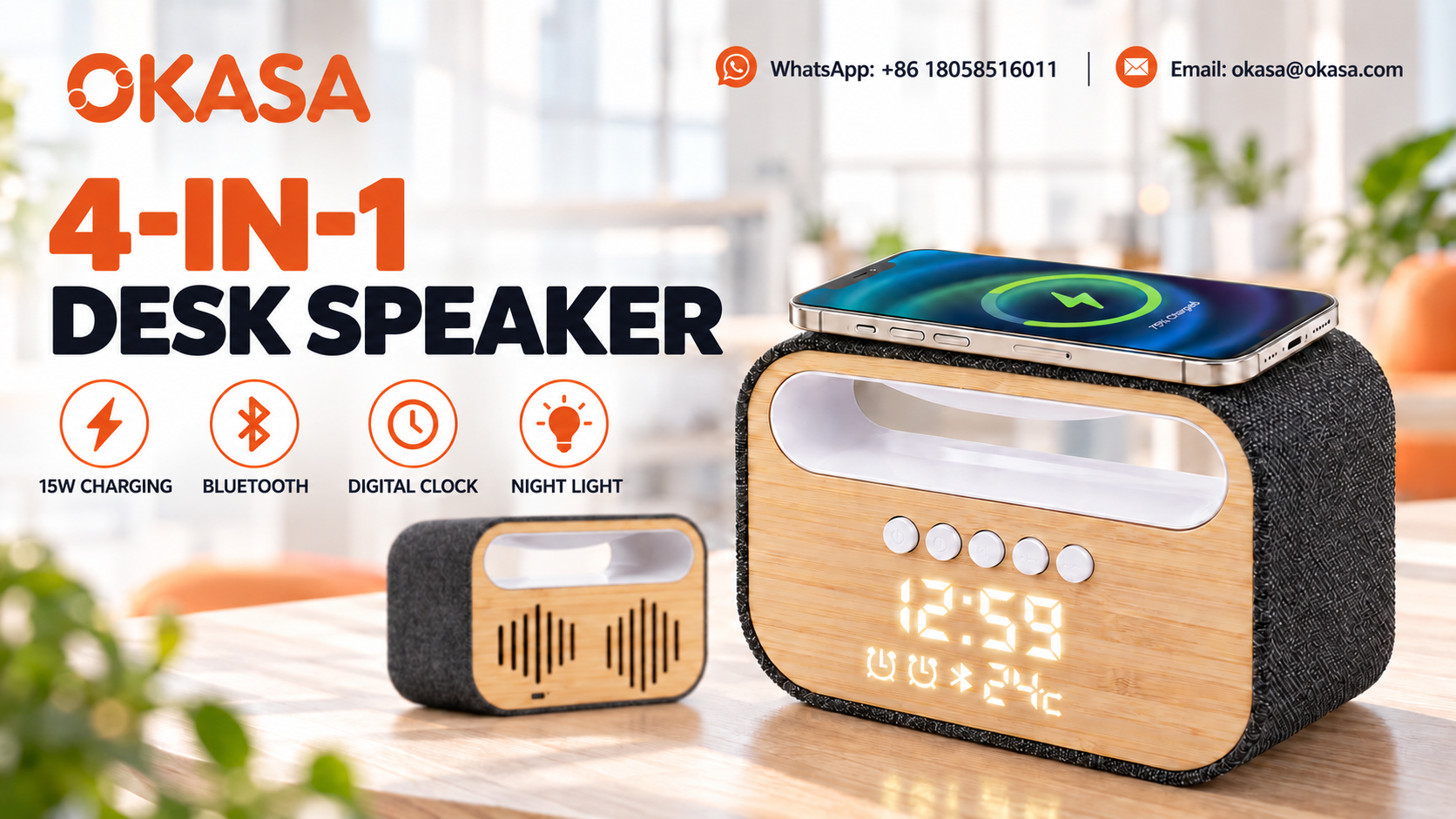
 A multifunctional desk gift sounds easy to buy. Put a speaker, wireless charger, clock and light into one compact body, add a logo, pack it neatly and send it to recipients. The product photograph may look convincing, and the first quotation may even fit the budget. Yet this is exactly the kind of project in which a small assumption can become an expensive complaint.
A phone may charge only when it is placed at a precise angle. The speaker can sound clean in a quiet sample room but distort when the volume rises. A digital display that seemed bright in a showroom may be distracting beside a bed. A logo can look elegant on bamboo and weak on woven fabric. Then there are practical questions that do not appear in a lifestyle image: What power adapter is used? What is included in each box? Does the instruction sheet match the destination market? Can the factory reproduce the approved color and assembly quality across several thousand units?
This guide is written for procurement teams, promotional merchandise distributors, brand managers and corporate gifting agencies that need a useful answer before they place a purchase order. It uses the OKASA K01 multifunctional Bluetooth speaker as a working example, but the method applies to many custom wireless charging speakers and desktop tech gifts. The goal is not to make the longest specification sheet. It is to remove uncertainty in the order that matters: use case first, performance second, presentation third and repeatability throughout.
The short answer
Before ordering a custom wireless charging speaker, verify nine things: the recipient use case, the frozen product specification, wireless charging conditions, real-world audio performance, battery and power behavior, destination-market documentation, branding execution, packaging and instructions, and the inspection plan for production. Do not approve a bulk order from a photograph or a generic data sheet. Approve a physical sample, record the test conditions, sign off the artwork on the actual surface and turn every agreed detail into a measurable requirement.
That sequence matters. Buyers sometimes begin with logo size because it is visible and familiar. The harder questions are hidden inside the product. If the charging coil, firmware, battery, speaker driver or power input changes after approval, the product experience can change even when the exterior looks identical. A disciplined brief protects both sides: the buyer receives a consistent product, while the manufacturer knows exactly what must be controlled.
Product example and specification starting point
The K01 combines several functions in one desktop format. According to the product information supplied by OKASA, it includes 15W wireless fast charging, a 5W Bluetooth speaker, a digital alarm clock with a temperature display and a three-mode adjustable night light. Its body combines natural wood accents with gray fabric panels. The listed size is 170 × 65 × 120 mm, the listed weight is 565 g, and the power input is USB Type-C. A 1200 mAh 18650 battery is listed, with approximately 2.5 hours of playback at medium volume and an indicated charging time of two to three hours.
Those figures are a useful RFQ starting point, not a substitute for project-specific verification. Wireless charging performance depends on the phone, case, alignment, input power and operating conditions. Playback time depends on volume, light use, battery condition and other loads. A responsible buyer writes those conditions into the test plan instead of turning a nominal figure into a universal promise.
|
Specification area |
K01 reference point |
What the buyer should confirm |
|
Product format |
Desktop speaker, charger, clock and light |
Final functions, controls and included accessories |
|
Wireless charging |
Listed as 15W fast charging |
Compatible devices, case thickness, alignment and input requirements |
|
Speaker |
5W, 4-ohm speaker, 66 mm diameter |
Sound at agreed volume range, pairing behavior and distortion |
|
Battery |
1200 mAh 18650 |
Actual runtime under the agreed test setup and battery documentation |
|
Clock and display |
Alarm clock and temperature display |
Brightness, time format, memory behavior and button operation |
|
Night light |
Three adjustable modes |
Brightness steps, color appearance and heat during extended use |
|
Input |
USB Type-C |
Cable specification, adapter responsibility and printed instructions |
|
Size and weight |
170 × 65 × 120 mm and 565 g |
Production tolerance, packed weight and carton planning |
|
Exterior |
Natural wood accent and gray fabric |
Grain variation, fabric lot, logo method and acceptable cosmetic limits |

A K01 wireless charging speaker undergoing dimensional power and audio checks
Why a multifunctional tech gift needs a different buying method
A passive promotional item is usually judged by material, dimensions, print and workmanship. A multifunctional electronic gift adds interactions. The phone sits on the charging area while the speaker is paired. The display remains visible while the light is on. Buttons must make sense without a long explanation. A power cable and instruction sheet become part of the recipient experience. Packaging has to protect both cosmetic surfaces and internal assemblies.
This creates what experienced buyers informally call a stacked risk. One function may pass, but the product must still work as a system. For example, a unit can play music correctly and charge a phone correctly in separate tests. The more useful test is whether it behaves properly when the speaker, display, light and charger operate together. Heat, power allocation, wireless interference and user confusion often appear only in combined use.
There is also a perception issue. Corporate recipients do not grade a gift like an engineer. They notice whether it works on the first attempt. If pairing is awkward, the charging position is unclear or the alarm buttons are confusing, the gift may be set aside. A product with four functions does not automatically deliver four times the value. It delivers value when the functions feel coherent.
For that reason, a sourcing team should treat the project as a small consumer-electronics launch. The following nine-step method keeps the work practical without turning every order into a laboratory program.
Step 1 Define the recipient and the moment of use
Start with the desk, room or event in which the gift will live. “Corporate giveaway” is too broad to guide a product decision. A welcome gift for hybrid employees has different needs from a hotel conference gift. An executive recognition program may favor a calm, permanent desk presence. A short trade-show campaign may place more weight on visual impact and quick setup.
Write a one-sentence use case before discussing decoration. A useful version might read: “The product will be sent to home-based employees who use a smartphone during the working day and need a compact speaker and charging point on a desk.” Another could be: “The product will be placed in guest rooms during a three-day leadership event and must be intuitive without staff assistance.”
That sentence immediately changes the questions. For home workers, call audio and all-day desk usability may matter. For a hotel room, display brightness, alarm controls and nighttime light become more important. For international distribution, language, plug responsibility, battery transport and regional documentation move to the front of the plan.
Ask the buyer to define the following:
· Recipient profile and likely phone types
· Primary location such as home office, corporate desk, hotel room or event venue
· Main function that must never disappoint
· Expected daily use time
· Distribution countries and languages
· Gift date and latest acceptable arrival date
· Whether the product is shipped individually or distributed from one venue
This is also the point to decide whether the item will stand alone or sit inside a broader kit. If the project includes stationery, drinkware or a bag, work with a custom corporate gift set manufacturer that can plan the complete unboxing sequence rather than treating the electronic item as an afterthought. The outer kit must allow for cable storage, movement during transit and easy identification of the main product.
Step 2 Freeze the functional specification before pricing
Buyers often request “your best price” while the product is still described in loose language. That produces quotations that look comparable but are not. One supplier may include a charging cable, printed manual and individual gift box. Another may quote the bare unit. Battery capacity, speaker component, finish, packaging and test level may differ.
Create a controlled specification sheet and give it a revision number. Keep it short enough to use, but specific enough that a factory cannot interpret important points in several ways. The sheet should cover model reference, dimensions, exterior materials, color, functions, power input, battery, included accessories, logo artwork, packaging, labeling and inspection criteria.
For a K01-based project, the specification might state that the approved configuration includes the Bluetooth speaker, wireless charging surface, time and temperature display, alarm function, adjustable light modes, USB Type-C input and an agreed cable. It should also state what is not included. If an AC adapter is excluded, do not hide that detail in small print; make it clear in the quotation, sample approval and instruction sheet.
The golden-sample record should contain photographs, measurements and operating notes. If the buyer approves a charcoal fabric, record the approved sample or color reference. Natural bamboo or wood-pattern surfaces may show normal variation. Define the acceptable range instead of demanding an impossible identical grain from every unit.
Price only after this version is frozen. If a feature changes, update the revision and ask for a revised quotation. This simple habit stops an old price from being attached to a new specification.
Step 3 Verify wireless charging under stated conditions
Wireless charging claims need context. A headline such as “15W” is not the entire user experience. The delivered rate may depend on the phone model, the power source, the charging protocol, phone settings, battery state, temperature and case. Thick cases, metal rings, wallet attachments and poor coil alignment can reduce performance or prevent charging.
Build a small compatibility matrix around the recipient population. You do not need to test every phone ever made. Choose representative devices, including the most common models expected in the program and at least one device with an ordinary protective case. Record the cable and power source used during the test. Then check charging initiation, alignment tolerance, stability over time and surface temperature.
Do not rely only on the charging animation that appears for a few seconds. Leave the device in place, operate other product functions and watch for repeated connection and disconnection. Try placing the phone slightly off-center, because recipients will not always position it perfectly. Check whether camera bumps or cases make the phone unstable.
Ask the supplier to clarify whether any certification claim applies to the finished configuration and to provide supporting documentation where relevant. A generic statement in a catalog is not evidence for a specific production lot. Equally, do not write “works with all phones” in campaign copy. A more accurate message is that wireless charging is available for compatible devices under the stated conditions.
The test record should include:
· Device model and operating state
· Case type and approximate thickness
· Input source and cable
· Phone placement
· Time until charging begins
· Stability during a defined test period
· Behavior while audio and light functions are active
· Observed temperature or abnormal interruption
This makes the final product description more credible. It also gives customer-service teams a useful answer if a recipient reports a problem.
Step 4 Listen to the speaker in a normal room
A speaker sample is often tested at a desk from half a meter away. That is a start, but a corporate buyer should also test it in the environment implied by the campaign. Pair it with at least two phones. Walk away and reconnect. Pause, take a call, return to music and switch the unit off and on. A gift is judged by these ordinary transitions, not by a single song played under ideal conditions.
Use several types of content. Spoken audio reveals whether voices are clear. Music with bass exposes rattles and cabinet vibration. A quieter track shows background noise. Test at low, medium and high volume. The aim is not to compare a compact desk product with a full-size home speaker. The aim is to confirm that the sound is appropriate for the promised use and consistent with the approved sample.
Record pairing name and voice prompts, if any. A factory-default Bluetooth name can look unfinished or confuse recipients when many units are used in one room. If the pairing name can be customized, confirm character limits, development cost and lead time before approval. If it cannot, include the exact pairing name in the instruction sheet.
Pay attention to vibration. A speaker that sounds acceptable on a soft mat may buzz on a wooden desk. Test on a hard surface similar to the final environment. Operate the light and charger simultaneously, then listen for interference or electrical noise. Run several samples rather than one hand-picked unit.
Sound is partly subjective, so define pass criteria in practical terms: no obvious rattle at the agreed maximum test volume, stable pairing at the specified distance, intelligible voice audio and consistent button response. A short signed video can support the sample record, but it should not replace physical approval.
Step 5 Test battery power and everyday behavior together
Battery capacity is one line on a specification sheet. Runtime is a system result. Speaker volume, light brightness, display operation, wireless charging activity, battery age and room temperature all affect performance. The listed approximately 2.5 hours of playback at medium volume for the K01 should therefore be treated as a reference condition to verify, not a promise for every pattern of use.
Choose an operating profile that resembles the campaign. One practical test could use the speaker at an agreed medium volume with the display on and light off. A second can add the light. A third can check behavior while external power is connected and a compatible phone is charging. Record start time, end time, interruptions and the exact setup.
Also test what happens after the battery is depleted. Does the product restart normally when power returns? Does the clock keep its setting? Is there an audible low-battery prompt? Does the display dim? These small details determine whether the recipient finds the product helpful or irritating.
Confirm the USB Type-C cable specification and length. A USB-C connector does not by itself guarantee a particular charging behavior. The instruction sheet should state the appropriate input and any adapter requirement. If an adapter is not supplied, say so plainly on the product page, box insert and program briefing.
For bulk orders, ask how batteries are controlled between incoming inspection, assembly, aging and shipment. Check the applicable transport documentation for the battery and destination route with the supplier and logistics provider. Requirements vary by market, carrier and configuration, so the shipping plan should be confirmed for the actual order rather than copied from a previous project.
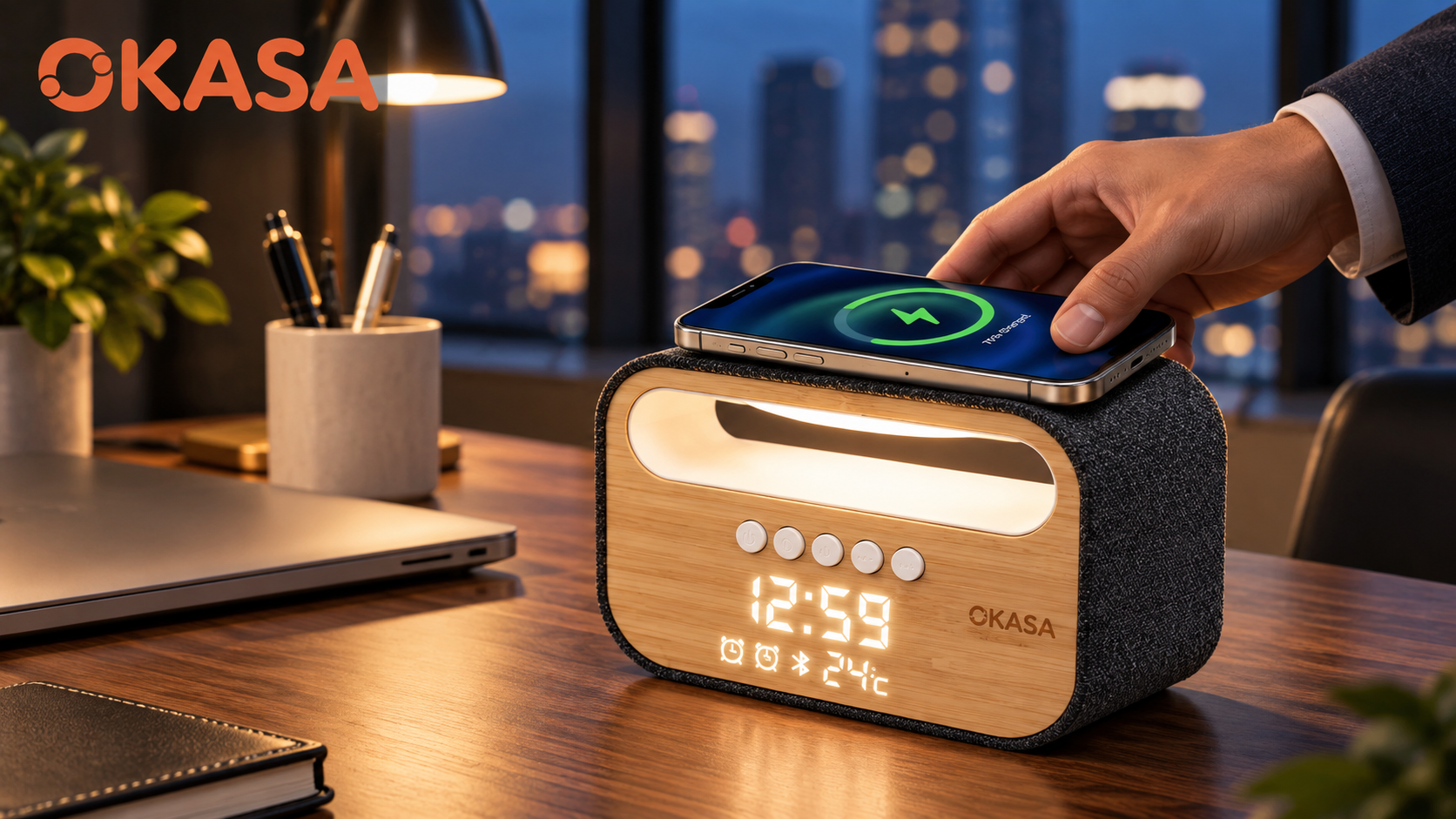
K01 multifunctional charging speaker in an executive office at the end of the working day
Step 6 Review safety and compliance by destination market
Compliance is not a decorative logo on a quotation. It is a set of requirements connected to the product, its wireless functions, battery, materials, labeling, packaging, destination and sales channel. The correct file can differ between markets, and a report for a similar model may not cover the exact configuration being purchased.
Begin with the distribution map. List every country in which the units will be placed on the market or delivered to recipients. Then ask a qualified compliance professional or test laboratory which requirements apply. Depending on the market and product configuration, the review may involve radio, electromagnetic compatibility, electrical safety, battery transport, restricted substances, packaging or recycling obligations. These are examples, not a universal checklist.
Request complete, readable documents and check the model reference, applicant, manufacturer, test dates, standards, photos and configuration.The identifier on the report should connect logically to the product in hand. If the branded version changes an electrical component, housing, cable or power arrangement, confirm whether the existing evidence still applies.
Labeling and instructions deserve the same attention. Verify required product markings, importer or responsible-party information, disposal symbols, warnings and local-language content. Keep approved artwork files under revision control. A late label change can delay production or lead to manual rework that looks untidy.
The supplier should be willing to explain the document trail without making broad promises. A serious answer may include conditions and limitations. “Everything is certified” is less useful than a file that identifies exactly what was tested. For high-volume or regulated-market programs, independent document review is a sensible budget item.
Step 7 Design branding for the surface and the user experience
The largest possible logo is rarely the best logo. A multifunctional desk gift is likely to remain visible for months, so branding should feel intentional. On a K01-style product, the natural wood face, fabric wrap and packaging offer very different decoration behavior. The wood face provides a clean visual field but competes with controls and the display. Fabric can soften a mark or reduce edge sharpness. Packaging can carry a larger campaign story without crowding the product.
Ask for a decoration map showing the maximum area, safe area, distance from controls and proposed method. Then approve the mark on the actual production surface. A digital mockup cannot reveal wood-grain interaction, fabric absorption, gloss difference or the tactile effect of a printed layer.
Keep fine lines and tiny registered symbols under control. If the campaign artwork contains small text, simplify it or move it to the box and instruction card. Test contrast under normal desk lighting. An elegant dark gray mark may disappear on charcoal fabric, while a bright white logo can feel louder than intended.
Branding can extend beyond the logo. Review the Bluetooth pairing name, start-up sound, instruction language, clock format, box label and cable presentation. These details form the first five minutes of ownership. They are especially important in bulk corporate gifting solutions, where recipients may never see a salesperson or event staff member.
When several merchandise categories belong to one campaign, use a shared brand-control file. A custom notebook manufacturer, custom drinkware manufacturer and custom bag manufacturer work with different surfaces and production processes. The logo will not reproduce identically by accident. Define the visual target, acceptable adaptations and priority surfaces across the whole program.
|
Branding location |
Strength |
Watch point |
Best approval method |
|
Bamboo or wood-look front |
Premium and permanent appearance |
Grain variation and competition with controls |
Physical decorated sample viewed in normal light |
|
Fabric side or wrap |
Subtle lifestyle character |
Soft edges, uneven ink and low contrast |
Production-material strike-off or sample |
|
Top charging area |
High visibility when phone is absent |
Wear, phone contact and charging-zone interference |
Confirm safe area and perform use test |
|
Gift box |
Largest storytelling area |
Print color, scuffing and label placement |
Printed packaging sample and transit check |
|
Instruction card |
Useful for campaign message and support |
Too much text or missing setup details |
Final language proof plus functional review |
Step 8 Approve packaging instructions and the sample ladder
Electronics need packaging that protects appearance and function. A box that survives a local courier route may not survive export cartons, warehouse handling and individual reshipment. Ask how the unit is restrained, where the cable sits and what prevents abrasion between the fabric, wood-look face and accessories.
The packaging brief should identify the retail or gift box material, insert structure, print, finish, label, barcode, accessory position and opening direction. If sustainability is part of the campaign, request specific material information and avoid unsupported environmental language. A sustainable promotional products manufacturer should be able to discuss material choices, packaging reduction and documentation without turning a modest improvement into a sweeping claim.
For a premium program, a custom gift box manufacturer can coordinate the structure with the product rather than selecting a box by outer dimensions alone. The insert should support the unit at strong points, keep the phone-charging surface free from pressure and prevent the cable from scratching the front.
Use a sample ladder:
1. Stock sample: confirms the base product, controls and general quality.
2. Decorated pre-production sample: confirms logo, color, packaging and instructions.
3. Golden sample: the signed reference used for mass-production comparison.
4. Production sample: taken from the actual run to confirm the line matches approval.
5. Shipment sample: retained with final inspection records for future claims or reorders.
The instruction sheet should be tested by someone who has not seen the product before. Give that person the packed sample and watch what happens. If they cannot set the clock, pair the speaker or find the charging position without verbal help, rewrite the instructions. Use diagrams where they are clearer than paragraphs. State adapter responsibility, pairing name, button functions, charging alignment and basic troubleshooting.
Do not rush approval through photographs when timing becomes tight. A photograph can confirm placement, but it cannot confirm button feel, charging stability, speaker noise or packaging protection. Build physical sample transit time into the schedule from the beginning.
Step 9 Turn approval into measurable production control
The final step is not “inspect quality.” It is to define what quality means for this order. A useful inspection plan connects every important buyer promise to a test, sample size and acceptance rule. It covers quantity, model, color, logo, packaging, accessories, cosmetics and function.
For a multifunctional speaker, the functional check should include power-on behavior, Bluetooth pairing, audio playback, buttons, display, alarm or clock controls, temperature display, light modes, wireless charging indication and USB-C input. Combined-use checks should be included on a defined sample. Cosmetic inspection should cover fabric fit, seams, gaps, wood-look surface, scratches, dust under displays, logo position and print quality.
Golden-sample comparison is especially important for sound and light because written descriptions are limited. Inspectors can compare the production unit with the signed reference while still recording objective observations. If color or grain naturally varies, provide approved boundaries and photographs of acceptable and unacceptable examples.
Packaging inspection should verify the box, insert, cable, manual, label, barcode and carton marks. Perform a carton count and confirm that mixed markets or languages are separated clearly. A unit that works perfectly but reaches the wrong recipient with the wrong manual is still a failed order.
Agree how defects will be classified. A safety-related or non-functioning unit is not equivalent to a faint cosmetic mark. The purchase agreement should state the inspection standard, reinspection process, corrective action and responsibility for approved deviations. Keep it commercial and specific.
For repeat orders, do not assume the original setup remains unchanged. Ask the OEM promotional products manufacturer to declare material or component changes before production. Reconfirm critical components, firmware behavior, artwork and packaging. A reorder is faster because the control file exists, not because control is unnecessary.
RFQ details that produce a useful quotation
A high-quality inquiry gives the supplier enough information to quote the right configuration and expose open decisions. Sending only a logo and quantity usually creates several rounds of clarification. It can also produce a price that later rises when packaging, testing or documentation is added.
|
RFQ field |
Information to provide |
Why it changes the quotation |
|
Product reference |
K01 or the agreed equivalent configuration |
Prevents pricing of a different internal setup |
|
Quantity |
Required units plus any spare percentage |
Affects production, decoration and component purchasing |
|
Destination |
Countries, delivery points and trade terms |
Drives documentation, labeling and freight planning |
|
Deadline |
Event date and requested delivery date |
Determines whether sampling and production are realistic |
|
Branding |
Vector artwork, logo size, colors and locations |
Affects process, setup, reject risk and sample cost |
|
Functions |
Required charging, audio, clock and light behavior |
Stops feature assumptions and component substitutions |
|
Accessories |
Cable, adapter if any, manual and other inclusions |
Changes unit cost, packaging and compliance scope |
|
Packaging |
Standard box, custom box or multi-item kit |
Changes tooling, print, assembly and carton size |
|
Testing |
Sample tests, production checks and inspection level |
Adds measurable quality-control work |
|
Compliance |
Destination-specific document request |
Identifies testing or review that may affect schedule |
If you are managing promotional products sourcing China, send the RFQ as one controlled file and ask every bidder to mark exceptions. This is more revealing than asking suppliers to say “confirmed” to a long email. An exception list shows where a component, lead time, test method or packaging assumption differs.
A realistic sourcing schedule
Lead time should be built backward from the date recipients need the product, not from the purchase-order date. Leave room for decisions, sample shipping and corrections. The following sequence is illustrative; actual timing depends on quantity, customization, factory capacity, testing and transport.
|
Phase |
Main output |
Buyer decision |
|
Brief and RFQ |
Frozen use case and quotation basis |
Select required configuration and target budget |
|
Stock sample review |
Base function assessment |
Continue, change model or stop |
|
Artwork and pre-production sample |
Decorated product, box and instructions |
Approve or issue one consolidated correction list |
|
Compliance and logistics review |
Market-specific document and shipping plan |
Confirm route and required labels |
|
Mass production |
Units made to approved revision |
Authorize production only after sample approval |
|
In-process and final inspection |
Measured production evidence |
Accept, rework, reinspect or hold shipment |
|
Freight and delivery |
Export cartons and distribution |
Track against recipient or event deadline |
A rushed program does not merely have less time; it has fewer opportunities to discover mistakes while they are still cheap to correct. If the event date cannot move, simplify the customization rather than compressing every approval. Standard packaging with a well-designed sleeve may be safer than a new rigid-box structure. A single proven logo position may be better than several untested decorations.
Common mistakes and the better decision
- Buying from the hero photograph. Lifestyle images communicate use, not production detail. Request the current specification and a physical sample.
- Treating the highest charging number as the whole story. Test representative phones, cases, input power and alignment. Write campaign copy around verified conditions.
- Testing every function separately. Add combined-use testing with the speaker, light, display and charging function operating together.
- Approving the logo on a digital mockup only. Inspect the actual surface. Bamboo grain, fabric texture and gloss can change the mark.
- Leaving the adapter question until packaging. Decide what supplies power, what is included and what the user must provide before the box and manual are approved.
- Accepting broad compliance language. Check whether documents match the model, configuration and destination. Use qualified advice for the actual market.
- Choosing a box before testing the product fit. The insert must protect controls, surfaces and accessories during the real distribution route.
- Inspecting appearance but not operation. A tech gift needs a functional inspection plan, including combined-use checks and clear defect classification.
- Assuming a reorder is identical. Require change disclosure and reconfirm critical components. Component availability can change even when the model name does not.
How to compare suppliers without relying on price alone
The strongest supplier response is not always the most polished presentation. Look for evidence that the team understands the product as a system. Do they ask which markets will receive it? Do they explain test conditions? Can they identify what is standard, what is customizable and what needs engineering confirmation? Do their samples and documents use consistent model references?
A capable promotional products manufacturer China should make decisions easier to trace.The quotation, sample, artwork and production instruction should point to the same revision. Questions should be answered with conditions and evidence, not only reassuring adjectives.
Also consider category coordination. A campaign may later add drinkware, notebooks, bags or packaging. Working with a supplier that can manage the electronic hero item and coordinate adjacent categories can reduce handoffs. However, category breadth should not replace product competence. Ask who owns the tech-gift specification, sample approval, factory communication, documentation and final inspection.
For buyers seeking a custom corporate gift set manufacturer, the useful question is not simply whether several items can fit in one box. It is whether the supplier can control the complete recipient experience: balanced item selection, consistent branding, safe separation, correct manuals, stable presentation and practical distribution cartons.
Frequently asked questions
Is a 15W wireless charging claim enough to approve the product
No. It is a nominal product claim that needs a defined test context. Confirm compatible devices, input power, cable, case conditions, alignment tolerance, charging stability and behavior during combined use. Do not promise the same result for every phone and accessory combination.
Should an AC adapter be included
That depends on the program, destination and user experience. Including an adapter adds cost, weight and compliance considerations. Excluding it can be reasonable if the required input is clearly stated and recipients are likely to have a suitable source. Decide early and communicate the choice on the box and instruction sheet.
What is the best logo position on a multifunctional speaker
There is no universal best position. The mark should avoid controls, displays, wear areas and functional zones. On a wood-look face, check grain and contrast. On fabric, check edge clarity and ink behavior. Packaging may carry the largest campaign message while the product uses a smaller permanent logo.
How many samples should a buyer review
At minimum, review a stock sample and a decorated pre-production sample, then establish a signed golden sample. For substantial orders, take a sample from production and retain a shipment sample. Multiple units are useful for checking functional consistency rather than relying on one ideal piece.
Can the clock speaker be used while a phone is charging
That is a combined-use scenario that should be tested on the approved configuration. Check audio, light, display, charging stability and temperature together with the intended cable and power source.
What information should be included in the first inquiry
Provide quantity, destination, deadline, use case, required functions, artwork, branding locations, packaging concept, accessories, target budget and documentation needs. If some details are undecided, label them as open questions instead of allowing the supplier to guess.
How should a buyer evaluate a sustainability claim
Ask what specific material, packaging reduction or process the statement refers to and request relevant evidence. Keep the claim proportional. A bamboo accent or reduced-plastic box does not automatically define the environmental impact of the entire electronic product.
Is a multifunctional tech gift suitable for an international program
It can be, but international distribution increases the importance of market mapping, instructions, labeling, wireless and battery documentation, power guidance and logistics. Confirm requirements for every destination rather than treating one market approval as universal.
What causes the most delays in customized tech gifts
Common causes include an incomplete brief, late artwork changes, uncertainty about adapters or accessories, repeated sample corrections, missing destination information, packaging redesign and delayed document review. A frozen revision and consolidated feedback reduce avoidable delay.
Why work with one partner across several promotional categories
One coordinated partner can align branding, packaging, deadlines and inspection across products. Buyers often begin with a tech item and later add a box, notebook, drinkware or bag. A supplier offering bulk corporate gifting solutions can manage the program as one recipient experience, provided each category still receives appropriate technical control.
Final buyer checklist
Before releasing the purchase order, confirm that your team can answer yes to each point:
· The recipient, use environment and main function are clearly defined.
· The quotation refers to a frozen product and packaging revision.
· Wireless charging has been tested with representative phones and stated conditions.
· Audio has been tested with voice, music, different volumes and normal reconnection behavior.
· Battery, cable and power instructions match the intended use.
· Destination markets and applicable documentation have been reviewed.
· The logo has been approved on the actual material.
· Packaging protects the unit and presents the cable and instructions clearly.
· A signed golden sample is available for production comparison.
· Final inspection includes cosmetic, packaging, functional and combined-use checks.
· Reorders require component-change disclosure.
· The delivery schedule includes approval and correction time rather than only production time.
The central lesson is simple: multifunctionality creates value only when the details work together. A well-managed custom wireless charging speaker can stay on a recipient's desk long after an event ends. It keeps the brand present because it earns a place in daily life, not because the logo is large. The buying process should reflect that ambition.
OKASA supports customized tech gifts as part of broader promotional product programs. Buyers can also explore coordinated sourcing with a custom drinkware manufacturer, custom bag manufacturer, custom notebook manufacturer, custom gift box manufacturer, sustainable promotional products manufacturer, OEM promotional products manufacturer and promotional products manufacturer China. Share the actual market, quantity and performance expectations so the proposal can be built around the program rather than a generic catalog item.
Ready to Source a Custom Wireless Charging Speaker
Share your quantity, destination markets, deadline, artwork and required functions with OKASA.