

The same logo can look sharp on paper, soft on fabric and uneven on a textured or curved surface. That is why custom gift sets with logo should not begin with “Put this mark on every item.” They should begin with a branding plan for each material, product and viewing distance.
A notebook, pouch, pen, bottle and gift box may need different decoration processes even when they belong to one coordinated set. The buyer's job is to decide where the brand should lead, where it should support and which details must be approved before bulk production.
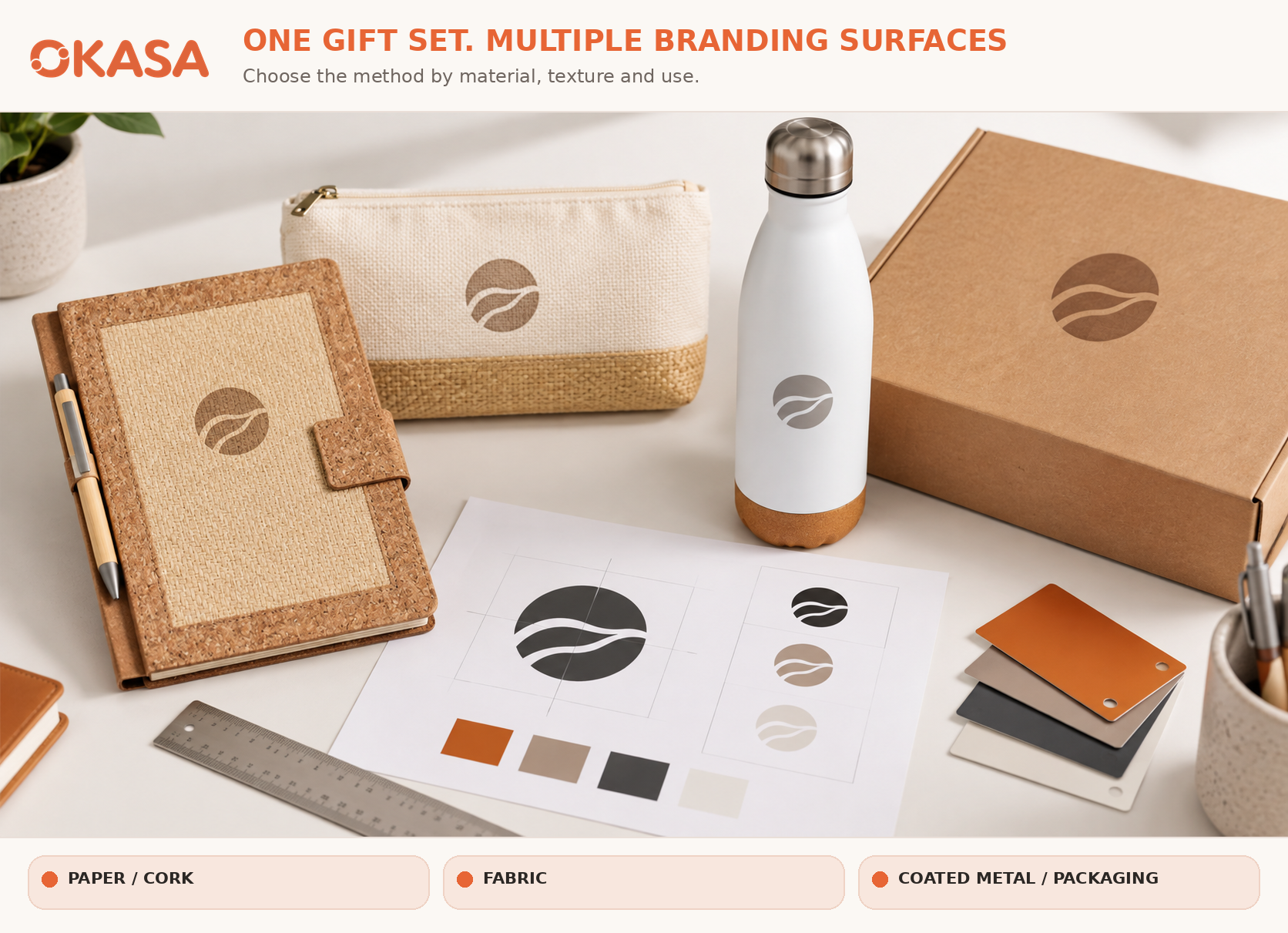
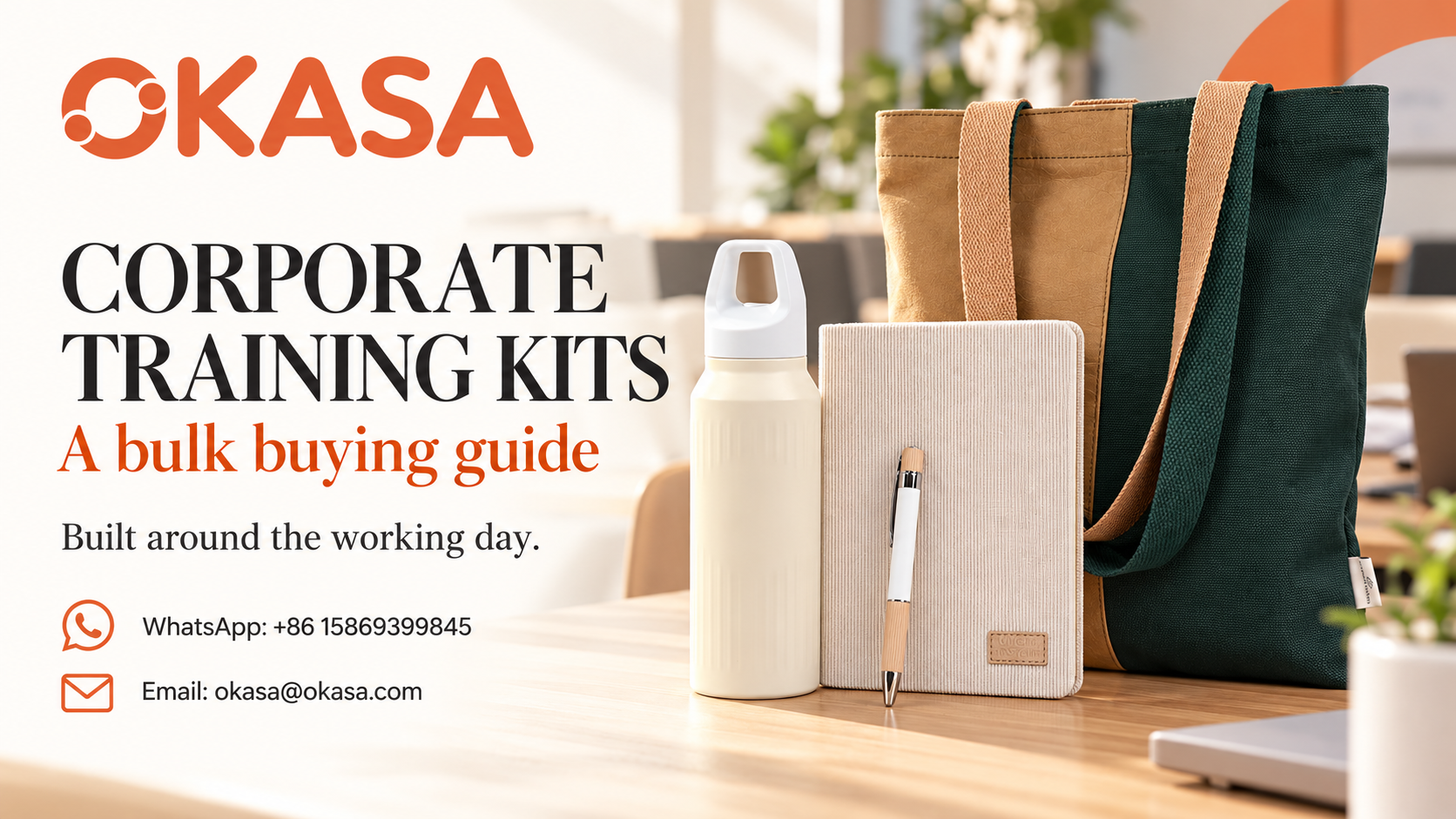
Suggested Alt: Branded stationery gift set arranged in a clean business setting
Buyer quick answer
Use one visual hierarchy across the gift set, but choose the production method separately for each surface.
· Select one hero branding position that remains clearly visible.
· Use supporting marks only where they improve coordination.
· Match every proposed method to the material, texture, shape and expected wear.
· Approve a decorated sample using the final artwork, size and color reference.
· Define inspection criteria for placement, color, adhesion, edge quality and durability.
This approach produces a more intentional result than repeating the largest possible logo on every component.
1. One artwork file is not one production process
A vector logo describes shapes and colors. It does not decide how ink sits on paper, how a woven label is constructed, how an engraving reads on metal or how artwork crosses a curved bottle.
Before asking for corporate gift logo printing, separate the order into surfaces:
|
Surface |
Common options to evaluate |
Main approval questions |
|
Paper or paper-wrapped board |
Screen or pad printing, foil, debossing, embossing, printed wrap or label |
Is the surface smooth or textured? Will fine lines, coverage or pressure create variation? |
|
Cork or natural-texture panel |
Screen or pad printing, laser marking, debossing or a separate label |
Is the surface flat enough? How much natural variation is acceptable? |
|
Cotton, RPET or woven fabric |
Screen printing, heat transfer, embroidery, woven label or stitched patch |
Does the fabric stretch, absorb ink or show backing? Will the method survive expected use? |
|
Coated metal |
Pad printing, screen printing, laser marking or other process confirmed for the coating |
Is the surface curved? How will color, adhesion, abrasion and placement be checked? |
|
Bamboo detail |
Laser marking, printing or another method confirmed on the sample |
How do grain and color variation affect contrast and legibility? |
These are methods to shortlist, not blanket OKASA promises. Final feasibility depends on artwork, material, surface, size, color, quantity and the production route confirmed for the order.
2. Set a brand hierarchy before selecting techniques
Strong branded corporate gift sets do not treat every product as a separate billboard. They create a clear order of attention.
Hero mark
The hero mark is the first branding element the recipient should notice. It may appear on the box lid, the largest reusable product or the notebook cover. Its scale and contrast should work at the normal viewing distance.
Supporting marks
A small woven label, pen mark, bottle detail or inside-box message can connect the products without competing with the hero position. Supporting marks are especially useful when materials do not accept the same visual treatment.
Campaign information
Dates, slogans, team names or temporary campaign messages may be better placed on a card, sleeve or removable label. This can protect the longer-term usefulness of the main products and reduce the need to create several permanent artwork versions.
For custom gift sets with logo, write the hierarchy into the brief: primary position, secondary positions and any temporary message. The supplier can then evaluate process, MOQ and setup by version.
3. Paper surfaces can be smooth, coated or visibly textured
The phrase “paper notebook” covers many surfaces. A smooth coated wrap, uncoated kraft paper, grass-paper sheet, coffee-waste paper and paper-woven material can respond differently to ink, foil, pressure and fine artwork.
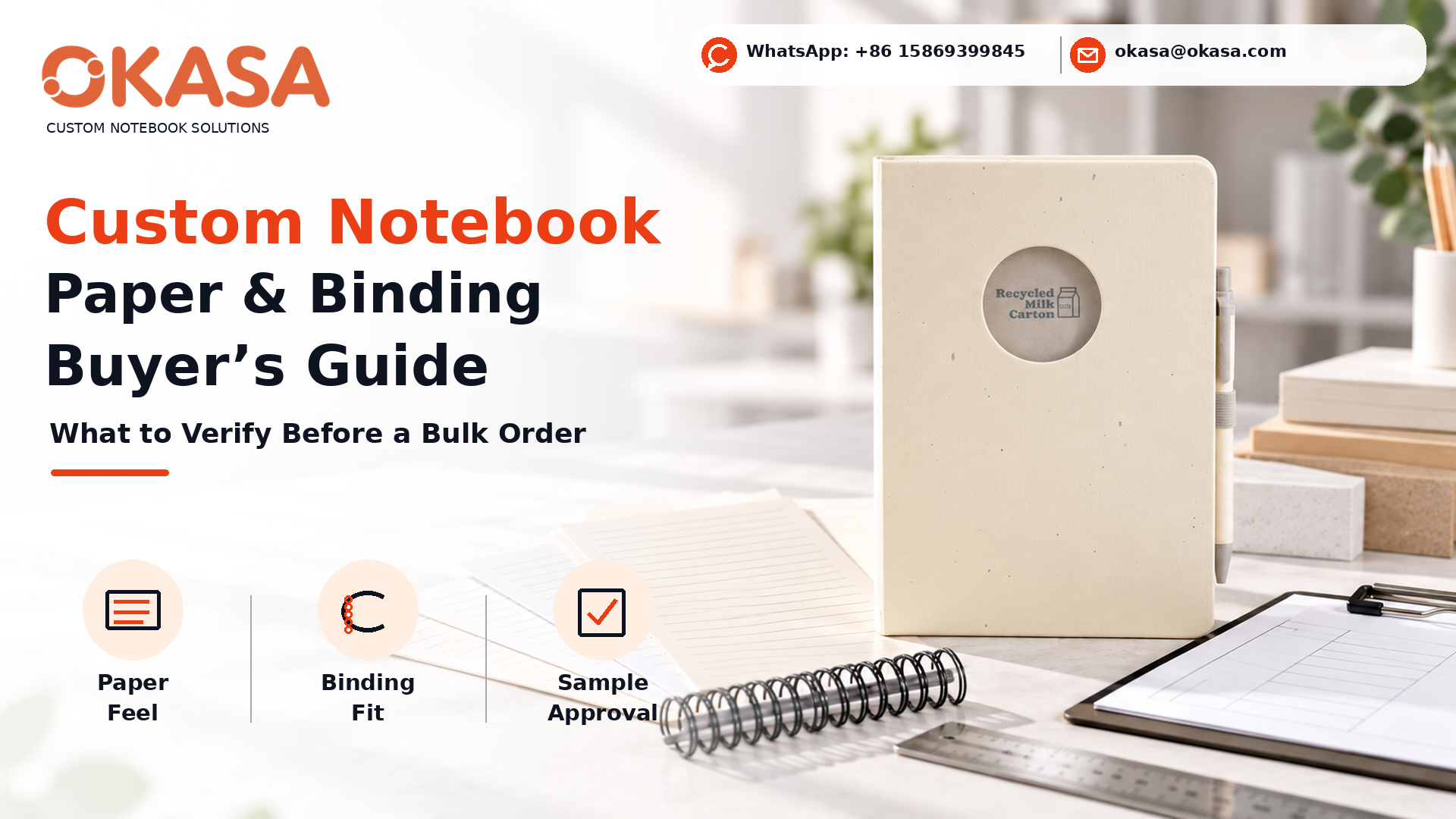
When planning logo printing on notebooks, confirm:
· The exact cover layer receiving the logo.
· Whether the surface is coated, textured, flecked or laminated.
· Minimum line width and smallest readable text.
· Solid-color coverage and acceptable pinholes or texture show-through.
· Pressure marks or cracking near folds, edges and joints.
· Registration relative to straps, seams, closures or cut-outs.
· Color reference and permitted variation under agreed lighting.
A digital artwork proof confirms layout, not the final interaction between material and process. Approve the mark on the intended cover material.
4. Cork and bamboo need realistic contrast expectations
Cork and bamboo vary naturally in grain, tone and small surface features. That variation can be part of the design, but it can also reduce consistency when the logo is small, low-contrast or highly detailed.
For cork, decide whether the mark should sit on the natural surface or on an adjacent paper or fabric area. Check the result across more than one material piece. For bamboo, evaluate the darkest and lightest likely grain range and confirm whether the chosen process remains readable.
Avoid assuming that a laser mark always looks dark or that one print color appears identical on every natural piece. The approved tolerance should describe the acceptable result, not demand impossible uniformity.
5. Fabric branding is part of the construction
On cotton, paper-woven fabric, RPET and other textiles, the logo method can affect hand feel, flexibility, seams and usable area.
Direct print or transfer
Confirm color, edge sharpness, coverage, stretch response and any visible backing or press marks. Test the decorated fabric after the handling or care conditions relevant to the product.
Embroidery
Check stitch density, backing, puckering, reverse-side appearance and clearance from seams or zippers. Very small text and fine negative spaces may need artwork adjustment.
Woven label or stitched patch
Confirm finished size, thread colors, fold, cut edge, sewing position and orientation. A label is not just printed artwork; it becomes a physical component in the product specification.
One real construction reference is the OKASA TGS920 stationery gift set. Its cotton and paper-woven pouch includes a side woven-label position, while the grass-paper and cork notebook creates a separate paper-and-natural-texture branding decision. The image shows where these surfaces sit; the customer's final process still requires artwork and sample confirmation.
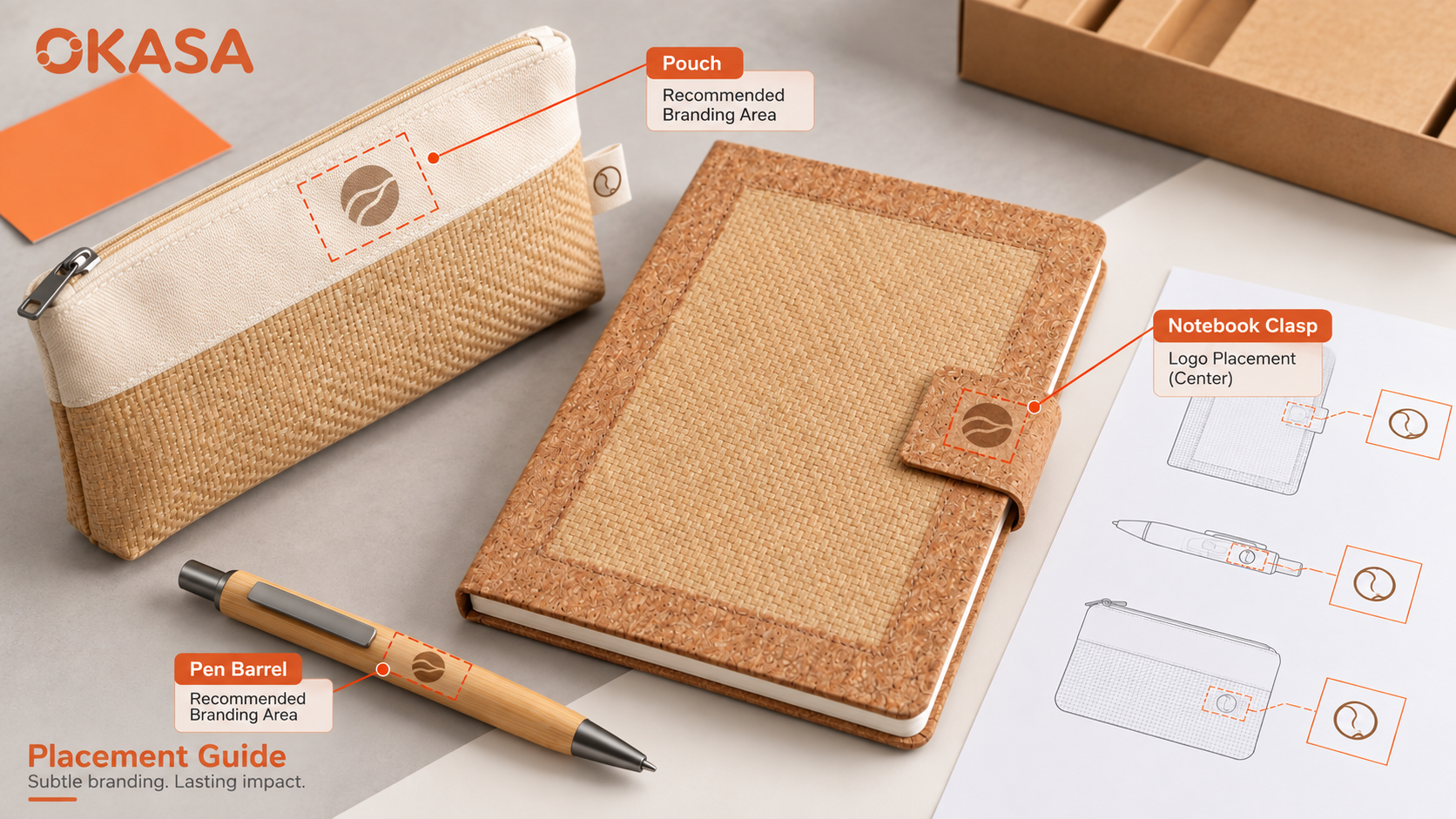
Suggested Alt: OKASA stationery gift set with notebook pouch bamboo pen and side woven label reference
6. Coated metal requires surface-specific testing
A bottle or tumbler creates a different problem from a flat notebook. Curvature changes image distortion and the available decoration area. Powder coating or paint can affect adhesion, contrast and laser results. Lids, seams and grip areas can restrict placement.
When evaluating a logo on drinkware, confirm:
· Exact printable or markable area and orientation.
· Whether the process works on the specified coating and color.
· Artwork size around the curve and viewing angle.
· Resistance required for handling, rubbing, washing or temperature exposure.
· Alignment relative to lid, handle, seam, base or packaging presentation.
· Acceptance criteria for missing areas, scratches, color and position.
A recycled aluminium pen, stainless steel bottle and coated bottle body should not automatically receive the same method. Each component has its own material and finish.
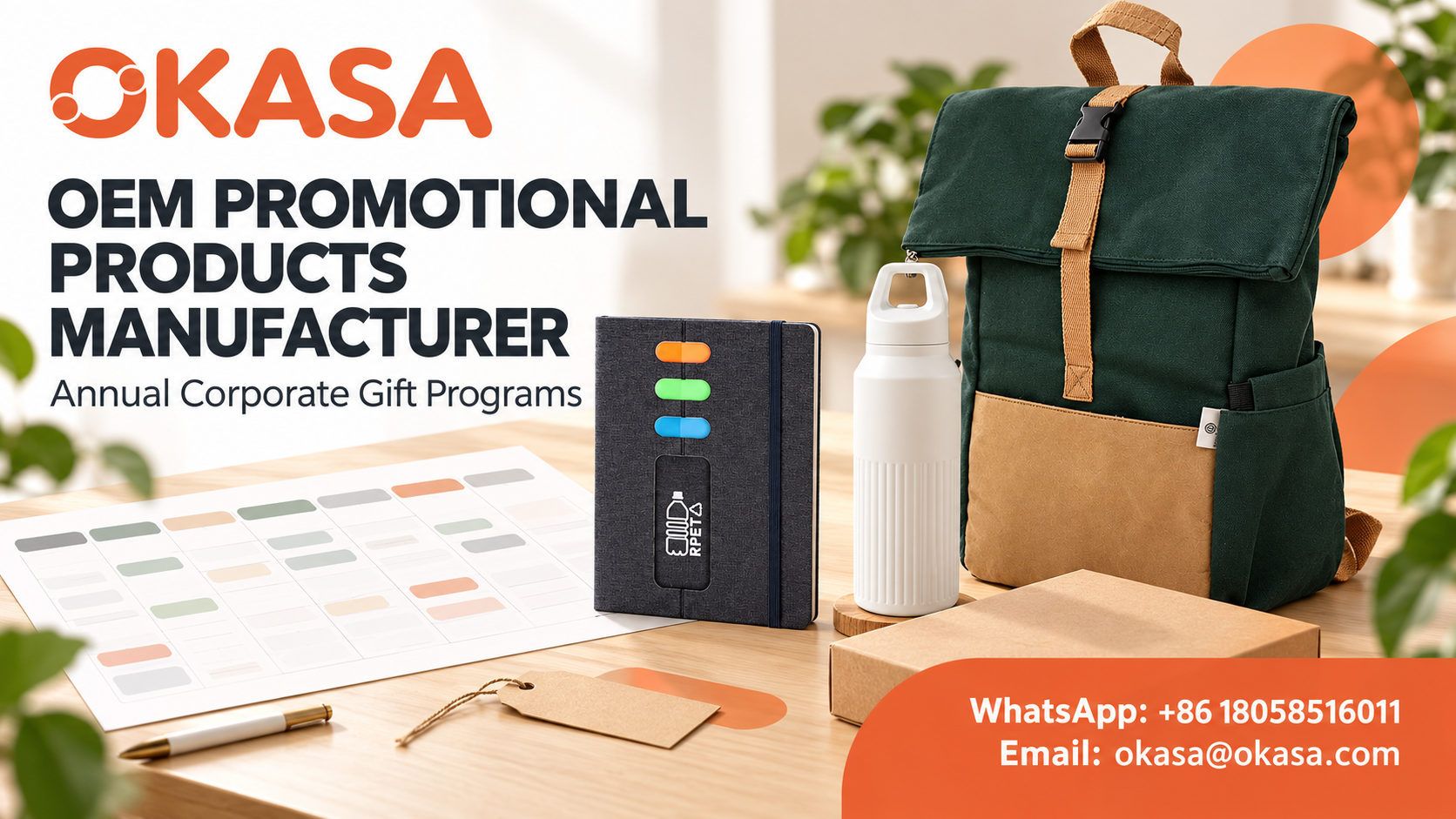
The OKASA TGS921 sustainable gift set provides a useful multi-surface example: a coffee-waste-paper notebook with a single-color logo reference, a painted stainless steel bottle with cork base and a recycled aluminium pen with bamboo detail. The existing notebook reference does not automatically confirm a customer's logo method on the bottle or pen.
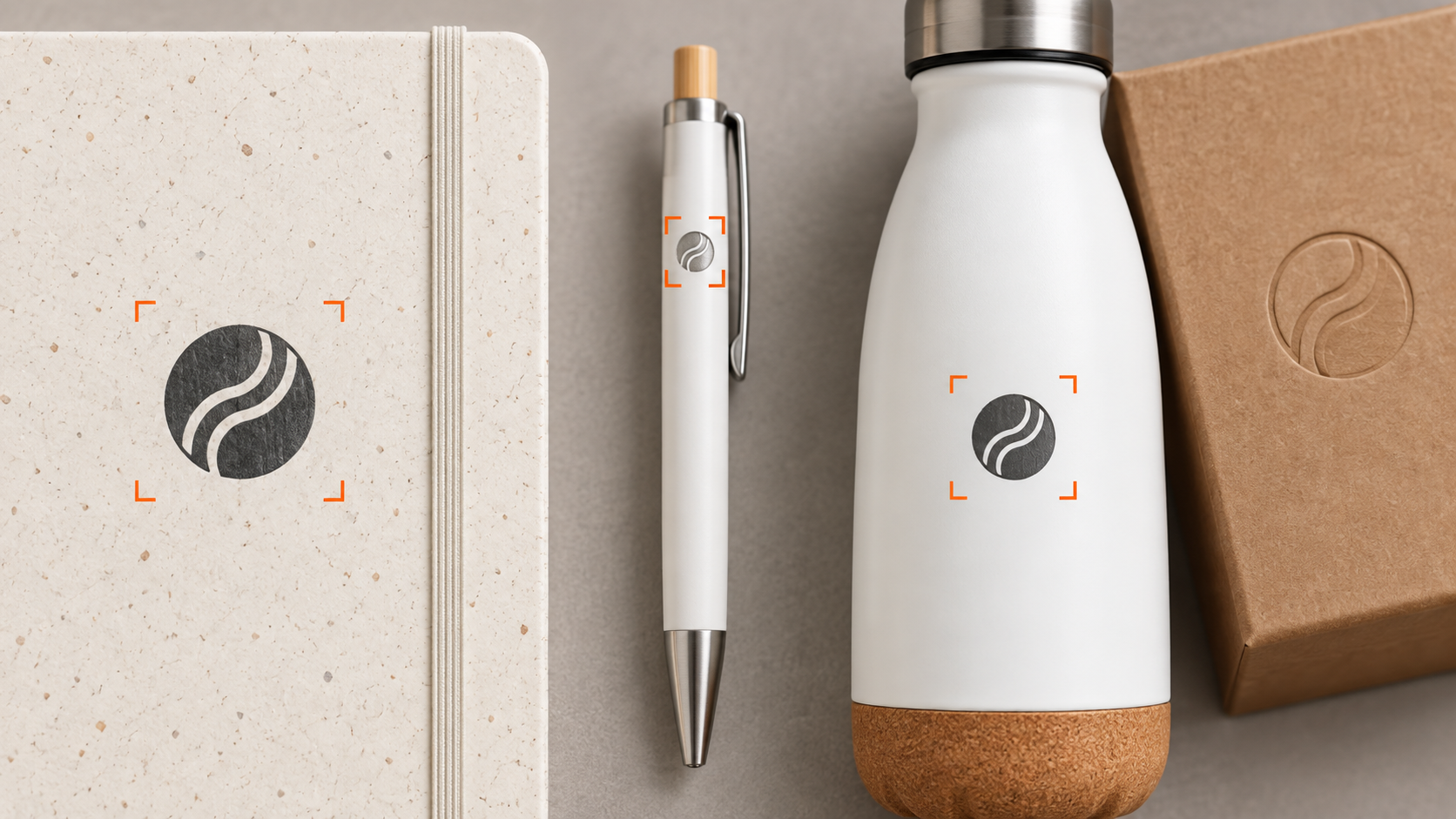
Suggested Alt: OKASA gift set with printed notebook coated stainless steel bottle and metal pen surfaces
7. Packaging should carry a role, not duplicate every mark
The gift box controls the first impression and often offers the largest flat branding area. But the right solution depends on box structure, wrap material, shipping protection, budget and whether the campaign message should remain permanent.
For custom gift box printing, compare:
|
Packaging direction |
Suitable branding role |
What to confirm |
|
Printed or foil-stamped lid |
Strong permanent first impression |
Surface, coverage, foil or ink color, registration and rub resistance |
|
Paper sleeve |
Campaign layer over a more reusable standard box |
Sleeve fit, opening direction, scuffing, MOQ and assembly |
|
Label or seal |
Small version changes or simple closure |
Adhesion, removal behavior, position and surface compatibility |
|
Message card |
Recipient, market or campaign information |
Size, print, language versions and packing accuracy |
|
Inside-lid print |
Brand story revealed after opening |
Viewing angle, product obstruction and production method |
If the box needs a different quantity from the complete sets, confirm packaging MOQ and surplus handling before approval. The custom corporate gift set MOQ guide explains how artwork and packaging versions can split one order into smaller production quantities.
8. More logo versions can change MOQ, price and packing risk
An order of 1,000 gift sets may become four 250-set artwork versions when products are divided by region, business unit or campaign. Some base products may be shared, while screens, plates, labels, printed boxes, cards and packing instructions are created separately.
Send a version matrix before requesting a final quotation:
|
Version field |
Example information to provide |
|
Product color |
One shared color or quantity by color |
|
Main logo |
Artwork file and quantity by version |
|
Supporting logo |
Product, position and whether it changes |
|
Box artwork |
Shared or version-specific |
|
Card or sleeve |
Language, team, campaign and quantity |
|
Packing identification |
Barcode, label, carton mark or destination |
Ask which setup steps can be shared and which have separate minimums or charges. Do not assume that a total quantity automatically satisfies every decoration version.
9. Approve five things on the decorated sample
The sample should answer more than “Do we like it?” Record approval against:
1. Accuracy: correct artwork revision, spelling, proportions and required elements.
2. Position: distances from edges, seams, closures and other reference points.
3. Appearance: color, contrast, coverage, edge definition and acceptable material variation.
4. Performance: adhesion, abrasion, flexing, washing or handling relevant to the product.
5. Repeatability: tolerances that can be checked during production and final inspection.
Photographs help communicate the approval, but keep the physical sample, artwork number, color reference and specification connected. If the production material or process changes, the logo result should be reviewed again.
10. Build inspection around likely failure points
Generic “logo quality” is difficult to inspect. Use surface-specific defects:
· Paper: missing ink, fiber show-through outside tolerance, foil gaps, cracking or misregistration.
· Fabric: bleed, peeling, puckering, loose threads, skewed labels or inconsistent sewing position.
· Metal: scratches, poor adhesion, weak contrast, distortion or incorrect orientation.
· Natural materials: unreadable marks or variation outside the approved reference range.
· Packaging: scuffing, wrong artwork version, misplaced label or incorrect card packing.
Define sampling level, defect categories and release responsibility before shipment. This turns the approved appearance into a measurable production control.
11. What to send for a logo-method proposal
Send OKASA:
· Product links or the functions and materials required.
· Complete-set quantity and quantity by color or artwork version.
· Vector logo files and brand color references.
· Preferred hero branding position.
· Any positions that must remain discreet or unbranded.
· Destination and required arrival date.
· Packaging, card and language versions.
· Durability, testing or documentation requirements.
For the TGS920 and TGS921 starting configurations shown here, products in the combination can be adjusted, the working MOQ is 1,000 complete sets and production is normally planned at 20 to 35 days after the necessary specification and approval conditions are complete. Final processes, minimums, pricing, sample timing and shipping are confirmed against the exact brief.
For complete budget planning, read the corporate gift set cost guide. If the product combination is still open, start with the corporate gift set selection guide.
Frequently asked questions
Should every product carry the same logo size?
No. Scale should follow the surface, viewing distance and branding hierarchy. A smaller supporting mark may create a more coordinated result than repeating one large size.
Can one Pantone color look identical on paper, fabric and metal?
The same target color can appear different because substrates, coatings, inks, texture and lighting vary. Approve realistic tolerances on the actual materials.
Is a digital artwork proof enough for bulk approval?
No. It confirms layout and content but not the final interaction between process and material. Use a decorated sample or another production-representative approval method confirmed for the order.
Which logo method is most durable?
There is no universal winner. Durability depends on the substrate, finish, process, use conditions and test criteria. Compare methods against the actual product and expected use.
Make the brand system clear before production
The best custom gift sets with logo use one coordinated visual system and several surface-appropriate production decisions. Define the hero mark, supporting positions, materials, versions and acceptance criteria before requesting bulk approval.
Send OKASA the products, quantity, artwork, destination and deadline. We can review suitable branding routes, packaging, MOQ, sample requirements and production conditions for the exact project.
Request a corporate gift logo proposal