

A material name can start a product search, but it cannot finish a buying decision. Sustainable materials for corporate gifts must still match the product's job, expected use, branding, packaging, destination market and the evidence available for the actual order.
RPET, recycled aluminium, bamboo, cork, grass paper and coffee-waste paper do not make the same claim. Some use recycled inputs. Some come from renewable sources. Some incorporate agricultural or food-industry by-products. A complete gift set may combine several of these routes with conventional materials that provide structure, insulation or durability.
The useful question is therefore not “Which material sounds greenest?” It is “What does this material contribute to the product, and what must be verified before we communicate it?”

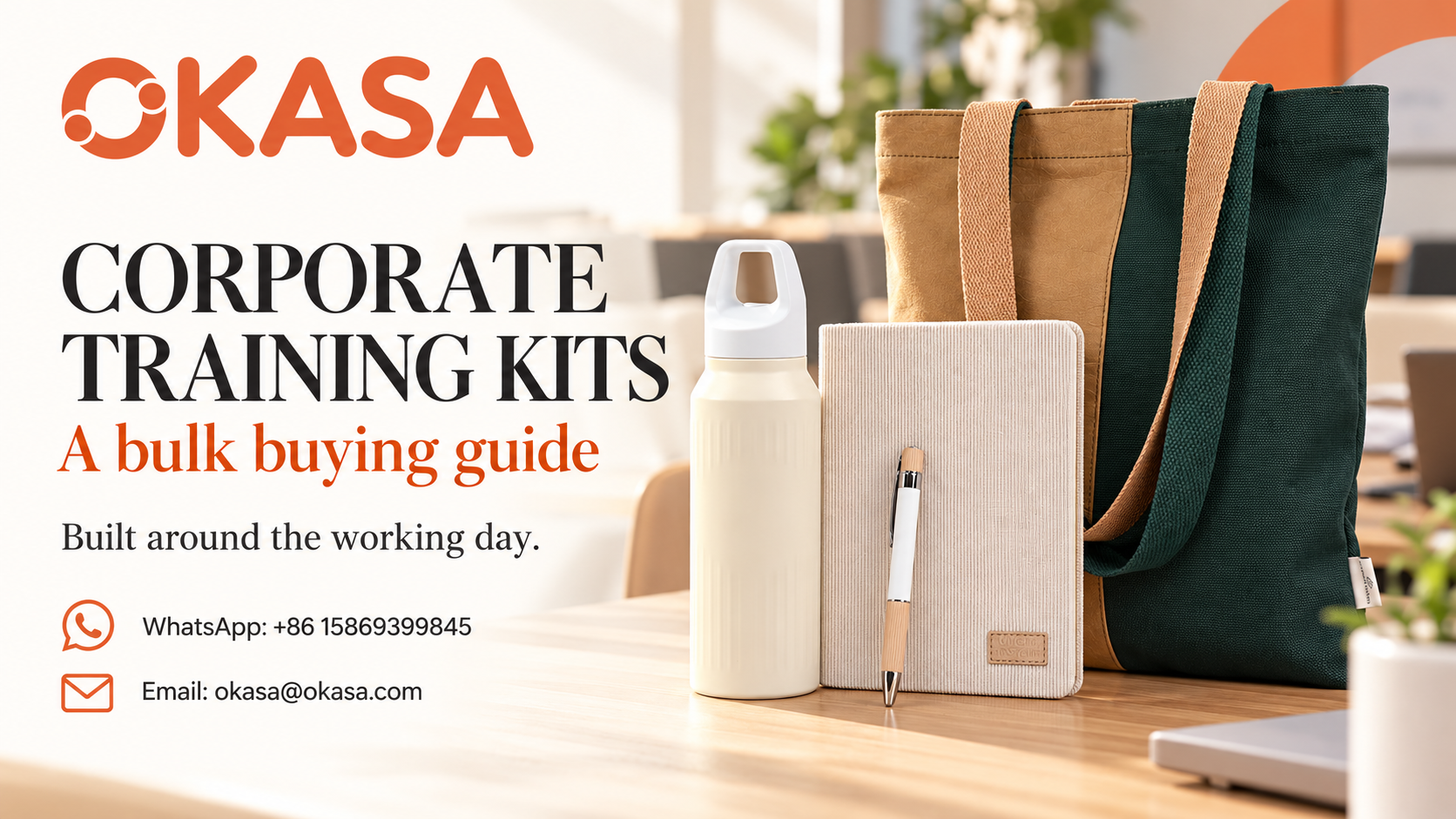
Suggested Alt: Sustainable materials for corporate gifts including RPET cork bamboo grass paper coffee-waste paper and recycled aluminium
Buyer quick answer
Choose materials in this order:
1. Define what each product must do and how long it should remain useful.
2. Identify the exact material and component carrying the environmental story.
3. Confirm performance, decoration and packaging on a representative sample.
4. Request order-specific documents before publishing recycled-content, certification or environmental statements.
Do not use “recycled,” “renewable,” “natural,” “reusable” or “recyclable” as interchangeable terms. A gift set can contain a recycled fabric, a renewable bamboo detail and a reusable steel bottle while still requiring separate evidence and careful wording for each component.
1. Begin with the product function
The same material can be a sensible choice for one product and a poor choice for another. A notebook cover needs folding, bonding and print performance. A pouch needs seam strength and zipper compatibility. A bottle needs food-contact suitability, corrosion resistance, closure fit and coating performance. A gift box must protect several shapes during transport.
For sustainable promotional products, begin with four practical questions:
· What repeated action should the product support?
· Which surfaces will receive a logo or color treatment?
· What wear, moisture, temperature or transport conditions will it face?
· Which claim or documentation does the buyer actually need?
Only after these are clear should a supplier shortlist materials. Otherwise, the team may approve an attractive sample that does not perform, cannot carry the intended branding or cannot support the proposed marketing statement.
2. Separate three material routes
|
Material route |
Typical examples |
What it can communicate |
What still needs verification |
|---|---|---|---|
|
Recycled input |
RPET, recycled aluminium, recycled cotton, recycled paper |
A specified input comes from recovered material |
Exact component, claimed percentage, pre- or post-consumer source, certificate and transaction scope |
|
Renewable or natural input |
Bamboo, cork, cotton, paper fibers |
The input comes from a biological or forest-based source |
Species or fiber identity where relevant, sourcing route, treatments, durability and applicable chain-of-custody evidence |
|
By-product or residue input |
Coffee-waste paper, grass paper, tea-residue paper |
A named residue is incorporated into a material or surface |
Which layer contains it, percentage or formulation if claimed, supplier declaration and limits of the statement |
These routes are not a ranking. They describe where a material story begins. Environmental performance also depends on quantity of material, manufacturing, service life, transport, packaging, use and end of life. A buyer comparing eco friendly corporate gift sets should therefore ask for specific facts instead of accepting the phrase as proof.
3. What RPET needs to mean in an order
RPET is recycled polyethylene terephthalate. In a corporate gift, it may be used as fabric on a notebook cover, bag, pouch, lanyard or accessory. The buying brief should identify the exact component rather than describe the entire mixed-material product as RPET.
For RPET corporate gifts, confirm:
· Whether the stated content applies to the whole item or one fabric component.
· The claimed recycled-content percentage and whether it is calculated by weight.
· Whether the source is pre-consumer, post-consumer or a combination.
· The supplier and production stage covered by any certificate.
· Whether order-level transaction documentation is required.
· Color, weight, backing, lamination, coating and decoration details.
· Strength, seam and appearance criteria for the finished construction.
The Textile Exchange Recycled Claim Standard and Global Recycled Standard use chain-of-custody systems for recycled materials. A certificate should be checked for holder, scope, validity and product relevance; it should not be assumed to cover every company, product or shipment. Buyers can review the current RCS standard and GRS standard when such documentation is part of the brief.
The OKASA TGS919 notebook and tumbler set is one product example in which RPET fabric is combined with cork on a notebook cover. The presence of RPET on that component does not automatically describe the stainless steel tumbler, silicone grip, inner pages, board, adhesives or gift box.
4. Renewable materials still need a job
Bamboo and cork can contribute a warm tactile direction, but their value in a product should be connected to function and construction.
A bamboo pen barrel or cap is different from a complete product made only of bamboo. A cork patch, bottle base or notebook panel is one component within a mixed construction. The brief should name the component and confirm dimensions, surface finish, natural variation, bonding, moisture exposure and logo method.
For paper and other forest-based inputs, a brand may request chain-of-custody information. FSC explains that chain-of-custody certification tracks eligible forest-based materials through companies that process, manufacture or distribute them and controls the use of FSC claims and trademarks. Review the FSC chain-of-custody overview and confirm whether the exact supplier, product and sales documents fall within scope.
Renewable does not automatically mean recyclable, compostable or lower impact. Coatings, inks, adhesives, mixed components and local infrastructure can change the end-of-life route. Those are separate questions.
5. Treat residue-based paper as a precise material statement
Grass paper, coffee-waste paper, tea-residue paper and similar materials can create a distinctive texture and give a design team a clear starting story. The safest purchasing approach is to describe exactly what the supplier can support.
Ask:
· Is the named residue in the surface paper, a blended sheet, a coating or a decorative layer?
· What percentage or formulation can be documented, if a percentage will be claimed?
· What other fibers, binders, pigments or coatings are present?
· How does the sheet perform during folding, wrapping, printing, stamping and bonding?
· What variation in color, visible particles and texture is acceptable?
· Which statement can appear on the product, packaging or campaign page?
A visible flecked surface is not laboratory proof of composition. At the same time, a material can be genuine even when the residue is not visually dramatic. Approval should follow the specification and available documents, not appearance alone.
6. Recycled aluminium and stainless steel answer different questions
A recycled aluminium pen can reduce reliance on virgin aluminium for the stated component when recycled content is verified. A stainless steel bottle may be selected for insulation, corrosion resistance and repeated use even if recycled content is not being claimed for that order.
Do not combine those facts into one unsupported sentence. Instead, record materials by component:
|
Component |
Material fact to record |
Performance to approve |
Claim question |
|
Pen barrel |
Aluminium grade or recycled-content claim |
Finish, component fit, refill and writing |
Is recycled content documented for this barrel and order? |
|
Bottle body |
Inner and outer steel specification |
Insulation, coating, dimensions and surface |
Is any recycled-content statement actually required and supported? |
|
Lid and base |
Steel, plastic, silicone, cork or mixed construction |
Seal, fit, stability and wear |
Does the marketing text clearly limit each statement to the correct part? |
This component map is more credible than calling the whole set “made from recycled metal.”
7. A mixed-material gift set is not automatically a problem
Corporate gift sets often need different materials because the products perform different jobs. The goal is not necessarily to force every component into one material family. The goal is to know why each material is present, control it in the specification and avoid making a whole-set claim from one feature.
One practical stationery direction uses paper-based and natural-texture surfaces for writing and organization. The OKASA TGS920 stationery set combines a grass-paper and cork notebook, a cotton and paper-woven pouch, a bamboo pen and a rigid kraft-paper-wrapped box. It is useful as a construction example because the material story is distributed across several components.

Suggested Alt: TGS920 components arranged with cork paper-woven cotton and bamboo material samples
Another direction combines a residue-based notebook cover with drinkware and a metal pen. The OKASA TGS921 sustainable gift set includes a coffee-waste-paper notebook, a stainless steel bottle with cork detail and a recycled aluminium pen with bamboo detail. Each material statement should remain tied to its component.
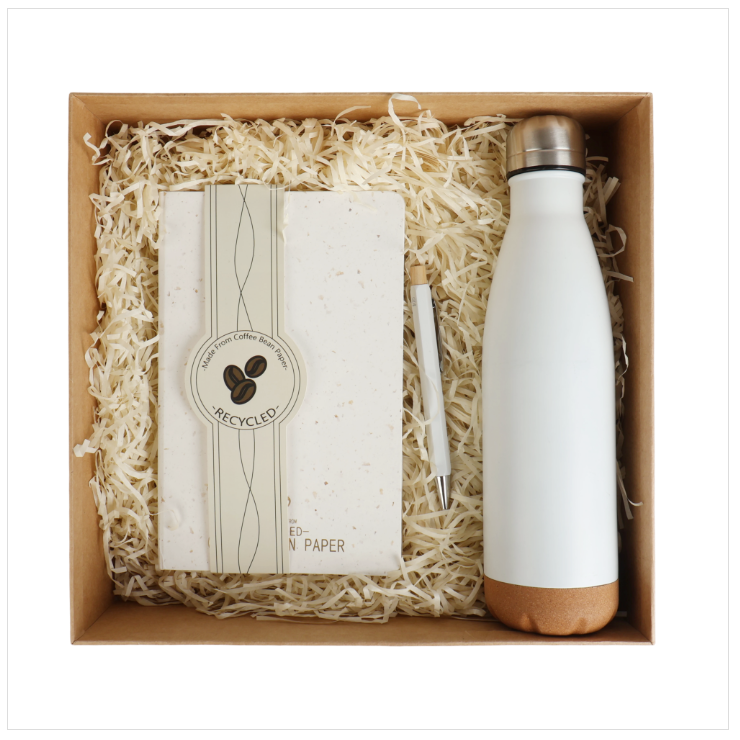
Suggested Alt: TGS921 notebook bottle and pen arranged with coffee-waste paper cork bamboo and recycled aluminium samples
These examples are starting configurations, not proof of a buyer's final claim. Product substitutions, colors, decoration and packaging can change both performance and documentation requirements.
8. Compare materials with an evidence matrix
Before approving recycled corporate gifts or residue-based materials, use one row for every important component.
|
Decision field |
What to record |
|
Product function |
Intended use, target service life and conditions |
|
Component identity |
Body, cover, lining, handle, insert, lid, label, coating or other part |
|
Material statement |
Exact material name and claimed content where applicable |
|
Source evidence |
Supplier declaration, certificate, transaction document or test report required |
|
Branding |
Process, position, size, color, durability and sample result |
|
Quality |
Dimensions, appearance, strength, fit, writing or insulation performance |
|
Packaging |
Box, insert, filler, wrapping, labels and protection |
|
Market communication |
Exact wording, geography, channel and approval owner |
The result becomes a practical product brief. It also prevents the marketing team from extending a narrow input fact into a broad environmental promise.
9. Confirm the decorated sample, not only the raw material
Material evidence and product approval solve different problems. Documents may support the identity or chain of custody of an input. A decorated sample shows whether the real construction, color, logo, seams, coating, components and packaging work together.
For recycled material gift sets, the approval record should connect:
· The latest bill of materials and specification revision.
· The approved physical sample or sample photographs.
· Artwork version, logo position and color reference.
· Material and certificate references required for the order.
· In-process checks and final inspection criteria.
· Approved substitutions and change-control responsibility.
If one material or supplier changes during production, review whether appearance, performance and the intended claim also need to change.
10. What to send for a material-led quotation
Send OKASA:
· The recipient use or product function that matters most.
· Preferred product links or the items that must remain in the set.
· Quantity and number of color or artwork versions.
· Destination market and required arrival date.
· Logo artwork and preferred brand appearance.
· Materials you prefer and materials you want to avoid.
· Exact recycled-content, certification or environmental statements under consideration.
· Packaging and documentation requirements.
For the TGS920 and TGS921 starting configurations discussed here, the working MOQ is 1,000 complete sets and the products in the combination can be adjusted. Production is normally planned at 20 to 35 days after the required specification and approval conditions are complete. Final MOQ, branding, packaging, documentation and shipping time are confirmed for the order.
For quantity planning, read the custom corporate gift set MOQ guide. For budget structure, use the corporate gift set cost guide.
Frequently asked questions
Is an RPET product automatically recyclable?
No. Recycled content describes the source of an input. Recyclability concerns the finished item, its components and a viable collection and processing route in the relevant market. They require separate evidence.
Is bamboo always more sustainable than metal or plastic?
No universal conclusion follows from the material name alone. Compare function, amount of material, processing, durability, transport, use and end-of-life conditions for the specific product.
Can one material certificate cover the whole gift set?
Only if its scope actually includes every relevant component, organization, product and transaction. More commonly, a certificate or document supports a defined input or supply-chain stage.
What is the best material for a corporate gift?
There is no single best material. The strongest choice is the one that fits the product's function, brand direction, quality requirements, destination market and evidence needs.
Build the material brief before writing the claim
The best sustainable materials for corporate gifts are not selected by adjective. They are selected by function, component-level facts, representative samples and order-specific evidence.
Tell OKASA what the products need to do, which material story matters and what proof your team requires. We can use that brief to review suitable products, customization, packaging, MOQ and production conditions.
Request a material-led corporate gift proposal